Transport in Benissa: Buses, Taxis, Trains, Cars & Getting Around
Introduction
Transport Benissa is more varied than many visitors expect, but the practical experience depends heavily on where a property is located.
Benissa is not one compact town. The municipality covers around 70 km² between the mountains and Mediterranean coast, with the historic town inland, Benissa Costa, established residential areas and extensive rural countryside. That means a property in central Benissa can have a very different transport profile from a villa in La Fustera, Fanadix or a finca in Pedramala.
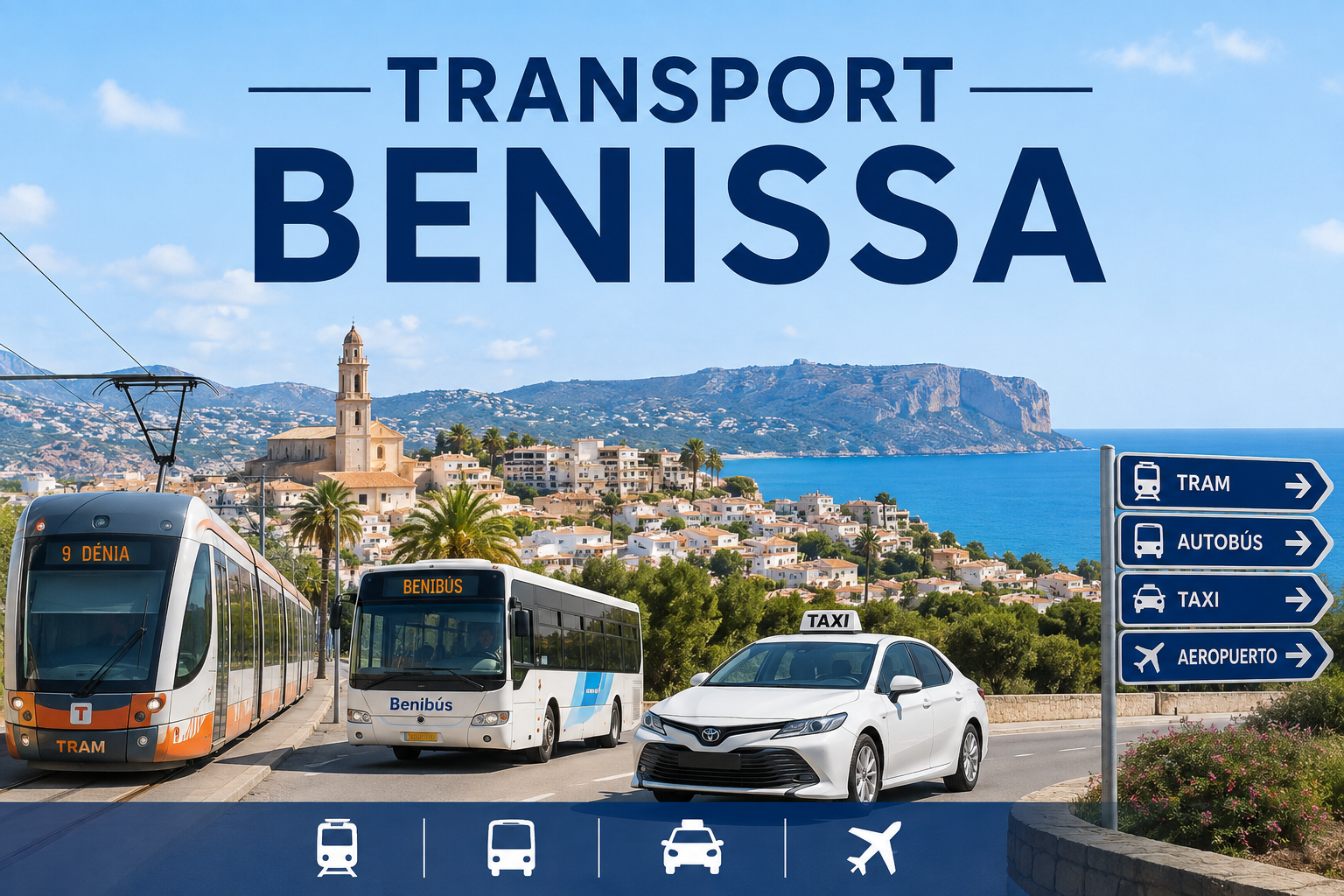
Benissa has local and regional buses, taxis, the TRAM d'Alacant railway, good road connections and access to both Alicante and Valencia airports. The municipality itself identifies the AP-7, N-332, ALSA, TRAM, Benibús, IFACH buses and taxis as important transport options.
The short answer: do you need a car in Benissa?
Not necessarily in Benissa town, but a car is usually recommended for Benissa Costa and generally essential for comfortable everyday life in rural Benissa.
-
Benissa Town: many everyday journeys can be made on foot, by bus or by taxi.
-
Benissa Costa: a car is usually very useful and often the most practical option.
-
Rural Benissa: a car is generally recommended because properties can be relatively isolated from everyday services.
-
Holiday homes: car-free ownership can work if the property is close to services and you are comfortable using taxis, transfers and occasional car hire.
-
Families: a car normally provides the greatest flexibility.
-
Retirees: location becomes particularly important if you want to remain independent without driving.
Expert Tip: When buying property in Benissa, do not ask whether "Benissa" has good transport. Ask whether this particular property has good transport. The distance to a bus stop, supermarket, beach, healthcare, the TRAM and the main road can make a major difference to everyday life.
Table of Contents
Transport in Benissa at a Glance
Benissa has a useful mix of public and private transport, but the services are not distributed evenly across the municipality.
The official Benissa tourism service currently identifies:
-
Benibús, a free local service connecting the town centre with the coast during its operating period;
-
ALSA intercity buses;
-
Autobuses IFACH, with connections relevant to Benissa Costa, Calpe and Teulada-Moraira;
-
taxis;
-
car hire;
-
TRAM rail connections;
-
and the AP-7 and N-332 road network.
Transport options in Benissa
| Transport option | Best for | Main advantage | Main limitation |
|---|---|---|---|
| Benibús | Seasonal town-to-coast journeys | Free | Seasonal rather than a full year-round network |
| ALSA | Regional travel | Useful intercity connections | Timetables and stops need checking |
| Autobuses IFACH | Benissa Costa and neighbouring towns | Useful coastal connections | Limited compared with a car |
| TRAM | Calpe, Teulada, Gata and Dénia corridor | Avoids driving and parking | Station is outside central Benissa |
| Taxi | Door-to-door journeys | Flexible | Less economical for frequent daily travel |
| Rental car | Holidays and property visits | Maximum flexibility | Rental and parking costs |
| Private car | Permanent residents | Greatest flexibility | Purchase, fuel, insurance and maintenance costs |
Benissa's own tourism information describes the municipality as offering several practical mobility options, while its wider destination-planning documentation recognises that private vehicles remain the predominant option for interurban travel.
Quick verdict: Is a car necessary in Benissa?
A car is not essential everywhere in Benissa, but it becomes increasingly useful as you move from the town centre towards the coast and countryside.
The most useful way to think about Benissa is as three different transport environments:
-
Town: comparatively walkable and best suited to car-free living.
-
Coast: possible without a car, but considerably easier with one.
-
Countryside: generally car-dependent.
That distinction is particularly important when buying a property.
Benissa Town vs Benissa Costa vs Rural Benissa
Benissa Town
Central Benissa is the strongest choice for anyone prioritising everyday convenience.
Depending on the exact property, you can be within practical walking distance of:
-
shops;
-
cafés and restaurants;
-
pharmacies;
-
municipal services;
-
schools;
-
healthcare;
-
bus stops;
-
other everyday facilities.
You may still want a car for larger shopping trips, beaches, appointments elsewhere or regional travel, but it is possible to build a relatively independent lifestyle without one.
Benissa Costa
Benissa Costa is spread over a much larger area.
Residential locations such as La Fustera, Baladrar, Advocat, Fanadix, Buenavista and San Jaime contain properties at very different distances from shops, restaurants, beaches and public transport.
A villa may be only a short distance from the coast but still require a car for the supermarket or medical appointments.
The official Benissa tourism information describes the coastal area as being connected to the town by Benibús during its operating season and identifies IFACH buses as a connection between Benissa Costa, Calpe and Teulada-Moraira.
Rural Benissa
Rural locations such as Pedramala and Benimarco offer something different: privacy, land, countryside views and traditional fincas.
The transport trade-off is greater dependence on private transport.
For a rural property, consider the road to the house, not just the distance on a map. A few kilometres can represent a significant daily journey when it is repeated for shopping, school, healthcare, maintenance and social activities.
Public Transport in Benissa
Benibús
Benibús is Benissa's free local bus service connecting the town centre with the coast and other local destinations during its operating period.
Benissa Tourism describes it as a free service linking the urban centre with the coves and municipal facilities. The published service is seasonal, so it should not be treated as a permanent year-round replacement for a private vehicle.
This makes Benibús particularly useful for:
-
summer visitors;
-
visitors staying on the coast;
-
residents travelling between the town and coves;
-
people who want to avoid driving and parking during busy periods.
Seasonal considerations
Seasonality is important.
The municipality's planning documentation has identified the seasonal nature of Benibús as a limitation and has considered extending the service beyond the summer period.
For property buyers, the lesson is simple:
Never buy a property on the assumption that a seasonal bus service will provide the same level of mobility throughout the year.
Where to check current Benibús information
Use the official Benissa Tourism website and check the latest timetable before travelling or assessing a property.
Benissa Tourism – Getting Around
Benibús information – Benissa Tourism
ALSA Buses
ALSA provides regional and intercity connections serving Benissa.
Benissa Tourism identifies ALSA as the intercity service connecting Benissa with Alicante, Valencia and other destinations, with several stops in the town.
ALSA is particularly useful for:
-
travel between Benissa and neighbouring towns;
-
journeys towards Alicante;
-
travel towards Valencia;
-
occasional journeys without a car;
-
airport connections on suitable services.
The important point for property owners is that having an ALSA stop in Benissa does not mean every property in the municipality is conveniently connected to ALSA.
A buyer living in central Benissa may be able to walk to a stop. Someone living in a villa on the coast may first need a taxi or private vehicle.
When ALSA is useful
ALSA is most practical when your property is reasonably close to the relevant stop and the timetable matches your journey.
For example, a resident who occasionally needs to travel to Calpe may find the bus perfectly adequate. A family travelling to several activities every day is likely to find a car more convenient.
ALSA – Official bus timetables and tickets
Autobuses IFACH
Autobuses IFACH provides local connections relevant to Benissa Costa, particularly in relation to Calpe and Teulada-Moraira.
Benissa Tourism and municipal planning documentation specifically identify IFACH as a service facilitating access between Benissa Costa and Calpe or Teulada-Moraira.
This can be particularly useful for coastal residents because the nearest useful destination is not necessarily Benissa town.
For example:
-
a property in southern Benissa may have a practical relationship with Moraira;
-
a northern coastal property may be more naturally connected with Calpe;
-
a resident may use Benissa town for municipal services but Calpe for shopping or leisure.
This is one reason property buyers should assess real-life travel patterns rather than administrative boundaries.
Is Public Transport in Benissa Good Enough for Everyday Life?
For occasional journeys, public transport can be perfectly useful.
For a car-free permanent lifestyle, however, the answer depends heavily on the property.
Strengths
-
Benissa has local and regional bus services.
-
The town has intercity connections.
-
Benibús provides a free town-to-coast service during its operating period.
-
IFACH provides useful coastal connections.
-
The TRAM provides a rail corridor towards Calpe, Teulada, Gata and Dénia.
-
Taxis provide door-to-door flexibility.
-
The AP-7 and N-332 provide strong private-road connections.
Limitations
-
Public transport is not comparable with the network of a large Spanish city.
-
Services are less useful when a property is far from a stop.
-
Seasonal services can differ from winter services.
-
The TRAM station is outside the town centre.
-
Rural properties are generally poorly suited to completely car-free living.
-
Timetables may not match school, work or evening schedules.
Practical assessment
A useful rule is:
The closer you are to concentrated services, the more realistic car-free living becomes.
That is why transport should be considered when comparing individual properties rather than simply comparing municipalities.
Trains and TRAM in Benissa
Does Benissa Have a Train Station?
Yes.
Benissa is served by the TRAM d'Alacant, the narrow-gauge railway network connecting the northern Costa Blanca corridor.
Benissa Tourism confirms that the municipality has a TRAM stop on the line between Alicante and Dénia.
However, there is an important distinction for property buyers:
The Benissa TRAM station is not in the historic town centre.
That means a property described as "close to Benissa train station" needs to be assessed by actual road or walking distance.
Benissa TRAM Station
The station is part of the Line 9 corridor serving the northern Costa Blanca.
For a property buyer, check:
-
The actual driving distance to the station.
-
The walking route rather than straight-line distance.
-
Whether you can reach it without a car.
-
Parking and drop-off arrangements.
-
How you would return after an evening journey.
-
Whether the timetable works for your normal travel.
The railway infrastructure around Benissa also includes the historic Quisi viaduct area, illustrating how the railway route runs through the wider municipality rather than through the centre of the old town.
TRAM Line 9
Line 9 forms an important transport corridor between Benidorm and Dénia, serving towns including Calpe, Benissa, Teulada and Gata de Gorgos.
FGV documentation identifies Line 9 as the Benidorm–Dénia route and records infrastructure and renewal work along the Calpe–Teulada–Gata–Dénia sections.
Calpe
Calpe is one of the most relevant neighbouring destinations for Benissa residents.
The town offers:
-
shopping;
-
restaurants;
-
beaches;
-
healthcare;
-
leisure;
-
regional transport connections.
Teulada
Teulada provides another useful connection for residents on the southern side of Benissa and those travelling towards Moraira.
Gata de Gorgos
Gata is an important regional point on the Line 9 corridor and provides access towards Dénia and the wider Marina Alta.
Dénia
Dénia is a major regional centre for:
-
shopping;
-
healthcare;
-
restaurants;
-
services;
-
leisure;
-
ferry connections.
Connections further south
The wider TRAM network provides connections into Alicante and the southern part of the Costa Blanca, although a journey from a Benissa property to Alicante Airport is usually more complicated by public transport than by car or pre-booked transfer.
FGV / TRAM d'Alacant official information
Is the TRAM Useful for Benissa Property Owners?
Yes, particularly if you live close enough to the station to use it conveniently.
It can be useful for:
-
shopping trips;
-
appointments;
-
visiting Calpe or Dénia;
-
travelling towards Teulada and Gata;
-
days out without driving;
-
reducing parking pressure;
-
households sharing one car.
It is less useful when reaching the station requires a significant car journey.
Expert Tip: If a property listing says "close to the TRAM", measure the actual door-to-station journey. Straight-line distance can be misleading in Benissa.
Benissa Taxi Services
Benissa Taxi
Taxis are an important part of the local transport network, particularly for people who do not want to own a car.
The official Benissa Tourism website currently lists Radio Taxi Benissa and publishes the telephone number 965 731 407.
The same official page also lists the Benissa Tourism contact details, making it a useful place to verify information before travelling.
How to book
For local journeys, contact the taxi service directly and confirm the destination and arrangements.
For airport journeys or journeys at unusual times, advance booking is sensible.
Radio Taxi Benissa – official Benissa Tourism information
Important — verify before publication: Taxi telephone numbers, operating arrangements and prices can change. Telio Homes should check the current Radio Taxi Benissa contact details and any published fares immediately before this article is published and periodically afterwards.
Taxi From Benissa Town to Benissa Costa
A taxi can be particularly useful when:
-
arriving with luggage;
-
visiting a coastal property;
-
staying in a holiday home;
-
travelling with children;
-
travelling with older relatives;
-
public transport does not match the timetable;
-
you do not want to rent a car for a short visit.
For a second-home owner who visits only several times a year, occasional taxis can be a practical part of a car-free strategy.
For someone making several journeys every day, a private car is usually more economical and flexible.
Taxi From Benissa to Nearby Towns
Taxis can provide direct journeys to:
Calpe
Useful for shopping, restaurants, healthcare, leisure and transport connections.
Moraira
Particularly relevant to properties in southern Benissa and areas close to the Teulada-Moraira boundary.
Teulada
Useful for local services and regional connections.
Dénia
A longer journey, but taxis can be useful for medical appointments, evenings out, airport connections or group travel.
Taxi prices should be confirmed directly with the operator rather than relying on old online figures.
Airport Taxi Transfers
For international property owners, airport transfers can make car-free ownership much more practical.
A pre-booked transfer is particularly useful for:
-
families;
-
groups;
-
elderly travellers;
-
late arrivals;
-
owners carrying substantial luggage;
-
short visits where renting a car seems unnecessary.
Getting to Benissa From Alicante Airport
Alicante-Elche Miguel Hernández Airport is normally the most convenient international airport for Benissa.
Benissa Tourism currently quotes approximately 80 km from the airport on its transport information page, while another official municipal geographical reference gives approximately 95 km, illustrating why airport distances vary according to the reference point and route.
For property buyers, the important point is not the exact kilometre figure but the practical journey from the airport to the property's front door.
By Rental Car
For most visitors staying in a villa or rural property, a rental car is the simplest option.
Advantages include:
-
door-to-door travel;
-
easy luggage handling;
-
flexibility after arrival;
-
straightforward supermarket trips;
-
easy access to beaches;
-
freedom to visit several properties during a buying trip.
For a rural finca, rental car access is particularly valuable.
By Private Transfer
A pre-booked transfer can be the most convenient car-free option.
It is particularly attractive for:
-
families;
-
elderly travellers;
-
groups;
-
late-night arrivals;
-
owners staying for only a few days.
By Taxi
A taxi provides direct door-to-door transport.
For an airport journey, confirm the fare and destination arrangements before travelling.
By Public Transport
Public transport from Alicante Airport to Benissa is possible and is more practical than many visitors realise.
Aena currently lists an ALSA Airport–Jávea service with stops including Benissa, Teulada, Benitachell and Jávea. Aena also lists other regional services from Alicante Airport, including routes towards Calpe and Dénia.
However, the service needs to be matched to your arrival time and the exact location of your accommodation or property.
If the final destination is a villa in Benissa Costa, you may still need a taxi for the last part of the journey.
Which Option Is Best?
| Option | Convenience | Flexibility | Approx. journey | Best for |
|---|---|---|---|---|
| Rental car | High | Very high | Around 1–1.5 hours by road, depending on destination and traffic | Families, villas, multiple stops |
| Private transfer | Very high | High | Around 1–1.5 hours by road | Families, second homes, luggage |
| Taxi | Very high | High | Around 1–1.5 hours by road | Door-to-door travel |
| Public transport | Moderate | Low–moderate | Variable | Travellers without a car |
Journey times are indicative. Traffic, roadworks, weather, the exact Benissa destination and connections can materially affect the journey.
Expert Tip: If you are buying a holiday home, test the airport journey all the way to the actual property. "Alicante Airport to Benissa" is not the same journey as "Alicante Airport to a villa in Pedramala".
Getting to Benissa From Valencia Airport
Valencia Airport is farther north but remains a useful alternative, particularly when flight availability or fares are better.
Benissa Tourism currently gives approximately 110 km between Valencia Airport and Benissa on its access information. Its wider geographical information gives approximately 115 km to Valencia itself.
By Car
Driving is generally the simplest option.
For property owners, the advantage is the same as from Alicante: direct travel with no need to coordinate multiple connections.
By Private Transfer
A private transfer offers door-to-door convenience but the greater distance means the price becomes a more important consideration.
It can nevertheless make sense for:
-
families;
-
groups;
-
second-home owners;
-
travellers with considerable luggage.
By Public Transport
Public transport normally requires more planning.
Aena currently confirms that Valencia Airport has direct Metrovalencia Lines 3 and 5, as well as the Line 150 bus to Valencia city centre.
From Valencia, travellers need to continue towards the Marina Alta using the appropriate regional transport connection.
For a traveller unfamiliar with the area, this is considerably more complicated than a direct car journey.
Which Airport Is More Convenient for Benissa?
For most property owners, Alicante Airport is the more convenient airport for Benissa.
Valencia Airport can still be a good choice when:
-
the flight is significantly cheaper;
-
the flight schedule is better;
-
Alicante has no suitable direct flight;
-
you are already travelling through Valencia;
-
a private transfer is being shared between several passengers.
The best airport is therefore not always the geographically closest one. It is the airport that gives you the best overall combination of flight, arrival time and onward transport.
Driving in Benissa
For many residents, driving remains the most practical form of everyday transport.
Benissa's own planning documents recognise that private vehicles remain the predominant method for interurban journeys.
Main Roads Serving Benissa
AP-7
The AP-7 provides the main high-speed road connection along the Mediterranean coast.
Benissa is served by AP-7 Exit 63, which provides access towards the municipality and the N-332.
This is one reason Benissa works well for owners who regularly travel to other Costa Blanca destinations.
N-332
The N-332 is the main national road running through the municipality and provides an important north-south connection.
Local roads
Local roads are particularly important when travelling towards:
-
Benissa Costa;
-
La Fustera;
-
Baladrar;
-
Advocat;
-
Fanadix;
-
San Jaime;
-
Buenavista;
-
Benimarco;
-
Pedramala;
-
other coastal and rural residential areas.
The practical quality of a journey can vary significantly between individual roads and properties.
Driving From Benissa to Calpe
Calpe is one of the most important nearby destinations for Benissa residents.
The journey is generally straightforward by road, but the most convenient route depends on where you start.
For properties on the northern coast, Calpe can be particularly convenient for:
-
supermarkets;
-
restaurants;
-
healthcare;
-
leisure;
-
beaches;
-
shopping.
This is another example of why the nearest useful town is not necessarily the town where the property is officially located.
Driving From Benissa to Moraira and Teulada
For properties in southern Benissa, Teulada and Moraira can be extremely relevant to everyday life.
This is particularly true around areas such as:
-
Fanadix;
-
Buenavista;
-
San Jaime;
-
southern Benissa Costa.
A buyer who spends most of their time in Moraira may find a property in southern Benissa very practical even though Benissa town itself is farther away.
Driving From Benissa to Dénia
Dénia is farther away but remains an important regional centre.
It can be relevant for:
-
healthcare;
-
shopping;
-
restaurants;
-
services;
-
leisure;
-
ferry connections.
The TRAM offers an alternative for appropriate journeys, but a car remains more flexible for door-to-door travel.
Parking in Benissa
Parking varies significantly depending on the property.
In Benissa town, consider:
-
whether there is private parking;
-
proximity to the centre;
-
street parking;
-
seasonal demand;
-
access for larger vehicles;
-
whether the property is suitable for elderly or less mobile occupants.
On Benissa Costa, detached villas often have private parking, but buyers should inspect the actual access.
"Private parking" is not necessarily the same as easy parking.
A narrow entrance, steep driveway or difficult turning area can make a property less convenient than its listing suggests.
Car Rental in Benissa
Car hire is particularly useful for:
-
holiday homeowners;
-
buyers viewing several properties;
-
short stays;
-
families;
-
owners who do not want permanent car ownership.
For a second-home owner who visits several times a year, renting a vehicle when required can be a sensible alternative to keeping a car permanently.
Walking, Cycling and Everyday Mobility in Benissa
Transport in Benissa is not only about buses and cars.
Walking and cycling can work well for particular lifestyles, but they need to be assessed realistically.
Walking in Benissa Town
Central Benissa is the strongest area for everyday walking.
The concentration of shops, services and amenities makes short trips more realistic.
However, even within the town, a property on a steep street can have a different accessibility profile from one on a flatter route.
Walking on Benissa Costa
The coast has attractive walking routes, including the ecological promenade linking much of the coastline.
Benissa Tourism describes the coastal route as extending along much of the coast, with connections towards Les Bassetes and the coves around La Fustera.
But a beautiful coastal walking route does not mean every residential property is walkable to everyday services.
A villa may be close to the sea but still be inconveniently located for a supermarket, pharmacy or bus stop.
The 2-kilometre test
Before buying, ask:
Could I comfortably walk two kilometres from this property to something I need every week?
Then test the route.
Consider:
-
gradients;
-
pavements;
-
crossings;
-
traffic;
-
summer heat;
-
shade;
-
road shoulders;
-
luggage or shopping;
-
whether the route is practical at night.
Straight-line distance is not enough.
Cycling and E-bikes
Cycling can be useful for experienced riders, particularly for leisure and road cycling.
For everyday transport, however, Benissa's hills, road conditions, heat and distances mean that cycling should not automatically be treated as a replacement for a car.
An e-bike can make some coastal and town journeys considerably more realistic, but buyers should test the actual route before relying on it.
For older residents or people with limited cycling experience, an e-bike may complement public transport rather than replace private transport.
Do You Need a Car in Benissa?
Living in Benissa Town Without a Car
This is the most realistic part of the municipality for car-free living.
Depending on the exact location, residents may have practical access to:
-
shops;
-
restaurants;
-
pharmacies;
-
schools;
-
healthcare;
-
municipal services;
-
buses.
A car can still be useful, but it does not necessarily have to be part of everyday life.
Living in Benissa Costa Without a Car
It is possible, but the property must be selected carefully.
A coastal home close to shops, restaurants and a suitable bus connection is a very different proposition from a detached villa several kilometres from the nearest service.
Without a car, you may depend more heavily on:
-
taxis;
-
buses;
-
family lifts;
-
delivery services;
-
occasional car hire.
Living in Rural Benissa Without a Car
For most rural properties, a car is strongly recommended.
A finca in Pedramala or Benimarco may provide privacy and views, but everyday activities can require longer journeys.
This affects not only shopping but also:
-
healthcare;
-
school;
-
tradespeople;
-
property maintenance;
-
waste disposal;
-
social activities;
-
appointments.
Buying a Holiday Home Without a Car
A car-free holiday home can work surprisingly well.
It is most practical when:
-
airport transfers are easy;
-
restaurants are nearby;
-
shops are accessible;
-
beaches are within practical reach;
-
taxis can be booked;
-
public transport covers some journeys;
-
car hire is available when required.
It becomes much less convenient when the property is isolated.
Permanent Living vs Holiday Use
Transport requirements change depending on how often you use the property.
| Situation | Likely car requirement |
|---|---|
| Benissa town, single resident | Low–moderate |
| Benissa town, family | Moderate |
| Benissa Costa, couple | Moderate–high |
| Benissa Costa, family | High |
| Rural finca | High |
| Holiday apartment near services | Low–moderate |
| Isolated holiday villa | High |
| Rental property near shops/beach | Moderate |
| Retiree near town centre | Low–moderate |
Common Mistake: Buying a countryside property because it has wonderful views, then discovering after completion that almost every routine journey requires driving.
Transport and Buying Property in Benissa
Why Transport Should Be Considered Before Buying
Transport is part of a property's practical value.
It can influence:
-
everyday convenience;
-
accessibility for older owners;
-
family life;
-
holiday use;
-
rental appeal;
-
airport access;
-
resale appeal;
-
the cost and complexity of living at the property.
Two villas can have similar prices, views and construction quality while offering very different lifestyles because of their location.
How Location Changes Your Transport Options
Consider two hypothetical properties.
Property A: Coastal convenience
A villa around La Fustera is relatively close to shops, restaurants, the coast and a practical transport connection.
This may suit:
-
holiday-home owners;
-
retirees;
-
buyers who want to drive less;
-
rental owners whose guests may arrive without a car.
Property B: Rural privacy
A finca in Pedramala offers:
-
larger land;
-
countryside surroundings;
-
privacy;
-
open views.
But the owner may need a car for almost every practical journey.
Neither property is objectively better.
They suit different buyers.
Questions to Ask Before Buying a Property
Before making an offer, ask:
-
How far is the nearest bus stop?
-
Which services operate from that stop?
-
Is the service seasonal?
-
How far is the nearest supermarket?
-
Can I walk there safely?
-
How far is the nearest pharmacy?
-
How far is the nearest healthcare facility?
-
How far is the beach?
-
Where is the nearest TRAM station?
-
How would I reach the station?
-
Is there convenient parking?
-
Is there private parking at the property?
-
Is the access road practical year-round?
-
How long does the journey take in winter?
-
How easy is it to get a taxi?
-
How would guests reach the property?
-
How would I reach Alicante Airport?
-
Would I need a car every day?
Can You Test a Property's Location Before Buying?
Yes — and buyers should.
A property viewing should not end when you leave the house.
1. Walk the route
Walk from the property to the nearest shop, bus stop or restaurant.
Do not rely exclusively on Google Maps.
2. Test public transport
If you want to live without a car, actually use the bus or TRAM.
3. Visit outside summer
Summer can create a misleading impression because some services are seasonal and traffic patterns change.
4. Test everyday journeys
Calculate the journey to:
-
supermarket;
-
healthcare;
-
school;
-
workplace;
-
beach;
-
airport route;
-
favourite town.
5. Check the journey in poor weather
A route that is pleasant in July may feel very different during a wet or windy winter day.
Expert Tip: Spend another 30–60 minutes exploring the immediate surroundings after the viewing. For a Benissa Costa or rural property, this can reveal more about the practical lifestyle than another ten minutes inside the house.
Transport by Area of Benissa
The following is a practical property-buying assessment, not an official municipal transport classification. Transport conditions can vary significantly within each area.
| Area | Walkability | Public transport | Taxi usefulness | Car dependency | Best suited to |
|---|---|---|---|---|---|
| Benissa Town | High in central areas | Goodest overall | Good | Low–moderate | Permanent living, retirees |
| Benissa Costa | Variable | Moderate/variable | Good | Moderate–high | Coastal living, second homes |
| La Fustera | Variable | Moderate/variable | Good | Moderate–high | Holiday homes, coastal lifestyle |
| Baladrar | Limited | Limited/variable | Good | High | Coastal villas |
| Advocat | Limited | Limited/variable | Good | High | Coastal villas |
| Fanadix | Variable | Moderate/variable | Good | High | Villas, southern Benissa |
| Montemar | Limited–variable | Limited/variable | Good | High | Villas and holiday homes |
| Buenavista | Variable | Limited–moderate | Good | High | Coastal and residential living |
| San Jaime | Variable | Limited–moderate | Good | High | Coastal villas |
| Benimarco | Low | Limited | Useful | Very high | Fincas and rural living |
| Pedramala | Low | Limited | Useful | Very high | Rural properties |
These ratings should be understood as general guidance. A property close to a bus stop or local services can have a significantly better transport profile than another property in the same named area.
Benissa Town
For buyers who prioritise convenience, Benissa town is generally the strongest choice.
It suits:
-
permanent residents;
-
retirees;
-
people who prefer not to drive;
-
buyers who want everyday services nearby.
Benissa Costa
Benissa Costa suits buyers prioritising:
-
beaches;
-
sea views;
-
outdoor living;
-
holiday use;
-
coastal lifestyle.
The transport trade-off is greater dependence on a car.
La Fustera
La Fustera is one of the most recognisable coastal areas of Benissa.
Its combination of beach, coastal walking routes and nearby amenities can make some properties comparatively convenient.
But "La Fustera" covers more than one type of property location. Always check the exact distance to shops, bus stops and roads.
Baladrar
Baladrar is particularly attractive for buyers looking for coastal surroundings and sea views.
The residential nature of the area means a car is generally useful for everyday life.
Advocat
Advocat is similarly better assessed on a property-by-property basis.
A villa may be attractive for privacy and coastal access but still require a car for routine shopping and appointments.
Fanadix
Fanadix is particularly interesting for buyers considering southern Benissa.
Its location can make Moraira and Teulada highly relevant to everyday life, depending on the exact property.
Montemar
Montemar properties can have useful road connections, but car dependency remains relatively high for many everyday journeys.
Rural Benissa
Pedramala and Benimarco are good examples of the transport trade-off associated with countryside property.
The advantages can include:
-
privacy;
-
larger plots;
-
open views;
-
traditional architecture;
-
greater distance from dense development.
The disadvantages can include:
-
greater driving requirements;
-
fewer practical public transport options;
-
longer shopping journeys;
-
greater reliance on private vehicles.
For rural property buyers, road access should be treated as part of the property assessment.
Transport for Different Property Types
Transport needs are not only determined by location. The type and purpose of the property matter too.
| Property type | Typical transport profile | Main consideration |
|---|---|---|
| Town apartment | Low car dependency | Walkability |
| Coastal apartment | Moderate | Distance to services |
| Coastal villa | Moderate–high | Parking and everyday driving |
| Holiday villa | Moderate–high | Airport and guest access |
| Rural finca | High | Road access and services |
| Isolated country property | Very high | Almost complete car dependence |
This is particularly important when comparing a modern apartment in central Benissa with a traditional finca in the countryside.
The latter may offer more land and privacy, but transport becomes part of the ownership equation.
Best Transport Option for Different Situations
For Permanent Residents
Permanent residents should prioritise reliability.
If you work locally or regularly travel to schools, shops, healthcare and sports activities, a car generally provides the greatest flexibility.
However, living centrally in Benissa can significantly reduce car dependence.
For Second-Home Owners
Second-home owners have more flexibility.
A combination of:
-
airport transfer;
-
taxi;
-
public transport;
-
occasional car hire;
can work very well.
You do not necessarily need to maintain a car all year.
For Families
A car is usually the most practical option.
School runs, sports, shopping, beaches and evening activities can create multiple journeys in one day.
This is especially relevant to families living outside central Benissa.
For Retirees
Transport should be considered as a long-term lifestyle issue, not simply a holiday convenience.
A property that is manageable with a car at 60 may be less convenient if you no longer want to drive at 75.
For this reason, retirees should pay particular attention to:
-
flat walking routes;
-
nearby shops;
-
healthcare;
-
taxis;
-
bus stops;
-
parking;
-
access to the property.
For Holiday-Rental Owners
Transport can influence the practical appeal of a holiday rental.
Consider how guests arriving from abroad will reach the property.
Useful features include:
-
airport transfer options;
-
parking;
-
nearby restaurants;
-
supermarket access;
-
beaches;
-
taxi availability;
-
public transport.
Avoid describing a property as "walkable to the beach" simply because the beach is close in a straight line.
For Rural Property Owners
A reliable vehicle is normally essential.
You may need it for:
-
garden maintenance;
-
builders and tradespeople;
-
shopping;
-
waste disposal;
-
healthcare;
-
property inspections;
-
accessing local services.
For rural buyers, inspect the access road as carefully as the house itself.
Transport and Accessibility for Older Residents
Transport becomes increasingly important when buying a property intended for long-term ownership.
A property may be legally accessible by road but still be difficult for someone with reduced mobility.
Before buying, consider:
-
steps from the road to the entrance;
-
driveway gradients;
-
pavement availability;
-
distance to shops;
-
distance to healthcare;
-
taxi access;
-
parking close to the entrance;
-
whether everyday services are reachable without driving.
A central property with fewer views may sometimes be a better long-term choice than a more isolated villa if independence is a priority.
This is not an argument against rural or coastal property. It is an argument for matching the location to the buyer's likely future needs.
Benissa Transport: Practical Property-Buyer Checklist
Before Viewing a Property
-
Check the property's exact location.
-
Identify the nearest bus stop.
-
Check current bus routes.
-
Check whether the service is seasonal.
-
Locate the nearest TRAM station.
-
Check the distance to shops.
-
Check the distance to medical services.
-
Check the distance to the nearest pharmacy.
-
Check access to the nearest beach.
-
Check taxi availability.
-
Check parking.
-
Look at the access road on a map.
-
Check walking routes rather than straight-line distances.
Before Making an Offer
-
Test the route without a car.
-
Check transport outside the summer season.
-
Test airport access.
-
Consider how visitors will reach the property.
-
Assess realistic car dependency.
-
Consider car rental costs if it is a second home.
-
Check whether the property's road access is practical.
-
Consider future accessibility.
-
Consider resale appeal.
-
Think about whether the property would still suit you if your driving habits changed.
Warning: Never assume that a property is "close to everything" because it is within a few kilometres of Benissa town. The municipality covers a large and varied area, and hills, road layouts and property location can make a short map distance feel considerably longer in everyday life.
Useful Transport Contacts and Official Resources
Transport information changes, particularly seasonal bus services and timetables. For this reason, official operator and municipal sources should always take precedence over old property articles, forum posts or social-media information.
Benissa Town Hall / Tourism
Benissa Tourism – How to Get Around
Benissa Tourism – How to Get to Benissa
Benibús
Benibús information – Benissa Tourism
ALSA
Autobuses IFACH
Check the current operator information and timetable before travelling.
TRAM d'Alacant / FGV
Radio Taxi Benissa
Benissa Tourism currently lists 965 731 407 for Radio Taxi Benissa. The contact should be verified before travelling because taxi information can change.
Radio Taxi Benissa – Benissa Tourism
Alicante Airport
Aena – Alicante-Elche Airport transport information
Valencia Airport
Aena – Valencia Airport transport information
Frequently Asked Questions About Transport in Benissa
Is there public transport in Benissa?
Yes. Benissa has local and regional public transport, including Benibús, ALSA and IFACH buses, together with the TRAM railway connection. The usefulness of each service depends heavily on where your property is located and whether the service operates at the time you need it.
Can you live in Benissa without a car?
Yes, particularly in central Benissa town. It becomes considerably more difficult on Benissa Costa and in rural areas. If car-free living is important to you, choose the property specifically around transport access rather than assuming the whole municipality has the same level of convenience.
Does Benissa have a train station?
Yes. Benissa has a stop on the TRAM d'Alacant network connecting the northern Costa Blanca corridor. It is not located in the historic town centre.
Where is the Benissa TRAM station?
The station is on the railway corridor outside the historic centre. For property buyers, the important consideration is the actual walking or driving distance from the property rather than simply seeing "Benissa" listed as a station.
How often does the TRAM run from Benissa?
TRAM timetables vary and should be checked directly with FGV for the date of travel. Because services can change, it is better not to rely on an old timetable published in a property article.
Is there a bus from Benissa to Calpe?
Yes. Regional bus services provide connections between Benissa and Calpe, while IFACH also provides coastal connections relevant to the Benissa–Calpe corridor. Current timetables should be checked before travelling.
Is there a bus from Benissa to Moraira?
Connections exist through the regional and local transport network, including IFACH services relevant to Benissa Costa and Teulada-Moraira. The exact route and timetable depend on the stop and travel date.
Is there a bus between Benissa town and Benissa Costa?
Yes. Benibús provides a free service linking the town centre with the Benissa coast during its operating period. It is seasonal, so buyers should not assume it provides a year-round service.
How do I get from Alicante Airport to Benissa?
You can travel by rental car, private transfer, taxi or public transport. Aena currently lists an ALSA airport service towards Jávea with stops including Benissa, Teulada and Benitachell.
For a coastal or rural property, the final journey from the public transport stop to the house should also be considered.
How do I get from Valencia Airport to Benissa?
Driving or using a private transfer is normally the simplest solution. Public transport involves travelling from Valencia Airport into Valencia and then continuing towards the Marina Alta.
Aena currently confirms direct metro connections from Valencia Airport to Valencia city via Lines 3 and 5, as well as the Line 150 airport bus.
Is there a taxi service in Benissa?
Yes. Benissa Tourism lists Radio Taxi Benissa and currently publishes 965 731 407. Verify the number and arrangements before travelling.
What is the Benissa taxi number?
The official Benissa Tourism page currently lists 965 731 407 for Radio Taxi Benissa. Because telephone numbers and operating arrangements can change, verify the number immediately before using the service.
Is Benissa Costa easy to access without a car?
It depends on the property.
Some coastal locations have useful access to services, buses and walking routes, while other villas are heavily car-dependent.
A property in La Fustera close to local amenities can offer a very different experience from a detached villa further inland.
Do you need a car to live in rural Benissa?
In most cases, yes.
A car is strongly recommended for rural properties because everyday services, shopping, healthcare and maintenance can involve longer journeys. This is particularly relevant to properties in areas such as Pedramala and Benimarco.
Which areas of Benissa are best without a car?
Central Benissa town is generally the strongest option.
Some parts of Benissa Costa may also work for buyers who are prepared to combine walking, buses and taxis, but the exact property location is critical.
Is Benissa suitable for retirees without a car?
It can be, particularly if the property is centrally located and close to shops, healthcare, taxis and public transport.
Retirees should also think about future mobility rather than only their current ability to drive.
Is cycling practical in Benissa?
Cycling can be excellent for leisure and road cycling, but Benissa's hills, distances and Mediterranean climate mean it should not automatically be considered a substitute for a car.
An e-bike can make some journeys more realistic, but the actual route should be tested before relying on it for everyday transport.
Is Benissa well connected to other Costa Blanca towns?
Yes, particularly by road.
The AP-7 and N-332 provide strong regional road connections, while ALSA, IFACH and the TRAM provide alternatives for selected journeys.
What is the best way to get around Benissa?
For maximum flexibility, a car is generally the best option outside central Benissa.
In the town centre, walking combined with buses and occasional taxis can work well. On Benissa Costa, the best solution depends on the property's exact location. In rural Benissa, private transport is usually the most practical choice.
Transport in Benissa: What Property Buyers Should Know
Transport in Benissa is good when it is assessed in relation to the property rather than the municipality as a whole.
Benissa town is the easiest part of the municipality for car-free living. Services are more concentrated, walking is more realistic and public transport is easier to access.
Benissa Costa offers a different lifestyle. The beaches, coves, coastal paths and residential areas are highly attractive, but distances are greater and a car becomes more useful.
Rural Benissa is different again. A finca in Pedramala or Benimarco may offer privacy, land and spectacular surroundings, but the trade-off is usually greater dependence on a vehicle.
That does not make one location better than another.
It means the right transport profile depends on the buyer.
A retiree who wants to walk to shops has very different requirements from a family with two cars. A holiday-home owner may happily use airport transfers and rent a vehicle when required. A rural property owner may consider a reliable car essential.
Before committing to a purchase, test the location as you would actually use it:
-
Walk the route.
-
Check the bus stop.
-
Check the current timetable.
-
Test the journey to shops.
-
Check healthcare access.
-
Look at the route to the beach.
-
Test the airport journey.
-
Consider winter conditions.
-
Assess parking and road access.
-
Think about how your transport needs could change over time.
Telio Homes Local Advice: One of the most important questions when comparing Benissa properties is not simply "How far is it from the beach?" or "How close is it to Benissa town?" It is "How will I live here on an ordinary Tuesday in January?" That question often reveals more about a property's suitability than the headline location.
Transport should be considered alongside the other practical aspects of buying in Benissa, including the property's legal status, condition, utilities, running costs, accessibility and long-term suitability.
If you are buying, the best property is not necessarily the one with the best view or the largest plot. It is the one whose location works for the way you genuinely intend to live.
If you are selling a property in Benissa, transport accessibility is also part of the property's market position. A home with convenient access to beaches, services, roads and neighbouring towns should be presented accurately, just as a rural property should be marketed honestly around its privacy and countryside setting rather than vague claims about convenience.
For buyers considering Benissa Town, Benissa Costa, La Fustera, Fanadix, Buenavista, San Jaime, Benimarco or Pedramala, transport is therefore best assessed property by property.
That is the practical reality of Transport Benissa: the municipality has more options than a simple "you need a car" answer suggests, but the exact location of your home determines how useful those options will actually be.