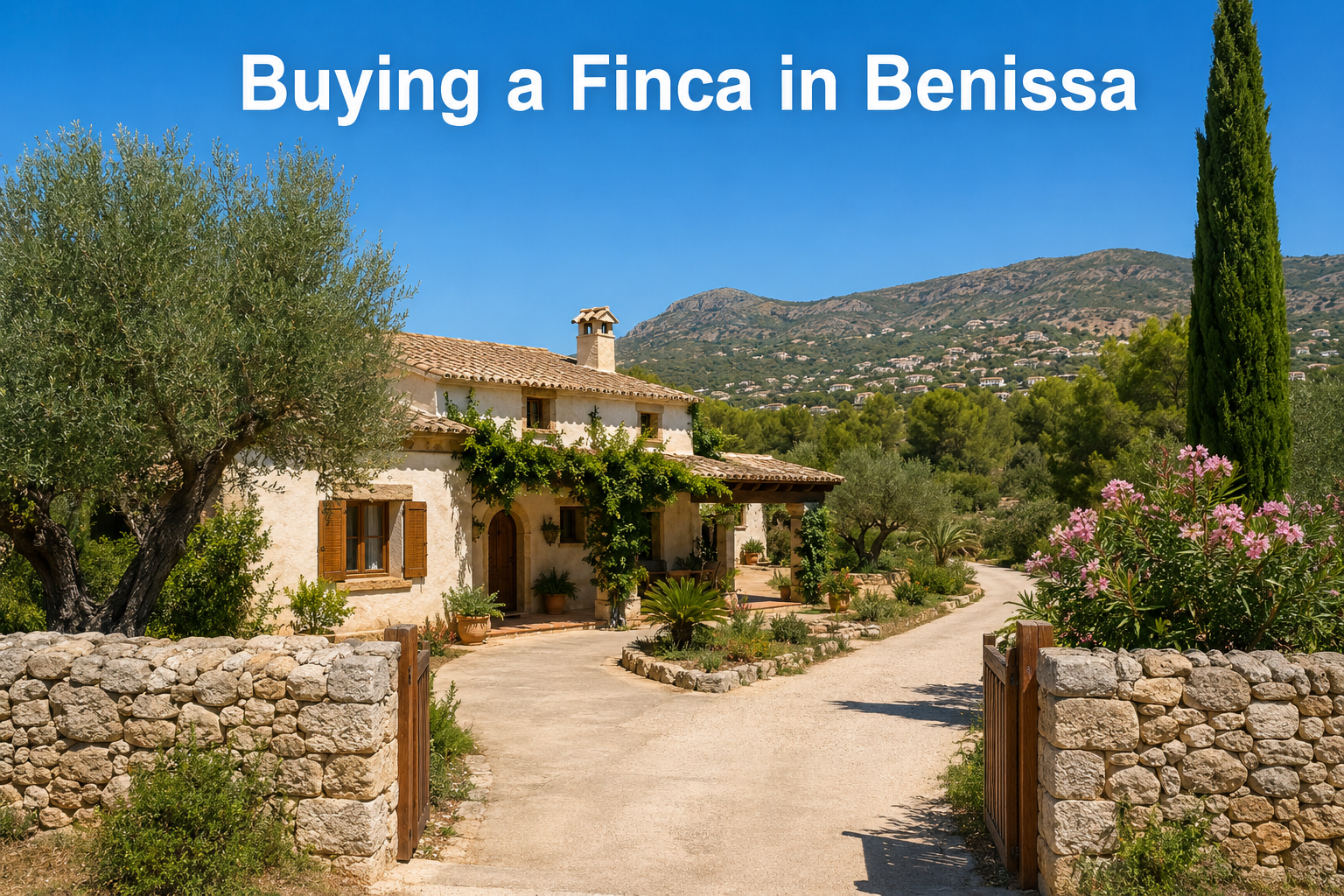
Buying a Finca in Benissa: Complete Buyer’s Guide
Buying a finca in Benissa can offer a rare combination of land, privacy, traditional architecture and access to the Mediterranean lifestyle of the Costa Blanca North.
But buying a rural property is different from buying a standard villa or apartment.
A finca may include an older house, agricultural land, terraces, outbuildings, a swimming pool, private water infrastructure, a septic system or buildings that have been altered over many years. The property you see today may therefore not be described in exactly the same way in every document.
That does not automatically mean there is a problem. It does mean the property needs to be investigated properly before you commit to buying it.
The most important rule when buying a finca: assess the land, the buildings, the paperwork, the planning situation, the utilities and the practical lifestyle — not just the house.
This guide explains what buyers should consider when buying a country house in Benissa, from choosing the right location and checking the Nota Simple to understanding rustic land, renovation possibilities, water supplies, septic tanks, financing, buying costs and the purchase process.
It also explains some of the practical issues that are particularly relevant to rural property in Benissa, including access, drainage, fire risk, maintenance and the differences between areas such as Benimarco, Pedramala, Fanadix, Buenavista, La Fustera and San Jaime.
Important: This is general property information, not legal, planning, architectural or tax advice. Spanish and Valencian regulations can change, and every property must be assessed according to its individual circumstances. Buyers should obtain independent professional advice before committing to a purchase.
What Is a Finca in Benissa?
What Does “Finca” Mean in Spain?
The word finca does not describe one particular architectural style.
In Spain, finca broadly refers to a property or parcel of land. In the Costa Blanca property market, the term is commonly used for rural properties consisting of a house and surrounding land, often with agricultural or countryside characteristics.
A Benissa finca might be:
-
A traditional stone country house
-
A renovated rural property
-
A farmhouse surrounded by agricultural land
-
A property with olive, almond or citrus trees
-
A house with traditional terraces or agricultural structures
-
A rural home with a swimming pool
-
A larger landholding with an existing dwelling
-
A property requiring substantial renovation
The word itself does not establish whether a property is legally compliant, whether you can extend it, whether additional buildings can be constructed or whether the property is suitable for permanent occupation.
Those questions require separate checks.
Quick answer
A finca in Benissa is generally a rural property or landholding, often including a country house and surrounding land. The term describes the nature of the property rather than guaranteeing its planning status, legal compliance, permitted uses or future development rights.
Finca vs Country House vs Villa
Property terminology can be confusing, particularly for international buyers.
| Term | Usually refers to | What it does not automatically tell you |
|---|---|---|
| Finca | Rural property or landholding | Whether all buildings are legal |
| Country house | A house in a countryside setting | The land's planning classification |
| Villa | Detached residential property | Whether the property is urban or rustic |
| Rustic property | Property associated with rural/non-urban land | What can legally be built or altered |
| Finca rústica | Rural/rustic property or land | Whether existing construction complies with planning rules |
For a buyer, the important question is not what the property is called in the listing.
It is:
What exactly am I buying, what is documented, what physically exists, and what can I legally do with it?
Why Buyers Choose a Finca in Benissa
Fincas appeal to a particular type of buyer because the attraction is often the overall lifestyle rather than simply the house.
Land
Depending on the individual property, a finca can provide substantially more outdoor space than a conventional residential plot.
That can appeal to buyers who want:
-
Gardens
-
Fruit trees
-
Vegetable growing
-
Outdoor entertaining
-
Space for children
-
Privacy
-
Walking areas
-
A pool
-
A more natural setting
However, more land also means more responsibility.
A buyer should ask not only:
“How much land do I get?”
but:
“How much land am I realistically prepared to maintain?”
Privacy
Many rural properties are separated from neighbouring houses by agricultural land, terraces, trees or natural features.
But privacy varies considerably. A large plot does not necessarily mean complete isolation, so buyers should understand surrounding properties and land uses.
Traditional architecture
The countryside around Benissa contains properties with traditional Mediterranean characteristics, including stone walls, tiled roofs, timber elements and agricultural structures.
Some properties also retain traditional riurau architecture, associated with the historic agricultural and raisin-producing culture of the Marina Alta.
For many buyers, preserving this character is part of the reason for purchasing a finca in the first place.
Outdoor lifestyle
Terraces, mature trees, shaded areas, gardens and swimming pools can become as important as the internal living space.
The appeal is often strongest for buyers who expect to spend a significant amount of time outdoors.
Space
For buyers moving from northern Europe or densely developed coastal areas, the amount of land can be one of the biggest attractions.
Countryside setting
Rural living can provide peace and privacy while still allowing access to Benissa town, the coast and neighbouring towns.
The trade-off is that countryside living usually requires more planning, more driving and more property maintenance.
Where Can You Find Fincas in Benissa?
Benissa is particularly interesting for rural-property buyers because the municipality stretches from the historic inland town towards the Mediterranean coast.
The experience of owning a finca therefore changes considerably depending on its exact location.
Benissa Countryside
The inland parts of the municipality contain a mixture of agricultural land, traditional rural properties and more modern countryside homes.
Areas such as Benimarco and Pedramala offer a distinctly rural character, although the exact experience varies from one partida, road and property to another.
The landscape can change significantly over relatively short distances, with differences in elevation, views, agricultural activity, surrounding houses and road access.
This is why “Benissa countryside” is too broad a description when assessing a specific finca.
Rural Areas Between Benissa and the Coast
Some properties occupy a useful middle ground between rural and coastal living.
They can feel peaceful and private while remaining reasonably convenient for:
-
Benissa town
-
Supermarkets
-
Schools
-
Restaurants
-
Medical services
-
Beaches
-
Calpe
-
Moraira
-
Teulada
For many buyers, this balance is more important than finding the most isolated property possible.
Areas Towards Calpe and Moraira
Some parts of the wider Benissa area provide relatively easy access towards Calpe, Moraira and the coast.
Properties around Fanadix, Buenavista and La Fustera can offer a different combination of countryside and coastal living.
San Jaime is another example of an established residential area where the lifestyle is more closely associated with villas and community infrastructure than traditional agricultural countryside.
The distinction matters because a buyer looking for a genuine rural finca may have very different priorities from someone looking for a villa surrounded by greenery but close to the coast.
Comparing Different Parts of Benissa
| Area | General character | Lifestyle considerations | Often attractive to |
|---|---|---|---|
| Benimarco | Countryside and agricultural landscape | Rural atmosphere with practical access to Benissa and surrounding areas | Permanent residents and rural-lifestyle buyers |
| Pedramala | Rural countryside with varied landscapes | Privacy, land and countryside setting | Buyers seeking space and character |
| Fanadix | Rural/residential mix | Balance between countryside and coastal access | Second-home and lifestyle buyers |
| Buenavista | Established residential area | More developed residential environment | Buyers wanting convenience with a quieter setting |
| La Fustera | Coastal/residential | Strong connection to beaches and the coast | Holiday-home and coastal-lifestyle buyers |
| San Jaime | Established residential | More community-oriented villa lifestyle | Buyers prioritising services and coastal convenience |
These are broad descriptions, not rules. Individual properties can differ substantially within the same area.
How Location Affects Everyday Life
Before buying a finca, drive the route yourself.
Do not rely entirely on a journey time shown on a property portal.
Check:
-
The final few kilometres
-
Road width
-
Road surface
-
Steep sections
-
Turning areas
-
Gates
-
Night-time access
-
Distance to supermarkets
-
School journey
-
Medical services
-
Beaches
-
Restaurants
-
Airport routes
-
Mobile reception
-
Internet availability
A property that feels wonderfully private during a one-hour viewing may feel very different if you have to make the same journey every day.
What Is It Like to Live in a Finca in Benissa?
Privacy, Space and Outdoor Living
For many buyers, this is the main attraction.
A finca can provide a sense of separation that is difficult to reproduce on a compact urban or coastal plot.
But land creates work.
A larger property may mean more:
-
Trees to maintain
-
Irrigation to manage
-
Walls to inspect
-
Vegetation to control
-
Pool maintenance
-
Outdoor lighting
-
Fencing
-
Access infrastructure
The right amount of land is therefore a lifestyle decision, not simply a financial one.
Getting Around by Car
Car dependency is one of the biggest practical differences between countryside and urban living.
For many rural properties, owning a car is effectively essential.
Consider your normal routine:
-
Supermarket
-
School
-
Work
-
Gym
-
Restaurants
-
Beach
-
Medical appointments
-
Airport
-
Friends and family
Calculate the journey from the actual property rather than estimating from the municipality as a whole.
Shops, Restaurants and Everyday Services
Rural living in Benissa does not necessarily mean being far from everything.
Depending on the property, you may have access to services in Benissa, Calpe, Moraira, Teulada and neighbouring areas.
The precise location matters.
A finca a short drive from a supermarket is a very different proposition from one requiring a longer journey for routine shopping.
Beaches and the Coast
The Costa Blanca coastline is one of Benissa's major attractions.
Depending on location, rural-property owners can have relatively convenient access to beaches and coves along Benissa Costa, including La Fustera.
This is one of the area's advantages: countryside and Mediterranean coastal living do not necessarily have to be mutually exclusive.
Living in the Countryside All Year
A property that works perfectly as a holiday home may not be ideal for permanent living.
Ask:
-
Is the heating adequate?
-
Is the house insulated?
-
Is the internet reliable enough for work?
-
Is there sufficient water storage?
-
Is the access practical during heavy rain?
-
Is waste collection convenient?
-
Are shops and services close enough?
-
Does the house remain comfortable outside the summer season?
Assess the property for the lifestyle you will actually live, not the lifestyle shown in summer photographs.
Maintaining Land, Gardens and Pools
Maintenance should be treated as part of the ownership decision.
Before buying, establish:
-
Who maintains the garden?
-
How much irrigation is required?
-
How much pool maintenance is needed?
-
Are trees healthy?
-
Are retaining walls in good condition?
-
Is there automatic irrigation?
-
Are there agricultural structures?
-
Does the property have a gardener or pool technician?
-
What happens when you are away?
Expert Tip: A mature Mediterranean garden can be a major asset, but it can also represent a significant ongoing responsibility.
Agriculture and Existing Trees
Some fincas retain olive, almond, citrus or other agricultural trees.
Ask:
-
Are the trees actively maintained?
-
Who currently looks after them?
-
Is irrigation required?
-
Are terraces and retaining walls in good condition?
-
Is there agricultural equipment?
-
Does the property have an established agricultural use?
-
Do you actually want to maintain the land?
You do not have to become a farmer simply because you buy a finca, but you should understand what you are taking responsibility for.
Finca Living: Advantages and Disadvantages
| Advantages | Potential disadvantages |
|---|---|
| Privacy | Greater car dependency |
| More outdoor space | More land to maintain |
| Countryside lifestyle | Utilities may require closer investigation |
| Traditional architecture | Older buildings may require renovation |
| Outdoor living | Gardens and pools require maintenance |
| Space for entertaining | Rural roads may be less convenient |
| Potential views | Planning restrictions may apply |
| Peace and quiet | Fewer services immediately nearby |
What Should You Check Before Buying a Finca in Benissa?
Buying a finca requires more investigation than simply checking whether the house appears attractive.
The central principle is:
Compare the property you can physically see with the property described in the legal, cadastral and planning documentation.
Ownership and Title
First establish who owns the property.
Check:
-
Seller's identity
-
Registered ownership
-
Ownership percentages
-
Mortgages
-
Embargoes or other charges
-
Easements
-
Other registered rights
Do not rely solely on information contained in the estate-agent listing.
The Nota Simple
The Nota Simple is one of the first documents that should be reviewed.
It can provide information about registered ownership and charges affecting the property.
Look for:
-
Registered owner
-
Property description
-
Surface information
-
Charges
-
Mortgages
-
Embargoes
-
Easements or other rights
-
References to buildings where applicable
-
Cadastral reference
-
Whether the property appears coordinated with Catastro
A Nota Simple is important, but it is not a substitute for complete legal due diligence.
Catastro
The Catastro Inmobiliario is an administrative register containing information about property characteristics, location, use, physical features and cadastral value.
It can be particularly useful when investigating:
-
Plot boundaries
-
Cadastral reference
-
Built area
-
Land area
-
Existing buildings
-
Mapping
But Catastro and the Registro de la Propiedad serve different purposes.
Registro de la Propiedad
The Registro de la Propiedad records registered legal rights and interests affecting property.
It is particularly important for understanding:
-
Registered ownership
-
Mortgages
-
Charges
-
Registered rights
-
Easements
-
The registered description of the property
Catastro vs Registro: Why the Difference Matters
| Question | Catastro | Registro de la Propiedad |
|---|---|---|
| Main purpose | Administrative/cadastral information | Registration of property rights |
| Property location | Yes | Yes |
| Cadastral reference | Yes | May be referenced |
| Physical characteristics | Yes | May be described |
| Legal ownership | Cadastral information | Registered ownership |
| Mortgages and charges | Not its primary purpose | Yes |
| Property rights | Not equivalent to title registration | Core function |
| Mapping | Yes | May contain coordinated graphical information |
| Should buyers compare both? | Yes | Yes |
A difference between Catastro, Registro and the physical property is not automatically proof that a property is illegal.
It is, however, something that should be understood before buying.
Land Classification
One of the most important questions for a finca is:
What type of land is it?
Terms such as finca, finca rústica, rustic property and country house are commonly used in property marketing, but they do not by themselves tell you the property's actual planning classification.
In Benissa, planning documentation includes provisions relating to suelo no urbanizable and other planning categories.
The classification can affect:
-
Existing buildings
-
Extensions
-
New construction
-
Pools
-
Outbuildings
-
Agricultural structures
-
Changes of use
-
Renovation
-
Occupancy
-
Future development
Never buy a finca on the assumption that a particular plot size automatically gives you a particular building right.
The applicable planning rules and the property's individual history must be checked.
What Does Rustic Land Actually Mean?
For a buyer, it is useful to think of rural property as a chain of questions:
What land is this?
↓
What planning rules apply?
↓
What buildings currently exist?
↓
What is documented?
↓
What is legally recognised?
↓
What works are permitted now?
↓
What future changes, if any, are possible?
This is much safer than starting with the question:
“How many square metres is the plot?”
Plot size can be relevant, but it is not a complete answer to what can be built or altered.
Plot Boundaries and Access
A rural property is not properly understood until the land itself has been examined.
Check:
-
Boundary lines
-
Fences
-
Walls
-
Existing gates
-
Access roads
-
Rights of way
-
Easements
-
Shared access
-
Neighbouring claims
-
Whether physical boundaries correspond with available plans
Where boundaries are uncertain, a professional survey may be appropriate.
Access Roads and Rights of Way
A finca may be reached via:
-
A public road
-
A private road
-
A shared road
-
An easement
-
A combination of routes
Ask:
-
Who owns the road?
-
Is access legally established?
-
Who maintains it?
-
Are there shared maintenance costs?
-
Is access suitable for normal vehicles?
-
Can emergency vehicles reach the property?
-
What happens after heavy rainfall?
Do not confuse regular use of a road with proof of a legally established right of access.
Comparing the Documents With the Physical Property
| What you see at the property | What you should verify |
|---|---|
| Main house | Registered/cadastral description and planning status |
| Bedrooms | Documentation and lawful residential use where relevant |
| Pool | Planning/licensing status |
| Garage | Documentation and permitted use |
| Terrace | Whether alterations were authorised or recognised |
| Outbuilding | Legal status and permitted use |
| Agricultural structures | Description and planning status |
| Land | Boundaries and cadastral/registered information |
| Water tank | Source, ownership and legal/technical status |
| Septic system | Installation, maintenance and applicable requirements |
| Access | Legal right of access and maintenance responsibilities |
Common Mistake: Assuming that because a structure has existed for many years, it must automatically be legally compliant.
The age of a building or alteration can be relevant to certain legal and planning questions, but it does not by itself answer every question about its current status.
Is the Finca Legally Compliant?
What Does “Legal” Actually Mean?
“Legal” is often used too casually in property marketing.
There are several separate questions:
-
Is ownership correctly registered?
-
What is the land classification?
-
Is the house authorised or recognised?
-
Are extensions documented?
-
Are outbuildings documented?
-
Is the pool properly authorised or recognised?
-
Is the use of the property compatible with its planning status?
-
Is appropriate habitation or occupancy documentation available?
-
Are there outstanding planning issues?
A property should therefore not be reduced to a simple label of “legal” or “illegal” without understanding the individual circumstances.
Is the House Registered?
Establish how the house appears in the relevant documentation.
The physical building may not correspond exactly with an older deed or registered description.
Questions include:
-
Is the house described?
-
Is the built area consistent?
-
Are later additions included?
-
Are separate structures recorded?
-
Is the use correctly described?
-
Is there documentation relating to construction or modification?
Are Extensions and Outbuildings Documented?
Rural properties often evolve over decades.
A finca may contain:
-
Added bedrooms
-
Enclosed terraces
-
Converted storage areas
-
Garages
-
Guest accommodation
-
Agricultural buildings
-
Pool houses
-
Covered terraces
Each element should be assessed individually.
What About Pools, Terraces and Garages?
Never assume that a pool, terrace or garage is irrelevant because similar features are common in the area.
The relevant question is whether the particular structure was permitted, documented or otherwise recognised under the applicable rules.
Habitation and Occupancy Documentation
Depending on the property and intended use, buyers may need to consider documentation relating to habitation or occupation.
The precise terminology and requirements can vary according to the property's history and circumstances.
Do not assume that documentation associated with one property automatically proves the same status for another.
What If You Find a Problem?
A discrepancy does not necessarily mean the purchase should be abandoned.
The correct response is to establish:
-
What the discrepancy actually is
-
Why it exists
-
Whether it has legal or planning significance
-
Whether a remedy exists
-
What that remedy involves
-
What it could cost
-
Whether the process has been completed
Warning: Never accept “the lawyer will sort it out later” or “it has always been there” as a substitute for professional due diligence.
Why a Professional Legal and Technical Check Matters
Different professionals have different roles.
| Professional | Typical role |
|---|---|
| Independent lawyer | Ownership, contracts, charges, legal and planning due diligence |
| Architect/technical professional | Building condition, measurements, technical and planning matters |
| Surveyor | Physical measurements and boundaries where required |
| Tax adviser | Tax consequences and obligations |
| Estate agent | Local market knowledge, property information, seller communication and transaction coordination |
An estate agent can identify potential issues and help organise information, but should not replace an independent lawyer or qualified technical professional where specialist advice is required.
Can You Renovate a Finca in Benissa?
A finca can be an excellent renovation project, but the correct question is not simply:
“Can I renovate it?”
It is:
“Which works can I legally carry out on this particular property under its current planning and building circumstances?”
Cosmetic Renovation
Cosmetic work can include:
-
Painting
-
Flooring
-
Kitchens
-
Bathrooms
-
Lighting
-
Internal finishes
-
Furniture
Even here, buyers should establish whether proposed works go beyond purely cosmetic changes.
Structural Renovation
Structural work is very different.
It can involve:
-
Structural walls
-
Floors
-
Foundations
-
Roof structures
-
Large openings
-
Structural reinforcement
Professional advice should be obtained before committing to a renovation budget.
Roof and Building Repairs
Traditional fincas can contain older construction methods and materials.
Before buying, investigate:
-
Roof condition
-
Water ingress
-
Timber condition
-
Structural cracking
-
Damp
-
Drainage
-
Retaining walls
A beautiful traditional exterior can conceal substantial technical work.
Extending the Existing House
An existing house does not automatically give the owner an unrestricted right to make it larger.
Whether an extension is possible depends on the property's planning circumstances and applicable regulations.
Additional Buildings and Outbuildings
Do not assume an existing agricultural building can automatically become:
-
Guest accommodation
-
A bedroom
-
An office
-
A gym
-
A rental unit
Its permitted use must be established.
Can You Build a Guest House?
This is one of the questions buyers should ask before purchasing a large finca.
The answer depends on the property's planning classification, existing construction, applicable regulations and proposed use.
A large plot should never be treated as proof that a second dwelling can be constructed.
Can You Build a Swimming Pool?
The possibility of constructing or substantially altering a pool depends on the individual property and applicable planning requirements.
An existing pool and a proposed new pool should not automatically be treated as the same situation.
Legalising Existing Works
In some circumstances, Spanish and Valencian planning legislation provides mechanisms dealing with existing buildings or works where planning compliance is an issue.
However:
“It can probably be legalised” is not a sufficient basis for buying a property.
A professional should establish whether a legal route exists, what procedure applies and what limitations remain.
Why You Should Check Before Buying
A renovation project can become significantly more expensive when a buyer discovers after completion that an apparently simple alteration requires additional planning, technical or legal work.
Expert Tip: Buy a property because you are comfortable with what legally exists today. Treat future renovation possibilities as a bonus only after they have been professionally confirmed.
Renovation Risk Matrix
| Proposed work | Main question |
|---|---|
| Kitchen | Is it cosmetic or does it affect structure/utilities? |
| Bathroom | Are plumbing and drainage changes required? |
| Roof | Is this repair or major structural work? |
| Terrace | Is the existing structure documented? |
| Pool | What is the current status and what work is proposed? |
| Extension | Is the additional floor area permitted? |
| Outbuilding | What is its legal use? |
| Agricultural building | Can its use legally change? |
| Guest accommodation | Is separate residential use permitted? |
Water, Electricity, Sewage and Internet
Utilities are one of the biggest practical differences between a conventional villa and a rural property.
A buyer should understand not only whether a utility exists, but how the system works.
Mains Water
Ask:
-
Is the property connected to mains water?
-
Is the connection individual?
-
Where is the meter?
-
Are there outstanding issues?
-
Is pressure adequate?
-
Are storage tanks also used?
Do not assume that a mains connection somewhere nearby means the property is already connected.
Water Tanks, Wells and Alternative Supplies
Some rural properties use water storage or other private supply arrangements.
Establish:
-
Source of the water
-
Storage capacity
-
How water reaches the property
-
How often the system needs filling
-
Pump condition
-
Maintenance requirements
-
Documentation where applicable
-
Whether supply is sufficient for the intended use
Water becomes especially important where a property has extensive gardens, mature trees or a swimming pool.
Electricity
Check:
-
Mains connection
-
Meter
-
Electrical installation
-
Contracted supply
-
Distribution board
-
Batteries
-
Generator
-
Recent electrical works
If solar panels are installed, establish what the system actually supplies and whether it is grid-connected.
Septic Tanks and Rural Sewage
A rural property may not have mains sewerage.
If it uses a septic tank or another private wastewater system, establish:
-
What type of system exists
-
Where it is located
-
Age and condition
-
Maintenance history
-
Capacity
-
Emptying arrangements
-
Documentation
-
Whether the system meets applicable requirements
-
Whether upgrades are needed
Important: A septic system should be treated as part of the property's infrastructure and due diligence, not simply as an alternative to mains drainage.
Internet and Mobile Coverage
For buyers who work remotely, this can be decisive.
Test the connection at the property itself.
Ask about:
-
Fibre
-
Fixed wireless
-
4G/5G
-
Satellite internet
-
Download speed
-
Upload speed
-
Reliability
-
Mobile signal
Do not rely solely on a provider's coverage map.
Fire Risk and Vegetation
Rural Mediterranean property also requires consideration of vegetation and wildfire risk.
Before buying, consider:
-
Surrounding vegetation
-
Trees close to buildings
-
Access for emergency services
-
Condition of boundary areas
-
Maintenance requirements
-
Insurance implications
-
Whether the property is close to wooded or heavily vegetated areas
Buyers should seek current professional or official advice where specific fire-prevention obligations apply.
Rainfall, Drainage and DANA Conditions
Intense rainfall is another consideration for rural property on the Costa Blanca.
Look at:
-
Natural drainage
-
Sloping land
-
Retaining walls
-
Water runoff
-
Road access
-
Low points
-
Nearby ravines or watercourses
-
Signs of previous water damage
Do not judge drainage solely on a sunny viewing day.
Where appropriate, buyers should consult official flood-risk information and obtain technical advice.
Access Roads
Establish:
-
Who owns the access road
-
Whether there is a legal right of access
-
Whether access is shared
-
Road condition
-
Drainage
-
Maintenance responsibilities
-
Access for emergency vehicles
-
How the road behaves during heavy rainfall
Utility Due-Diligence Table
| Utility/infrastructure | What to check | Questions to ask |
|---|---|---|
| Water | Source and infrastructure | Is it mains, tank, well or another supply? |
| Electricity | Connection and installation | Is it mains-connected? |
| Solar | Panels and batteries | What does the system actually power? |
| Sewage | Septic/private system | Is it documented and maintained? |
| Internet | Actual connection | What speed is available at the property? |
| Mobile | Signal | Does your provider work reliably there? |
| Access | Road and legal access | Who maintains the road? |
| Drainage | Runoff and flooding | What happens during heavy rainfall? |
Financing a Finca in Benissa
Can You Get a Mortgage on a Finca?
A mortgage may be possible for a finca, but there is no universal rule that every rural property qualifies under the same terms as a standard villa or apartment.
Lenders can consider:
-
Property type
-
Valuation
-
Documentation
-
Planning status
-
Registered construction
-
Land
-
Borrower's financial circumstances
-
Income
-
Residency
-
Loan-to-value requirements
-
The lender's own risk criteria
Why Rural Properties Can Be Different
A rural property can present more variables than a modern residential property.
For example:
-
The house may be older
-
Documentation may require clarification
-
The land may have a non-urban planning classification
-
Buildings may have been modified
-
Utilities may be private
-
The plot may be large
-
Renovation may be required
These factors can influence how a lender assesses the property.
What Lenders May Consider
A lender may undertake its own assessment involving:
-
Property valuation
-
Legal documentation
-
Property description
-
Existing charges
-
Borrower's financial position
-
Planning and documentation issues
The exact criteria vary between lenders.
Financing a Property That Needs Renovation
If the finca needs significant work, ask the lender early how the proposed purchase and renovation would be treated.
Do not assume a mortgage will automatically cover:
-
Purchase price
-
Renovation
-
Extensions
-
Structural work
-
Future improvements
The financing structure must be agreed with the lender.
Mortgage-Readiness Checklist
Before committing to a property, consider whether you have:
-
Established your borrowing capacity
-
Discussed rural property with the lender
-
Confirmed required documentation
-
Allowed time for valuation
-
Budgeted for professional fees
-
Considered renovation costs separately
-
Allowed a contingency for unexpected work
Expert Tip: If you require finance, investigate mortgage suitability before becoming emotionally committed to a particular finca.
Costs of Buying a Finca in Benissa
Buying costs depend on the property, transaction structure, buyer and applicable tax rules.
There is no single percentage that should be treated as the universal cost of buying a finca.
Purchase Taxes
Depending on the transaction, taxes can include ITP or VAT and potentially AJD, among other considerations.
The applicable treatment depends on factors including the nature of the transaction and property.
Tax rules can change, so obtain a transaction-specific calculation before signing.
Notary and Property Registration
There can be costs associated with:
-
Notarial documentation
-
Copies
-
Registration
-
Administrative processing
The amount depends on the transaction.
Legal Fees
An independent lawyer's fees may cover:
-
Documentation review
-
Legal due diligence
-
Contract review
-
Planning investigation
-
Completion
-
Registration
Technical and Survey Costs
Depending on the property, buyers may benefit from:
-
Building inspection
-
Architect's report
-
Survey
-
Boundary survey
-
Structural assessment
-
Utility assessment
These costs can be particularly valuable for rural property.
Mortgage-Related Costs
If financing is involved, potential costs can include:
-
Valuation
-
Mortgage-related professional services
-
Banking costs
-
Insurance or other lender requirements
The exact allocation of mortgage costs depends on the circumstances and applicable legislation.
Initial Renovation Costs
Potential costs can include:
-
Roof repairs
-
Damp treatment
-
Electrical work
-
Plumbing
-
Windows
-
Kitchens
-
Bathrooms
-
Pool work
-
Septic upgrades
-
Landscaping
-
Walls
-
Fencing
Ongoing Ownership Costs
After completion, budget for:
-
Insurance
-
Utilities
-
Pool maintenance
-
Garden maintenance
-
Repairs
-
Waste-related services where applicable
-
Rural infrastructure maintenance
-
Property management if you are not living there full-time
Buying Cost Planning Table
| Cost category | When it arises | What to do |
|---|---|---|
| Purchase tax | Transaction | Confirm applicable tax with adviser |
| Lawyer | Before and during purchase | Obtain a written quote |
| Technical inspection | Before purchase | Obtain professional assessment |
| Survey | Where required | Clarify scope and cost |
| Notary | Completion | Confirm transaction costs |
| Registration | After completion | Confirm applicable fees |
| Mortgage | If financed | Obtain lender's cost breakdown |
| Renovation | After purchase | Obtain realistic quotations |
| Utilities | Depending on property | Inspect before buying |
| Ongoing maintenance | Throughout ownership | Build an annual budget |
Important: Current tax rules and transaction costs can change. Obtain up-to-date professional advice before committing to a purchase.
For current property values, use the Benissa Property Market Report rather than relying on €/m² figures in a general buying guide.
The Finca Buying Process Step by Step
1. Define What You Need
Start with your lifestyle rather than property portals.
Decide:
-
Minimum house size
-
Amount of land
-
Maximum renovation
-
Required internet
-
Pool
-
Water requirements
-
Permanent or holiday use
-
Maximum driving distance
-
Budget
-
Mortgage requirements
Also decide whether you want:
A finished finca, a manageable renovation or a major project.
Those are three very different purchases.
2. Find Suitable Fincas
Work with an agent who understands the differences between Benissa's rural and coastal areas.
Look beyond photographs.
Ask for:
-
Exact location
-
Property documentation available
-
Land classification
-
Utility arrangements
-
Renovation history
-
Known planning issues
3. View the Property
Do more than walk through the house.
Inspect:
-
Land
-
Boundaries
-
Access
-
Outbuildings
-
Pool
-
Water infrastructure
-
Electricity
-
Septic system
-
Roof
-
Retaining walls
-
Drainage
-
Neighbouring properties
If possible, visit at different times of day and consider visiting after rainfall if drainage is a concern.
4. Carry Out Initial Checks
Before making a serious commitment, start checking:
-
Nota Simple
-
Catastro
-
Property deeds
-
Existing plans
-
Building documentation
-
Utility information
-
Planning information
5. Make an Offer
Your offer should reflect the property as it actually exists.
If significant documentation or technical questions remain unresolved, do not simply assume they will be resolved later.
6. Complete Legal and Technical Due Diligence
Your lawyer and, where appropriate, architect or technical professional should investigate the property.
This is one of the most important stages of the entire purchase.
7. Reservation and Deposit
A reservation agreement may be used to take the property off the market.
Understand:
-
Amount
-
Conditions
-
Who holds the funds
-
Refund provisions
-
Deadline
-
What happens if due diligence reveals a problem
Do not transfer a significant sum without understanding the agreement governing it.
8. Private Purchase Contract
A private purchase agreement, often referred to as an arras agreement, may set out the terms before the public deed.
Understand:
-
Purchase price
-
Deposit
-
Completion date
-
Conditions
-
Default provisions
-
What happens if financing fails
-
What happens if a legal or technical problem emerges
Have the contract reviewed by your lawyer before signing.
9. Mortgage and Final Checks
If financing is involved, make sure:
-
Mortgage approval is progressing
-
Valuation is acceptable
-
Legal conditions are understood
-
Required documents are complete
-
Completion funds are available
10. Completion Before the Notary
Completion normally involves signing the public deed before the notary, paying the agreed purchase funds and transferring the property according to the transaction terms.
11. Registration and Post-Purchase Administration
After completion, the process does not simply end at the notary.
The buyer may need to deal with:
-
Property registration
-
Tax filings
-
Utility transfers
-
Insurance
-
Bank arrangements
-
IBI administration
-
Property management
-
Renovation planning
Finca Buyer Red Flags
This section should be one of the first places buyers return to when assessing a property.
The Documents Do Not Match the Property
A discrepancy does not automatically mean the deal should be abandoned.
It means:
Stop. Understand the discrepancy before proceeding.
Unregistered Extensions or Buildings
An extension, garage or outbuilding that is not properly documented can create legal, planning, financing or resale complications.
Unclear Planning Situation
If nobody can clearly explain the property's planning status, do not rely on verbal reassurance.
Obtain professional advice.
Problems With Access
A beautiful finca becomes considerably less attractive if access rights are unclear.
Unclear Water Supply
Ask exactly where the water comes from, how it reaches the property and whether the supply is adequate.
Old or Unclear Sewage System
Establish the type, condition, documentation and applicable requirements.
Major Renovation Assumptions
“Easy to renovate” is not a technical assessment.
Obtain professional advice before pricing major works.
Financing Difficulties
If a lender will not lend against the property or the valuation differs substantially from expectations, investigate why before proceeding.
Unclear Boundaries
Do not assume that a wall or fence necessarily represents the legally recognised boundary.
Drainage or Flood-Risk Concerns
Signs such as erosion, water channels, damaged walls or repeated access problems should be investigated.
Excessive Vegetation Near the House
Trees and vegetation are part of the appeal of a finca, but their condition and proximity to buildings can affect maintenance, fire risk and insurance considerations.
What Are the Signs of a Well-Prepared Finca?
A good rural property is not necessarily the one with the newest kitchen.
It is one where the buyer can understand what they are buying.
Clear Ownership
The seller's ownership can be established and matches the transaction.
Consistent Property Documentation
The available deeds, registry information, cadastral information and physical property can be reconciled.
Clearly Defined Boundaries
The plot can be understood physically and legally.
Established Utilities
Water, electricity, sewage and internet arrangements are clearly explained.
Good Access
The property has practical and legally established access.
Documented Renovation History
Where the property has been renovated, the available documentation provides a clear history.
Clear Planning Situation
The buyer can understand the planning status of the property and existing structures.
Transparent Seller Documentation
The seller is willing to provide relevant documents and answer reasonable questions.
Expert Tip: Transparency is a positive sign. A well-prepared seller does not necessarily have a perfect property; they have a property whose strengths, weaknesses and documentation can be explained clearly.
Real-Life Benissa Finca Scenarios
The following are illustrative examples, not descriptions of specific Telio Homes clients.
A Finca With Around 1,100 m² of Land and an Existing House
Imagine a buyer finds a finca with a house, mature garden and swimming pool.
The photographs look excellent.
Instead of focusing only on the interior, the buyer should investigate:
-
Actual built area
-
Plot information
-
House documentation
-
Pool status
-
Water supply
-
Electricity
-
Planning position
-
Renovation history
-
Access
The key lesson is that the house and the land need to be investigated together.
A Traditional Finca With Several Thousand Square Metres
A buyer finds a traditional house on a large rural plot.
They assume the large plot means they can add another dwelling or substantially enlarge the existing house.
That assumption may be wrong.
The correct approach is to investigate the land classification and applicable planning rules before building a purchase strategy around future construction.
A Traditional Finca Requiring Renovation
A traditional house may have wonderful character but require:
-
Roof work
-
Electrical upgrades
-
Plumbing
-
Insulation
-
Windows
-
Structural repairs
The buyer should separate:
“I love this house.”
from:
“I understand what it will take to make this house work for me.”
When Catastro and Registro Show Different Information
Suppose the physical house appears larger than the area described in one document.
Do not immediately assume either:
-
The property is illegal, or
-
The difference does not matter.
Instead, ask the appropriate professionals to determine:
-
Why the discrepancy exists
-
Which records refer to which construction
-
Whether the difference has legal significance
-
Whether it can or should be regularised
-
What impact it could have on the purchase
A Finca With Private Water and a Septic System
This can be perfectly practical for the right buyer.
But the buyer needs to understand the entire system.
Ask:
-
How is water obtained?
-
How much storage exists?
-
Who maintains it?
-
What happens if supply is interrupted?
-
What type of wastewater system is installed?
-
How is it maintained?
-
What documentation exists?
-
Is it adequate for permanent occupation?
The key is not whether a property uses mains utilities.
The key is whether its infrastructure is suitable, documented and manageable for the intended use.
A Holiday Finca vs a Permanent Home
A holiday buyer may prioritise:
-
Privacy
-
Pool
-
Views
-
Outdoor entertaining
-
Traditional character
A permanent resident may prioritise:
-
Internet
-
Heating
-
Winter comfort
-
Access
-
Services
-
Maintenance
-
Storage
-
Year-round utilities
Neither buyer is wrong.
They simply need to assess the same property differently.
A Finca Close to the Coast but Still Rural
A property around the wider Fanadix, Buenavista or La Fustera area may offer a combination of countryside surroundings and coastal access.
A buyer should establish whether the property genuinely offers the rural lifestyle they want or whether it is better understood as a residential coastal property with a larger garden.
The distinction can affect expectations about privacy, neighbours, services and land.
Holiday Home and Rental Considerations
Some buyers purchase a finca primarily as a second home, while others may consider rental income.
These are different ownership strategies.
Before assuming a finca can be used as a holiday rental, investigate:
-
Applicable tourism rules
-
Licensing requirements
-
Planning compatibility
-
Insurance
-
Pool requirements
-
Wastewater arrangements
-
Access
-
Neighbouring properties
-
Property management
-
Local restrictions that may apply
Do not assume that because a property has previously been rented, the same arrangement will automatically continue under current rules.
If rental income is an important part of the purchase decision, obtain current legal and tax advice before relying on projected returns.
Benissa Finca Buyer Checklist
Before Viewing
-
Confirm the approximate location
-
Check access and driving time
-
Understand whether the property is rural or within an established residential area
-
Ask about land classification
-
Establish whether the house requires renovation
-
Ask what utilities are available
-
Check your financing position
-
Decide whether you want permanent or holiday use
During the Viewing
-
Inspect the house
-
Walk the land
-
Look at boundaries
-
Check access
-
Inspect the pool
-
Look at outbuildings
-
Check the roof
-
Ask about water
-
Ask about sewage
-
Test mobile reception
-
Test internet if possible
-
Look for damp or structural concerns
-
Ask about renovation history
-
Inspect drainage
-
Consider surrounding vegetation
-
Visit surrounding roads
Before Making an Offer
-
Request available property documentation
-
Review the Nota Simple
-
Review Catastro information
-
Understand the seller's ownership
-
Identify obvious discrepancies
-
Understand planning concerns
-
Discuss major renovation requirements
-
Confirm financing feasibility
-
Understand water and sewage arrangements
-
Check access
During Due Diligence
-
Independent lawyer appointed
-
Legal title checked
-
Charges checked
-
Planning status checked
-
Buildings checked
-
Extensions checked
-
Pool checked
-
Access checked
-
Boundaries checked where necessary
-
Utilities checked
-
Technical inspection completed where appropriate
-
Renovation feasibility assessed
-
Purchase contract reviewed
Before Completion
-
Final legal checks completed
-
Mortgage ready, if applicable
-
Completion funds available
-
Contract conditions satisfied
-
Property condition checked
-
Keys and possession arrangements confirmed
-
Utility transfer arrangements prepared
-
Insurance arranged
-
Post-completion tax responsibilities understood
-
Registration arrangements understood
Is Buying a Finca in Benissa Right for You?
A finca is not automatically the best property type simply because it has more land.
The lifestyle has to suit you.
A Finca Could Be Right for You If...
-
You value privacy
-
You enjoy outdoor living
-
You want land
-
You are comfortable driving
-
You appreciate traditional architecture
-
You are willing to maintain gardens and outdoor areas
-
You understand that rural properties require more due diligence
-
You are comfortable managing private utilities where applicable
-
You are prepared to investigate renovation possibilities carefully
-
You want a quieter lifestyle without necessarily being far from the coast
A Finca May Not Be Right for You If...
-
You want everything within walking distance
-
You dislike property maintenance
-
You want predictable communal services
-
You are uncomfortable with rural access
-
You need a completely turnkey property
-
You do not want to manage land
-
You are relying on a mortgage that has not yet been assessed against the property
-
You expect every existing structure to be automatically available for conversion
-
You want a lock-up-and-leave property requiring very little maintenance
Questions to Ask Yourself Before Buying
-
How often will I actually use the property?
-
Will I live here permanently?
-
Am I comfortable depending on a car?
-
How much land do I genuinely want?
-
Who will maintain it?
-
How much renovation am I willing to undertake?
-
Do I understand the utility systems?
-
Have I investigated the planning position?
-
Does the property still work financially if renovation costs increase?
-
Would I still want the property if I could not make the alterations I currently imagine?
-
Am I buying the lifestyle I want, or simply the property I like most in photographs?
-
Do I understand the responsibilities of owning rural land?
The most important question may be the tenth.
Buy the property that already works for your needs, rather than buying it primarily for a future project that may not be permitted.
Frequently Asked Questions About Buying a Finca in Benissa
What is a finca in Benissa?
A finca is generally a rural property or landholding, often containing a country house and surrounding land. In the Benissa property market, the term is commonly used for countryside homes with larger plots and rural characteristics. It does not, by itself, establish the property's planning or legal status.
What is the difference between a finca and a country house?
The terms overlap. “Finca” generally describes the property or landholding, while “country house” focuses more on the residential building and its countryside setting. Neither term tells a buyer whether the construction is legally compliant or what can be built in the future.
Can foreigners buy a finca in Benissa?
Foreign buyers can purchase property in Spain, subject to the legal, identification, tax and transaction requirements applicable to their circumstances.
Buying property should be kept separate from questions concerning Spanish residency. Property ownership does not, by itself, determine immigration or residency rights.
Can you live permanently in a finca in Benissa?
Potentially, but buyers should establish the property's residential and habitation status rather than assuming that the physical existence of a house automatically answers the question.
The relevant documentation and planning circumstances should be checked before buying for permanent residence.
Are fincas in Benissa on rustic land?
Many rural properties are associated with suelo no urbanizable or other rural land classifications, but buyers should never assume the classification from the word “finca” alone.
The individual property's planning classification must be established.
What documents should I check before buying?
Depending on the property, important documents and information can include:
-
Nota Simple
-
Title documentation
-
Catastro information
-
Cadastral plan
-
Existing building documentation
-
Planning information
-
Licences
-
Occupancy or habitation documentation where applicable
-
Utility information
-
Pool documentation where applicable
-
Technical reports
-
Information concerning access and boundaries
What is the difference between Catastro and Registro?
Catastro is an administrative property database containing physical, economic and other cadastral information. The Registro de la Propiedad records registered property rights and charges.
They are different systems and should be compared during rural-property due diligence.
Can I renovate a finca in Benissa?
Renovation may be possible, but the permitted works depend on the individual property and applicable planning and building rules.
Cosmetic refurbishment can be very different from structural changes, extensions or changes of use.
Can I extend a finca in Benissa?
Not automatically.
An existing house does not create an unrestricted right to extend it. The land classification, existing building status and applicable planning rules need to be checked before purchasing with an extension in mind.
Can I build another house or guest house on a finca?
Do not assume that a large plot permits another dwelling.
The answer depends on the property's planning classification, existing construction, applicable regulations and proposed use.
A buyer considering a finca primarily because they want to build another dwelling should obtain professional planning advice before making an offer.
Can I build additional structures?
That depends on the property, land classification, intended use and applicable planning regulations.
Having a large plot does not automatically mean additional buildings can be constructed.
Can I convert an agricultural building into a home?
Not automatically.
An agricultural building may have a particular lawful use that does not permit residential occupation. Any proposed change of use needs to be assessed under the applicable planning rules.
What happens if a finca has an illegal extension?
First establish exactly what “illegal” means in that case.
The issue may involve an undocumented construction, a planning breach, an incomplete process or another legal situation.
The buyer's lawyer and appropriate technical professional should determine the property's actual status and whether any remedy is available.
Can I get a mortgage for a finca?
Potentially, but mortgage availability depends on the property, documentation, valuation, borrower and lender.
Rural properties should be discussed with a lender early in the buying process.
What utilities should I check?
At minimum:
-
Water
-
Electricity
-
Sewage
-
Internet
-
Mobile coverage
-
Access
If the property uses private infrastructure, understand how it works and what maintenance it requires.
What costs are involved in buying?
Potential costs include applicable purchase taxes, notarial and registration costs, legal fees, technical inspections, mortgage-related costs and renovation expenses.
Tax treatment varies according to the transaction and can change, so obtain an up-to-date calculation before signing.
Is a finca suitable for year-round living?
It can be, but suitability depends heavily on the individual property.
For permanent living, pay particular attention to:
-
Heating and insulation
-
Internet
-
Access
-
Water
-
Sewage
-
Winter maintenance
-
Distance to services
-
Security
-
Property maintenance
Should I use an independent lawyer or technical professional?
For a rural property, independent professional advice is strongly recommended.
A lawyer can investigate legal and contractual matters, while an architect, surveyor or other technical professional can investigate appropriate physical, building or planning questions.
What should I check about flood risk?
Look at the property's topography, drainage, retaining walls, access roads and proximity to relevant watercourses or low-lying areas.
Where appropriate, consult official flood-risk information and obtain technical advice.
What should I check about fire risk?
Consider surrounding vegetation, access for emergency services, the condition of gardens and boundary areas, the property's location and insurance requirements.
Specific obligations can depend on the property and current regulations.
Can I rent my finca as a holiday home?
Possibly, but do not assume that a rural property automatically qualifies for tourist rental.
Current tourism, planning, licensing, tax and property-specific requirements should be checked before relying on rental income as part of your purchase decision.
Buying a Finca in Benissa With Local Expertise
Why Local Knowledge Matters
Buying a finca is partly about paperwork and partly about understanding the place.
Local knowledge helps buyers understand the differences between:
-
Benissa town and the countryside
-
Benissa Costa and inland areas
-
La Fustera and more rural locations
-
Fanadix and Buenavista
-
San Jaime and traditional countryside
-
Benimarco and Pedramala
-
Properties close to Calpe
-
Properties close to Moraira
It can also help buyers ask better questions about:
-
Access
-
Services
-
Lifestyle
-
Land
-
Renovation
-
Infrastructure
-
Location
-
Resale considerations
But local knowledge should complement, not replace, independent legal and technical due diligence.
How Telio Homes Can Help Buyers
Telio Homes focuses specifically on Benissa and the surrounding Costa Blanca North property market.
For a finca buyer, our role can include:
-
Identifying suitable rural properties
-
Explaining differences between areas
-
Providing local market context
-
Helping compare properties
-
Communicating with sellers
-
Identifying documentation that needs further investigation
-
Helping coordinate the buying process
-
Connecting buyers with appropriate independent professionals where specialist advice is required
The objective should not simply be to find a finca that looks attractive.
It should be to help you understand whether the property fits your lifestyle, budget and plans.
Conclusion
Buying a finca in Benissa can be an excellent choice for buyers looking for privacy, land, traditional architecture and a more rural Costa Blanca lifestyle.
But a finca should never be assessed purely by its views, gardens or character.
The most important work happens behind the scenes.
Before buying a country house in Benissa, understand:
-
What you are legally buying
-
Who owns it
-
What the Nota Simple says
-
How Catastro and Registro compare
-
What type of land it occupies
-
Whether the existing buildings are documented
-
What planning restrictions apply
-
Whether renovations are possible
-
Whether additional structures are possible
-
How water and sewage work
-
Whether access is legally established
-
How the property will be financed
-
What it will cost to maintain
-
How drainage and rural risks affect the property
-
Whether the property suits permanent or holiday use
The best finca purchase is not necessarily the property with the biggest plot or the most impressive views.
It is the property whose location, lifestyle, land, documentation, infrastructure and future potential all make sense for you.
If you are considering buying a finca in Benissa, thorough due diligence and professional advice are worth far more than discovering a problem after completion.
Considering Buying a Finca in Benissa?
Telio Homes can help you understand the local property market and identify rural properties that match your requirements.
When you contact us, it is useful to tell us:
-
Your preferred area
-
Your budget
-
How much land you want
-
Whether you want a traditional or modern property
-
How much renovation you are prepared to undertake
-
Whether you need a mortgage
-
Whether the property will be a holiday home or permanent residence
-
Which utilities are essential
That allows the search to focus on properties that fit your actual requirements rather than simply showing you every finca currently available.
You can also explore the wider Benissa Property Guide for information about buying costs, mortgages, legal checks, rustic land, individual areas and the latest Benissa Property Market Report.
The right finca is not simply a property with land around it. It is a property whose land, house, location, documentation and lifestyle all work together.