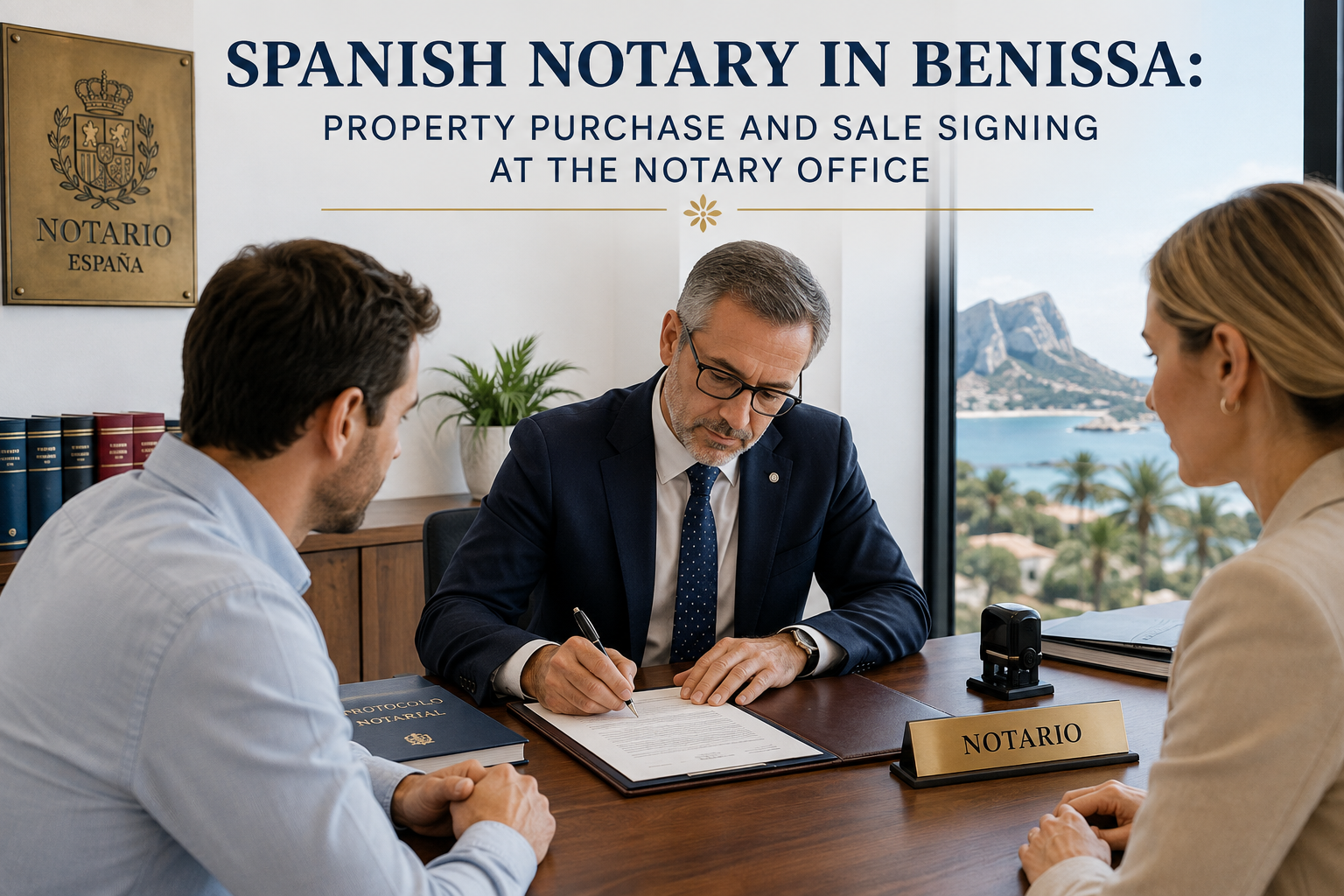
Notary in Benissa: The Role of the Notary When Buying or Selling Property
Buying or selling property in Benissa is one of the most important financial decisions most people will ever make. Whether you are purchasing a holiday home in La Fustera, investing in a luxury villa in San Jaime, or selling a traditional finca in Pedramala, the transaction will culminate in one essential legal step: signing the Escritura Pública (public deed) before a Spanish notary.
For many international buyers, the role of the notary can be confusing. Some assume the notary represents the buyer, while others believe the notary carries out all legal checks on the property. Neither is correct. A Spanish notary is an independent public official whose responsibility is to authenticate the transaction, ensure the legal formalities have been met and provide legal certainty for all parties.
Understanding the notary's role before you reach completion day can help you avoid delays, reduce stress and make informed decisions throughout the buying or selling process. Just as importantly, it helps you understand where the notary's responsibilities end—and why appointing an independent lawyer remains essential.
In this guide, you'll discover:
- Why every Spanish property transaction requires a notary.
- What a Spanish notary does before, during and after completion.
- Which legal checks the notary performs—and which they do not.
- The documents buyers and sellers need to prepare.
- What happens on completion day.
- Whether you can buy or sell property without travelling to Spain.
- How notary fees are calculated.
- Practical advice based on common property transactions in Benissa and the Costa Blanca North.
Whether you're a first-time overseas buyer or an experienced property owner, this guide explains the process in clear, practical language to help you complete your transaction with confidence.
Related Guide: Before reading further, we recommend our Complete Guide to Buying Property in Benissa, which explains every stage of the buying process from viewing properties through to registration.
Table of Contents
- Why a Notary Is Essential in Every Spanish Property Transaction
- The Role of the Notary During a Property Purchase
- What Does the Notary Check?
- What Doesn't the Notary Check?
- Lawyer vs Notary in Spain
- Documents Required for the Notary Appointment
- What Happens on Completion Day?
- Can You Buy or Sell Property Without Being Present?
- Notary Fees in Spain
- Buying Property in Benissa: Local Considerations
- Common Mistakes Buyers Make
- Common Mistakes Sellers Make
- Real-Life Examples
- Frequently Asked Questions
- How Telio Homes Supports Buyers and Sellers
- Conclusion
Why a Notary Is Essential in Every Spanish Property Transaction
Quick Answer
A Spanish notary is an independent public official who authenticates property transactions, verifies the identity and legal capacity of the parties, confirms that the legal formalities have been followed and authorises the Escritura Pública (public deed). The notary does not represent either the buyer or seller and does not replace the role of an independent property lawyer.
What Is a Spanish Notary?
A Spanish notary (Notario) is a public official appointed by the Spanish Government who has the legal authority to certify documents and oversee important legal transactions.
When buying or selling property, the notary ensures that the transaction complies with Spanish law and that the parties understand the legal consequences of signing the deed.
Unlike an estate agent, mortgage adviser or solicitor acting for one party, the notary must remain completely impartial.
Their duty is to:
- Verify the identity of the parties.
- Confirm they have legal capacity to sign.
- Ensure the deed complies with Spanish law.
- Authenticate the public deed.
- Provide legal certainty for the transaction.
The notary's signature transforms the purchase into an official public document that can be registered at the Land Registry (Registro de la Propiedad).
Why Is a Notary Required?
Spanish property transactions rely on the notarial system to provide legal security.
Although buyers and sellers may agree terms privately, the purchase is ordinarily formalised through an Escritura Pública, which is signed before a notary.
This process offers important legal protections.
Legal Certainty
The notary confirms that the transaction satisfies the legal requirements for signing the public deed.
This includes checking that:
- the parties are correctly identified;
- they have legal capacity to sign;
- the deed accurately records the agreement;
- legal formalities have been observed.
Independent Protection
One of the greatest strengths of the Spanish notarial system is impartiality.
The notary does not work for:
- the buyer;
- the seller;
- the estate agent;
- the bank.
Instead, they act independently to ensure that the transaction complies with the law.
Authentication of the Transaction
Once signed, the Escritura Pública becomes an official public document.
This provides:
- legal evidence of ownership;
- increased legal certainty;
- a document capable of registration;
- protection against future ownership disputes.
Registration of Ownership
Following completion, the deed can be submitted for registration at the Registro de la Propiedad.
Registration provides important legal protection because it publicly records ownership and makes future transactions, inheritance matters and mortgage applications significantly easier.
Although ownership and registration are distinct legal concepts, registration offers valuable protection and is strongly recommended in practice.
Can You Choose Your Own Notary?
Yes.
In many transactions, the parties are free to agree which notary will handle the completion.
The notary does not have to be located in Benissa itself. Depending on the circumstances, completion may take place at another notarial office if it is practical for everyone involved.
When choosing a notary, buyers often consider:
- location;
- appointment availability;
- experience with international clients;
- language support;
- efficiency of the office.
Your lawyer or estate agent can usually recommend a notary familiar with property transactions involving overseas buyers.
Is a Notary the Same as a Lawyer?
No.
This is one of the most common misunderstandings among international buyers.
Although both professionals are involved in the transaction, they perform very different roles.
| Notary | Independent Lawyer |
|---|---|
| Public official | Private legal adviser |
| Must remain impartial | Represents only their client |
| Authenticates the deed | Reviews legal risks |
| Ensures legal formalities | Carries out legal due diligence |
| Verifies identity | Protects the buyer's interests |
| Cannot favour either party | Negotiates contractual protections |
Your lawyer investigates matters that fall outside the notary's responsibilities, including:
- planning permissions;
- building legality;
- occupancy licences;
- boundary issues;
- contractual risks;
- easements;
- legal restrictions;
- tax implications.
Important
The notary provides legal certainty, but they do not carry out comprehensive legal due diligence on behalf of the buyer. Independent legal advice remains one of the most important safeguards when purchasing property in Spain.
The Role of the Notary During a Property Purchase
The notary becomes involved long before completion day.
From preparing the public deed to ensuring the transaction complies with Spanish law, the notary plays an important role at every stage of the process.
Before Completion
Preparation usually begins several weeks before the signing appointment.
The notary's office receives information from the lawyers, the estate agent and, where applicable, the mortgage lender.
Typical tasks include:
- preparing the draft deed;
- reviewing identification documents;
- examining the legal documentation required for completion;
- checking mortgage paperwork;
- confirming the authority of anyone signing under a Power of Attorney;
- coordinating with the lending bank.
Early preparation helps minimise the risk of delays on completion day.
Preparing the Public Deed
The draft Escritura Pública summarises the legal details of the transaction.
It generally includes:
- the identities of the buyer and seller;
- a description of the property;
- the agreed purchase price;
- the payment method;
- mortgage details where applicable;
- legal declarations required by Spanish law.
Your lawyer should review the draft carefully before the appointment to ensure that it accurately reflects the agreed terms.
Receiving Documentation
The notary's office coordinates documentation from several sources, including:
- buyer's lawyer;
- seller's lawyer;
- estate agent;
- mortgage lender;
- Land Registry;
- cadastral records where appropriate.
This collaborative approach helps ensure that all necessary information is available before completion.
Liaising With Banks
Where the buyer is obtaining a Spanish mortgage, the notary also works closely with the lender.
The bank supplies documentation relating to the mortgage loan, including the mortgage deed and lending conditions.
In most mortgage purchases, two separate deeds are signed on completion day:
- The purchase deed.
- The mortgage deed.
As a result, mortgage transactions often take longer than cash purchases.
Did You Know?
A straightforward cash purchase may take less than an hour at the notary's office, while a mortgage transaction often takes longer because the bank's documentation must also be completed.
On Completion Day
Completion day marks the official transfer of ownership.
Although every transaction is different, the process generally follows a similar sequence.
Before the Appointment
Before leaving for the notary's office, buyers should check they have:
- passport or national identity card;
- NIE certificate where applicable;
- payment confirmation or banking documentation;
- mortgage paperwork if required;
- any original Power of Attorney documentation.
Your lawyer will normally confirm the exact requirements in advance.
Identity Verification
On arrival, the notary verifies the identity of everyone attending.
This protects all parties and helps prevent fraud.
Identification is checked against the documentation prepared before completion.
Confirmation of Legal Capacity
The notary must also confirm that each party:
- understands the transaction;
- is signing voluntarily;
- has legal authority to complete the purchase or sale.
If someone is signing on behalf of another person, the notary verifies that the Power of Attorney is legally valid.
Verification of Payment
Spanish anti-money laundering legislation requires the payment method to be clearly documented.
Depending on the transaction, payment may involve:
- bank transfer;
- banker's draft;
- mortgage funds;
- a combination of different payment methods.
The notary records these details in the public deed, creating an official record of how the purchase price was paid.
Reading the Public Deed
Before anyone signs, the notary reads—or explains—the contents of the deed.
This includes:
- identities of the parties;
- property description;
- purchase price;
- payment arrangements;
- mortgage details where applicable;
- legal declarations.
If a party does not understand Spanish, suitable language assistance may be required in accordance with the applicable legal requirements.
No one should ever feel pressured to sign before they fully understand the document.
Signing the Escritura Pública
Once all parties are satisfied:
- The buyer signs.
- The seller signs.
- The bank signs (where applicable).
- The notary signs and seals the deed.
The transaction is now formally completed.
Handing Over the Keys
After signing, the buyer usually receives:
- property keys;
- garage remotes;
- alarm codes;
- community access cards where relevant;
- manuals and warranties supplied by the seller.
Whether you're taking ownership of a contemporary villa in San Jaime, a seafront apartment near La Fustera or a countryside finca in Benimarco, this is the moment your new chapter begins.
Immediately After Completion
Although the signing is complete, several administrative steps remain.
These generally include:
- payment of the applicable taxes within the legal deadlines;
- submission of the deed for registration;
- mortgage registration where relevant;
- utility transfers;
- updating ownership records.
Your lawyer normally coordinates these post-completion formalities and keeps you informed of progress.
Expert Tip
Keep copies of every document relating to your purchase, including payment confirmations, the public deed and registration paperwork. These documents will be important if you later refinance, sell the property or deal with inheritance matters.
What Does the Notary Check?
One of the biggest misconceptions among overseas buyers is that the notary carries out a complete legal investigation of the property.
In reality, the notary's role is different.
The notary ensures that the transaction complies with Spanish law, that the parties understand what they are signing, and that all legal formalities have been correctly observed before the public deed is executed.
They do not replace the buyer's independent lawyer.
Understanding exactly what the notary checks—and what they do not—is essential for making informed decisions throughout the purchase process.
Quick Summary
The notary checks:
- Identity of the parties
- Legal capacity
- Ownership
- Mortgage documentation
- Payment method
- Public deed
- Legal formalities
The notary does not check:
- Building legality
- Urban planning compliance
- Hidden defects
- Structural condition
- Planning permissions
- Future legal risks
- Full legal due diligence
Identity of Buyer and Seller
The first responsibility of the notary is to confirm that everyone signing the deed is correctly identified.
This helps prevent fraud and ensures that ownership is transferred to the correct person.
The notary will normally verify:
- Valid passport or national identity card
- NIE (where applicable)
- Company documentation if a company is purchasing or selling
- Marriage regime where relevant
- Power of Attorney documentation if someone is signing on another person's behalf
Practical Advice
Check that your:
- passport
- NIE
- mortgage paperwork
- bank documents
- purchase contract
all use exactly the same name.
Small spelling differences can create unnecessary delays.
Ownership
The notary confirms that the seller has the legal authority to transfer ownership.
This generally involves reviewing information from the Land Registry together with the documentation supplied before completion.
Typical checks include:
- Registered owner
- Property description
- Registered mortgages
- Existing charges
- Restrictions affecting the property
If the property is owned by several individuals, the notary verifies that everyone required to sign is present or properly represented.
Mortgage Documentation
If the buyer is obtaining a Spanish mortgage, the notary also reviews the documentation supplied by the lender.
This usually includes:
- Mortgage deed
- Loan conditions
- Identity of the lender
- Loan amount
- Security being granted
Spanish mortgage legislation contains important consumer protection rules.
The notary plays a role in ensuring that the legal requirements surrounding the mortgage have been satisfied before the mortgage deed is signed.
Payment Method
Spanish anti-money laundering regulations require the purchase funds to be properly documented.
The notary records the agreed payment method in the public deed.
This may include:
- Bank transfer
- Banker's draft
- Mortgage funds
- Combination of personal funds and mortgage finance
Depending on the transaction, supporting banking documentation may also be reviewed.
Why This Matters
Recording the payment method:
- creates legal certainty;
- supports anti-money laundering compliance;
- provides evidence of payment;
- protects both buyer and seller.
Legal Capacity
The notary must be satisfied that everyone signing:
- understands the transaction;
- is acting voluntarily;
- has legal capacity;
- has authority to complete the sale.
If these requirements are not met, the notary cannot authorise the deed.
Property Description
The public deed must accurately identify the property being sold.
The description generally includes:
- Postal address
- Plot reference
- Property description
- Land Registry details
- Cadastral reference
- Participation in communal areas where applicable
For villas around Fanadix or San Jaime, this may include garages, swimming pools or gardens.
For apartments in La Fustera, parking spaces or storage rooms may also form part of the legal description.
For rural fincas around Pedramala or Benimarco, several adjoining plots may be included within the same purchase, making accurate documentation especially important.
Compliance With Legal Formalities
Before signing the deed, the notary confirms that the legal requirements for execution have been satisfied.
This includes:
- Correct identification
- Appropriate documentation
- Proper drafting of the deed
- Mortgage documentation where applicable
- Payment declarations
- Compliance with Spanish legal formalities
Only once these requirements have been fulfilled can the deed be authorised.
Source of Funds and Anti-Money Laundering
Spain applies strict anti-money laundering (AML) legislation to property transactions.
Although your bank and lawyer may also carry out checks, the notary has obligations under these regulations.
Depending on the circumstances, buyers may be asked to provide information regarding:
- the origin of purchase funds;
- international transfers;
- supporting banking documentation;
- identification of the payer.
Providing requested documentation promptly helps avoid unnecessary delays.
Expert Tip
If you're transferring funds from outside Spain, organise your banking arrangements well before completion. International compliance checks can occasionally take longer than expected.
What Doesn't the Notary Check?
Knowing the limits of the notary's responsibilities is just as important as understanding what they do.
Many overseas buyers wrongly assume that because a notary is involved, every legal and technical aspect of the property has already been investigated.
This is not the case.
Several important matters remain the responsibility of the buyer and their independent lawyer.
Building Legality
The notary does not investigate whether every part of the property has been legally built or altered.
This is particularly important for:
- Older villas
- Rural fincas
- Properties with guest accommodation
- Swimming pools
- Extended terraces
- Converted garages
- Outdoor kitchens
Legal investigations into building compliance should be carried out before completion.
Urban Planning Issues
The notary does not analyse planning regulations affecting the property.
Examples include:
- Protected land
- Green zones
- Future road proposals
- Coastal planning restrictions
- Municipal planning designations
Your lawyer should investigate whether any planning matters could affect the property's future use.
Structural Problems
The notary does not inspect the physical condition of the building.
They do not identify:
- Damp
- Cracked walls
- Roof defects
- Subsidence
- Faulty wiring
- Plumbing problems
- Termite damage
If purchasing an older property or renovation project, consider obtaining an independent building survey.
Hidden Defects
Hidden defects may not become apparent until after completion.
Examples include:
- Underground leaks
- Defective drainage
- Septic tank failures
- Water ingress
- Air conditioning faults
Neither the notary nor the Land Registry inspection identifies these issues.
Planning Permissions
The notary does not verify whether:
- extensions were authorised;
- swimming pools received planning approval;
- renovations were licensed;
- occupancy licences exist where required.
This remains part of the buyer's legal due diligence.
Outstanding Legal Risks
The notary is not responsible for identifying every legal issue affecting the property.
Examples include:
- Boundary disputes
- Easements
- Neighbour disputes
- Rights of way
- Historic contractual obligations
- Pending litigation
These matters should be reviewed by your lawyer before completion.
Registry and Reality
One issue encountered from time to time in the Costa Blanca is that the legal records do not always perfectly match the physical property.
Examples include:
- Different built areas
- Additional terraces
- Swimming pools added later
- Separate storage buildings
- Multiple cadastral parcels
These discrepancies should be investigated before signing rather than afterwards.
This is particularly relevant for older countryside properties around Pedramala, Benimarco and inland Benissa.
Why Independent Legal Advice Remains Essential
An independent lawyer represents your interests.
Their responsibilities commonly include:
- Legal due diligence
- Contract review
- Planning investigations
- Registry and Cadastre comparisons
- Licence checks
- Tax advice
- Completion coordination
- Registration after completion
Without this advice, buyers may unknowingly inherit avoidable legal or administrative problems.
Warning
Never assume a property is legally perfect simply because it is being sold before a notary. The notary authenticates the transaction—they do not certify that every aspect of the property complies with planning or building regulations.
Lawyer vs Notary in Spain
This is one of the questions international buyers ask most frequently.
"If there's a notary involved, why do I need a lawyer?"
The answer is simple.
Because they perform completely different roles.
Responsibilities of the Lawyer
Your lawyer works exclusively for you.
Their role is to protect your interests from reservation through to registration.
Typical responsibilities include:
- Legal due diligence
- Reviewing contracts
- Investigating planning matters
- Checking licences
- Comparing Registry and Cadastre records
- Advising on taxes
- Calculating completion costs
- Liaising with the lender
- Registering ownership
- Advising throughout the purchase
If legal risks are identified, your lawyer can negotiate amendments before completion.
Responsibilities of the Notary
The notary remains impartial throughout.
Typical responsibilities include:
- Authenticating the public deed
- Confirming identity
- Confirming legal capacity
- Recording payment methods
- Reviewing mortgage documentation
- Explaining the deed
- Authorising completion
The notary does not negotiate on behalf of either party.
Who Protects the Buyer?
This question often surprises first-time overseas purchasers.
Although the notary ensures that the legal formalities have been correctly followed, they do not act as the buyer's legal adviser.
Only your independent lawyer investigates risks and provides advice based on your specific circumstances.
Why Both Professionals Are Essential
The safest property transactions involve three experienced professionals:
- Estate Agent – Coordinates the transaction, communication and practical arrangements.
- Independent Lawyer – Protects the client's legal interests and carries out due diligence.
- Spanish Notary – Authenticates the transaction and ensures compliance with Spanish legal formalities.
Each performs a unique role.
Together, they provide the highest level of protection for buyers and sellers.
Lawyer vs Notary Comparison
| Responsibility | Lawyer | Notary |
|---|---|---|
| Represents buyer | ✓ | X |
| Represents seller | If appointed | X |
| Must remain impartial | X | ✓ |
| Reviews contracts | ✓ | Limited to the deed |
| Carries out legal due diligence | ✓ | X |
| Investigates planning issues | ✓ | X |
| Reviews licences | ✓ | X |
| Advises on legal risks | ✓ | X |
| Verifies identity | Limited | ✓ |
| Confirms legal capacity | Limited | ✓ |
| Records payment method | Limited | ✓ |
| Authenticates the public deed | X | ✓ |
| Coordinates post-completion registration | ✓ | May assist procedurally, but usually handled by the lawyer or gestor |
Common Mistake
Some overseas buyers believe they can save money by relying solely on the notary. In practice, the notary and the lawyer perform complementary—not interchangeable—roles. Independent legal advice remains one of the best investments you can make when buying property in Spain.
Documents Required for the Notary Appointment
One of the most common reasons for delays on completion day is missing or incomplete documentation.
Although your lawyer and estate agent will normally coordinate the paperwork well in advance, understanding which documents are required helps ensure the transaction proceeds smoothly.
Preparing everything early reduces the risk of postponements, avoids unnecessary stress and gives all parties time to resolve any outstanding issues before the signing appointment.
Expert Tip
Begin gathering your documentation as soon as the private purchase contract has been signed. Replacing lost title deeds, renewing passports or obtaining certificates from a Community of Owners can take several weeks.
Buyer Documents
Passport or National Identity Card
Every buyer must present valid identification.
The name on your identification should match all other documentation relating to the purchase, including:
- NIE certificate
- Bank account
- Mortgage documents
- Purchase contract
- Power of Attorney (where applicable)
Expired identification may prevent completion from taking place.
NIE (Número de Identificación de Extranjero)
Most overseas buyers require an NIE before purchasing property in Spain.
The NIE is used throughout the purchase process and is generally required for:
- Purchasing property
- Paying taxes
- Registering ownership
- Opening utility accounts
- Banking procedures
- Other official administrative matters
Applying early is advisable, particularly if you are buying from abroad.
Proof of Funds
Spanish anti-money laundering legislation requires transparency regarding the purchase funds.
Depending on the circumstances, buyers may need to provide:
- Bank statements
- Transfer confirmations
- Evidence of savings
- Mortgage approval documentation
- Source of funds information
Your lawyer will advise exactly what documentation is appropriate for your purchase.
Mortgage Documents
If purchasing with a Spanish mortgage, additional documentation will be required.
Typical documents include:
- Mortgage offer
- Identification documents
- Bank instructions
- Mortgage deed
- Loan information
The bank usually coordinates these documents directly with the notary before completion.
Power of Attorney (If Applicable)
If someone is signing on your behalf, the notary must verify the validity of the Power of Attorney.
The document must grant sufficient legal authority to complete the purchase or sale.
Many international buyers appoint their lawyer to act under a Power of Attorney when they cannot travel to Spain for completion.
Seller Documents
Passport or National Identity Card
Every registered owner selling the property must provide valid identification.
Where several owners are involved, each owner—or their authorised representative—must be correctly identified.
Title Deed (Escritura)
The seller provides the existing title deed showing how ownership was originally acquired.
This forms an important part of preparing the new public deed.
Energy Performance Certificate (EPC)
In most sales, an Energy Performance Certificate is legally required before marketing and completing the sale, subject to any applicable exemptions.
The buyer should receive information relating to this certificate before completion.
Community Certificate
Where the property forms part of a Community of Owners, the seller is commonly asked to provide a certificate confirming the status of community fees.
This helps establish whether any outstanding community charges exist.
Latest IBI Receipt
The latest IBI (Impuesto sobre Bienes Inmuebles) receipt is commonly requested during the conveyancing process.
It helps identify the property and confirms the municipal property tax reference.
Utility Information
Preparing utility information before completion makes the transfer of services significantly easier.
Useful information includes:
- Electricity supplier
- Water provider
- Internet provider
- Gas supplier (where applicable)
- Meter readings
- Alarm company details
Many sellers prepare a simple handover folder for the buyer.
Mortgage Cancellation Documents
If the property is subject to an existing mortgage, additional documentation may be required so that the mortgage can be repaid and cancelled in accordance with the applicable legal procedures.
This process is usually coordinated between the lender, the lawyer and the notary.
Property Documents
Alongside the personal documentation of the buyer and seller, several documents relating to the property itself are normally reviewed.
Nota Simple
The Nota Simple is an extract from the Spanish Land Registry.
It commonly includes:
- Registered ownership
- Property description
- Existing mortgages
- Charges
- Restrictions
- Registry reference
Buyers should ask their lawyer to review an up-to-date copy before completion.
Cadastral Information
The Catastro records the physical characteristics of the property for administrative and tax purposes.
Typical information includes:
- Plot boundaries
- Built area
- Land area
- Building description
- Cadastral reference
Although the Land Registry and Cadastre often correspond, differences can arise—particularly with older properties or those that have been altered over time.
Mortgage Documentation
Where a mortgage exists or a new mortgage is being granted, the relevant mortgage paperwork forms part of the completion documentation.
Licences Where Required
Depending on the property, additional documents may also be relevant.
Examples include:
- Occupancy licence (where applicable)
- Tourist rental licence (if applicable)
- Building licences for significant works
- Documentation relating to authorised alterations
Requirements vary depending on the property's age, location and history.
Document Checklist
| Document | Buyer | Seller | Normally Required |
|---|---|---|---|
| Passport / ID | ✓ | ✓ | ✓ |
| NIE | ✓ | Often (if non-resident) | ✓ |
| Title Deed | X | ✓ | ✓ |
| Energy Performance Certificate | X | ✓ | Usually |
| Community Certificate | X | ✓ (where applicable) | Usually |
| Latest IBI Receipt | X | ✓ | Usually |
| Proof of Funds | ✓ | X | Often |
| Mortgage Documentation | If applicable | If applicable | As relevant |
| Power of Attorney | If applicable | If applicable | As relevant |
| Nota Simple | Reviewed | Reviewed | ✓ |
| Cadastral Information | Reviewed | Reviewed | ✓ |
| Relevant Licences | Sometimes | Sometimes | Property dependent |
Completion Preparation Checklist
Buyers
✓ Passport valid
✓ NIE obtained
✓ Purchase funds available
✓ Mortgage approved
✓ Buildings insurance arranged where appropriate
✓ Draft deed reviewed with lawyer
✓ Completion costs confirmed
✓ Utility arrangements understood
Sellers
✓ Title deed located
✓ Energy Performance Certificate available
✓ Community certificate requested
✓ Latest IBI receipt prepared
✓ Mortgage cancellation organised (if applicable)
✓ Utility information prepared
✓ Keys and remote controls ready
✓ Alarm codes available
✓ Completion appointment confirmed
What Happens on Completion Day?
For many buyers, completion day is the most exciting stage of the purchase.
After weeks—or sometimes months—of legal work, the property officially changes ownership.
Knowing what to expect makes the experience considerably less stressful.
Before Arriving
Before travelling to the notary's office, make sure you have:
- Passport
- NIE
- Banking documentation
- Mortgage paperwork (if applicable)
- Original Power of Attorney (if required)
- Any documents specifically requested by your lawyer
Arriving early is always recommended.
At the Notary Office
Depending on the transaction, those present may include:
- Buyer
- Seller
- Lawyers
- Estate agent
- Bank representative
- Interpreter (where required)
- Attorney acting under a Power of Attorney
Although the atmosphere is formal, appointments are generally relaxed and well organised.
Typical Completion Timeline
| Time | Stage |
|---|---|
| 09:45 | Arrival and document checks |
| 10:00 | Identity verification |
| 10:10 | Mortgage documentation (if applicable) |
| 10:25 | Review of the public deed |
| 10:45 | Payment confirmation |
| 10:55 | Buyer and seller sign |
| 11:05 | Notary authorises the deed |
| 11:10 | Keys handed over |
| 11:15 | Completion concluded |
Times are illustrative only. Actual appointments vary depending on the transaction.
Reading the Public Deed
The notary explains the contents of the deed before anyone signs.
Typical points covered include:
- Property description
- Purchase price
- Payment arrangements
- Mortgage details
- Legal declarations
- Rights and obligations
If anything is unclear, ask questions before signing.
A good lawyer will already have reviewed the draft deed with you beforehand.
Important
Never sign a legal document that you do not fully understand. If necessary, request clarification or appropriate language assistance before proceeding.
Payment of the Purchase Price
Funds are transferred according to the agreed arrangements.
Depending on the purchase, payment may involve:
- Mortgage funds
- International transfer
- Banker's draft
- Combination of payment methods
The payment method is officially recorded within the deed.
Signing
Once everyone is satisfied:
- Buyer signs.
- Seller signs.
- Bank representative signs (where applicable).
- Notary signs and seals the public deed.
The property transaction is now formally completed.
Receiving the Keys
After signing, the buyer normally receives:
- Property keys
- Garage remotes
- Alarm codes
- Community access cards
- Mailbox keys
- Instruction manuals
- Warranty documents supplied by the seller
For many overseas buyers, this is the moment they finally become owners of their new home in Benissa.
Immediately After Completion
The administrative work continues after everyone leaves the notary's office.
Typical next steps include:
- Paying the applicable taxes within the legal deadlines
- Registering ownership
- Registering the mortgage (if applicable)
- Transferring utilities
- Updating community records
- Arranging direct debits
- Updating insurance policies
Your lawyer usually coordinates these procedures on your behalf.
What Happens Over the Following Weeks?
Although you now own the property, several administrative tasks continue behind the scenes.
A typical sequence is:
- The applicable taxes are paid.
- The deed is processed for registration.
- Ownership is registered.
- Mortgage registration is completed (if applicable).
- Utility accounts are transferred.
- Community records are updated.
- The registered documentation is returned to your lawyer.
Registration times vary depending on the complexity of the transaction and administrative workload.
Can You Buy or Sell Property Without Being Present?
Yes.
Many international buyers and sellers complete Spanish property transactions without travelling to Spain.
The most common method is through a Power of Attorney (POA).
Using a Power of Attorney
A Power of Attorney allows another person—usually your lawyer—to sign legal documents on your behalf.
This is particularly useful if you:
- Live overseas
- Cannot travel
- Have work commitments
- Are buying several properties
- Need someone to deal with post-completion administration
The document must be legally valid and suitable for use in Spain.
Buying From Abroad
Remote purchases have become increasingly common.
Many buyers now:
- View properties virtually
- Reserve remotely
- Review documents electronically
- Transfer funds internationally
- Complete through a Power of Attorney
This approach allows the purchase to proceed even if the buyer cannot travel.
Selling From Abroad
Many owners who have returned to countries such as:
- United Kingdom
- Netherlands
- Belgium
- Germany
- France
complete the sale through their lawyer acting under a valid Power of Attorney.
This avoids unnecessary travel while ensuring the transaction proceeds efficiently.
Digital Preparation Before Signing
Although the public deed must still be executed in accordance with Spanish legal requirements, much of the preparation can now be carried out digitally.
Examples include:
- Reviewing draft deeds
- Sharing identification
- Communicating with lawyers
- Organising banking documentation
- Preparing completion statements
This makes international transactions significantly easier than they were in the past.
Did You Know?
Many overseas buyers of holiday homes in Benissa grant a Power of Attorney to their lawyer not only for completion but also for paying taxes, registering ownership and arranging utility transfers after the purchase. This can save considerable time, particularly if you are returning home immediately after completion.
Notary Fees in Spain
Notary fees form an important part of the overall cost of buying or selling property in Spain. Fortunately, unlike many professional services, they are regulated by law, meaning fees are calculated according to official tariffs rather than being set individually by each notary.
For most buyers, notary fees represent only a small proportion of the total acquisition costs, but understanding how they are calculated helps you budget accurately and avoid surprises on completion day.
Quick Answer
Spanish notary fees are regulated and generally depend on the value and complexity of the transaction, the number of deeds being signed, and the number of authorised copies required. Mortgage purchases usually involve additional notarial work because a separate mortgage deed is signed.
How Fees Are Calculated
Although official tariffs apply, the final fee depends on several factors, including:
- Purchase price of the property
- Complexity of the transaction
- Number of public deeds signed
- Whether a mortgage is involved
- Number of authorised copies issued
- Additional legal documents executed during the appointment
For example, a straightforward cash purchase of an apartment will usually involve less notarial work than the purchase of a countryside finca with multiple land parcels and a mortgage.
Typical Costs
The following table provides a general overview of the costs buyers should expect to budget for.
| Cost | Typical Range* | Notes |
|---|---|---|
| Notary fees | Regulated; typically several hundred euros | Depends on value and complexity |
| Land Registry fees | Regulated | Based on registration value |
| Legal fees | Agreed with your lawyer | Varies by firm and scope of work |
| Property taxes | Depends on the transaction | Varies according to applicable legislation |
| Mortgage costs | If applicable | Additional deeds and registration may apply |
| Bank valuation | If required by lender | Mortgage purchases only |
*Indicative only. Costs vary depending on the transaction. Always obtain an individual completion statement from your lawyer before signing.
What Can Increase Notary Fees?
Certain circumstances may increase the amount payable, including:
- A higher purchase price
- Multiple buyers or sellers
- Simultaneous mortgage deed
- Cancellation of an existing mortgage
- Several authorised copies
- Complex ownership structures
- Company purchases
- Multiple registered plots
These additional costs are generally modest compared with the overall value of the transaction but should still be included in your budget.
Who Pays the Notary Fees?
Responsibility for costs depends on:
- The type of transaction
- Current legislation
- The agreement between the parties
- The documents being signed
In many resale transactions, buyers usually pay the costs associated with acquiring and registering the property, while sellers remain responsible for their own obligations arising from the sale. However, legal requirements may change, and individual circumstances vary.
Always rely on advice from your lawyer rather than assumptions or outdated guidance.
Additional Completion Costs
Notary fees are only one part of the total cost of purchasing property.
Depending on the circumstances, buyers should also budget for:
- Property transfer taxes or VAT (as applicable)
- Land Registry fees
- Legal fees
- Mortgage-related costs
- Bank valuation fees
- Currency exchange costs
- Utility transfer costs
- Insurance
Expert Tip
Ask your lawyer for a detailed completion statement several days before completion. This should set out every expected payment, making it much easier to organise funds and reducing the likelihood of unexpected costs on the day of signing.
Buying Property in Benissa: Local Considerations
Buying property in Benissa follows the same legal principles as elsewhere in Spain, but the local property market has characteristics that overseas buyers should understand.
The municipality offers a diverse range of properties, from coastal apartments to luxury villas and traditional rural fincas. Each type of property presents its own practical and legal considerations.
Villas
Detached villas remain the most popular choice among international buyers.
Many are located in established residential areas such as:
- San Jaime
- La Fustera
- Fanadix
- Buenavista
When purchasing a villa, your lawyer may investigate:
- Building extensions
- Swimming pool documentation
- Occupancy licence (where applicable)
- Land Registry and Cadastre consistency
- Community obligations, if located within an urbanisation
Older villas may have undergone several renovations over the years, making careful legal due diligence particularly important.
Apartments
Apartment purchases are often more straightforward but still require careful review.
Important considerations include:
- Community of Owners documentation
- Outstanding community fees
- Parking space registration
- Storage room ownership
- Lift maintenance obligations
- Building insurance arrangements
If you intend to rent the apartment to holidaymakers, obtain legal advice regarding any licensing or regulatory requirements that may apply.
Rural Fincas
Traditional fincas are one of Benissa's defining property types and are particularly sought after around:
- Pedramala
- Benimarco
- Inland Benissa
These properties often require more extensive legal due diligence because they may include:
- Multiple cadastral parcels
- Agricultural land
- Water deposits
- Irrigation rights
- Septic tank systems
- Private access roads
- Historic outbuildings
- Older extensions
None of these characteristics necessarily present problems, but they require careful investigation before completion.
Warning
Never assume that a rural property fully complies with current planning regulations simply because it has existed for many years. Older properties may have been altered over several decades. Your lawyer should investigate the relevant documentation before you commit to the purchase.
Mortgage Purchases
Purchasing with a Spanish mortgage generally involves additional coordination between:
- The lender
- Your lawyer
- The estate agent
- The notary
Extra steps commonly include:
- Property valuation
- Mortgage approval
- Consumer protection formalities
- Preparation of the mortgage deed
- Bank attendance at completion
Mortgage purchases therefore tend to take longer than cash transactions.
International Buyers
Benissa continues to attract buyers from across Europe, particularly from:
- United Kingdom
- Netherlands
- Belgium
- Germany
- France
- Scandinavia
International buyers often require additional assistance with:
- NIE applications
- Currency exchange
- Spanish banking
- Translation of documentation
- Power of Attorney
- Registration after completion
- Utility transfers
Choosing professionals who regularly assist overseas clients can significantly simplify the process.
Did You Know?
Many buyers first discover Benissa through its beaches at La Fustera, then later choose inland areas such as Pedramala or Benimarco, where larger plots, greater privacy and traditional fincas offer a different lifestyle while remaining only a short drive from the coast.
Common Mistakes Buyers Make
Even experienced property buyers can make costly mistakes when purchasing in Spain.
The following issues arise regularly and are largely avoidable with good preparation.
Assuming the Notary Performs Full Legal Checks
This is by far the most common misunderstanding.
The notary authenticates the transaction but does not replace your lawyer.
Always obtain independent legal advice before committing to a purchase.
Not Appointing an Independent Lawyer
Some buyers rely solely on the estate agent or assume the notary protects their interests.
An independent lawyer carries out legal due diligence, reviews contracts and advises on risks specific to your purchase.
Leaving Currency Exchange Too Late
Exchange rate movements can significantly affect the total purchase cost.
International buyers should plan currency transfers well before completion rather than waiting until the final days.
Waiting Too Long to Obtain an NIE
Without an NIE, several administrative steps cannot be completed.
Apply as early as possible, particularly if purchasing from overseas.
Underestimating Additional Costs
The purchase price is only one part of the total budget.
Remember to account for:
- Taxes
- Legal fees
- Notary fees
- Land Registry fees
- Mortgage costs
- Insurance
- Currency exchange costs
A detailed completion statement helps avoid unexpected expenses.
Not Reviewing the Draft Deed
The public deed should never be the first time you see the legal documentation.
Review the draft carefully with your lawyer before attending the notary appointment.
Ignoring Rural Property Issues
Buyers sometimes underestimate the additional investigations required when purchasing a finca.
Matters such as:
- Water rights
- Septic tanks
- Agricultural land
- Multiple plots
- Building alterations
may require additional legal review.
Buyer Checklist
Before completion:
- ✓ Appoint an independent lawyer
- ✓ Obtain your NIE
- ✓ Organise funds
- ✓ Arrange currency exchange
- ✓ Review the draft deed
- ✓ Understand the completion costs
- ✓ Prepare all documentation
- ✓ Arrange insurance where appropriate
Common Mistakes Sellers Make
Good preparation is equally important for sellers.
Many delays can be avoided simply by organising the required documentation before accepting an offer.
Missing Documentation
Replacing missing paperwork often takes longer than expected.
Common examples include:
- Title deed
- Energy Performance Certificate
- Community certificate
- Mortgage documentation
Preparing these early helps keep the transaction on schedule.
Outstanding Community Fees
Where applicable, community charges should be settled before completion.
Buyers frequently request confirmation that payments are up to date.
Mortgage Cancellation Delays
If an existing mortgage needs to be cancelled, begin the process as early as possible.
Leaving this until the final stages can delay completion.
Missing Licences
Some properties require additional documentation depending on their age and history.
Examples include:
- Occupancy licence
- Documentation relating to authorised building works
- Property-specific permits
Your lawyer can advise which documents are relevant.
Incorrect Property Records
Discrepancies between:
- Land Registry
- Cadastre
- Physical property
should be investigated before completion whenever possible.
Resolving these matters early is generally simpler than dealing with them after exchange of funds.
Leaving Utility Transfers Until the Last Minute
Preparing utility information before completion makes the transition much smoother for the buyer.
Useful information includes:
- Electricity provider
- Water supplier
- Internet company
- Alarm details
- Meter readings
- Community contact information
A simple information folder is often greatly appreciated by buyers.
Seller Checklist
Before completion:
- ✓ Locate the title deed
- ✓ Obtain the Energy Performance Certificate
- ✓ Request the community certificate
- ✓ Prepare the latest IBI receipt
- ✓ Organise mortgage cancellation (if applicable)
- ✓ Gather utility information
- ✓ Prepare all keys and remote controls
- ✓ Confirm completion arrangements with your lawyer
Expert Tip
Sellers who organise their documentation before marketing their property often experience fewer delays once a buyer is found. Early preparation allows legal issues to be identified and resolved before they affect the agreed completion date.
Real-Life Examples
Every property transaction is unique, but the following examples reflect situations that commonly arise when buying and selling property in Benissa and the surrounding Costa Blanca North. They illustrate how the notary, lawyer and estate agent each contribute to a smooth completion.
Example 1: British Couple Buying a Villa in San Jaime With a Spanish Mortgage
A British couple agree to purchase a villa in San Jaime.
Because they are financing part of the purchase with a Spanish mortgage, two deeds need to be signed at the notary's office:
- The purchase deed (Escritura Pública de Compraventa)
- The mortgage deed (Escritura de Préstamo Hipotecario)
Before completion:
- Their lawyer reviews the property's legal documentation.
- The lender completes the mortgage approval process.
- The notary prepares both deeds.
- Completion funds are organised and verified.
On completion day:
- The notary confirms the identities of all parties.
- The mortgage conditions are explained.
- The purchase deed is read.
- Payment is confirmed.
- The deeds are signed.
- The buyers receive the keys.
Following completion, the lawyer arranges payment of the applicable taxes, registration of ownership and registration of the mortgage.
Example 2: Dutch Buyer Purchasing a Villa in La Fustera Through a Power of Attorney
A Dutch buyer reserves a villa in La Fustera but is unable to travel to Spain for completion.
Their lawyer is appointed under a valid Power of Attorney.
Before completion:
- The buyer reviews the draft deed remotely.
- Purchase funds are transferred.
- The Power of Attorney is verified.
- The lawyer confirms that all documentation is complete.
On completion day:
- The lawyer signs on behalf of the buyer.
- The seller signs in person.
- The notary authorises the deed.
- Ownership transfers.
- Registration and utility transfers are organised after completion.
The buyer collects the keys during their next visit to Spain.
Example 3: German Seller Completing From Abroad
A German owner has sold an apartment near Benissa Costa after returning permanently to Germany.
Rather than travelling back to Spain, the seller grants a Power of Attorney to their Spanish lawyer.
The lawyer:
- Attends the notary appointment.
- Signs the deed on the seller's behalf.
- Coordinates the transfer of sale proceeds.
- Oversees the remaining post-completion formalities.
This approach avoids unnecessary travel while allowing the sale to proceed on schedule.
Example 4: Traditional Finca in Pedramala Requiring Additional Documentation
A buyer agrees to purchase a traditional finca in Pedramala.
During legal due diligence, the lawyer discovers that additional documentation is required because the property includes:
- Multiple registered land parcels
- A water deposit
- An older septic tank installation
- Historic alterations carried out over many years
Rather than rushing to completion, the parties postpone the notary appointment while the outstanding documentation is obtained.
Although completion is delayed slightly, resolving these issues beforehand significantly reduces the risk of future legal complications.
Important
Rural properties often require more extensive legal investigation than modern apartments or villas. Allow additional time for legal due diligence when purchasing a finca or countryside property.
Frequently Asked Questions
Is a notary mandatory when buying property in Spain?
Yes. Property purchases that are to be formalised by public deed are ordinarily completed before a Spanish notary. The public deed is then used to register ownership at the Land Registry.
Can I choose my own notary?
In many transactions, yes. The parties can generally agree which notary will act, provided this is practical and complies with the applicable legal requirements.
Does the notary have to be located in Benissa?
No. Completion may take place at another notarial office if appropriate for the parties involved.
Who usually chooses the notary?
This varies depending on the transaction and the agreement between the parties. Your lawyer or estate agent can advise on the most practical option.
Does the notary protect the buyer?
The notary protects the legality of the transaction, not the interests of one particular party.
They remain impartial throughout the process.
Does the notary represent the seller?
No.
The notary acts independently and cannot favour either the buyer or the seller.
Is a lawyer still necessary?
Yes.
Your lawyer investigates legal risks, reviews contracts, advises on planning matters, coordinates completion and protects your interests throughout the transaction.
How much do notary fees cost?
Notary fees are regulated and depend on factors such as the value and complexity of the transaction and the documentation being signed. Your lawyer can provide a personalised estimate before completion.
How long does a notary appointment usually take?
A straightforward cash purchase may take around one hour.
Mortgage purchases or more complex transactions generally take longer because additional documentation must be reviewed and signed.
Do I need an interpreter?
If you do not understand Spanish sufficiently to follow the contents of the deed, appropriate language assistance may be required. Your lawyer can advise on the most suitable arrangements.
Can I sign remotely?
The public deed itself must be executed in accordance with Spanish legal requirements.
However, many overseas buyers and sellers complete transactions through a valid Power of Attorney, allowing an authorised representative to sign on their behalf.
Can someone sign for me?
Yes.
A properly executed Power of Attorney can authorise another person—often your lawyer—to sign the purchase or sale documentation.
What documents must I bring?
Typically:
- Passport or national identity card
- NIE (where applicable)
- Banking documentation
- Mortgage paperwork (if applicable)
- Power of Attorney (if relevant)
Your lawyer will confirm the exact requirements for your transaction.
Does the notary check debts?
The notary reviews the documentation required for the public deed but does not replace the legal investigations carried out by your lawyer. Comprehensive legal due diligence remains essential.
When do I receive the keys?
In most transactions, the keys are handed over immediately after the deed has been signed and the agreed payment arrangements have been completed.
What happens after signing?
After completion:
- The applicable taxes are paid.
- The deed is submitted for registration.
- Ownership is registered.
- Mortgage registration is completed where relevant.
- Utility transfers and administrative updates are arranged.
How long does registration take?
Registration times vary depending on the transaction and administrative workload.
Your lawyer will keep you informed throughout the process and confirm once registration has been completed.
What happens if the property has an existing mortgage?
If the seller has an existing mortgage, arrangements are made to deal with it during completion.
If the buyer is taking out a new mortgage, a separate mortgage deed is normally signed before the notary at the same appointment.
How Telio Homes Supports Buyers and Sellers
Buying or selling property in Benissa involves much more than finding a buyer or choosing a property.
A successful transaction depends on effective coordination between the estate agent, lawyer, lender and notary.
At Telio Homes, we help guide buyers and sellers through every stage of the process while working alongside trusted independent professionals.
Coordinating With Lawyers
We work closely with your chosen lawyer to help ensure that:
- Documentation is available promptly.
- Questions are answered quickly.
- Communication remains clear.
- Deadlines are monitored.
- Completion progresses as smoothly as possible.
Preparing Documentation
Well-prepared documentation reduces the likelihood of delays.
We help buyers and sellers understand:
- Which documents may be required.
- When they should be obtained.
- Which issues should be addressed before completion.
Early preparation often saves considerable time later in the transaction.
Managing the Transaction Timeline
Property purchases involve numerous moving parts.
We help coordinate:
- Reservation
- Private purchase contract
- Mortgage timetable
- Completion arrangements
- Key handover
- Communication between all parties
Keeping everyone informed helps minimise unnecessary delays.
Liaising With the Notary
We regularly communicate with the notary's office to help ensure:
- Appointments are efficiently organised.
- Documentation is available when required.
- Practical arrangements are in place before completion.
Supporting International Clients
Many of our clients purchase or sell property while living abroad.
We regularly assist buyers and sellers from:
- United Kingdom
- Netherlands
- Belgium
- Germany
- France
- Scandinavia
- Other international markets
By coordinating with experienced local professionals, we help make the buying and selling process as straightforward as possible.
Expert Tip
Choosing professionals who regularly work together can improve communication, reduce delays and provide a smoother experience from reservation through to completion.
Conclusion
A Spanish notary plays a fundamental role in every property transaction, ensuring that the public deed is executed correctly and that the legal formalities required by Spanish law have been satisfied.
However, it is equally important to understand the limits of the notary's responsibilities.
The notary does not replace an independent lawyer, investigate every legal issue affecting the property or guarantee its planning or physical condition.
The safest approach when buying or selling property in Benissa is to work with:
- An experienced local estate agent
- A qualified independent lawyer
- An impartial Spanish notary
Together, these professionals help ensure your transaction progresses smoothly from reservation through to registration.
Whether you are buying a villa in La Fustera, selling an apartment on Benissa Costa, investing in San Jaime, or purchasing a traditional finca in Pedramala or Benimarco, careful preparation and expert guidance can make the process significantly more straightforward.
Understanding the role of the notary before completion allows you to approach one of life's biggest financial decisions with confidence and peace of mind.
Ready to Buy or Sell Property in Benissa?
Whether you're planning a Notary Benissa property purchase, preparing to sell your home, or simply looking for clear, impartial guidance on the Spanish property process, Telio Homes is here to help.
We can assist you by:
- Explaining every stage of the buying or selling journey.
- Helping you prepare for completion.
- Coordinating with your independent lawyer and the notary.
- Keeping your transaction on schedule.
- Sharing practical local knowledge of Benissa and the Costa Blanca North.
Our aim is simple: to help you navigate the property process with clarity, confidence and professional support from your first viewing through to the day you receive—or hand over—the keys.