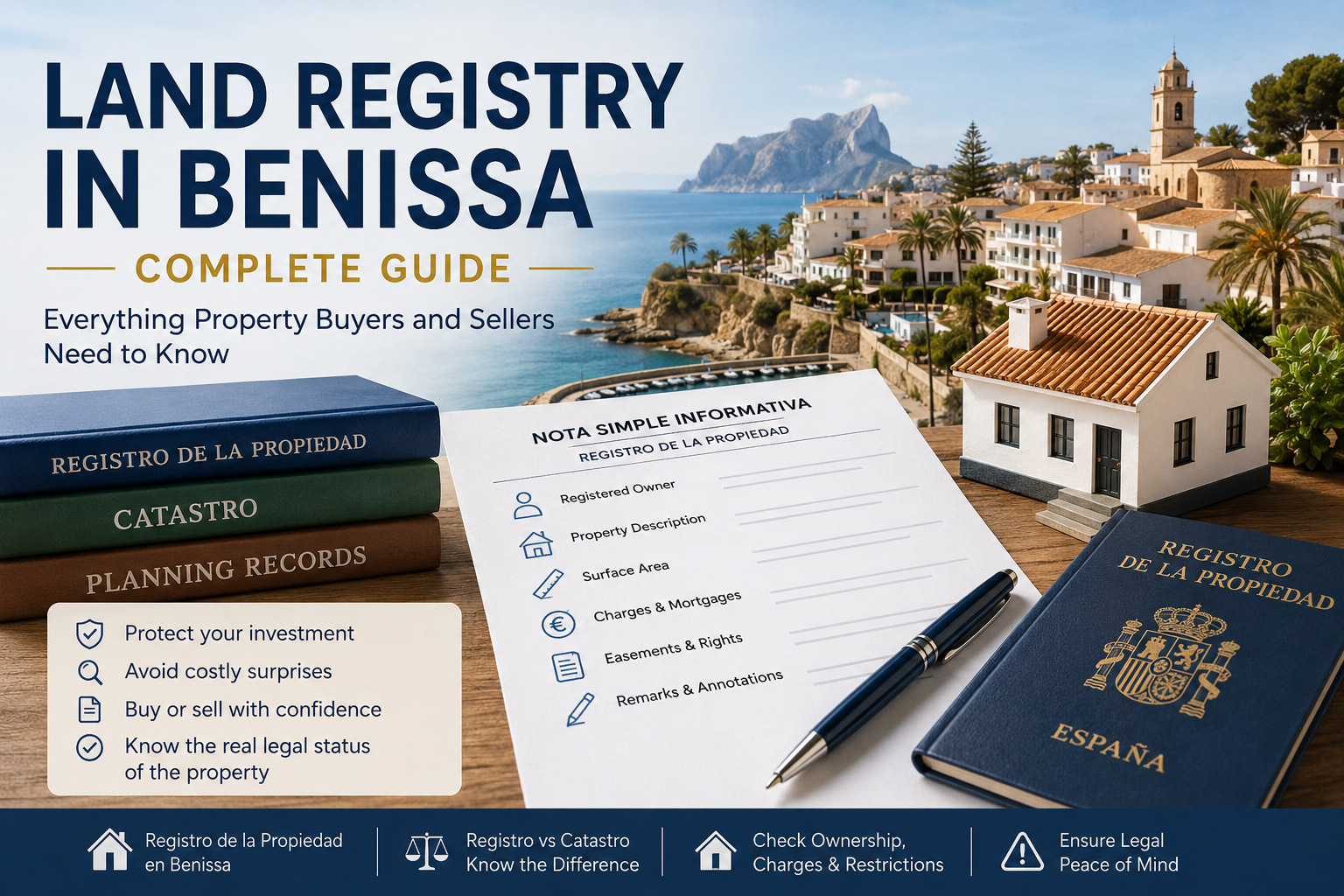
Registro de la Propiedad en Benissa: A Complete Guide for Property Buyers and Sellers
Buying or selling a property in Benissa involves much more than checking the asking price, viewing the house and signing a contract. One of the most important parts of the process is understanding the Registro de la Propiedad en Benissa and what its records tell you about the property.
The Spanish Land Registry can show who is registered as owner, the ownership shares, mortgages, embargoes, easements, usufructs and other registered rights or restrictions. A Nota Simple is normally the first document used to obtain this information.
But there is an important limitation: the Land Registry is only one part of property due diligence.
For a proper assessment, buyers and sellers should consider the relationship between:
-
Registro de la Propiedad — registered ownership and property rights
-
Catastro — administrative and cadastral information about the property
-
Escritura — the public deed documenting a transaction or other legal act
-
Planning records — planning permissions, construction status and other municipal matters
-
The physical property — what actually exists on the land
This distinction is particularly important in Benissa. The local market includes modern villas in Benissa Costa, La Fustera, San Jaime, Fanadix and Buenavista, as well as older villas, fincas and rural properties in areas such as Benimarco and Pedramala.
Older properties can have extensions, pools, garages, storage buildings, reforms or other alterations that need to be compared against the available documentation.
Expert Tip: A property being registered does not automatically mean that every part of the physical property is planning-compliant. The strongest due-diligence process compares the Registry, Catastro, escritura, planning information and the property itself.
Table of Contents
-
What Is the Registro de la Propiedad in Benissa?
-
What Is a Nota Simple?
-
How to Read a Nota Simple
-
Registro de la Propiedad vs Catastro
-
Does Being Registered Mean a Property Is Legal?
-
How Is a Property Registered in Spain?
-
Common Land Registry Problems in Benissa
-
What Buyers Should Check Before Buying a Property in Benissa
-
What Sellers Should Check Before Putting a Property on the Market
-
What Happens If the Registry Information Is Incorrect?
-
Real-Life Benissa Property Examples
-
Registro de la Propiedad de Benissa: Practical Information
-
Land Registry Checklist for a Benissa Property
-
Frequently Asked Questions
-
Conclusion
What Is the Registro de la Propiedad in Benissa?
What does the Spanish Land Registry do?
The Registro de la Propiedad is Spain's official property registration system. It provides public information about registered real estate rights and is designed to provide greater legal certainty in property transactions.
For a property in Benissa, Registry information can help answer questions such as:
-
Who is registered as owner?
-
How is ownership divided?
-
Is there a mortgage?
-
Is there an embargo?
-
Are there easements?
-
Is there a usufruct?
-
Are other rights or restrictions registered against the property?
-
How is the property described in the Registry?
The Registry is therefore particularly important when buying or selling property because the physical appearance of a house does not, by itself, establish who owns it or what rights other people may have over it.
What information is recorded?
The exact information depends on the property's history, but Registry records may include:
| Information | Why it matters |
|---|---|
| Registered owner | Identifies who holds the registered ownership rights |
| Ownership shares | Important where several people own the property |
| Finca registration number | Identifies the registered property |
| CRU/IDUFIR | Provides an identifying reference for the registered finca |
| Property description | Helps establish what is registered |
| Surface area | Can be compared with Catastro and physical measurements |
| Mortgages | Shows registered mortgage rights |
| Embargoes | Can indicate enforcement-related restrictions |
| Easements | May affect access, use or other rights |
| Usufructs | Shows rights held by someone other than the owner |
| Other charges or restrictions | May affect the transaction or use of the property |
Why should buyers check the Registry?
A buyer should normally obtain recent Registry information before becoming contractually committed to the purchase.
The main reasons are simple:
-
Confirm the registered owner.
-
Understand ownership shares.
-
Identify mortgages and other charges.
-
Compare the registered property with the property being sold.
-
Identify issues requiring further investigation.
This is particularly useful for older properties and inherited properties, where the ownership or documentary history may be more complicated.
Important: A Nota Simple is an essential starting point for property due diligence, but it should not be treated as a complete legal, planning or technical inspection.
What Is a Nota Simple?
A Nota Simple Informativa is an informative extract of relevant information held by the Registro de la Propiedad.
For many property transactions, it is the first Registry document a buyer, seller, lawyer, notary or estate agent will examine.
The official Colegio de Registradores describes the Nota Simple as containing information such as the identification of the finca, registered rights holders and the extent, nature and limitations of those rights. It is informative rather than a formal certification of the Registry's contents.
What information does a Nota Simple contain?
A Nota Simple can include:
-
Property identification
-
Finca registration information
-
CRU/IDUFIR
-
Registered owner or owners
-
Ownership percentages
-
Property description
-
Surface information
-
Mortgages
-
Embargoes
-
Easements
-
Usufructs
-
Other registered charges
-
Restrictions or limitations
It may also contain information about the cadastral reference and, where applicable, the relationship between the Registry and Catastro.
Nota Simple vs Registry Certification
These documents have different purposes.
| Nota Simple | Registry Certification | |
|---|---|---|
| Main purpose | Informational property check | Formal certification of Registry contents |
| Ownership information | Yes | Yes |
| Registered charges | Yes | Yes |
| Typical buyer due diligence | Usually the starting point | Used when formal proof is required |
| Evidential value | Informative | Public document with formal evidential value |
| Signed by Registrar | No formal certification | Yes |
The official Benissa Registry states that the certification provides formal evidence of the contents of the Registry and has the value of a public document, whereas the Nota Simple is informative.
For ordinary purchase due diligence, a recent Nota Simple is usually the logical starting point. Where formal proof of the Registry's contents is required, a lawyer or other professional may recommend a certification.
How to obtain a Nota Simple for a Benissa property
The official Colegio de Registradores provides an online service for requesting a Nota Simple.
Depending on the information available, the property can be identified using details such as:
-
CRU/IDUFIR
-
Registry information
-
Registered owner
-
Finca details
-
Other identifying information accepted by the Registry
The official Benissa Registry page currently states that a Nota Simple can be requested online for an official price of €9.02 plus VAT, with an average delivery time of less than two hours. Prices and service conditions can change, so the official source should always be checked before publication or ordering.
The official Registry service can also provide a Nota de Localización, which is designed to help identify the Registry, province and municipality where a particular person or company has registered property rights.
How to Read a Nota Simple
A Nota Simple can look complicated, particularly if you are an international buyer unfamiliar with Spanish property terminology.
You do not need to understand every legal phrase to perform a useful first review. Focus on the information that can materially affect the transaction.
Property identification and finca information
First establish that the document actually relates to the property you are buying or selling.
Check:
-
Finca registration number
-
CRU/IDUFIR
-
Municipality
-
Property description
-
Location information
-
Cadastral reference, where included
This is particularly important for rural property.
A finca may be described in formal Registry terminology that looks very different from the description used in estate-agent marketing.
That difference does not automatically indicate a problem. It means the descriptions need to be compared.
Registered owner and ownership shares
Check exactly who is registered.
Look for:
-
Full name of the owner or owners
-
Ownership percentage
-
Multiple ownership
-
The legal basis of acquisition, where shown
If two people are registered owners but only one person appears to be selling, the situation needs to be clarified.
The same applies to inherited property where the family believes ownership has already passed to the heirs but the Registry still shows a previous owner.
Property description and surface area
Compare the Registry description with:
-
Escritura
-
Catastro
-
Existing plans
-
Physical measurements
-
Estate-agent particulars
-
Architect or survey documentation, where available
Surface differences are not automatically evidence of illegality.
A difference may result from:
-
Historical measurements
-
Different descriptions
-
A later extension
-
An alteration that has not been reflected everywhere
-
A technical measurement issue
-
A cadastral or Registry discrepancy
The important question is:
Why is there a difference, and does it affect the legal, planning, financial or practical position of the property?
CRU and IDUFIR
International buyers often encounter CRU and IDUFIR when dealing with Spanish Registry documents.
Both are identifiers associated with registered properties.
The CRU, or Código Registral Único, is the current unique Registry identifier used for a finca. Older documentation may contain an IDUFIR (Identificador Único de Finca Registral).
For practical purposes, the key point is that these identifiers help the Registry identify the specific registered finca.
If an older escritura contains an IDUFIR while newer documentation refers to a CRU, do not assume that they refer to different properties. The identifiers should be checked against the Registry documentation.
Mortgages and other charges
Pay particular attention to the cargas section.
This may contain:
-
Mortgages
-
Embargoes
-
Easements
-
Usufructs
-
Restrictions
-
Other registered rights
An existing mortgage does not necessarily prevent a property from being sold.
The important question is what will happen to the registered mortgage in connection with the transaction.
Embargoes and annotations
An embargo is different from an ordinary mortgage.
If an embargo or other potentially problematic annotation appears, do not assume that it is irrelevant because the seller says that the matter has already been resolved.
The circumstances should be investigated and the appropriate legal position established before the buyer commits to the transaction.
Easements, usufructs and other rights
Easements can be particularly important for rural property.
They may relate to:
-
Access
-
Passage
-
Water
-
Utilities
-
Other rights benefiting or burdening a property
The physical way a property is accessed may also be different from the legal rights recorded over it.
For example, a rural property may appear to have straightforward access from a road, while the legal access arrangements deserve separate investigation.
What should immediately raise a red flag?
Pay particular attention if:
-
The seller is not the registered owner
-
Multiple owners exist but not all are participating
-
There is a significant surface discrepancy
-
A building or extension appears to be missing
-
A mortgage said to have been repaid remains registered
-
An embargo appears
-
An unusual restriction is recorded
-
An easement affects access
-
An inheritance has not been reflected
-
The property description materially differs from the physical property
-
A rural property contains substantial construction requiring planning investigation
Warning: A red flag does not necessarily mean a transaction is impossible. It means the issue should be identified, understood and appropriately dealt with before the buyer becomes financially committed.
Registro de la Propiedad vs Catastro
One of the most important concepts for an international buyer is understanding that Registro de la Propiedad and Catastro are different systems.
They complement one another but should not be treated as interchangeable.
What is the Registro de la Propiedad?
The Registro focuses primarily on registered property rights.
It helps answer questions such as:
-
Who is registered as owner?
-
What ownership rights are recorded?
-
Is a mortgage registered?
-
Is there an embargo?
-
Are easements or usufructs recorded?
What is Catastro?
Catastro is an administrative register operated by Spain's Ministry of Finance.
It contains information about real estate, including cadastral references, physical characteristics, uses, surfaces, graphic information and cadastral values.
The Dirección General del Catastro expressly distinguishes Catastro from the Registro de la Propiedad while explaining that both systems work together under a statutory coordination framework.
Registro vs Catastro vs Escritura vs Planning
| Source | Main purpose | Useful for answering | Does it prove planning legality? |
|---|---|---|---|
| Registro de la Propiedad | Registered property rights | Who owns it? What charges exist? | No |
| Catastro | Administrative and cadastral property information | What physical/cadastral information is recorded? | No |
| Escritura | Documents a legal act or transaction | What was formally documented? | Not by itself |
| Planning records | Planning and construction status | Was construction/use authorised? | This is the relevant area |
This is why a proper property check uses several sources rather than relying on one document.
Why can Registro and Catastro show different information?
There are several possible explanations:
-
Different measurement dates
-
Historical descriptions
-
Extensions or alterations
-
Different methods of describing surfaces
-
Updates that occurred in one system before another
-
Boundary or identification issues
-
Documentation that has not yet been updated
-
Changes to the physical property
A discrepancy does not automatically tell you which record is wrong.
It tells you that the discrepancy needs to be understood.
What should buyers compare?
| Item | Registro | Catastro | Physical property | What to investigate |
|---|---|---|---|---|
| Ownership | Registered rights | Cadastral holder | Person occupying/using property | Whether ownership is consistent |
| Plot size | Registered description | Cadastral surface | Physical boundaries | Reason for differences |
| Built area | Registered description | Cadastral construction | Actual buildings | Whether construction is documented |
| Cadastral reference | May appear | Core identifier | Property location | Correct identification |
| Buildings | Registered description | Cadastral information | Actual structures | Planning/documentary status |
| Swimming pool | May or may not appear | May appear | Actual pool | Planning and documentation |
| Boundaries | Registered description/graphic information where applicable | Cadastral mapping | Physical boundaries | Boundary position and coordination |
What does "coordinated with Catastro" mean?
Spain has a formal system for coordinating the Registry with Catastro.
Under this system, a finca registral can incorporate a georeferenced cadastral graphic representation. When the property is properly coordinated, the registered graphic information provides greater certainty regarding the property's location, boundaries and surface.
The official Catastro guidance explains that, once a finca is coordinated, the Registry identifies that coordination and the relevant date.
This is particularly relevant to rural properties where boundaries and plot surfaces can be more complicated.
However, coordination should not be confused with planning legality.
A coordinated parcel provides greater certainty about its geographic identification and boundaries. It does not, by itself, mean that every building on the land was legally constructed.
Does appearing in Catastro mean that a building is legally compliant?
No.
This is one of the most important principles in Spanish property due diligence.
A construction appearing in Catastro does not, by itself, prove that all required planning permissions were obtained or that the construction currently complies with applicable planning regulations.
Likewise, the absence of a building from one record does not automatically prove that it is illegal.
The planning history and applicable regulations need to be investigated separately.
Key Takeaway: Registro, Catastro, escritura and planning records answer different questions. A buyer should not treat one as a substitute for the others.
Does Being Registered Mean a Property Is Legal?
No—not necessarily.
This distinction is fundamental when buying property in Benissa.
Registered ownership is not the same as planning legality
The Registro can tell you who holds registered rights.
Planning records deal with different questions, such as:
-
Whether construction was authorised
-
Whether alterations required permission
-
Whether a structure complies with applicable planning rules
-
Whether licences were obtained
-
Whether planning restrictions affect the property
-
Whether particular works can be regularised
These are separate issues.
A property can therefore have a clearly identifiable registered owner while still requiring investigation into the planning status of its buildings.
Why the physical property must also be checked
Imagine a villa where the documents describe the original house, but the current property also contains:
-
An enclosed terrace
-
A converted garage
-
A separate storage building
-
A swimming pool
-
Additional accommodation
-
A later extension
The question should not simply be:
"Does it appear on Catastro?"
The more useful question is:
"What is the legal and planning status of each element?"
Extensions and additional buildings
Extensions can be particularly important because they may have been constructed at different times under different regulatory conditions.
For example, an older property in Pedramala or Benimarco may have been extended years after the original house was built.
The original house may be correctly documented while a later extension requires separate investigation.
Swimming pools and other structures
The same principle applies to swimming pools.
A pool appearing in Catastro is useful information, but it is not automatically proof of planning approval.
Depending on the circumstances, a buyer may need to establish:
-
When it was constructed
-
Whether permission was required
-
Whether appropriate permission was obtained
-
Whether it is correctly reflected in relevant documentation
-
Whether there are current planning issues
Why this matters particularly for rural properties in Benissa
This distinction is especially important for fincas and countryside properties.
Properties in areas such as Benimarco and Pedramala can have long documentary histories involving:
-
Older houses
-
Agricultural buildings
-
Extensions
-
Garages
-
Storage areas
-
Pools
-
Water deposits
-
Terraces
-
Septic systems
-
Different historical property descriptions
A rural property should therefore be assessed as a complete package:
land classification + Registry + Catastro + physical buildings + planning status + relevant technical documentation.
Common Mistake: "The pool is on Catastro, so the pool is legal."
Why this is wrong: Catastro records administrative property information. It is not, by itself, planning approval or a certificate of building legality.
How Is a Property Registered in Spain?
Understanding how registration works helps explain why discrepancies sometimes occur.
Registration after buying a property
After a property purchase, the public deed documenting the transaction can be presented to the relevant Land Registry for registration.
At a high level, the process involves:
-
Completion of the transaction
-
Execution of the public deed
-
Completion of the applicable tax and documentary requirements
-
Presentation of the deed and required documentation to the Registry
-
Registry examination of the document
-
Registration if the requirements are satisfied, or identification of defects requiring attention
The exact requirements depend on the transaction and property.
The Registry does not simply act as a filing cabinet. The Registrar examines the document and the relevant Registry position before making the requested registration.
What is inmatriculación?
Inmatriculación means the first registration of a property in the Land Registry.
This is different from updating the Registry after an ordinary sale of an already registered finca.
In a first-registration situation, establishing the property's identity, ownership and graphic representation can be particularly important.
The official Catastro guidance states that cadastral graphic representation is required for certain operations involving land reorganisation and for inmatriculación.
What if a property has never been registered?
A property can exist physically without having the current ownership position recorded in the Registry in the way a buyer might expect.
This situation requires specialist investigation.
Possible issues include:
-
Establishing the documentary ownership history
-
Identifying the property correctly
-
Establishing boundaries
-
Matching the property with Catastro
-
Establishing the appropriate first-registration route
-
Checking whether neighbouring properties are affected
A buyer should not assume that an unregistered property is automatically illegal. Equally, it should not be treated as a routine purchase without understanding why it is unregistered and what evidence exists to establish ownership.
Registering a new construction or alteration
The Registry can also become relevant when a new construction or alteration needs to be reflected in the registered property.
The documentation required can depend on the nature, date and circumstances of the construction.
A recent 2026 decision published in the BOE concerning the Registro de la Propiedad de Benissa illustrates how technically specific these matters can become. The case concerned the attempted registration of a declaration of new construction and a dispute over the documentation required for the building file. It demonstrates why construction registration should not be treated as a simple administrative formality.
What happens if the Registrar refuses registration?
A Registry filing can be suspended or refused if the Registrar identifies a defect or requirement that has not been satisfied.
The important concept is the calificación registral: the Registrar examines the document and its compatibility with the Registry and applicable legal requirements.
If a registration problem arises, the appropriate response depends on the reason for the refusal or suspension.
This is a situation where professional legal advice is particularly important because the solution could involve correcting documentation, obtaining additional evidence, clarifying ownership, addressing a technical issue or using an appropriate legal procedure.
Common Land Registry Problems in Benissa
Registro and Catastro show different surface areas
This is one of the most common discrepancies buyers encounter.
A difference can be minor and explainable, or it can indicate a more significant problem.
The correct response is to establish why the figures differ and whether the difference matters.
A building or extension is missing from the Registry
A property may physically contain more construction than the Registry description indicates.
Examples include:
-
Extensions
-
Enclosed terraces
-
Garages
-
Storage buildings
-
Guest accommodation
-
Additional rooms
The next step is to establish the history and status of the construction.
The seller is not the registered owner
This can happen for several reasons, including:
-
Inheritance not yet registered
-
Previous transaction not registered
-
Ownership transferred through another legal act
-
Documentation problems
-
Multiple ownership
The buyer should establish the ownership chain before committing.
An inheritance has not been registered
A family may have inherited a Benissa property but not completed all the steps required to update the Registry.
This can become complicated where:
-
Several heirs are involved
-
An heir lives abroad
-
Powers of attorney are needed
-
Documentation is incomplete
-
The property has passed through several generations
A property has multiple owners
Where several people own a property, the transaction must account for their respective ownership rights.
This is especially important with inherited property.
A repaid mortgage is still registered
Paying off a mortgage and cancelling the registered mortgage are separate concepts.
The official Benissa Registry explains that repayment of the debt does not by itself remove the mortgage from the Registry. A formal cancellation operation is used to remove the registered charge.
The distinction is therefore:
Mortgage debt repaid → registered mortgage may remain → formal cancellation → Registry updated
This is particularly relevant when preparing a property for sale.
An embargo or other charge appears on the property
This requires investigation.
Never assume that an old annotation is irrelevant because the seller believes the matter has been resolved.
Problems with the chain of ownership
The ownership history can become important where a property has been transferred through:
-
Sale
-
Inheritance
-
Donation
-
Adjudication
-
Other legal transactions
The buyer's lawyer should establish whether the documentary chain is sufficient for the proposed transaction.
Property ownership history: what does a Nota Simple actually tell you?
A standard Nota Simple should not automatically be treated as a complete historical ownership report.
If the buyer needs detailed historical information about previous owners or earlier Registry entries, a different form of Registry information or certification may be appropriate.
This is particularly relevant for properties with:
-
Multiple inheritances
-
Old ownership structures
-
Previous boundary changes
-
Historical mortgages
-
Long chains of transfers
What Buyers Should Check Before Buying a Property in Benissa
A buyer should approach Registry due diligence as a structured process rather than a single document check.
1. Obtain a recent Nota Simple
Check:
-
Registered owner
-
Ownership shares
-
Property identification
-
Description
-
Charges
-
Mortgages
-
Embargoes
-
Easements
-
Restrictions
2. Confirm who owns the property
The seller should be able to demonstrate the necessary authority to transfer the property.
If there are multiple registered owners, the situation should be clear before signing.
3. Check mortgages and other charges
Ask:
-
Is there a registered mortgage?
-
Has it been repaid?
-
Has it been formally cancelled?
-
Are there embargoes?
-
Are there other charges?
-
How will registered charges be dealt with at completion?
4. Compare Registro and Catastro
Compare:
-
Plot size
-
Built area
-
Cadastral reference
-
Property description
-
Buildings
-
Pool
-
Graphic information
5. Compare the documents with the physical property
Walk through the property while considering the documentation.
Ask:
Does the property contain anything that I cannot reconcile with the available documents?
This is especially important for older villas and rural properties.
6. Check buildings, extensions and pools
Identify:
-
Original construction
-
Extensions
-
Garages
-
Guest accommodation
-
Storage buildings
-
Pools
-
Other structures
Then establish whether additional planning or technical checks are required.
7. Check planning and legal status
Registry due diligence does not replace planning due diligence.
Depending on the property, the buyer may need further checks involving:
-
Municipal planning records
-
Licences
-
Architect or technical professional
-
Lawyer
-
Other official documentation
8. Check boundaries where relevant
Boundary issues deserve particular attention for rural property.
Compare:
-
Registry description
-
Cadastral map
-
Physical fences/walls
-
Existing plans
-
Georeferenced information where available
Where Registry and Catastro are coordinated, the registered graphic representation has greater legal significance concerning location, boundaries and surface.
9. Resolve significant discrepancies before signing
The buyer does not necessarily need to resolve every minor discrepancy before making an offer.
But significant issues should be understood before entering into a binding contract.
10. What to check before signing an arras contract
Before signing arras, establish:
-
Who owns the property
-
What exactly is being sold
-
Whether there are registered charges
-
Whether important discrepancies exist
-
Whether construction issues have been identified
-
Whether financing depends on satisfactory due diligence
-
What happens if an identified problem cannot be resolved
-
Which documents must be provided before completion
-
Whether any unresolved issue should be reflected expressly in the contract
Benissa Property Registry Checklist for Buyers
-
Recent Nota Simple obtained
-
Registered owner confirmed
-
Ownership shares understood
-
CRU/registration information checked
-
Plot surface compared
-
Built surface compared
-
Cadastral reference checked
-
Mortgages identified
-
Embargoes checked
-
Easements reviewed
-
Other charges reviewed
-
Physical property compared with documents
-
Extensions identified
-
Pool checked
-
Additional buildings identified
-
Boundaries considered
-
Planning status investigated where necessary
-
Significant discrepancies explained
-
Lawyer satisfied with the legal position before commitment
Expert Tip: The best time to discover a significant Registry discrepancy is before signing arras—not after a mortgage application has progressed, flights have been booked or the buyer has made other financial commitments.
What Buyers Should Do If They Find a Registry Discrepancy
Not every discrepancy requires the same response.
| Problem discovered | Appropriate first step |
|---|---|
| Ownership discrepancy | Legal investigation |
| Inheritance issue | Lawyer/notary and ownership documentation |
| Built-area difference | Compare Registry, Catastro, plans and physical measurement |
| Pool or extension issue | Planning/technical investigation |
| Boundary discrepancy | Survey/technical and legal investigation |
| Old mortgage | Establish debt status and cancellation position |
| Embargo | Legal investigation before commitment |
| Catastro discrepancy | Investigate cadastral information and supporting documentation |
| Registry refusal | Review the Registrar's qualification with a legal professional |
This approach is more useful than assuming that every problem should be "fixed at the Registry". Some problems originate in Catastro, planning, ownership documentation or the physical property rather than in the Registry itself.
What Sellers Should Check Before Putting a Property on the Market
Registry preparation is not only a buyer's responsibility.
A seller who identifies documentation issues before marketing can often avoid unnecessary delays later.
Confirm the registered ownership
Check that the current ownership position is correctly reflected.
This is particularly important if the property has been:
-
Inherited
-
Divided between family members
-
Transferred between spouses
-
Owned by several people
-
Acquired many years ago
Check the property description
Compare the Registry with the property as it exists today.
An old escritura may describe the original property without reflecting subsequent changes.
Compare Registry and Catastro
Check:
-
Plot surface
-
Built surface
-
Cadastral reference
-
Buildings
-
Pool
-
Other structures
Check the registered surface area
If the Registry, Catastro and physical measurements differ materially, understand the reason before the sales process reaches an advanced stage.
Check extensions, pools and other structures
Make a list of anything added after the original construction:
-
Extensions
-
Enclosed terraces
-
Garages
-
Guest accommodation
-
Pools
-
Storage buildings
-
Other structures
Check mortgages and old charges
If a mortgage was repaid years ago, check whether it remains registered.
The official Benissa Registry explains that formal cancellation is separate from repayment of the underlying debt.
Check inheritance and ownership issues
If the Registry still shows a previous owner, resolve the ownership position before accepting a binding offer whenever possible.
Resolve documentation problems before accepting an offer
A seller does not necessarily need to correct every minor discrepancy before marketing.
However, significant issues should be identified and understood.
This allows time to:
-
Obtain professional advice
-
Locate missing documents
-
Investigate planning matters
-
Clarify ownership
-
Deal with old charges
-
Explain known issues transparently to prospective buyers
This preparation can also support a more accurate property valuation in Benissa.
Pre-Sale Land Registry Checklist
-
Current owners verified
-
Ownership shares checked
-
Recent Nota Simple obtained
-
Plot size checked
-
Built area checked
-
Catastro compared
-
Physical property reviewed
-
Extensions identified
-
Pool checked
-
Additional buildings identified
-
Boundaries considered
-
Old mortgages checked
-
Charges reviewed
-
Inheritance issues resolved where applicable
-
Missing documentation identified
-
Planning issues investigated
-
Potential buyer questions anticipated
What Happens If the Registry Information Is Incorrect?
The appropriate response depends on what is wrong, how significant the issue is and which records are affected.
There is no universal solution for every discrepancy.
Minor discrepancies
A small difference in wording, measurement or description may have limited practical importance.
A professional may determine that no formal correction is required, or that another document or clarification is sufficient.
Registry and Catastro discrepancies
Do not automatically assume that one record should simply be changed to match the other.
The correct approach depends on:
-
Nature of the discrepancy
-
Documentary history
-
Physical boundaries
-
Existing graphic information
-
Whether the finca is coordinated
-
Planning circumstances
-
Applicable legal framework
The official Catastro system provides mechanisms for coordinating cadastral and Registry graphic information, including the use of alternative georeferenced representations in appropriate circumstances.
Missing or incorrectly described construction
First establish the history of the construction.
Ask:
-
Was it part of the original property?
-
Was it added later?
-
Was it built under a licence?
-
Was it an alteration to an existing structure?
-
Was its use changed?
-
Does it appear in Catastro?
-
Does it appear in the Registry?
-
What planning documentation exists?
Only after those questions are answered can the appropriate course of action be determined.
Ownership and inheritance problems
Ownership issues can be considerably more complex.
If a deceased owner remains registered, for example, the buyer's lawyer should establish:
-
What inheritance documentation exists
-
Who the heirs are
-
Whether ownership has been accepted/adjudicated
-
What remains to be registered
-
Whether all relevant parties can participate in the sale
What is a Registry qualification?
When a document is presented to the Registry, the Registrar examines whether the requested registration can be carried out.
The resulting calificación registral identifies the legal or documentary position relevant to the registration.
If registration is suspended or refused, the correct response depends on the specific reason given.
This is not a situation where a generic internet checklist can safely provide the answer. The actual qualification should be reviewed by an appropriately qualified professional.
When professional legal advice is needed
Professional advice is particularly appropriate where there is:
-
An inheritance issue
-
Multiple ownership
-
An embargo
-
A significant discrepancy
-
An unclear ownership chain
-
A rural property with complex construction
-
A potential planning issue
-
A boundary dispute
-
A mortgage or charge requiring cancellation
-
A registration refusal
-
A question about first registration
Spanish property, planning and tax regulations can change, and individual circumstances can produce different outcomes. This article provides general property information rather than individual legal advice.
Real-Life Benissa Property Examples
The following examples are hypothetical scenarios based on issues that can arise in Benissa property transactions. They are not descriptions of individual Telio Homes clients or transactions.
A Benissa finca with three different surface areas
Imagine a finca in Pedramala where:
| Source | Surface |
|---|---|
| Escritura | 9,850 m² |
| Registro | 9,850 m² |
| Catastro | 10,120 m² |
| Physical measurement | 10,050 m² |
The numbers alone do not establish that the property has a legal problem.
The buyer needs to investigate:
-
Where each measurement originated
-
Whether the Registry contains graphic information
-
Whether the finca is coordinated with Catastro
-
Whether physical boundaries correspond to the documentation
-
Whether neighbouring properties are affected
-
Whether the difference has any planning, financing or transaction implications
This is a good example of why "Which number is correct?" is often the wrong first question.
The better question is:
"Why are the numbers different, and what does the difference mean?"
A house extension that is not correctly reflected
Consider a villa in Buenavista where the original registered house is smaller than the current building.
The additional area could be an extension constructed years after the original house.
The buyer should investigate:
-
When it was built
-
Whether it required permission
-
What documentation exists
-
Whether it appears in Catastro
-
Whether it is reflected in the Registry
-
What its current planning status is
The fact that the extension appears in Catastro would not, on its own, answer the planning question.
A swimming pool appearing in Catastro but not the Registry
Imagine a property in La Fustera where a swimming pool is visible in cadastral information but is not included in the Registry description.
That is a discrepancy worth investigating.
But neither of the following conclusions is automatically justified:
"The pool is illegal."
or:
"The pool is legal because it appears in Catastro."
The buyer needs to establish the pool's documentary and planning position.
A seller who inherited the property
Suppose a house in Benimarco belonged to a parent who died several years ago.
The family may have completed some inheritance formalities, but the Registry still shows the deceased owner.
A buyer should establish:
Original owner → death → inheritance documentation → ownership adjudication → Registry → proposed sale
The situation can become more complicated if there are several heirs, an heir lives abroad or documentation from earlier generations is missing.
A mortgage that was repaid ten years ago
A seller may say:
"The mortgage was paid off years ago."
The buyer's concern is not necessarily that the debt still exists.
The issue may simply be that the registered mortgage has not been formally cancelled.
The distinction is:
Loan repaid → registered charge may remain → formal cancellation → Registry updated
The official Benissa Registry specifically explains that repayment of the debt does not itself remove the registered mortgage.
A property that appears to exist but is not properly registered
Consider an older rural property where the family has historical deeds and has occupied the land for decades, but the current ownership position is not properly reflected in the Registry.
That does not automatically mean the property is illegal.
But the buyer should establish:
-
Who owns it legally
-
What documentary evidence exists
-
Whether the finca has ever been registered
-
Whether first registration is required
-
Whether the property can be correctly identified
-
Whether Catastro corresponds
-
Whether the boundaries are clear
-
Whether there are planning or construction issues
This is an example where a property may look straightforward physically while requiring significantly more legal due diligence.
Registro de la Propiedad de Benissa: Practical Information
If you are specifically searching for Land Registry Benissa contact details, the official Colegio de Registradores currently lists the following information.
Registro de la Propiedad de Benissa at a glance
| Information | Current official listing |
|---|---|
| Registry | Registro de la Propiedad de Benissa |
| Address | Ricardo Benavente, 4 - A - bajo, 03720 Benissa, Alicante |
| Telephone | +34 965 73 05 08 |
| benissa@registrodelapropiedad.org | |
| Standard hours | Monday–Friday, 09:00–17:00 |
| August hours | Monday–Friday, 09:00–14:00 |
| Online Nota Simple | Available |
| Current official Nota Simple price | €9.02 + VAT |
| Average online delivery | Less than two hours |
| Other services | Nota de Localización and certifications |
The official Registry page currently lists the address, telephone number, email address, opening hours, online services, official Nota Simple price and average delivery time.
Because practical information can change, verify the official Registry website before travelling or ordering a document.
Where is the Benissa Land Registry?
The current official listing is:
Ricardo Benavente, 4 - A - bajo
03720 Benissa, Alicante
Official contact details
Telephone: +34 965 73 05 08
Email: benissa@registrodelapropiedad.org
The current listed Registrar is Virginia Mengual Frasés.
How to request Registry information
The official Colegio de Registradores provides online access to:
-
Nota Simple
-
Nota de Localización
-
Registry certifications
-
Other Registry services
A Nota Simple can be requested online without needing to visit the Benissa office.
How much does a Nota Simple cost?
The official Benissa Registry page currently lists the online Nota Simple at €9.02 plus VAT.
This is the official price currently displayed by the Colegio de Registradores and should be rechecked before publication or ordering because fees and service conditions can change.
How quickly can I receive a Nota Simple?
The official Benissa Registry page currently states an average delivery time of less than two hours for its online Nota Simple service. This is an average service indication rather than a guarantee for every request.
Can international buyers obtain a Nota Simple?
Yes. The official Registry service is designed to allow property information to be requested online.
The Benissa Registry also states that the Nota Simple service can include an English translation if requested.
For international buyers, however, an English translation should not be confused with independent legal advice or a complete explanation of the property's planning position.
Official online resources
The most authoritative resources are:
-
Colegio de Registradores de España
-
Registro de la Propiedad online services
-
Dirección General del Catastro
-
BOE legislation and official resolutions
Land Registry Checklist for a Benissa Property
Use this checklist when buying or selling.
Ownership
-
Registered owner identified
-
Ownership shares confirmed
-
Seller's identity matches registered ownership
-
Inheritance issues identified
-
All relevant owners identified
-
Ownership chain understood
Property identification
-
Finca registration number checked
-
CRU checked
-
IDUFIR checked if appearing in older documents
-
Cadastral reference confirmed
-
Location checked
Property description
-
Plot surface checked
-
Built surface checked
-
Description compared with escritura
-
Description compared with Catastro
-
Description compared with physical property
-
Existing plans reviewed where appropriate
Charges
-
Mortgages checked
-
Repaid mortgages checked for cancellation
-
Embargoes checked
-
Easements reviewed
-
Usufructs reviewed
-
Other charges reviewed
-
Restrictions reviewed
Catastro and boundaries
-
Cadastral reference checked
-
Plot size compared
-
Built area compared
-
Cadastral map reviewed
-
Registry/Catastro coordination considered
-
Physical boundaries checked where relevant
-
Neighbouring boundary issues investigated if necessary
Buildings and planning
-
Main house checked
-
Extensions identified
-
Garage checked
-
Additional buildings identified
-
Guest accommodation checked
-
Swimming pool checked
-
Rural structures identified
-
Planning status investigated where necessary
Before commitment
-
Recent Nota Simple obtained
-
Material discrepancies understood
-
Ownership issues resolved
-
Charges understood
-
Planning questions investigated
-
Arras contract reviewed
-
Important unresolved issues addressed contractually where appropriate
-
Independent professional advice obtained where necessary
Frequently Asked Questions About the Registro de la Propiedad in Benissa
What is the Registro de la Propiedad in Benissa?
The Registro de la Propiedad is Spain's property registration system. The Benissa Registry provides information about registered properties and rights, including ownership, mortgages, easements, embargoes, usufructs and other registered charges or restrictions.
What is a Nota Simple?
A Nota Simple is an informative extract of Registry information. It normally identifies the property, registered owner or owners and registered rights and charges. It is commonly used as the starting point for property due diligence.
How do I obtain a Nota Simple for a Benissa property?
You can request one online through the official Colegio de Registradores service or through the Registry's available channels. The property can generally be identified using Registry information, the registered owner or other accepted property identifiers.
How much does a Nota Simple from the Benissa Registry cost?
The official Benissa Registry page currently lists an online Nota Simple at €9.02 plus VAT. Fees should be checked on the official Registry website before ordering because they can change.
How quickly can I receive a Nota Simple?
The official Benissa Registry currently states an average online delivery time of less than two hours. This should be regarded as an average service indication rather than a guaranteed delivery time.
What information appears on a Nota Simple?
It can include the property's identification, registered owner or owners, ownership rights, property description, surface information and registered charges such as mortgages, embargoes, easements, usufructs and restrictions.
Does a Nota Simple prove ownership?
A Nota Simple provides informative evidence of who is registered as holding rights over a property, but it is not the same as a formal Registry certification. The official Registry states that certification is the document that formally accredits the contents of the Registry.
What is the difference between Registro and Catastro?
The Registro primarily concerns registered property rights, while Catastro is an administrative register containing cadastral and physical information about real estate. They work together but serve different purposes.
Why might Registro and Catastro show different information?
They may contain different information because of historical descriptions, measurements, extensions, alterations, updates or boundary issues. A discrepancy should be investigated rather than automatically assuming that either system is incorrect.
What does "coordinated with Catastro" mean?
It means that the cadastral graphic representation has been incorporated into the registered finca under the applicable coordination framework. When coordination is effective, the registered graphic information has particular legal significance concerning the property's location, boundaries and surface.
Does registration mean that a property is legally built?
No. Registration of ownership or construction information does not, by itself, establish that every physical structure complies with planning regulations. Planning legality requires separate investigation.
What is a CRU number?
CRU stands for Código Registral Único. It is a unique identifier associated with a registered finca and is commonly used to identify the property in Registry procedures.
What is the difference between CRU and IDUFIR?
Both are unique identifiers associated with registered properties. IDUFIR is an older identifier commonly found in historical documentation, while CRU is the current unique Registry identifier. When both appear in documents, they should be checked against the Registry to confirm they refer to the same finca.
Can I see previous owners of a Benissa property?
A standard Nota Simple should not automatically be treated as a complete historical ownership record. If detailed historical information is required, the appropriate Registry information or certification should be requested.
What happens if a property has never been registered?
The situation may involve inmatriculación, meaning first registration of the property. This requires careful investigation of ownership, documentary evidence, property identification, boundaries and applicable requirements.
How do I register a property after buying it?
After completion, the public deed and required documentation can be presented to the relevant Registry. The Registrar examines the documentation and the Registry position before registering the transaction if the applicable requirements are satisfied.
How can I check whether a property has a mortgage?
Review the charges section of a recent Nota Simple. If a mortgage appears, establish whether the underlying debt remains and, if it has been repaid, whether the registered mortgage has been formally cancelled.
How can I check whether a property has an embargo?
Embargoes and other registered charges can appear in the charges or annotations section of Registry information. If an embargo appears, obtain professional advice before assuming that it has been resolved.
What happens if the seller is not the registered owner?
The ownership chain needs to be investigated. There may be an inheritance, an unregistered transfer or another explanation, but the buyer should establish who has the relevant rights and authority to sell before proceeding.
Can I buy a property with Registry discrepancies?
Potentially, yes. A discrepancy does not automatically make a transaction impossible. The important question is whether the cause and consequences are understood and whether the buyer is adequately protected before becoming committed.
What should I check before signing arras?
Check ownership, charges, the property being sold, significant discrepancies, construction and planning issues, financing conditions and any unresolved matters that could affect completion.
Can I check the Land Registry online?
Yes. The Colegio de Registradores provides online services for requesting Registry information, including Nota Simple, Nota de Localización and certification.
What happens if the Registrar refuses registration?
The Registrar may suspend or refuse registration where a legal or documentary defect prevents the requested registration. The appropriate response depends on the specific qualification and should be reviewed with an appropriately qualified professional.
Should I use a lawyer when there are Registry problems?
For significant ownership, inheritance, mortgage, embargo, boundary, construction or planning issues, independent legal advice is strongly advisable.
Can I request a Nota Simple in English?
The official Benissa Registry states that the Nota Simple service can include an English translation if requested.
Conclusion — Why the Land Registry Matters When Buying or Selling in Benissa
The Registro de la Propiedad en Benissa is one of the most important sources of information when buying or selling a property in the area.
A recent Nota Simple can reveal who is registered as owner, how ownership is divided and whether mortgages, embargoes, easements, usufructs or other registered rights affect the property.
But the Registry should never be viewed in isolation.
A reliable property due-diligence process considers:
Registro de la Propiedad + Catastro + escritura + planning records + physical property.
This matters particularly in Benissa because the market ranges from modern coastal villas in San Jaime, La Fustera, Fanadix and Buenavista to older properties and rural fincas in Benimarco and Pedramala.
A property can have a clear registered owner while still requiring investigation into an extension, swimming pool, additional building or other physical feature.
Equally, a discrepancy between Registro and Catastro does not automatically mean that a property is illegal.
The important questions are:
What is different? Why is it different? Which record or professional needs to investigate it? Does the discrepancy affect ownership, boundaries, planning, financing, value or the proposed transaction?
For buyers, identifying these questions before signing arras can prevent avoidable problems later.
For sellers, checking the documentation before putting a property on the market can help identify issues early, provide more confidence to prospective buyers and reduce the risk of last-minute delays.
If you are considering buying or selling property in Benissa and a Registry, Catastro or documentation issue has appeared, Telio Homes can help you understand the property context and identify the questions that should be investigated with your lawyer, notary or technical professional.
You can also explore our wider Benissa Property Guide for practical information about buying, selling, legal issues, rural property and the local market.
Official Sources
For the most authoritative and current information, use the following official sources:
-
Colegio de Registradores de España — Registry services, Nota Simple, certification and Benissa Registry information. Registro de la Propiedad de Benissa — official Registry information
-
Dirección General del Catastro — Catastro information and Registry/Catastro coordination. Official Spanish Cadastre — Registry/Catastro coordination
-
BOE — Spanish legislation and official Registry resolutions, including recent decisions concerning the Registro de la Propiedad de Benissa. BOE — official legislation and resolutions
Spanish property, planning and tax rules can change. The information in this guide is general educational information and should not be treated as individual legal or tax advice. Where a transaction involves ownership disputes, inheritance, boundaries, construction, planning, mortgages, embargoes or registration problems, obtain advice from an appropriately qualified professional.