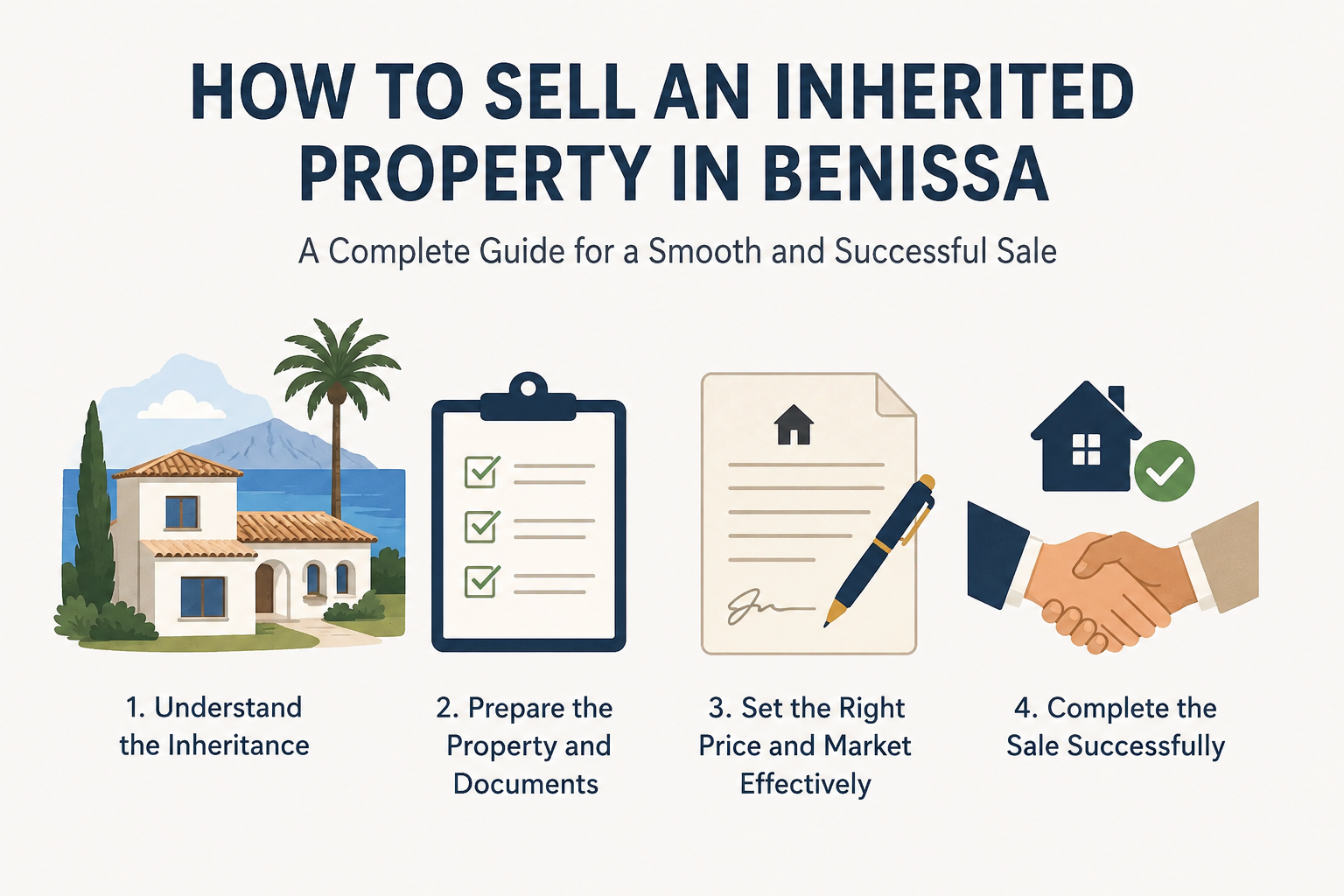
Selling Inherited Property in Benissa: The Complete Guide for Heirs and Property Owners
Inheriting a property is often an emotional experience. Alongside the loss of a loved one, heirs are suddenly faced with legal paperwork, tax obligations and important financial decisions. If the inherited property is located in Spain, the process can seem even more complicated, particularly for families living abroad.
Whether you have inherited a contemporary villa overlooking the Mediterranean, a traditional finca in the Benissa countryside or a holiday apartment near La Fustera, selling an inherited property involves additional legal steps that do not apply to a standard property sale.
Many owners ask questions such as:
- Can I sell an inherited property immediately?
- Do I have to accept the inheritance first?
- What taxes will I have to pay?
- What happens if several heirs inherit the property?
- How long does the entire process take?
- Can everything be handled without travelling to Spain?
The good news is that, with the right preparation and professional guidance, selling inherited property in Benissa can be a straightforward process.
At Telio Homes, we regularly assist local and international families selling inherited homes throughout Benissa, Benissa Costa, La Fustera, San Jaime, Fanadix, Buenavista, Pedramala and Benimarco. Having worked with buyers, sellers, lawyers, notaries and tax advisers across the Costa Blanca North, we understand the practical challenges that arise and how they can be resolved before they delay a sale.
This guide explains every stage of the process—from obtaining the first legal documents to handing over the keys on completion day. Along the way, you'll find practical advice, real-life examples, expert tips and checklists to help you make informed decisions with confidence.
Expert Tip
Every inheritance is different. Spanish inheritance law, taxation and property regulations may change over time, and individual circumstances can vary significantly. This guide provides general information and should not replace personalised advice from a qualified Spanish lawyer or tax adviser.
Quick Answer
Can you sell inherited property in Benissa?
Yes. However, in most cases the inheritance must first be legally accepted, any required tax formalities completed and ownership correctly registered before the property can be sold. Once these steps have been completed, the sale follows a similar process to any other property transaction in Spain.
Table of Contents
- Can You Sell an Inherited Property in Benissa?
- Step-by-Step Process for Selling an Inherited Property
- Documents Required to Sell an Inherited Property
- Taxes When Selling an Inherited Property in Spain
- Selling an Inherited Property with Multiple Heirs
- How Much Is an Inherited Property Worth?
- Should You Renovate Before Selling?
- Selling Different Types of Inherited Property
- Common Problems When Selling an Inherited Property
- How Long Does It Take to Sell?
- Real-Life Examples from Benissa
- Frequently Asked Questions
- Why Choose Telio Homes?
- Conclusion
Can You Sell an Inherited Property in Benissa?
The simple answer is yes.
However, unlike a standard property sale, inherited property cannot normally be sold immediately after the owner's death. Before ownership can legally pass to a buyer, the heirs generally need to complete several legal and administrative steps.
These usually include:
- Confirming who the legal heirs are.
- Accepting the inheritance.
- Completing any required tax formalities.
- Registering the property in the heirs' names.
- Preparing the property for sale.
Although this may sound daunting, most inheritance transactions progress smoothly when the documentation is organised from the outset.
What Happens When You Inherit Property in Spain?
When someone dies owning property in Spain, ownership does not automatically transfer to the beneficiaries.
Instead, the property forms part of the deceased's estate until the inheritance has been formally dealt with.
The process normally involves:
- obtaining the death certificate
- confirming whether a will exists
- identifying the legal heirs
- signing an inheritance deed
- completing the relevant tax procedures
- updating the Spanish Land Registry
Only once these stages have been completed can the heirs usually transfer ownership to a buyer.
If the deceased owned a holiday villa in Benissa, for example, the legal procedure is broadly similar whether the heirs live in Spain, the United Kingdom, the Netherlands, Belgium, Germany or elsewhere.
What If You Live Abroad?
Many owners of Costa Blanca property are non-residents.
Fortunately, Spanish law allows overseas heirs to inherit and sell Spanish property.
If you live abroad, you may need additional documentation such as:
- certified translations
- apostilled documents where applicable
- proof of identity
- foreign probate documents in some circumstances
Every international estate is different, making specialist legal advice particularly valuable.
Do You Have to Accept the Inheritance Before Selling?
In most situations, yes.
Before the property can normally be sold, the heirs need to become the registered legal owners.
This usually involves signing an Inheritance Deed (Escritura de Aceptación de Herencia) before a Spanish notary.
The deed records:
- who inherits
- each person's ownership share
- the assets included in the inheritance
- formal acceptance of ownership
Without this document, completion of a property sale is unlikely to be possible.
Important
Accepting an inheritance may also involve accepting certain rights and obligations associated with the estate. Before signing any legal documentation, heirs should obtain independent legal advice to understand the implications.
Can You Sell Before the Inheritance Process Is Completed?
In most cases, no.
A buyer expects clear legal ownership before purchasing the property.
While it is perfectly sensible to begin preparing for the sale by:
- arranging a valuation
- gathering documentation
- obtaining legal advice
- planning the marketing strategy
…the actual transfer of ownership usually cannot take place until the inheritance has been completed.
Starting preparations early often reduces delays later.
Who Legally Owns the Property During Probate?
Until the inheritance has been formally accepted, the property generally remains part of the deceased person's estate.
Although the heirs may have legal rights under a will or the applicable succession rules, ownership usually needs to be formalised before the property can be transferred to a purchaser.
Where estates involve assets in several countries, foreign wills or multiple jurisdictions, the legal process can become considerably more complex.
Can You Refuse an Inheritance?
Yes.
In some situations, a beneficiary may decide not to accept an inheritance.
Reasons might include:
- debts associated with the estate
- disagreements between heirs
- personal financial considerations
- tax implications
Because declining an inheritance can have significant legal consequences, professional advice should always be sought beforehand.
Can You Sell an Inherited Property Without Travelling to Spain?
Often, yes.
Many international owners complete the entire sale remotely.
This is commonly achieved by granting a Power of Attorney to a trusted lawyer or representative in Spain.
A Power of Attorney may allow your representative to:
- sign inheritance documents
- obtain certificates
- communicate with public authorities
- complete the property sale
- sign before the notary on your behalf
For overseas owners, this can save considerable time and travel costs.
Expert Tip
If several heirs live in different countries, appointing a single legal representative often simplifies communication and helps avoid unnecessary delays.
Step-by-Step Process for Selling an Inherited Property
Understanding the overall process makes the transaction much less intimidating.
Although every inheritance is unique, most sales follow a broadly similar sequence.
Selling an Inherited Property: Process Overview
| Step | Purpose |
|---|---|
| Obtain death certificate | Starts the legal process |
| Locate the will | Identifies beneficiaries |
| Accept the inheritance | Transfers ownership rights |
| Complete tax formalities | Meets legal obligations |
| Register ownership | Updates Land Registry |
| Prepare the property | Improves marketability |
| Market the property | Finds suitable buyers |
| Accept an offer | Agrees sale terms |
| Complete before the notary | Transfers ownership |
Step 1 – Obtain the Death Certificate
The inheritance process begins with obtaining the official death certificate.
If the death occurred in Spain, this is issued by the Civil Registry.
If the death occurred overseas, additional legalisation or certified translations may be necessary before Spanish authorities can process the inheritance.
Without the death certificate, the remaining legal procedures cannot normally begin.
Step 2 – Locate the Will or Declaration of Heirs
The next step is determining who legally inherits the property.
Where a valid Spanish will exists, the process is often more straightforward.
If no will exists, or if it does not deal with the Spanish property, a Declaration of Heirs may be required.
This legal procedure establishes who inherits under the applicable succession rules.
For international estates, lawyers often need to coordinate documentation from more than one country.
Common Mistake
Many owners assume that a foreign will automatically deals with Spanish property. Depending on the circumstances, additional Spanish legal procedures may still be required.
Step 3 – Accept the Inheritance
Once the heirs have been identified, they formally accept the inheritance before a Spanish notary or through an authorised representative.
The inheritance deed records:
- ownership shares
- inherited assets
- acceptance of the estate
Only after this stage can ownership generally be registered.
Step 4 – Pay Inheritance Tax (Where Applicable)
Inheritance Tax obligations vary depending on several factors, including:
- relationship to the deceased
- residency
- regional legislation
- value of inherited assets
- available allowances
Spanish tax legislation changes periodically.
Professional tax advice should always be obtained before calculating any liability.
Step 5 – Register the Property in the Heirs' Names
Once the inheritance has been completed, ownership is normally updated in the Spanish Land Registry.
This is one of the most important stages because buyers' lawyers almost always verify ownership before exchange and completion.
Any inconsistencies should ideally be resolved before the property is marketed.
Step 6 – Prepare the Property for Sale
Preparing an inherited property properly often increases buyer confidence and can shorten the selling process.
Recommended preparation includes:
- deep cleaning
- garden maintenance
- removing unnecessary personal belongings
- carrying out minor repairs
- checking legal documentation
- arranging professional photography
If the property has been vacant for some time, it should also be inspected for:
- damp
- plumbing leaks
- electrical issues
- pest damage
- pool maintenance
- security concerns
Vacant holiday homes in areas such as Pedramala, Benimarco and La Fustera benefit greatly from regular maintenance while they are on the market.
Vacant Property Checklist
✓ Check insurance remains valid.
✓ Inspect for water leaks.
✓ Maintain the swimming pool.
✓ Keep the garden tidy.
✓ Ventilate the property regularly.
✓ Arrange periodic security inspections.
✓ Collect post.
✓ Ensure utilities remain operational where appropriate.
Step 7 – Market the Property
Successful marketing begins with accurate pricing.
A professional valuation should consider:
- location
- property condition
- legal status
- plot size
- views
- orientation
- buyer demand
- comparable recent sales
Professional marketing usually includes:
- high-quality photography
- detailed floor plans
- multilingual descriptions
- international property portals
- digital advertising
- buyer qualification
Different areas of Benissa appeal to different buyers.
For example:
- La Fustera attracts many international holiday-home buyers.
- San Jaime appeals to golf enthusiasts and second-home owners.
- Benimarco and Pedramala are popular with buyers seeking traditional fincas and countryside living.
A marketing strategy should reflect these differences rather than adopting a one-size-fits-all approach.
Expert Tip
The first few weeks after a property is launched are often the most important. Correct pricing from day one usually generates significantly more interest than reducing the price after several months on the market.
Step 8 – Accept an Offer
The highest offer is not always the best offer.
Before accepting, consider:
- buyer finances
- mortgage approval
- proposed completion date
- conditions attached to the offer
- flexibility
- overall certainty of completing the transaction
An experienced estate agent can help evaluate the overall strength of each offer rather than focusing solely on price.
Step 9 – Completion at the Notary
Completion takes place before a Spanish notary.
During the appointment:
- the purchase deed is signed
- ownership transfers to the buyer
- purchase funds are paid
- keys are handed over
- legal documentation is finalised
Following completion, the buyer registers the property in their own name while the seller completes any remaining post-sale tax or administrative obligations.
Key Takeaways
Selling inherited property in Benissa involves additional legal procedures compared with a standard sale, but careful preparation makes the process considerably easier.
Organising the inheritance early, gathering documentation, obtaining professional legal and tax advice, maintaining the property and choosing an accurate pricing strategy all help minimise delays and maximise buyer confidence.
Documents Required to Sell an Inherited Property
One of the most common reasons inherited property sales are delayed is incomplete documentation. Buyers, lawyers, notaries and mortgage lenders all rely on accurate paperwork to confirm ownership and identify any legal issues before completion.
Gathering the necessary documents before marketing the property not only reduces delays but also demonstrates to prospective buyers that the transaction is well organised.
Expert Tip
Start collecting documents as soon as the inheritance process begins. Waiting until a buyer has been found often results in avoidable delays and can reduce buyer confidence.
Personal Identification
Every seller must provide valid identification.
This will usually include:
- Passport or national identity card
- Spanish NIE (Número de Identificación de Extranjero)
- Proof of address if requested
- Power of Attorney documentation (where applicable)
Where several heirs own the property, identification is normally required from each owner.
Death Certificate
The death certificate officially confirms the owner's death and allows the inheritance process to begin.
If the death occurred outside Spain, additional requirements may include:
- Certified translations
- Apostille certification where applicable
- Supporting probate documentation
Your lawyer can advise which documents are required for your particular circumstances.
Will or Declaration of Heirs
The inheritance process depends largely on whether the deceased left a valid will.
If a Spanish will exists, it normally identifies:
- the beneficiaries
- the executor (where appointed)
- how the estate should be distributed
Where no valid will exists, a Declaration of Heirs may be required to establish who inherits under the applicable succession rules.
Inheritance Deed
The Inheritance Deed (Escritura de Aceptación de Herencia) is one of the most important documents in the entire process.
It confirms:
- acceptance of the inheritance
- ownership percentages
- inherited assets
- distribution between the heirs
Without this deed, ownership generally cannot be registered in the heirs' names.
Land Registry Extract (Nota Simple)
An updated Nota Simple provides essential information about the property.
It typically includes:
- registered ownership
- property description
- plot details
- mortgages
- charges
- easements
- embargoes
Obtaining a recent Nota Simple before listing the property allows any issues to be identified and resolved early.
Title Deed (Escritura)
The original title deed records the legal ownership history of the property.
It is commonly requested by:
- buyers
- lawyers
- notaries
- mortgage lenders
If the original document has been lost, an authorised copy can usually be obtained.
Energy Performance Certificate (EPC)
An Energy Performance Certificate is generally required before residential property is marketed in Spain.
The certificate provides information about:
- energy efficiency
- estimated energy consumption
- environmental performance
Obtaining the EPC before listing helps avoid unnecessary delays.
Latest IBI Receipt
The latest receipt for IBI (Impuesto sobre Bienes Inmuebles) confirms that local property tax payments are up to date.
Buyers often request this document during the conveyancing process.
It also contains useful property reference information.
Utility Documentation
Although often overlooked, recent utility bills can make ownership transfer easier after completion.
Useful documents include:
- Electricity bills
- Water bills
- Gas bills (if applicable)
- Internet contracts (optional)
Keeping these documents readily available helps avoid administrative delays.
Certificate of Community Fees (If Applicable)
For apartments or properties within communities of owners, a certificate confirming community fees have been paid is normally required.
This document is usually provided by the community administrator and reassures buyers that there are no outstanding community debts.
Document Checklist
Before marketing an inherited property, ensure you have:
✓ Valid identification
✓ NIE number
✓ Death certificate
✓ Will or Declaration of Heirs
✓ Signed Inheritance Deed
✓ Updated Nota Simple
✓ Title Deed
✓ Energy Performance Certificate
✓ Latest IBI receipt
✓ Utility documentation
✓ Community certificate (if applicable)
✓ Keys for all buildings and gates
✓ Alarm information (if installed)
✓Swimming pool documentation where relevant
Completing this checklist before listing the property can save considerable time later in the transaction.
Taxes When Selling an Inherited Property in Spain
Taxation is often the area that concerns heirs the most.
Several different taxes may apply during the inheritance process and later when the property is sold.
The exact amount depends on factors including:
- residency
- relationship to the deceased
- value of the inherited assets
- selling price
- regional legislation
- current tax rules
Because Spanish tax legislation changes periodically, this section provides general guidance only.
Always obtain advice from a qualified tax adviser before making financial decisions.
Tax Overview
| Tax | When It May Apply | Professional Advice Recommended |
|---|---|---|
| Inheritance Tax | During the inheritance process | ✓ |
| Capital Gains Tax | When selling the property | ✓ |
| Municipal Plusvalía | Usually on transfer of ownership | ✓ |
| Non-resident reporting | For overseas owners where applicable | ✓ |
Inheritance Tax
Inheritance Tax is generally dealt with before ownership is formally transferred to the heirs.
The amount payable varies according to factors such as:
- relationship to the deceased
- value of inherited assets
- residency
- regional legislation
- available allowances
The rules differ across Spain's autonomous communities and are subject to legislative change.
Capital Gains Tax
Capital Gains Tax may arise when an inherited property is sold.
Broadly speaking, the calculation considers the difference between the property's acquisition value for tax purposes and its eventual selling price, taking into account the applicable legislation and any allowable adjustments.
Whether tax is payable depends entirely on the individual circumstances.
Professional tax advice is essential before calculating any liability.
Municipal Plusvalía Tax
Municipal Plusvalía is a local tax associated with changes in the value of urban land.
Recent legislative changes have altered how this tax is calculated in some situations.
As every property differs, specialist advice should be obtained before assuming any liability.
Non-Resident Tax Considerations
Many inherited properties in Benissa belong to owners living overseas.
If you are not tax resident in Spain, additional obligations may apply.
These may include:
- tax reporting
- withholding requirements
- appointing a tax representative in certain situations
- post-sale tax declarations
Non-resident taxation can be complex, particularly where more than one country is involved.
How Is an Inherited Property Valued for Tax Purposes?
The valuation used during the inheritance process is not necessarily the same as the property's market value.
Different valuations may exist for different purposes.
For example:
| Type of Value | Main Purpose |
|---|---|
| Market Value | Determining an asking price |
| Inheritance Value | Estate administration |
| Tax Value | Certain tax calculations |
| Mortgage Valuation | Lending purposes |
These figures should not automatically be used interchangeably.
Tax Planning Tips Before Selling
Careful preparation can reduce unnecessary complications.
Before placing the property on the market:
- obtain professional tax advice
- understand likely tax obligations
- keep invoices relating to the property
- retain records of improvements where relevant
- avoid relying on outdated online information
Warning
Every inheritance is different. Advice given to friends or family members may not apply to your own circumstances.
Selling an Inherited Property with Multiple Heirs
Many inherited properties pass to more than one beneficiary.
Examples include:
- brothers and sisters inheriting a family villa
- children inheriting their parents' holiday apartment
- several relatives inheriting a traditional finca
While joint ownership is common, it often introduces additional practical challenges.
When All Heirs Agree
If everyone agrees to sell, the process is usually straightforward.
The heirs can jointly:
- appoint an estate agent
- agree on a pricing strategy
- instruct a lawyer
- prepare the property
- negotiate offers
- complete the sale
Open communication generally leads to a faster and smoother transaction.
What Happens if One Heir Refuses to Sell?
Disagreements are not uncommon.
One heir may wish to:
- keep the property
- rent it
- delay the sale
- wait for higher prices
The available legal options depend on the ownership structure and the circumstances of the inheritance.
Independent legal advice is essential where agreement cannot be reached.
Can One Heir Buy Out the Others?
Yes.
Instead of selling to an outside buyer, one beneficiary may purchase the shares owned by the other heirs.
Advantages include:
- keeping the property within the family
- avoiding an open-market sale
- simplifying ownership
- reducing uncertainty
An independent market valuation helps ensure that all parties are treated fairly.
Resolving Family Disputes
Inheritance disagreements often arise from emotions rather than legal issues.
Common causes include:
- sentimental attachment
- differing financial needs
- disagreements over value
- uncertainty about future plans
Where possible, families should consider:
- mediation
- independent valuation
- legal advice
- negotiated buy-outs
- clear communication
Court proceedings are generally regarded as a last resort due to the additional cost, uncertainty and time involved.
Expert Tip
In our experience, obtaining an independent valuation early in the process often helps families reach agreement more quickly because discussions are based on current market evidence rather than personal expectations.
Responsibilities During an Inherited Property Sale
| Task | Heirs | Lawyer | Estate Agent |
|---|---|---|---|
| Accept inheritance | ✓ | Assist | — |
| Register ownership | — | ✓ | — |
| Prepare documentation | ✓ | ✓ | — |
| Property valuation | — | — | ✓ |
| Marketing | — | — | ✓ |
| Negotiating offers | ✓ | Advise | ✓ |
| Completion | ✓ | ✓ | Assist |
How Much Is an Inherited Property Worth?
One of the first questions heirs ask is:
"What is the property actually worth?"
Determining an accurate market value is one of the most important decisions you'll make. Price the property too high and it may remain on the market for months, eventually requiring price reductions. Price it too low and you risk achieving less than its true market value.
A professional valuation should always be based on objective market evidence rather than emotional attachment or outdated price expectations.
Professional Valuation
An experienced local estate agent will assess a wide range of factors before recommending an asking price.
These typically include:
- Location
- Property type
- Plot size
- Built area
- Orientation
- Views
- Privacy
- Condition
- Quality of construction
- Energy efficiency
- Swimming pool
- Outdoor living space
- Parking
- Legal documentation
- Comparable recent sales
- Current buyer demand
In Benissa, even two similar villas can differ significantly in value because of factors such as sea views, privacy, accessibility or proximity to beaches and amenities.
Unlike automated online valuation tools, a local valuation also considers buyer behaviour and current demand.
Expert Tip
Request a valuation from an estate agent who regularly sells properties in Benissa rather than relying solely on national valuation websites. Local knowledge often makes a significant difference.
Market Value Versus Tax Value
Many heirs are surprised to discover that different values may exist for the same property.
| Type of Value | Purpose |
|---|---|
| Market Value | Estimated selling price in today's market |
| Inheritance Value | Used during the inheritance process |
| Tax Value | Used for certain tax calculations |
| Insurance Value | Used for rebuilding insurance |
| Mortgage Valuation | Used by lenders |
These values are calculated for different purposes and should not automatically be treated as interchangeable.
Current Benissa Market Trends
Property values are influenced by changing market conditions.
Factors currently affecting demand include:
- International buyer confidence
- Interest rates
- Supply of similar homes
- Seasonal demand
- Property condition
- Energy efficiency
- Lifestyle preferences
Demand also varies considerably between different parts of Benissa.
For example:
La Fustera
Popular with international buyers seeking holiday homes close to the beach.
San Jaime
Appeals to buyers looking for villas near golf courses and established residential areas.
Benissa Costa
Strong demand for villas with sea views and modern outdoor living areas.
Pedramala
Attracts buyers seeking countryside properties with privacy and panoramic views.
Benimarco
Particularly popular with purchasers looking for traditional fincas and larger plots.
Each micro-location attracts different buyer profiles, making local market knowledge essential when pricing a property.
Common Valuation Mistakes
Avoiding the following mistakes can save considerable time and money.
Emotional Pricing
Family memories naturally influence expectations, but buyers base their decisions on current market conditions.
Comparing Asking Prices Instead of Selling Prices
Online asking prices do not necessarily reflect the final agreed sale price.
Ignoring Legal Issues
Missing documentation, planning irregularities or unregistered alterations can affect both value and buyer confidence.
Overestimating Renovation Value
Not every improvement adds value.
Some renovations cost more than buyers are willing to pay for them.
Relying Solely on Automated Valuations
Online tools cannot assess:
- views
- privacy
- presentation
- quality of finishes
- buyer demand
- local market nuances
These factors often have a significant influence on value.
Property Valuation Checklist
Before deciding on an asking price, consider:
✓ Current market conditions
✓ Comparable sales
✓ Property condition
✓ Legal documentation
✓ Energy efficiency
✓ Outdoor areas
✓ Renovation requirements
✓ Buyer demand
✓ Professional valuation
Should You Renovate Before Selling?
Many heirs ask whether they should renovate an inherited property before placing it on the market.
The answer depends on the property's condition, target buyers and expected return on investment.
Major refurbishment is not always necessary.
In many cases, careful presentation provides a better return than expensive renovations.
When Renovations Increase Value
Renovations are most worthwhile when they improve the property's overall appeal without excessive cost.
Examples include:
- Modernising bathrooms
- Updating kitchens
- Interior painting
- Replacing damaged flooring
- Improving lighting
- Repairing visible defects
- Refreshing outdoor areas
These improvements can make the property more attractive to owner-occupiers looking for a move-in-ready home.
When Selling As-Is Makes More Sense
Selling without major renovation may be the better choice when:
- extensive structural work is required
- planning permission may be needed
- the heirs want a faster sale
- the property appeals to developers or investors
- renovation costs are unlikely to be recovered
Traditional fincas around Pedramala and Benimarco often attract buyers specifically looking for renovation opportunities.
Low-Cost Improvements with High Returns
Some of the most effective improvements require relatively modest investment.
Examples include:
- Professional cleaning
- Pressure washing terraces
- Garden maintenance
- Decluttering
- Neutral interior paint
- Replacing broken fittings
- Cleaning windows
- Professional photography
These improvements often increase buyer interest far more than expected.
Preparing a Vacant Inherited Home
Many inherited homes remain unoccupied while legal formalities are completed.
Vacant properties require regular attention.
Consider:
- checking for leaks
- maintaining the pool
- ventilating rooms
- inspecting for damp
- maintaining gardens
- arranging security inspections
- collecting post
- ensuring insurance remains valid
An empty property that appears neglected can discourage buyers before they even enter the house.
Did You Know?
First impressions are often formed within the first few minutes of a viewing. A clean entrance, tidy garden and well-maintained outdoor areas can significantly improve buyer perception.
Selling Different Types of Inherited Property
Each property type attracts different buyers and requires a tailored marketing strategy.
H3: Inherited Villas
Detached villas remain the most popular property type in Benissa.
Buyers typically look for:
- Swimming pool
- Outdoor entertaining areas
- Privacy
- Sea or countryside views
- Parking
- Modern kitchens
- Energy efficiency
Professional photography is particularly important because many buyers begin their search online.
Inherited Fincas
Traditional fincas often require additional due diligence.
Prospective purchasers may ask about:
- Water supply
- Septic systems
- Access roads
- Rustic land regulations
- Agricultural buildings
- Building legality
- Renovation potential
Providing accurate information early helps avoid unnecessary delays.
Inherited Apartments
Apartment buyers commonly focus on:
- Community fees
- Lift access
- Parking
- Walking distance to amenities
- Terrace space
- Holiday home suitability
- Energy efficiency
Community documentation should be readily available before marketing begins.
Inherited Building Plots
Plots are marketed differently from completed homes.
Potential purchasers often investigate:
- Planning classification
- Building potential
- Utilities
- Access
- Orientation
- Topography
- Building restrictions
Preparing planning information in advance increases buyer confidence.
Comparison of Property Types
| Property Type | Typical Buyer Priorities |
|---|---|
| Villa | Lifestyle, pool, views, privacy |
| Finca | Land, character, legality, water supply |
| Apartment | Location, amenities, community |
| Building Plot | Planning potential, access, utilities |
Common Problems When Selling an Inherited Property
Identifying problems early usually makes the selling process considerably smoother.
Missing Documentation
Missing paperwork is one of the most frequent causes of delay.
Examples include:
- Lost title deeds
- Missing building plans
- Missing occupancy documentation
- Historic planning records
Fortunately, many documents can be replaced through the relevant authorities.
Unregistered Extensions
Older homes sometimes contain alterations that have not been properly recorded.
Examples include:
- Enclosed terraces
- Additional bedrooms
- Garage conversions
- Swimming pools
- Storage buildings
These should be investigated before marketing the property.
Outstanding Mortgages
An inherited property may still have an outstanding mortgage.
This does not necessarily prevent a sale.
However, arrangements normally need to be made for the mortgage to be redeemed or otherwise dealt with during completion.
Illegal Building Work
Some rural properties include structures that do not fully correspond with the available records.
Examples include:
- Guest accommodation
- Extensions
- Outbuildings
- Enlarged terraces
Being transparent about these issues from the outset usually builds trust with buyers and helps avoid problems later in the transaction.
Outstanding Taxes
Before selling, check whether any property-related payments remain outstanding.
These may include:
- IBI
- Community fees
- Utility balances
Providing evidence that payments are up to date reassures buyers.
Property Occupied by Relatives or Tenants
Where someone continues to occupy the property after the owner's death, clarify:
- their legal status
- any tenancy agreements
- intended date of vacant possession
This information is essential for prospective purchasers.
Holiday Rental Bookings
Many inherited villas have existing holiday rental reservations.
Before selling, consider:
- whether bookings will be honoured
- how deposits will be handled
- management agreements
- obligations to guests
Clarifying these matters before marketing avoids misunderstandings with buyers.
Common Delays and How to Reduce Them
| Issue | Potential Impact | Recommended Action |
|---|---|---|
| Missing documents | Delays legal checks | Gather paperwork early |
| Family disagreements | Delays decisions | Agree strategy early |
| Incorrect pricing | Longer time on market | Obtain professional valuation |
| Unregistered alterations | Additional legal work | Investigate before listing |
| Poor presentation | Reduced buyer interest | Prepare the property properly |
| Outstanding payments | Buyer concerns | Settle balances where appropriate |
How Long Does It Take to Sell an Inherited Property?
Every inheritance is different, so there is no standard timetable.
However, understanding the process helps set realistic expectations.
Typical Stages
| Stage | Timescale* |
|---|---|
| Inheritance process | Varies depending on the estate |
| Registration of ownership | Varies |
| Preparing the property | Days to several weeks |
| Marketing | Depends on pricing and market demand |
| Conveyancing | Commonly several weeks |
*Actual timescales depend on legal complexity, documentation, buyer circumstances and administrative processing.
Factors That Can Delay a Sale
The most common causes include:
- incomplete inheritance documentation
- disagreements between heirs
- unrealistic pricing
- legal irregularities
- missing certificates
- buyer mortgage approval
- administrative processing times
Preparing thoroughly before listing significantly reduces the likelihood of avoidable delays.
Expert Tip
In our experience, documentation issues—not a lack of buyers—are one of the most common reasons inherited property sales take longer than expected. Resolving paperwork before marketing usually results in a smoother transaction.
Real-Life Examples from Benissa
Every inherited property is different, but many of the challenges encountered by families in Benissa follow similar patterns. The examples below are based on common situations experienced in the local property market. They have been anonymised and simplified to illustrate how preparation and professional guidance can help avoid delays.
Example 1 – Dutch Family Selling a Villa in La Fustera
A Dutch family inherited a detached villa in La Fustera that had been used as a holiday home for more than twenty years.
The property was well maintained but had remained empty for several months while the inheritance was being organised.
Before marketing the property, the family:
- completed the inheritance formalities
- updated the Land Registry
- obtained a new Energy Performance Certificate
- arranged professional photography
- refreshed the garden and pool area
Because everything was prepared before the property went on the market, the transaction progressed smoothly once a buyer was found.
Key lesson: Completing the legal and administrative work before listing often shortens the overall selling process.
Example 2 – British Owners Inheriting a Holiday Apartment
Two British siblings inherited an apartment close to Benissa Costa.
Initially, they planned an extensive refurbishment before selling. However, after obtaining a professional valuation, they decided that a modest cosmetic refresh would provide a better return.
They focused on:
- repainting throughout
- replacing dated lighting
- deep cleaning
- removing personal belongings
- updating the terrace furniture
The apartment attracted strong interest from buyers looking for a holiday home and sold without major renovation.
Key lesson: Expensive improvements are not always necessary. Presentation often matters more than complete modernisation.
Example 3 – Three Siblings Selling a Traditional Finca
Three siblings inherited a finca in Benimarco with mature gardens and a large plot.
The main challenge was not finding a buyer—it was agreeing on the asking price.
One sibling wanted to renovate.
Another wanted a quick sale.
The third believed the property was worth significantly more than similar homes.
An independent valuation based on current market evidence allowed the family to agree on a realistic pricing strategy.
The property was marketed to buyers specifically looking for traditional countryside homes and attracted strong interest.
Key lesson: Independent valuations help remove emotion from pricing decisions.
Example 4 – Resolving Documentation Before Listing
An inherited villa near Pedramala contained an enclosed terrace that was not reflected in the available property records.
Rather than marketing immediately, the heirs asked their lawyer to investigate the documentation first.
Although this delayed the launch slightly, it prevented difficult negotiations later when the buyer's lawyer carried out legal checks.
Key lesson: Resolving documentation issues early usually saves much more time later.
Frequently Asked Questions
Can I sell inherited property immediately?
In most cases, no. The inheritance usually needs to be accepted, the required legal formalities completed and ownership registered before the property can be sold.
Do all heirs have to agree to sell?
Where several people inherit the property jointly, agreement is often needed before a sale can proceed. If disagreements arise, legal advice should be obtained.
How long does the inheritance process take?
There is no standard timescale. It depends on factors such as the availability of documentation, the complexity of the estate and whether all heirs cooperate.
Can foreigners inherit Spanish property?
Yes. Foreign nationals can inherit property in Spain, although additional documentation and tax obligations may apply.
Can I inherit property if there is no Spanish will?
Possibly. If there is no valid Spanish will, the inheritance will usually follow the applicable succession rules. A Declaration of Heirs may be required.
Can I refuse an inheritance?
Yes. Depending on the circumstances, beneficiaries may be able to decline an inheritance. Independent legal advice should always be sought before making this decision.
Can I inherit debts as well as property?
Some inheritances may include obligations as well as assets. Before accepting an inheritance, you should obtain legal advice to understand the implications.
Can I sell using a Power of Attorney?
Yes, in many situations overseas owners appoint a trusted lawyer or representative to deal with the inheritance and sale on their behalf.
Do I need to travel to Spain?
Not always. Depending on your circumstances, much of the process may be handled remotely through a properly prepared Power of Attorney.
What taxes might apply?
Depending on your individual circumstances, taxes may include Inheritance Tax, Capital Gains Tax and Municipal Plusvalía. Tax legislation changes over time, so professional advice is recommended.
Do I need a Spanish lawyer?
Although not always legally required, using an experienced independent Spanish lawyer is highly recommended when dealing with inherited property.
What happens if the property still has a mortgage?
An outstanding mortgage does not automatically prevent a sale. It normally needs to be redeemed or otherwise dealt with during completion.
Should I renovate before selling?
Only if the likely increase in value outweighs the cost, time and disruption involved. Many inherited properties sell successfully with only cosmetic improvements.
What documents are required?
Typical documents include identification, the death certificate, inheritance deed, title deed, Nota Simple, Energy Performance Certificate and the latest IBI receipt. Additional documentation may be required depending on the property.
Can an inherited property be rented before it is sold?
It may be possible, but legal, tax and practical implications should be considered first. Existing rental agreements should also be disclosed to prospective buyers.
Can I remove furniture before selling?
Yes. In fact, removing excess furniture and personal belongings often improves presentation. However, discuss this with your estate agent before emptying the property completely.
What happens if important documentation is missing?
Many missing documents can be replaced or obtained from the relevant authorities. It is usually better to investigate these issues before the property is marketed.
How much are estate agency fees?
Fees vary depending on the services provided and the agreement between the seller and the estate agent. Ensure you understand exactly what is included before signing a listing agreement.
Can Telio Homes provide a valuation?
Yes. Telio Homes offers professional market appraisals based on local knowledge, comparable sales and current buyer demand throughout Benissa and the surrounding Costa Blanca North.
What happens on completion day?
Completion normally takes place before a Spanish notary, where the purchase deed is signed, ownership transfers to the buyer and the agreed purchase funds are paid.
Why Choose Telio Homes to Sell Your Inherited Property in Benissa?
Selling an inherited property requires far more than advertising it online.
It often involves coordinating with lawyers, notaries, tax advisers and multiple family members while keeping buyers informed throughout the transaction.
At Telio Homes, we specialise exclusively in Benissa and the Costa Blanca North, giving us detailed knowledge of the local market and the different buyer profiles attracted to each area.
Local Market Expertise
We understand the differences between selling property in:
- Benissa Costa
- La Fustera
- San Jaime
- Fanadix
- Buenavista
- Pedramala
- Benimarco
Each location attracts different buyers and benefits from a tailored pricing and marketing strategy.
Accurate Property Valuations
Every valuation is based on:
- current market conditions
- comparable local sales
- buyer demand
- property condition
- legal status
- presentation
- current competition
The aim is to achieve the strongest possible price while remaining competitive in the market.
International Buyer Network
Benissa continues to attract buyers from across Europe.
Our marketing reaches both Spanish and international purchasers, helping maximise exposure for every property we represent.
Professional Marketing
Effective marketing is about much more than listing a property online.
Our approach includes:
- professional photography
- detailed property descriptions
- multilingual marketing
- buyer qualification
- accompanied viewings
- regular seller feedback
- strategic pricing reviews where appropriate
Support Throughout the Legal Process
While legal advice should always come from an independent qualified professional, we work closely with experienced lawyers, notaries and tax advisers to help ensure the transaction progresses as smoothly as possible.
Clear communication between all parties often prevents unnecessary delays.
Working Alongside Lawyers and Tax Advisers
Inheritance sales often involve several professionals working together.
By coordinating with your chosen advisers, we help keep the transaction organised while allowing each specialist to focus on their area of expertise.
Conclusion
Selling inherited property in Benissa is rarely as simple as a conventional property sale, but with careful preparation it does not need to be overwhelming.
By completing the inheritance process correctly, gathering the necessary documentation, understanding the potential tax implications and obtaining an accurate market valuation, you can significantly reduce delays and improve your chances of achieving the best possible outcome.
Whether you have inherited a villa in La Fustera, a traditional finca in Benimarco, an apartment in Benissa Costa or a building plot elsewhere in the municipality, every successful sale begins with good preparation and informed decision-making.
Because inheritance law, taxation and property regulations may change, and every family's circumstances are different, always seek advice from qualified legal and tax professionals before making important decisions.
At Telio Homes, we are committed to helping property owners navigate the Benissa property market with honest advice, local expertise and professional support from the initial valuation through to completion.