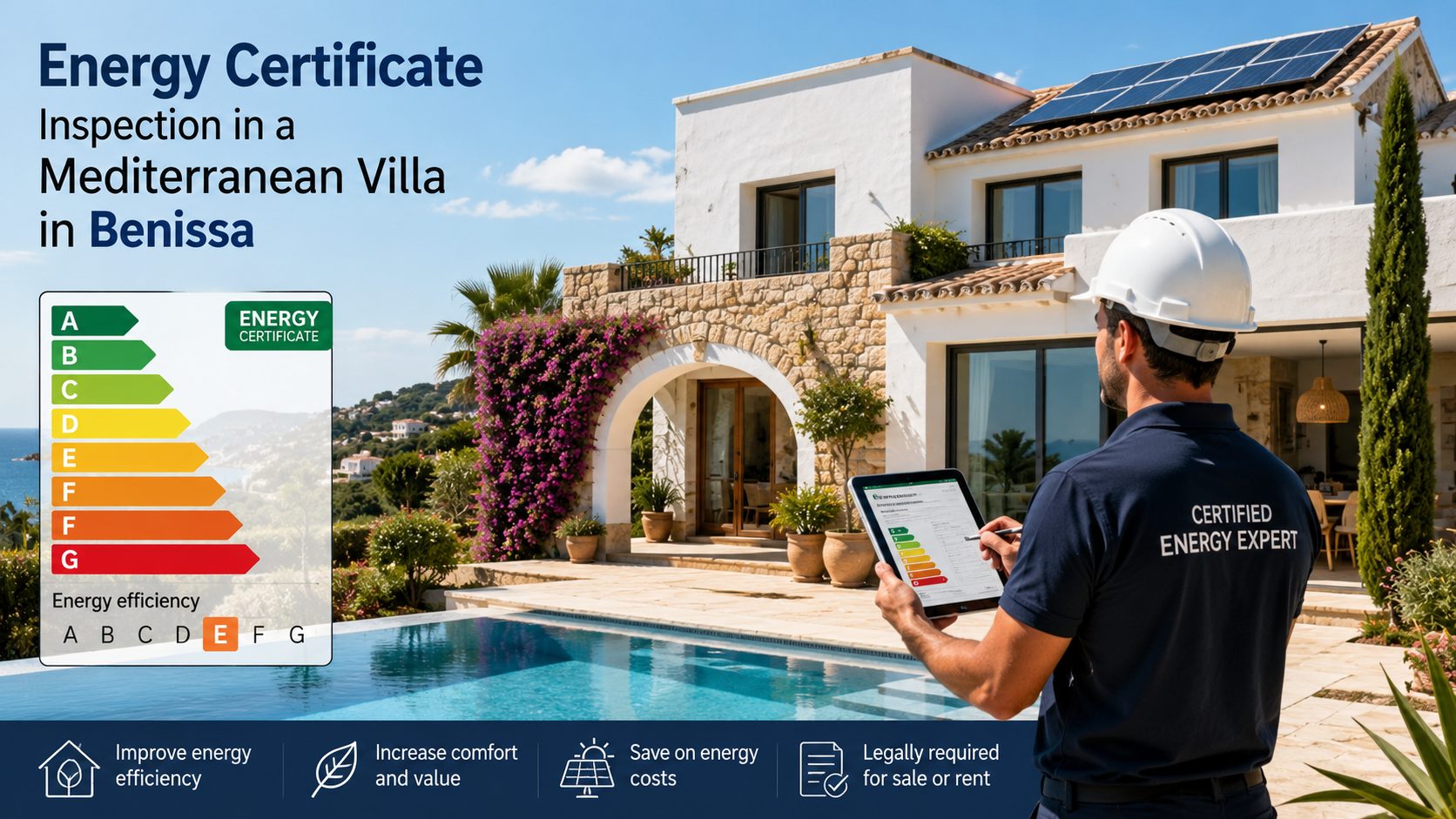
Energy Certificate Issues in Benissa: Complete Guide for Property Owners
If you are planning to sell or rent a property in Benissa, obtaining a valid Energy Certificate Benissa should be one of the first items on your checklist. Although the process is generally straightforward, leaving it until the last minute can delay your property sale, postpone marketing and create unnecessary stress.
Whether you own a modern villa in La Fustera, a traditional finca in Benimarco, an apartment in Benissa Costa, or a luxury home in San Jaime, understanding how the Spanish energy certification system works will help you prepare your property correctly and avoid avoidable delays.
An Energy Certificate, officially known in Spain as the Certificado de Eficiencia Energética (CEE), measures the energy efficiency of a property and assigns it a rating from A (most efficient) to G (least efficient). It provides prospective buyers and tenants with standardised information about the building's estimated energy consumption and carbon emissions.
For many international owners, the process can seem confusing, particularly when combined with other Spanish property documentation such as the Certificate of Habitability, the Land Registry and the Catastro. However, with the right preparation, obtaining an Energy Certificate is usually one of the simplest administrative steps involved in selling a property.
This comprehensive guide explains everything property owners need to know, including:
- What an Energy Certificate is
- When it is legally required in Spain
- How to obtain one in Benissa
- Typical costs and validity periods
- Common issues affecting villas and fincas on the Costa Blanca North
- Practical ways to improve your property's energy rating
- How Energy Certificates fit into the wider selling process
Whether you are preparing to sell now or simply planning ahead, this guide is designed to help you understand the process with confidence.
Table of Contents
- What Is an Energy Certificate?
- Is an Energy Certificate Mandatory in Spain?
- When Do You Need an Energy Certificate in Benissa?
- How to Obtain an Energy Certificate in Benissa
- What Does the Inspector Check?
- Documents You'll Need
- How Much Does an Energy Certificate Cost in Benissa?
- How Long Is an Energy Certificate Valid?
- Common Energy Certificate Issues in Benissa
- Can You Sell a Property Without an Energy Certificate?
- How to Improve Your Energy Rating
- Does an Energy Rating Affect Property Value?
- Energy Certificates and Other Property Documents
- How Telio Homes Helps Property Owners
- Frequently Asked Questions
- Conclusion
What Is an Energy Certificate?
Definition of an Energy Certificate (CEE)
Quick Answer
An Energy Certificate (Certificado de Eficiencia Energética or CEE) is an official document that evaluates the energy efficiency of a property. It estimates how much energy is required for heating, cooling, ventilation and hot water under standard conditions and assigns the property an energy rating from A to G.
Unlike a structural survey, an Energy Certificate does not assess the building's condition or identify defects. Instead, it focuses exclusively on energy performance and includes recommendations that could improve efficiency.
A typical Energy Certificate contains:
- Energy efficiency rating (A–G)
- Estimated annual energy consumption
- Estimated carbon dioxide (CO₂) emissions
- Description of construction materials
- Details of heating, cooling and hot water systems
- Recommendations for improving efficiency
The purpose of the certificate is to provide buyers and tenants with objective information that allows them to compare properties more easily.
What Does the Energy Rating (A–G) Mean?
The certificate assigns every property a rating between A and G.
| Rating | Meaning | Typical Characteristics |
|---|---|---|
| A | Excellent | Modern construction, high insulation, renewable energy systems |
| B | Very Good | Efficient heating and cooling with good insulation |
| C | Good | Above-average energy performance |
| D | Average | Typical of many well-maintained homes |
| E | Below Average | Older construction with limited insulation |
| F | Poor | Significant heat loss and older installations |
| G | Very Poor | High energy consumption and outdated systems |
It is important to understand that a lower rating does not necessarily make a property undesirable.
Many sought-after villas and fincas throughout Benissa receive relatively modest ratings simply because they were constructed decades before today's energy efficiency standards.
Expert Tip
Buyers choosing a holiday home in Benissa often prioritise location, sea views, privacy and outdoor living over the Energy Certificate rating. Nevertheless, presenting a valid certificate and demonstrating energy improvements can increase buyer confidence.
Why Energy Certificates Exist
Energy Certificates were introduced as part of wider European initiatives to improve transparency in the property market and encourage more energy-efficient buildings.
Their main objectives are to:
- Help buyers compare properties objectively.
- Encourage improvements to existing housing.
- Reduce energy consumption.
- Lower carbon emissions.
- Promote more sustainable buildings.
The certificate also provides recommendations for improving efficiency.
These recommendations are advisory. Property owners are generally not obliged to carry out the suggested improvements simply because they appear in the report.
Is an Energy Certificate the Same as an EPC?
Essentially, yes.
In the United Kingdom, the equivalent document is called an Energy Performance Certificate (EPC).
In Spain, the official name is Certificado de Eficiencia Energética (CEE).
Although both documents have the same objective—measuring the energy efficiency of a property—they are issued under different legislation and follow different administrative procedures.
A UK EPC cannot be used for a property in Spain.
Is an Energy Certificate Mandatory in Spain?
Current Spanish Legislation
Spanish legislation implementing the European Union's Energy Performance of Buildings framework requires Energy Certificates for many residential property transactions.
The legislation and administrative procedures may change over time, so property owners should always rely on the latest official guidance or seek advice from a qualified technician or legal adviser.
For most owners in Benissa, the practical position is straightforward:
If you intend to sell or market your property for a long-term residential rental, you will generally require a valid Energy Certificate.
When It Is Legally Required
An Energy Certificate is typically required when:
- Selling a residential property.
- Advertising a property for sale.
- Offering a property for long-term residential rental.
- Completing a newly constructed residential building.
Professional estate agents usually request the certificate before or shortly after marketing begins.
Obtaining it early helps avoid unnecessary delays later in the transaction.
Important
Many sellers assume the Energy Certificate is only required shortly before completion. In practice, arranging it before professional photography and marketing begins is usually the most efficient approach.
Properties Exempt from the Requirement
Certain buildings may be exempt under current legislation.
Examples may include:
- Some industrial buildings.
- Certain agricultural buildings with limited residential use.
- Temporary buildings.
- Buildings intended for demolition in specific circumstances.
- Certain places of worship.
Whether an exemption applies depends entirely on the property's circumstances and the legislation in force at the time.
Professional advice should always be obtained before assuming an exemption exists.
Penalties for Not Having a Valid Certificate
Spanish legislation allows for administrative penalties where Energy Certificate requirements are not met.
The severity of any sanction depends on the nature of the breach and the legislation in force at the time.
Rather than focusing on potential fines, the practical advice is simple:
Obtaining the certificate before marketing your property is considerably easier, less stressful and usually less expensive than resolving compliance issues later.
Common Mistake
Waiting until a buyer has been found before arranging an Energy Certificate can delay the sale unnecessarily, especially during busy periods when qualified technicians have limited availability.
When Do You Need an Energy Certificate in Benissa?
Although the legislation applies throughout Spain, owners in Benissa most commonly require an Energy Certificate in the following situations.
Selling a Property
For the majority of residential sales, a valid Energy Certificate is required.
This applies whether you are selling:
- A detached villa in San Jaime.
- A holiday apartment in Benissa Costa.
- A luxury villa in La Fustera.
- A countryside finca in Pedramala.
- A townhouse in Benissa's historic centre.
Preparing the certificate before your property goes on the market allows buyers to review the documentation from the outset and helps reduce avoidable delays during the conveyancing process.
Seller's Pre-Marketing Checklist
- ✓ Valid Energy Certificate
- ✓ Certificate of Habitability (where applicable)
- ✓ Latest IBI receipt
- ✓ Nota Simple
- ✓ Cadastral Reference
- ✓ Identification documents
- ✓ Community information (if applicable)
- ✓ Copies of any documentation relating to significant renovations
Buying a Property
Although buyers do not arrange the Energy Certificate themselves, reviewing it carefully provides useful information about:
- Estimated energy efficiency.
- Heating and cooling systems.
- Insulation quality.
- Potential future running costs.
- Possible improvement opportunities.
For international buyers unfamiliar with Spanish construction methods, the certificate offers another useful point of comparison between properties.
Long-Term Rentals
Properties offered for long-term residential rental generally require a valid Energy Certificate before being marketed.
Landlords should check the latest requirements before advertising the property.
Holiday Rentals
Holiday rentals may be subject to different regulatory requirements from long-term residential rentals.
Because the legislation in this area can change, owners should confirm the current requirements with a qualified adviser before advertising tourist accommodation.
New-Build Properties
Newly constructed homes are also subject to energy performance requirements.
The developer normally arranges the necessary certification as part of the completion process, and buyers usually receive the relevant documentation when purchasing the property.
How to Obtain an Energy Certificate in Benissa
Obtaining an Energy Certificate is usually a straightforward process, especially if you prepare the necessary documentation in advance. For most homeowners in Benissa, the process can be completed within a few days, although the exact timeframe depends on the availability of the technician and the registration process with the Valencian authorities.
Whether your property is located in Benissa Costa, La Fustera, San Jaime, Fanadix, Buenavista, Benimarco or Pedramala, the certification procedure is essentially the same.
Quick Summary
| Step | What Happens |
|---|---|
| 1 | Contact a qualified energy technician |
| 2 | Property inspection |
| 3 | Energy assessment and calculation |
| 4 | Registration with the Valencian authorities |
| 5 | Receive the official Energy Certificate |
Step 1 – Contact a Qualified Energy Technician
Only a qualified and authorised technician may issue an official Energy Certificate in Spain.
Depending on current regulations, this typically includes certain architects, technical architects, building engineers and other professionals authorised to carry out energy assessments.
When choosing a technician, consider:
- Experience with residential properties.
- Familiarity with villas and fincas in the Marina Alta.
- Transparent pricing.
- Whether registration is included in the quotation.
- Estimated turnaround time.
- Local reputation and reviews.
If you are already working with an estate agent, they can often recommend trusted local professionals and coordinate the appointment on your behalf.
Expert Tip
Arrange the inspection as soon as you decide to sell. During the spring and summer selling season, qualified technicians often become fully booked.
Step 2 – Property Inspection
The technician will visit your property to collect all the information needed for the assessment.
Most inspections take between 30 minutes and two hours, depending on:
- Property size.
- Number of floors.
- Complexity of the layout.
- Accessibility.
- Number of separate buildings.
The inspection is non-invasive.
The technician will not remove finishes, drill walls or carry out structural investigations. Instead, they visually assess the property's construction and installations before entering the information into approved assessment software.
What Should You Do Before the Inspection?
Preparing the property helps the inspection run smoothly.
Checklist
✓ Ensure all rooms are accessible.
✓ Unlock garages and storage rooms.
✓ Make roof access available if possible.
✓ Locate documentation relating to solar panels or heating systems.
✓ Have previous plans available if you have them.
✓ Provide any previous Energy Certificate.
Step 3 – Energy Assessment
After the inspection, the technician analyses the collected information using approved software.
The assessment considers numerous factors, including:
- Building orientation.
- Construction materials.
- Insulation levels.
- Windows and glazing.
- Heating systems.
- Air conditioning.
- Domestic hot water production.
- Ventilation.
- Renewable energy installations.
The software calculates:
- Estimated annual energy consumption.
- Estimated CO₂ emissions.
- Overall Energy Rating (A–G).
The report also contains recommendations that may improve the property's energy performance.
These recommendations are informative only—they are not legal obligations. Official guidance explains that the certificate includes recommendations for improving efficiency, but owners are not automatically required to implement them.
Step 4 – Registration with the Valencian Authorities
Once completed, the certificate must be registered with the competent authority in the Valencian Community before it becomes the official document used during the sale or rental process.
In most cases, the technician completes this registration on behalf of the owner.
Always confirm whether the registration fee is included in the quotation before instructing the technician.
Important
Not every quotation includes registration costs.
Ask whether the following are included:
- Property inspection
- Preparation of the certificate
- Official registration
- Delivery of the Energy Label
- VAT (where applicable)
Step 5 – Receiving Your Official Certificate
After registration has been completed, you will normally receive:
- The official Energy Certificate.
- The Energy Label showing the A–G rating.
- Registration confirmation.
- Recommendations for improving efficiency.
Store digital and printed copies safely together with your other property documentation.
Your estate agent, lawyer and prospective buyer may all request copies during the transaction.
Typical Timeline
Although every case differs, the process often follows a similar schedule.
| Stage | Typical Time |
|---|---|
| Book inspection | 1–7 days |
| Property inspection | 30 minutes–2 hours |
| Assessment and report | 1–3 working days |
| Registration | Varies depending on processing |
| Certificate issued | Usually within several days of inspection |
Timeframes are indicative only and can vary depending on workload, holidays and administrative processing.
What Does the Inspector Check?
Many owners expect the inspection to resemble a building survey.
It does not.
The technician is assessing energy performance, not structural condition or legal compliance.
Property Size and Layout
The inspection records information including:
- Built area.
- Number of floors.
- Internal layout.
- Orientation.
- Approximate ceiling heights.
South-facing properties may benefit from improved passive solar gain during winter, although many other factors influence the final rating.
Walls, Roof and Insulation
The technician assesses the building envelope, including:
- Wall construction.
- Roof type.
- Insulation.
- Floor construction (where relevant).
Many villas in Benissa built during the 1970s and 1980s were constructed before modern insulation standards.
This often affects their calculated energy performance, even when they have been well maintained.
Windows and Doors
Windows play an important role in thermal efficiency.
The assessment considers:
- Single or double glazing.
- Frame materials.
- Window size.
- Solar protection.
- External shading.
- Air tightness.
Replacing older single-glazed windows with modern double glazing is one of the most common ways to improve a property's energy performance.
Heating Systems
The technician records the type and efficiency of the heating installation.
Examples include:
- Electric radiators.
- Gas boilers.
- Underfloor heating.
- Heat pumps.
- Biomass or pellet stoves.
Air Conditioning
Air conditioning is particularly important on the Costa Blanca.
The inspector notes:
- Split systems.
- Central air conditioning.
- Approximate age.
- Efficiency where known.
Modern inverter systems generally perform more efficiently than older equipment.
Hot Water Systems
Domestic hot water production is also assessed.
Typical systems include:
- Electric boilers.
- Gas boilers.
- Solar thermal systems.
- Heat pump water heaters.
Ventilation
Ventilation affects both comfort and energy efficiency.
The assessment considers the building's ventilation characteristics together with the overall construction.
Traditional Mediterranean homes frequently rely on natural ventilation, while newer properties may incorporate mechanical systems.
Renewable Energy Systems
Renewable energy installations can contribute positively to a property's energy performance.
Examples include:
- Solar photovoltaic panels.
- Solar thermal hot water systems.
- Battery storage (where relevant).
If your property has renewable energy systems, provide the technician with any available documentation.
Did You Know?
The property's energy rating is influenced not only by insulation and windows, but also by the local climate, construction methods, heating and cooling systems, and renewable energy installations.
Documents You'll Need
Preparing the correct documents before the inspection helps avoid unnecessary delays.
Fortunately, only a few items are usually required.
Identification
Provide identification for the registered owner, such as:
- Passport.
- NIE.
- Spanish identity document (if applicable).
Property Address
Ensure you have the complete address, including:
- Street.
- House number.
- Urbanisation.
- Postcode.
Cadastral Reference
The Cadastral Reference is normally requested.
It can usually be found on:
- IBI receipts.
- Property deeds.
- Catastro records.
Existing Floor Plans (If Available)
Although not essential, floor plans may help the technician complete the assessment more efficiently.
Useful documents include:
- Architectural drawings.
- Building plans.
- Accurate sales plans.
Previous Energy Certificate (If Applicable)
If your property has already been certified, provide a copy.
The technician can determine whether:
- The certificate remains valid.
- Renewal is required.
- A new assessment would better reflect improvements made to the property.
Complete Document Checklist
Before booking your inspection, ensure you have:
- ✓ Identification
- ✓ Property address
- ✓ Cadastral Reference
- ✓ Previous Energy Certificate (if applicable)
- ✓ Floor plans (if available)
- ✓ Access to every room
- ✓ Information relating to recent improvements
- ✓ Documentation for solar installations (if applicable)
How Much Does an Energy Certificate Cost in Benissa?
There is no official fixed price for an Energy Certificate.
Fees vary according to the property's size, complexity and the professional carrying out the assessment.
Typical Price Ranges
| Property Type | Typical Market Range* |
|---|---|
| Apartment | €70–€150 |
| Townhouse | €90–€170 |
| Standard villa | €120–€250 |
| Luxury villa | €200–€400+ |
| Large finca | Individual quotation |
*Illustrative market ranges only. Actual fees vary between professionals and properties.
What Affects the Cost?
Pricing is influenced by factors including:
- Total built area.
- Number of separate buildings.
- Accessibility.
- Property complexity.
- Distance travelled.
- Registration costs.
- Urgency.
A traditional finca with several outbuildings generally requires considerably more inspection time than a modern apartment.
Who Pays for the Certificate?
In most residential property sales, the seller arranges and pays for the Energy Certificate.
Rental situations may differ depending on the applicable legislation and circumstances.
Is It Tax Deductible?
Whether the cost is deductible depends on your individual tax position and the purpose of the property.
Because tax legislation changes and varies according to personal circumstances, you should seek advice from a qualified tax adviser before relying on any particular tax treatment.
Warning
The cheapest quotation is not always the best value. An experienced local technician familiar with Benissa's villas, fincas and planning documentation may identify potential issues before they delay your sale.
How Long Is an Energy Certificate Valid?
An Energy Certificate remains valid for a limited period.
For certificates registered under the current framework, the general validity period is up to 10 years, although certificates with a G rating issued under the current rules have a shorter validity period of 5 years.
When Renewal Is Required
A new certificate is commonly required when:
- The existing certificate expires.
- The property is being sold or rented again after expiry.
- Significant energy improvements have been completed.
- A more up-to-date assessment is desired.
For example, replacing single glazing with double glazing, installing roof insulation or adding solar panels may justify obtaining a new certificate that reflects the property's improved performance.
Can It Be Renewed Before Expiry?
Yes.
Owners may request a new Energy Certificate at any time if they believe it better reflects the property's current energy performance. This can be particularly worthwhile after major renovation or energy-efficiency upgrades.
Common Energy Certificate Issues in Benissa
Although the certification process is relatively straightforward, certain property characteristics commonly found in Benissa can affect the energy assessment or create additional questions during the selling process.
Many of these issues are not unique to energy certification, but identifying them early can help avoid delays once a buyer has been found.
Older Villas with Poor Insulation
A large proportion of villas in Benissa Costa, San Jaime, Buenavista and Fanadix were built during the 1970s, 1980s and early 1990s.
At that time, building regulations placed far less emphasis on thermal insulation than they do today.
Common characteristics include:
- Solid masonry walls
- Limited or no cavity insulation
- Flat roofs with minimal insulation
- Older aluminium window frames
- Higher cooling requirements during summer
- Greater heat loss during winter
These properties often receive a lower energy rating than newer homes, despite being structurally sound and highly desirable.
Local Example
A well-maintained villa in San Jaime with panoramic sea views may receive an E rating simply because it still has its original windows and insulation. In practice, buyers often place much greater importance on the location, orientation and condition of the property than on the energy rating alone.
Traditional Fincas
Traditional fincas around Benimarco and Pedramala are among the most sought-after properties on the Costa Blanca North, but they frequently present unique characteristics during energy assessments.
Typical features include:
- Thick natural stone walls
- Timber roof beams
- High ceilings
- Natural ventilation
- Irregular layouts
- Limited insulation
Although thick stone walls can help regulate indoor temperatures naturally, older fincas often rely on outdated heating systems and were built long before modern insulation standards existed.
As a result, they commonly achieve modest energy ratings.
Expert Tip
Buyers looking for an authentic finca generally understand that these homes were built using traditional methods. A lower energy rating rarely outweighs the property's architectural character, privacy and countryside setting.
Single-Glazed Windows
Older single-glazed windows remain one of the most common reasons for reduced energy performance.
Typical issues include:
- Heat loss during winter
- Increased solar gain during summer
- Condensation
- Poor acoustic insulation
Replacing them with modern double-glazed units can improve:
- Indoor comfort
- Energy efficiency
- Noise reduction
- Buyer perception
For many villas, this is one of the most cost-effective improvements available.
Outdated Heating and Cooling Systems
Many holiday homes in Benissa are occupied mainly during the warmer months.
Consequently, they often contain:
- Older electric radiators
- Portable heaters
- First-generation air-conditioning units
- Inefficient electric water heaters
Modern inverter air-conditioning systems and heat pumps generally provide significantly better efficiency.
Properties with Solar Panels
Solar energy has become increasingly popular throughout the Marina Alta.
Where correctly installed and documented, solar photovoltaic systems and solar thermal hot water systems may contribute positively to the property's energy assessment.
If solar panels have been installed, it is helpful to provide:
- Installation documentation
- Technical specifications
- Commissioning information (if available)
Unregistered Extensions
One of the most common documentation issues encountered during property sales involves extensions that differ from official records.
Examples include:
- Enlarged kitchens
- Additional bedrooms
- Extended living rooms
- New guest accommodation
The Energy Certificate reflects the property as it exists on the inspection date.
It does not legalise any alterations.
Where discrepancies exist between:
- the physical property,
- the Catastro,
- planning permissions, or
- the Land Registry,
additional legal or technical advice may be required before the sale proceeds.
Warning
An Energy Certificate should never be viewed as proof that alterations are legal. Planning status, building licences and registration records must always be considered separately.
Enclosed Terraces
Across Benissa, many owners have enclosed covered terraces or nayas to create additional living space.
Examples include:
- Glazed terraces
- Extended dining rooms
- Winter lounges
- Home offices
If these areas are used as conditioned interior space, they are generally included in the energy assessment.
However, enclosed terraces are another area where differences between the property's current layout and official documentation are frequently identified.
Garage Conversions
Converting garages into additional accommodation is also relatively common.
Examples include:
- Guest bedrooms
- Studios
- Home gyms
- Offices
Again, these areas are assessed as part of the property's current configuration, but the Energy Certificate does not confirm whether the conversion complies with planning regulations.
Differences Between Catastro and Reality
Discrepancies between official records and the physical property are not unusual, particularly for older homes that have been altered over several decades.
Examples include:
- Different built areas
- Swimming pools added after construction
- Covered terraces
- Storage rooms
- Pergolas
- Extensions
These differences do not automatically prevent an Energy Certificate from being issued, but they may raise questions during legal due diligence.
Common Mistake
Many owners assume that because an extension appears in the Catastro it is automatically legal. The Catastro, Land Registry and planning records each serve different purposes, and consistency between them should be checked before marketing a property.
Frequently Encountered Inspection Issues
While most inspections are straightforward, technicians occasionally encounter situations that delay the process.
Examples include:
- Locked guest accommodation
- Inaccessible roof spaces
- Missing technical information for heating systems
- No access to garages or storage rooms
- Solar installations without documentation
Preparing the property in advance helps ensure the inspection can be completed efficiently.
Can You Sell a Property Without an Energy Certificate?
One of the questions most frequently asked by sellers is whether they can market or sell their property before obtaining an Energy Certificate.
For most residential properties, the safest approach is simple:
Arrange the Energy Certificate before marketing begins.
Legal Consequences
Current Spanish legislation generally requires an Energy Certificate for most residential property sales and long-term rentals.
The exact legal requirements may evolve, so owners should always rely on current official guidance and professional advice.
Possible Fines
Spanish legislation allows for administrative penalties where Energy Certificate obligations are not met.
The amount depends on the nature of the infringement and the legislation in force at the time.
Rather than risking delays or compliance issues, arranging the certificate early remains the simplest solution.
Notary Requirements
Although each transaction is different, buyers, lawyers and notaries normally expect all legally required documentation—including the Energy Certificate where applicable—to be available before completion.
Leaving certification until the final stages can delay the signing process unnecessarily.
Estate Agent Responsibilities
Professional estate agents typically request the Energy Certificate before launching a property onto the market.
This allows them to:
- Prepare compliant marketing material
- Include the appropriate energy information where required
- Provide buyers with complete documentation from the outset
Buyer Expectations
International buyers are becoming increasingly familiar with energy ratings.
Common questions include:
- Is the property well insulated?
- Does it have double glazing?
- Has the heating system been upgraded?
- Are solar panels installed?
- What improvements have already been made?
Having a valid Energy Certificate available demonstrates transparency and preparation.
Important
Buyers rarely judge a property solely by its energy rating, but they do appreciate sellers who have organised their documentation before marketing begins.
How to Improve Your Energy Rating
Improving an Energy Certificate rating does not necessarily require major renovation.
Some upgrades are relatively inexpensive yet provide worthwhile improvements in efficiency and buyer confidence.
Install Double Glazing
Replacing older single-glazed windows with modern double glazing may:
- Improve insulation
- Reduce heat loss
- Reduce external noise
- Improve comfort throughout the year
Improve Roof Insulation
Adding insulation to the roof is often one of the most effective ways to improve thermal performance.
Benefits include:
- Cooler interiors during summer
- Reduced heating requirements during winter
- Improved overall comfort
Upgrade Heating Systems
Replacing older systems with modern alternatives can improve efficiency.
Examples include:
- Heat pumps
- High-efficiency electric heating
- Modern gas boilers (where available)
Install Heat Pumps
Heat pumps provide both heating and cooling while using considerably less energy than many traditional systems.
They are becoming increasingly common in modern Costa Blanca homes.
Add Solar Panels
Solar photovoltaic systems can reduce electricity consumption and may improve the property's overall energy performance.
They are particularly attractive to buyers seeking lower long-term running costs.
Improve Hot Water Efficiency
Replacing older electric water heaters with more efficient alternatives may reduce energy consumption.
Possible upgrades include:
- Heat pump water heaters
- Solar thermal systems
- Modern insulated cylinders
Replace Old Lighting
Changing traditional bulbs to LED lighting is inexpensive and reduces electricity consumption.
Although the effect on the overall rating may be modest, it contributes to a more energy-efficient home.
Small Improvements That Make a Difference
Not every improvement requires significant investment.
Simple upgrades include:
- Sealing draughts around doors and windows
- Installing programmable thermostats
- Servicing air-conditioning systems
- Improving insulation around accessible pipework
- Replacing worn weather seals
Energy Improvement Comparison
| Improvement | Relative Cost | Difficulty | Potential Impact |
|---|---|---|---|
| LED lighting | Low | Easy | Low |
| Draught sealing | Low | Easy | Low–Moderate |
| Double glazing | Medium | Moderate | High |
| Roof insulation | Medium | Moderate | High |
| Heat pump installation | Medium–High | Moderate | High |
| Solar panels | High | Complex | High |
Local Example
A villa in La Fustera originally fitted with single glazing and older air-conditioning units may not require extensive renovation to become more attractive to buyers. Replacing the windows, installing an inverter heat pump and upgrading insulation can improve comfort significantly while also enhancing the property's energy performance.
Does an Energy Rating Affect Property Value?
The short answer is yes—but usually not on its own.
In the Benissa property market, value is influenced by numerous factors.
Does It Influence Selling Price?
Energy efficiency may influence negotiations, particularly for modern homes where buyers expect lower running costs.
However, factors such as:
- Sea views
- Walking distance to the beach
- Privacy
- Plot size
- Architectural style
- Overall condition
- Location
generally have a greater impact on market value.
A traditional finca with an F rating may still command a premium because of its character and setting.
Does It Affect Buyer Confidence?
Yes.
Providing a valid Energy Certificate demonstrates:
- Good preparation
- Transparency
- Professionalism
- Organised documentation
These qualities help build confidence, particularly among overseas buyers unfamiliar with the Spanish property market.
Does It Help Sell Faster?
An Energy Certificate alone will not determine how quickly a property sells.
However, sellers who prepare all documentation before marketing—including the Energy Certificate—often experience fewer delays once a buyer is found.
Mortgage and Financing Considerations
Some lenders increasingly consider energy efficiency as part of broader sustainability policies.
Mortgage products and lending criteria vary between financial institutions and continue to evolve.
If energy performance may influence your financing options, consult your lender or mortgage adviser for current guidance.
Energy Certificates and Other Property Documents
An Energy Certificate is only one part of the documentation typically required when selling property in Benissa. Preparing all the relevant paperwork before marketing your home can reduce delays, improve buyer confidence and help the transaction progress more smoothly.
Below are the documents most commonly associated with an Energy Certificate during the selling process.
Certificate of Habitability
The Certificate of Habitability (either the Licencia de Primera Ocupación or Licencia de Segunda Ocupación, depending on the property) confirms that a dwelling meets the legal requirements to be occupied as a home.
Although it serves a different purpose from an Energy Certificate, buyers, lawyers and banks frequently request both documents during the conveyancing process.
If you own an older villa or finca, checking the status of your Certificate of Habitability before marketing the property is often worthwhile.
Land Registry
The Land Registry (Registro de la Propiedad) records legal ownership and certain rights affecting a property.
An Energy Certificate does not confirm:
- Legal ownership
- Boundaries
- Mortgages
- Easements
- Planning status
Ensuring the Land Registry accurately reflects the property's legal situation before selling can help avoid delays later in the transaction.
Catastro
The Catastro records the physical characteristics of a property for administrative and tax purposes.
Typical information includes:
- Plot size
- Built area
- Property use
- Cadastral Reference
Many older properties in Benissa have differences between the Catastro and the physical building.
Examples include:
- Additional bedrooms
- Enclosed terraces
- Swimming pools
- Storage rooms
- Garage conversions
These discrepancies do not automatically prevent an Energy Certificate from being issued, but they may become important during legal due diligence.
IBI
The annual IBI (Impuesto sobre Bienes Inmuebles) receipt is another document commonly requested during a sale.
Although unrelated to the Energy Certificate, it provides useful information including:
- Cadastral Reference
- Property address
- Ownership details
Keeping the latest receipt readily available often simplifies the documentation process.
Building Licences
If substantial alterations have been carried out, it is advisable to gather any available building licences and approvals before placing the property on the market.
Examples include:
- Swimming pools
- Extensions
- Garage conversions
- Covered terraces
- Structural alterations
An Energy Certificate does not confirm that these works were carried out legally.
Selling Documentation Checklist
Before marketing your property, ensure you have:
Essential Documents
- ✓ Energy Certificate
- ✓ Certificate of Habitability (where applicable)
- ✓ Latest IBI receipt
- ✓ Nota Simple
- ✓ Cadastral Reference
- ✓ Identification
- ✓ Building licences (where relevant)
- ✓ Documentation relating to significant renovations
- ✓ Community information (if applicable)
Preparing these documents before marketing can significantly reduce delays once an offer has been accepted.
Expert Tip
One of the most common causes of delayed property sales in Spain is incomplete documentation. Gathering everything before marketing your property often saves weeks later in the transaction.
How Telio Homes Helps Property Owners
Selling a property successfully involves far more than arranging viewings.
One of the most valuable ways to avoid delays is identifying documentation issues before they become obstacles.
At Telio Homes, we encourage owners to prepare well before their property is advertised.
Coordinating Energy Certificates
If your property requires an Energy Certificate, we can help coordinate the process with trusted local professionals who regularly work throughout Benissa and the surrounding Costa Blanca North.
Obtaining the certificate before marketing allows buyers to receive complete information from the beginning of the sales process.
Preparing Your Property for Sale
Every property requires a different approach.
For example:
- A modern apartment in Benissa Costa.
- A luxury villa in San Jaime.
- A traditional finca in Pedramala.
Each presents different documentation requirements and buyer expectations.
Before launching a property onto the market, we help owners review:
- Property documentation
- Market positioning
- Asking price
- Presentation
- Photography
- Buyer expectations
Early preparation usually results in a smoother transaction.
Identifying Documentation Issues Early
During the preparation process, we commonly review matters such as:
- Expired Energy Certificates
- Expired occupancy licences
- Differences between the Catastro and reality
- Missing documentation
- Unregistered extensions
- Outdated property plans
Identifying these issues before marketing provides owners with time to resolve them rather than reacting once a buyer has been found.
Helping International Sellers
Many of our clients live outside Spain and only visit their property occasionally.
Coordinating certificates, inspections and paperwork from abroad can seem daunting.
We help simplify the process by explaining each stage clearly and coordinating with trusted local professionals whenever possible.
Although legal and technical advice should always come from the appropriate qualified experts, our role is to help owners navigate the selling process with confidence.
Frequently Asked Questions
Is an Energy Certificate mandatory in Benissa?
For most residential property sales and long-term rentals, yes. Current Spanish legislation generally requires a valid Energy Certificate, although certain exemptions may apply.
How much does an Energy Certificate cost?
There is no official fixed price.
The fee depends on factors including:
- Property size
- Complexity
- Location
- Technician
- Registration costs
How long is an Energy Certificate valid?
Generally up to 10 years, although certificates with the lowest energy rating may have a shorter validity period under current regulations.
Can I sell my property without an Energy Certificate?
For most residential properties, obtaining the certificate before marketing is strongly recommended and is generally required by current legislation.
Who pays for the Energy Certificate?
In most sales, the seller arranges and pays for the certificate.
What happens during the inspection?
The technician inspects:
- Construction
- Insulation
- Windows
- Heating
- Air conditioning
- Hot water systems
- Renewable energy installations
The inspection is visual and non-destructive.
Does an old finca need an Energy Certificate?
In many cases, yes.
Traditional fincas are generally subject to the same certification requirements unless a specific legal exemption applies.
Can I improve my Energy Rating?
Yes.
Improvements such as:
- Double glazing
- Roof insulation
- Heat pumps
- Solar panels
may improve energy performance.
What if my certificate has expired?
If it has expired, you will normally need to obtain a new certificate before selling or marketing the property.
Does an Energy Certificate affect my property's value?
It can influence buyer confidence and marketability, although location, condition, views and presentation generally remain the most important factors in the Benissa property market.
Are holiday homes exempt?
Not necessarily.
The applicable rules depend on how the property is used and the legislation in force at the time.
Can I obtain an Energy Certificate remotely?
The property itself must be inspected by a qualified technician.
However, owners living abroad can often arrange the inspection through an estate agent or representative who provides access to the property.
What if the technician cannot access every room?
The inspection should normally include all relevant areas of the property.
Restricted access may delay completion or require another visit.
Do swimming pools affect the Energy Certificate?
The swimming pool itself is generally not the determining factor.
However, associated installations and the overall characteristics of the property may influence the assessment where applicable.
Does replacing windows improve the Energy Rating?
Often, yes.
Replacing older single-glazed windows with modern double glazing is one of the most effective ways to improve thermal performance.
Can renovations invalidate an existing certificate?
Significant improvements do not automatically invalidate a certificate.
However, obtaining a new assessment after major energy upgrades may better reflect the property's improved efficiency.
Can a buyer request a new Energy Certificate?
A buyer can request updated information, but whether a new certificate is necessary depends on the circumstances and current legal requirements.
What if there is an error on my certificate?
If you believe the certificate contains incorrect information, contact the issuing technician promptly so any necessary corrections can be considered.
Conclusion
Obtaining an Energy Certificate Benissa is an essential step for most owners planning to sell or rent their property.
Although the certification process is usually straightforward, arranging it early can prevent unnecessary delays and help ensure that your property is ready for the market.
For many villas and fincas throughout Benissa Costa, La Fustera, San Jaime, Fanadix, Buenavista, Benimarco and Pedramala, the Energy Certificate forms just one part of a wider documentation review that may also include the Certificate of Habitability, Catastro records, Land Registry information and building documentation.
Preparing these documents before marketing not only helps create confidence among buyers but can also contribute to a faster and more straightforward transaction.
If you are unsure whether your existing certificate is still valid or would like guidance on preparing your property for sale, seeking professional advice early is always the most sensible approach.
Key Takeaways
- An Energy Certificate is legally required for most residential property sales and long-term rentals in Spain.
- Arrange the certificate before marketing your property to avoid unnecessary delays.
- The inspection assesses energy efficiency rather than structural condition.
- Traditional villas and fincas in Benissa often have characteristics that influence their energy rating.
- Improvements such as insulation, double glazing and efficient heating systems may enhance energy performance.
- The Energy Certificate is one of several important documents required for a smooth property sale.
- Organising all documentation before accepting an offer helps reduce the risk of delays during conveyancing.
Thinking of Selling Your Property in Benissa?
Preparing your paperwork before marketing is one of the simplest ways to make the selling process smoother.
At Telio Homes, we help property owners understand the documentation required for a successful sale, coordinate Energy Certificates with trusted local professionals and identify potential issues before they become obstacles.
Whether you own a holiday apartment, a luxury villa or a traditional finca, we're happy to guide you through the process and help ensure your property is ready for the market.