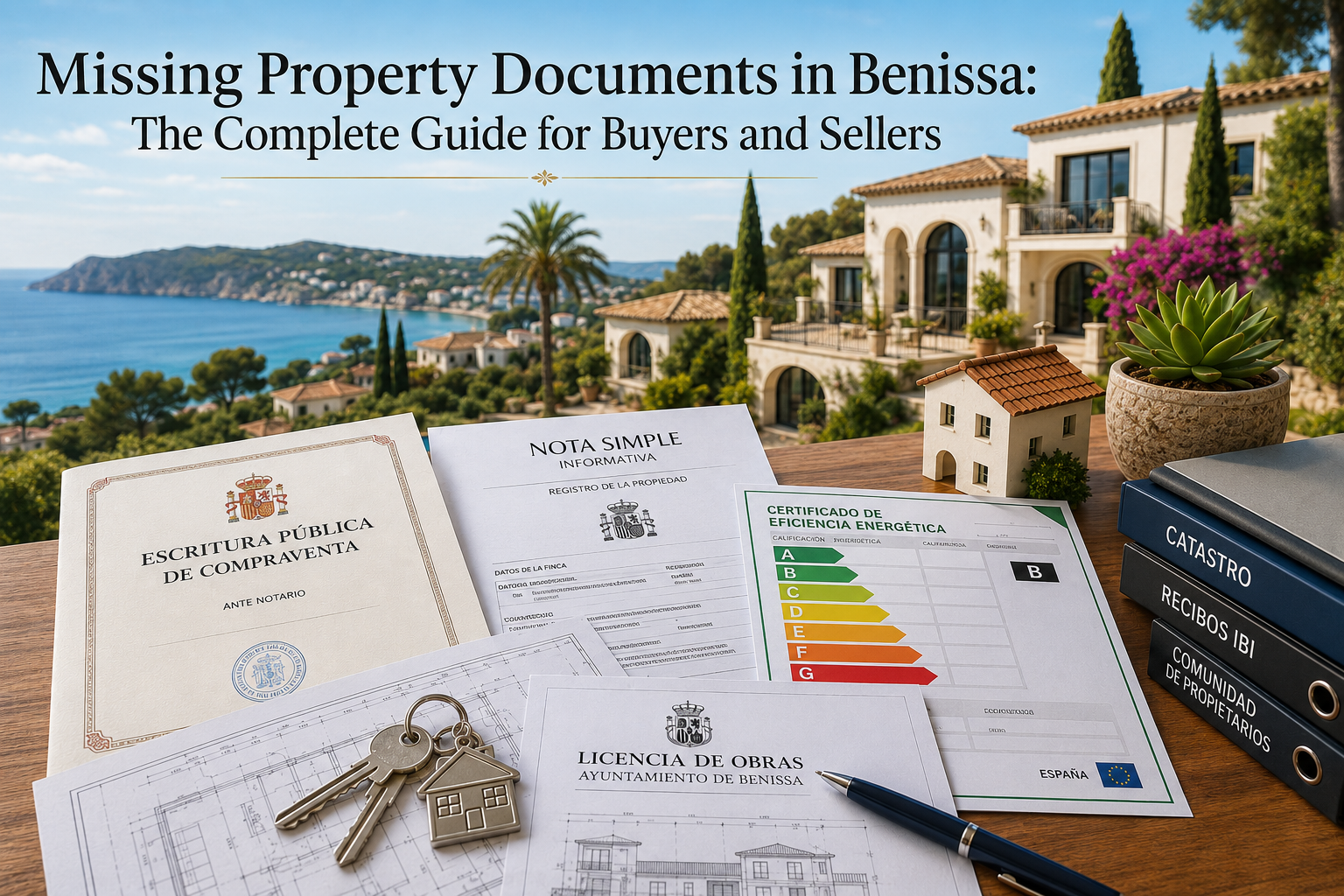
Missing Documents When Selling Property in Benissa: Complete Guide to Avoid Delays and Save Your Sale
Selling a property in Benissa should be an exciting milestone, but missing paperwork can quickly turn what should be a straightforward transaction into a stressful, expensive and time-consuming process.
From lost title deeds and expired occupancy licences to missing planning permissions and unregistered extensions, documentation issues are among the most common reasons property transactions are delayed across the Costa Blanca North.
The encouraging news is that most documentation problems can be identified and resolved before a buyer is found. With the right preparation and professional guidance, missing paperwork can often be replaced, updated or regularised, helping your sale proceed with fewer surprises.
Whether you are selling a villa in La Fustera, an apartment in Benissa Costa, a townhouse in the historic centre or a traditional finca in Pedramala or Benimarco, understanding which documents are required is one of the most important steps in preparing your property for sale.
This guide explains:
- Which documents are needed to sell property in Spain
- The most common missing documents in Benissa
- Which paperwork is easy to replace
- Which issues may require legal or architectural assistance
- Typical costs and expected timescales
- Special considerations for rustic properties and older fincas
- Practical steps to avoid delays before your property reaches the market
By organising your documentation before listing your property, you can reduce legal complications, strengthen buyer confidence and help ensure a smoother transaction from the first viewing to completion.
Quick Summary
Missing documents are one of the most common causes of delayed property sales in Benissa. Fortunately, many issues—such as lost title deeds, missing Energy Performance Certificates or outdated Registry information—can usually be resolved before completion. Reviewing your paperwork before marketing your property reduces delays, reassures buyers and helps avoid unnecessary mortgage or legal complications.
Table of Contents
- Why Missing Documents Matter When Selling Property in Benissa
- Documents Required to Sell Property in Benissa
- The Most Common Missing Documents
- Can You Sell a Property If Documents Are Missing?
- How to Replace Missing Property Documents in Spain
- Special Considerations for Rural Properties in Benissa
- Typical Costs of Replacing Missing Documents
- How Long Does It Take to Replace Missing Documents?
- Real Benissa Examples
- Checklist Before Listing Your Property
- Frequently Asked Questions
- Conclusion
Why Missing Documents Matter When Selling Property in Benissa
Many homeowners only discover documentation problems after accepting an offer. Unfortunately, this is often the worst possible moment.
At that stage, the buyer has instructed a lawyer, mortgage applications may already be underway and both parties are working towards an agreed completion date. Any missing paperwork can create unnecessary uncertainty, increase costs and delay the transaction.
The most successful property sales in Benissa usually have one thing in common: the seller prepared all essential documentation before the property was marketed.
Quick Answer
Missing documents do not always prevent a property from being sold, but they frequently delay the legal process. Identifying and resolving documentation issues before listing your property can reduce the risk of renegotiation, mortgage complications and completion delays.
How Missing Paperwork Can Delay or Stop a Sale
During conveyancing, the buyer's lawyer reviews the property's legal status in detail. This involves comparing information from the Property Registry, the Catastro, municipal planning records and the seller's documentation.
If discrepancies are identified, additional enquiries or technical reports may be required before the sale can proceed.
Common examples include:
- Lost title deeds
- Missing Energy Performance Certificate
- Expired or missing Certificate of Habitability
- Unregistered extensions
- Swimming pools that do not appear in official records
- Differences between the registered floor area and the property's actual size
- Missing community documentation
- Outstanding mortgage paperwork
Although many of these issues can ultimately be resolved, they often increase legal costs and extend the transaction.
For international buyers relocating from the United Kingdom, the Netherlands, Germany, Belgium or France, unexpected documentation issues can also reduce confidence and, in some cases, encourage them to consider alternative properties.
Why Buyers and Mortgage Lenders Require Complete Documentation
Cash buyers may have greater flexibility when purchasing a property with documentation issues, provided they understand the risks and receive appropriate legal advice.
Mortgage lenders are generally more cautious.
Before approving finance, lenders typically require confirmation that:
- The seller has legal authority to sell.
- Ownership is correctly registered.
- The property's legal description reflects its current condition.
- Significant alterations have been documented where required.
- There are no legal issues that materially affect the property's value or marketability.
If important documentation cannot be produced, the lender may request additional reports or delay releasing mortgage funds until the matter has been resolved.
This is one reason why preparing your paperwork before marketing your property benefits both sellers and buyers.
Expert Tip
Buyers are rarely discouraged by documentation issues that are already being addressed. They are much more concerned when unexpected problems emerge shortly before exchange or completion.
The Role of the Estate Agent, Lawyer, Architect and Notary
Selling property in Spain involves several professionals, each with a different responsibility.
Understanding their roles helps the transaction progress more smoothly.
Estate Agent
An experienced local estate agent can often identify potential documentation issues before the property is advertised.
Typical assistance includes:
- Reviewing available paperwork
- Identifying documents that may require updating
- Coordinating communication with lawyers and architects
- Helping sellers prepare their property for legal due diligence
Early preparation also reduces the likelihood of price renegotiations once legal checks begin.
Lawyer
Your independent lawyer is responsible for the legal aspects of the sale.
Their work may include:
- Reviewing ownership records
- Checking Registry information
- Advising on missing documentation
- Liaising with the buyer's lawyer
- Preparing completion documents
- Advising on legal solutions where documentation issues arise
Architect
Architects are particularly important for older villas and rustic properties around Benissa.
They may:
- Measure the property
- Verify built areas
- Prepare technical reports
- Produce architectural plans
- Assist with planning applications
- Help resolve Registry or Catastro discrepancies
For fincas in areas such as Pedramala and Benimarco, architectural input is often required where historic alterations have never been formally documented.
Notary
The notary formalises the transfer of ownership.
Their responsibilities include:
- Verifying identities
- Confirming legal capacity to sign
- Authorising the public deed of sale
- Ensuring the required documentation is available for completion
The notary does not normally resolve planning or documentation issues. These should ideally be addressed before the completion appointment.
Important
Property legislation, planning regulations and documentary requirements can change over time. Every property is unique, particularly older homes and rural fincas. Always obtain advice from a qualified lawyer or other appropriate professional before relying on general guidance.
Documents Required to Sell Property in Benissa
Before your property is marketed, it is advisable to assemble all the documentation that a buyer, lawyer and notary are likely to request.
Some documents prove ownership, while others confirm the property's legal status, tax position or energy efficiency.
Although requirements vary depending on the type of property and the circumstances of the sale, preparing these documents in advance demonstrates that your property has been professionally prepared and allows legal due diligence to begin immediately after an offer is accepted.
Expert Tip
If you are unsure which documents you already have, ask your estate agent or lawyer to carry out a documentation review before marketing your property. Identifying missing paperwork early is usually quicker, less expensive and considerably less stressful than dealing with problems after accepting an offer.
Required Documents at a Glance
| Required Document | Purpose | Mandatory?* | Who Issues It? | Can It Be Replaced? |
|---|---|---|---|---|
| Title Deed (Escritura) | Proves ownership | Yes | Notary / Property Registry | Yes |
| Nota Simple | Confirms Registry information | Normally requested | Property Registry | Yes |
| Energy Performance Certificate | Shows energy efficiency | Generally required | Qualified energy assessor | Yes |
| Certificate of Habitability | Confirms occupation requirements where applicable | Depends on circumstances | Local authority | Often |
| Latest IBI Receipt | Confirms municipal tax information | Strongly recommended | Local council | Yes |
| Community Certificate | Confirms community fee status | Required for community properties | Community administrator | Yes |
| Utility Information | Supports utility transfers | Recommended | Utility providers | Yes |
| Passport and NIE | Confirms seller identity | Yes | Government authorities | Yes |
| Mortgage Documentation | Confirms outstanding mortgage details | Required where applicable | Mortgage lender | Yes |
*Requirements vary according to the property, municipality and individual circumstances
Title Deed (Escritura)
The Escritura Pública de Compraventa, commonly known as the title deed, is one of the most important documents involved in a Spanish property sale.
It records the legal transfer of ownership when the property was purchased and forms the basis of the ownership recorded in the Property Registry.
During the conveyancing process, the buyer's lawyer compares the information contained in the deed with the Property Registry and Catastro to ensure that everything is consistent.
A title deed generally contains:
- The names of the legal owners
- A description of the property
- Plot details
- Purchase information
- Previous ownership details
- Rights, restrictions or easements affecting the property
What if the title deed has been lost?
Losing the original deed is far more common than many owners realise, particularly if the property was purchased many years ago or inherited.
Fortunately, ownership is not lost simply because the paper document has gone missing.
As the original deed was signed before a notary and ownership is recorded at the Property Registry, an authorised replacement copy can normally be obtained.
For most sellers, this is an administrative issue rather than a legal obstacle.
Nota Simple
The Nota Simple is an official extract from the Spanish Property Registry.
Although it is not proof of ownership, it provides an up-to-date summary of the property's registered legal status.
A recent Nota Simple typically confirms:
- Registered owner
- Property description
- Registry reference
- Mortgages
- Charges or liens
- Easements
- Other registered rights
Because buyers, lawyers and mortgage lenders rely heavily on this document, obtaining a recent copy before marketing your property is highly recommended.
Why is it important?
A Nota Simple may reveal discrepancies between the Registry and the physical property.
For example:
- An extension may not appear.
- A swimming pool may never have been registered.
- Ownership details may require updating.
- Historic mortgages may still appear on the Registry.
Identifying these issues early allows time to resolve them before they become obstacles during the sale.
Energy Performance Certificate (EPC)
The Energy Performance Certificate (Certificado de Eficiencia Energética) measures a property's energy efficiency.
It provides buyers with information about:
- Estimated energy consumption
- Carbon emissions
- Overall energy rating
- Recommendations for improving efficiency
A qualified technician must inspect the property before issuing the certificate.
For most residential property sales in Spain, an Energy Performance Certificate is required before the property is marketed.
Common issues
Typical problems include:
- No certificate has ever been obtained.
- The certificate has expired.
- Significant renovations have been completed since it was issued.
- The document has been lost.
Fortunately, obtaining a new certificate is generally straightforward.
Certificate of Habitability (Licencia de Segunda Ocupación)
The Certificate of Habitability, often referred to as the Licencia de Segunda Ocupación, confirms that a property satisfies the relevant administrative requirements for occupation where the certificate is required.
Buyers frequently ask whether this document is available because banks, utility companies or public authorities may request it for certain procedures.
Properties in Benissa may present additional challenges where:
- The certificate has expired.
- Alterations have been carried out.
- Historic records are incomplete.
- The property is several decades old.
Where a certificate is missing, expired or requires updating, your lawyer or architect can advise on the most appropriate course of action based on the property's individual circumstances.
Important
Rules relating to Certificates of Habitability may change over time. Requirements vary according to the property's age, location and history. Always seek current professional advice before relying on previous documentation.
IBI (Property Tax) Receipts
The Impuesto sobre Bienes Inmuebles (IBI) is the annual municipal property tax.
Buyers commonly ask to see the latest IBI receipt because it helps confirm:
- The cadastral reference
- Property tax payments
- Municipal records
- Ownership information
Providing recent receipts demonstrates that local taxes are up to date and often answers questions early in the conveyancing process.
Community of Owners Documentation (Where Applicable)
If your property forms part of a community—such as an apartment or a villa within a managed urbanisation—the buyer will usually request documentation from the Community of Owners.
This commonly includes:
- A certificate confirming community fees have been paid
- Current annual community charges
- Community regulations
- Information about approved extraordinary expenses
Properties within developments such as La Fustera, San Jaime, Fanadix and parts of Buenavista are often subject to community administration.
Providing this documentation before legal enquiries begin helps avoid unnecessary delays.
Utility Bills and Account Information
Although utility documents are rarely legal requirements for the sale itself, they make transferring ownership significantly easier.
Buyers often request recent bills for:
- Electricity
- Water
- Gas (where applicable)
- Internet
- Waste collection
These documents help identify:
- Supply contracts
- Customer account numbers
- Meter references
- Consumption points
For rural properties, buyers may also ask for information relating to water deposits, irrigation supplies or private water agreements.
Identification Documents (Passport and NIE)
Every seller must prove their identity before signing the transfer deed.
This usually requires:
- A valid passport or national identity card
- An NIE (Número de Identificación de Extranjero) for foreign owners
Where there is more than one owner, identification will normally be required from each person.
If the property is being sold using a valid Power of Attorney, additional documentation will also be necessary.
Mortgage Documentation (If Applicable)
If there is an existing mortgage secured against the property, additional paperwork is normally required before completion.
This may include:
- Mortgage account details
- Outstanding balance
- Redemption figures
- Bank contact information
- Arrangements for mortgage cancellation
Many mortgages are redeemed directly from the sale proceeds at completion.
Preparing this documentation in advance helps avoid last-minute delays.
Digital Copies and Original Documents
Many international owners now keep most of their paperwork digitally.
In practice, scanned copies are often sufficient for the initial stages of a transaction, allowing your estate agent and lawyer to begin reviewing the documentation.
However, depending on the document and the stage of the sale, original or officially certified copies may still be required.
If you live outside Spain, organising your paperwork digitally before marketing the property can significantly simplify the process and reduce unnecessary travel.
Owners Living Abroad
A significant proportion of property owners in Benissa live permanently in countries such as the United Kingdom, the Netherlands, Germany, Belgium or France.
If you are selling from abroad, it is often possible to organise much of the documentation remotely.
Depending on your circumstances, your lawyer may also be able to assist through a valid Power of Attorney, reducing the need to travel to Spain during every stage of the transaction.
Preparing your paperwork well in advance is particularly important if you are selling remotely, as obtaining replacement documents from overseas can sometimes take longer.
Common Mistake
Many owners assume that finding their paperwork shortly before completion is sufficient. In reality, buyers and their lawyers are primarily interested in whether the documentation is current, accurate and consistent with the property's present condition.
The Most Common Missing Documents
Documentation problems are more common than many sellers expect, particularly in Benissa where many villas and fincas have changed ownership several times over recent decades.
Properties may have been extended, inherited, renovated or improved without every administrative record being updated.
The important point is that a missing document does not automatically prevent a sale.
The key question is whether the issue can be resolved before completion and how much time that process is likely to require.
Below are the documentation issues most frequently encountered when preparing properties for sale in Benissa.
Lost Title Deeds
It is surprisingly common for owners to discover that the original Escritura has been misplaced.
Typical reasons include:
- House moves
- Archived paperwork stored abroad
- Inherited properties
- Documents lost over many years
- Previous owners retaining copies
Fortunately, authorised copies can usually be obtained without major legal difficulty.
Does this normally stop a sale?
No.
Provided ownership can be verified, losing the original paper deed rarely prevents completion.
Missing Energy Performance Certificate
Some owners only discover they need an Energy Performance Certificate once they decide to sell.
Others obtained one many years ago that has since expired.
Common situations include:
- Certificate never obtained
- Certificate expired
- Certificate lost
- Property substantially renovated since the original assessment
Obtaining a replacement is generally one of the simplest documentation issues to resolve.
Missing Certificate of Habitability
This is one of the most common questions raised during property sales across the Costa Blanca.
Older homes may no longer have current occupancy documentation readily available.
Common reasons include:
- Expired documentation
- Historic records unavailable
- Alterations carried out after construction
- Administrative changes over time
A missing certificate does not necessarily indicate that the property is illegal, but it should always be reviewed by an appropriate professional.
Missing Building Licence
During the legal review, the buyer's lawyer may ask for documentation relating to the property's original construction or later building works.
This commonly becomes relevant when:
- The property was built relatively recently.
- A major refurbishment has been carried out.
- Additional rooms have been added.
- A garage has been converted into living accommodation.
- Large terraces have been enclosed.
For properties constructed several decades ago, historic planning records may be incomplete or held in older municipal archives.
Where documentation cannot easily be located, your lawyer or architect can advise on the most appropriate solution based on the property's individual circumstances.
Missing Pool Licence or Documentation
Swimming pools are one of the most desirable features of a Costa Blanca home, but they are also one of the most common sources of legal enquiries during the selling process.
This is particularly relevant for villas in:
- Benissa Costa
- La Fustera
- San Jaime
- Fanadix
- Buenavista
Questions often arise where:
- The pool was added years after the house was built.
- Previous owners never updated official records.
- The pool does not appear on Registry or Catastro plans.
- Supporting planning documentation cannot be located.
Buyers and mortgage lenders frequently ask whether the pool has been correctly documented before proceeding with the purchase.
Missing Extension Approvals
Extensions are one of the most common causes of delays because they directly affect the property's legal description.
Typical examples include:
- Enclosed terraces
- Additional bedrooms
- Guest apartments
- Conservatories
- Larger kitchens
- Covered terraces converted into internal living space
If these alterations are not reflected in the Property Registry or Catastro, the buyer's lawyer may request additional investigations.
Depending on the circumstances, resolving the issue may require technical reports, Registry updates or other legal work before completion.
Missing Architect Certificates
Architects often become involved when the property's current layout differs from the available documentation.
They may be asked to:
- Measure the property.
- Verify built areas.
- Prepare technical certificates.
- Produce updated plans.
- Support planning applications.
- Assist with the regularisation of documentation where appropriate.
This situation is particularly common for older fincas in Pedramala, Benimarco and other rural parts of Benissa.
Missing Catastro Records
The Catastro is a separate administrative register from the Property Registry.
Although the two systems often contain similar information, they serve different purposes and are not automatically identical.
Common discrepancies include:
- Incorrect built area
- Missing swimming pool
- Unrecorded outbuildings
- Incorrect plot boundaries
- Outdated property descriptions
These differences do not necessarily prevent a sale, but they often lead to additional questions from buyers, lawyers and mortgage lenders.
Did You Know?
One of the most common legal checks during a Spanish property sale is comparing the physical property with both the Property Registry and the Catastro. The closer these records match reality, the smoother the conveyancing process is likely to be.
Missing Utility Documentation
Although utility paperwork is rarely a legal requirement, buyers appreciate receiving clear information about the property's services.
Missing documentation may relate to:
- Electricity contracts
- Water supply
- Internet services
- Gas installations
- Water deposits
- Rural water rights
This is particularly important for countryside properties where water comes from deposits, wells or irrigation communities rather than the public network.
Providing accurate utility information helps reassure buyers and simplifies the transfer of services after completion.
Missing Community Certificates
Owners of apartments and properties within managed urbanisations are usually expected to provide documentation from the Community of Owners.
Typical requests include:
- Confirmation that community fees have been paid
- Details of annual charges
- Information about approved major works
- Community regulations
Obtaining these documents is generally straightforward, but it is advisable not to leave the request until shortly before completion, particularly during holiday periods when administrators may have reduced availability.
Can You Sell a Property If Documents Are Missing?
Yes—in many cases you can.
However, the answer depends on:
- Which document is missing
- Why it is missing
- Whether it can be replaced
- Whether the buyer is purchasing with cash or mortgage finance
- Whether additional legal or technical work is required
Some documents can be replaced within days, while others may take several weeks or even months.
The earlier these issues are identified, the less likely they are to delay your sale.
Documents That Are Usually Easy to Replace
Several commonly requested documents can normally be obtained again without significant legal complexity.
These include:
- Recent Nota Simple
- IBI receipts
- Community certificates
- Utility bills
- Mortgage redemption statements
- Copies of title deeds
- Energy Performance Certificates (by arranging a new assessment)
Although these documents still require some administration, they rarely prevent a sale when dealt with promptly.
Documents That May Require Additional Legal Work
Some documentation issues involve considerably more than simply requesting another copy.
Examples include:
- Unregistered extensions
- Missing planning approvals
- Historic ownership discrepancies
- Registry corrections
- Catastro inconsistencies
- Missing technical certificates
Resolving these matters may require cooperation between:
- Lawyer
- Architect
- Surveyor
- Town Hall
- Property Registry
- Catastro
The exact process depends entirely on the property's history.
Documents That Could Delay Completion
The following issues are more likely to delay completion if they remain unresolved:
- Significant differences between the Property Registry and the physical property
- Major undocumented extensions
- Missing planning documentation for substantial alterations
- Ownership disputes
- Complex inheritance matters
- Properties requiring legalisation procedures
These situations do not necessarily prevent a sale, but they require realistic timescales and experienced professional advice.
Situations That May Affect Mortgage Approval
Mortgage lenders generally carry out more detailed legal due diligence than cash buyers.
Additional scrutiny may arise where:
- Built areas differ significantly from official records.
- Parts of the property have never been registered.
- Planning documentation is incomplete.
- Occupancy documentation requires updating.
- Ownership records need correcting.
Every lender has its own lending criteria, so the outcome will vary according to the individual case.
Resolving documentation issues before marketing your property often increases the number of buyers who are able to proceed with confidence.
Decision Table: Can You Still Sell?
| Missing Document | Can You Sell? | Typical Solution | Likely Delay |
|---|---|---|---|
| Lost Title Deed | Usually yes | Obtain authorised copy | Low |
| Nota Simple | Yes | Request new copy | Very low |
| Energy Performance Certificate | Usually yes | Arrange new assessment | Low |
| Certificate of Habitability | Depends on the circumstances | Renew or obtain updated documentation where applicable | Medium |
| Building Licence | Depends on the issue | Planning review and legal advice | Medium to High |
| Pool Documentation | Often yes | Technical review and possible regularisation | Medium |
| Extension Approval | Depends on the extent of the works | Architect and lawyer involvement | Medium to High |
| Catastro Discrepancy | Usually yes | Update records | Medium |
| Community Certificate | Yes | Request from administrator | Low |
| Mortgage Documentation | Yes | Obtain lender documentation | Low |
Documentation Risk Guide
| Issue | Overall Risk | Typical Professional Involved |
|---|---|---|
| Lost title deed | Low | Lawyer |
| Missing EPC | Low | Energy assessor |
| Missing community certificate | Low | Community administrator |
| Registry discrepancy | Medium | Lawyer |
| Catastro discrepancy | Medium | Architect |
| Unregistered extension | Medium to High | Architect and lawyer |
| Missing planning records | High | Lawyer and architect |
| Ownership dispute | High | Lawyer |
| Inheritance not completed | High | Lawyer |
Expert Tip
Buyers are generally reassured when documentation issues are identified early and a clear plan is already in place. Transparency builds confidence and helps keep negotiations focused on the property rather than unexpected legal surprises.
How to Replace Missing Property Documents in Spain
Discovering that important paperwork is missing can feel overwhelming, but in many cases the solution is simpler than sellers expect.
The key is to begin the process before your property is marketed.
Some documents can be obtained within days, while others require coordination between your lawyer, architect, the Town Hall, the Property Registry and the Catastro.
If you wait until a buyer has already instructed a lawyer, every additional week spent obtaining documentation increases the risk of delays.
Expert Tip
Start gathering your paperwork before requesting professional photography or launching your property onto the market. By the time buyers begin viewing, you should already understand whether any documentation requires updating.
Obtaining Replacement Title Deeds
If your original Escritura has been lost, there is usually no need to worry.
Ownership of your property is not dependent on possessing the original paper document. The deed remains part of the official notarial record, while ownership is reflected in the Property Registry.
Your lawyer can normally obtain an authorised copy by providing information such as:
- Property address
- Owner's name
- Approximate purchase date
- Name of the original notary (if known)
Even if you cannot remember every detail, the Property Registry often helps identify the relevant records.
Practical Advice
Before requesting a replacement, check whether copies already exist with:
- Your lawyer
- Your mortgage lender
- Previous conveyancing files
- Family records
- Digital archives
Many sellers discover they already have a perfectly usable copy.
Requesting a New Nota Simple
A Nota Simple is one of the easiest property documents to obtain.
Because it reflects the property's current Registry status, buyers' lawyers often request a recent version regardless of whether the seller already has an older copy.
Obtaining one before marketing your property allows you to verify:
- Ownership
- Existing mortgages
- Charges
- Easements
- Registry description
If discrepancies appear, you have time to investigate them before negotiations begin.
Applying for a New Energy Performance Certificate
If your Energy Performance Certificate is missing or has expired, the process is generally straightforward.
A qualified energy assessor will inspect the property and evaluate factors such as:
- Construction type
- Insulation
- Windows and glazing
- Heating systems
- Air conditioning
- Hot water systems
- Renewable energy installations where applicable
After the inspection, the certificate is prepared and registered in accordance with the applicable regional procedures.
Preparing for the Inspection
To help the assessment run smoothly:
- Ensure every room is accessible.
- Gather any documentation relating to insulation or renewable energy improvements.
- Inform the assessor about replacement windows, solar panels or recent upgrades.
Obtaining a New Certificate of Habitability
Where a new or updated Certificate of Habitability is required, the process depends on the property's age, condition and history.
The procedure may involve:
- Inspection of the property.
- Preparation of technical documentation.
- Verification that the property satisfies the relevant administrative requirements.
- Submission of the application to the appropriate authority.
For straightforward properties the process may be relatively simple.
Older villas, renovated homes and rustic fincas often require additional technical work before an application can proceed.
Because procedures and regulations may change, always seek current professional advice.
Recovering Planning Permissions
Missing planning documentation does not necessarily mean permission was never granted.
In many cases:
- Records have simply been misplaced.
- Previous owners failed to pass paperwork to the next owner.
- Documentation dates back several decades.
- Historic municipal archives require further investigation.
Your lawyer or architect can often request copies of available planning records from the local authority.
Where records cannot be located, they can recommend the most appropriate course of action based on the property's individual history.
Updating Catastro Records
One of the most common documentation exercises involves bringing the Catastro into line with the property's actual appearance.
Typical reasons include:
- A swimming pool has never been recorded.
- An extension has not been updated.
- Guest accommodation has been added.
- Plot boundaries differ.
- Built areas have changed.
Updating the Catastro does not automatically update the Property Registry.
Likewise, changes to the Registry do not automatically appear in the Catastro.
For this reason, reviewing both systems before marketing your property is highly recommended.
Did You Know?
It is perfectly possible for the Catastro and Property Registry to record different measurements for the same property. These discrepancies are relatively common in older homes but should always be investigated before a sale whenever possible.
Working with an Architect
Architects become essential whenever technical documentation is required.
Depending on the circumstances, they may:
- Measure the property
- Verify built areas
- Produce architectural plans
- Prepare technical certificates
- Assist with planning applications
- Help resolve discrepancies between official records and the physical property
This is particularly relevant for:
- Older villas
- Traditional fincas
- Rural homes
- Properties with several extensions
- Buildings altered over many years
Homes in Pedramala, Benimarco and other rural areas often require more detailed technical review than recently built properties.
Working with Your Lawyer
Your lawyer coordinates the legal aspects of resolving missing documentation.
Typical responsibilities include:
- Reviewing Registry information
- Confirming ownership
- Requesting official documents
- Advising on legal risks
- Liaising with the buyer's lawyer
- Preparing completion documentation
If planning or Registry issues arise, your lawyer will normally work alongside an architect to achieve the most appropriate solution.
For owners living abroad, much of this process can often be managed remotely.
How Your Estate Agent Can Coordinate the Process
A proactive estate agent does considerably more than market a property.
Preparing documentation before launch is one of the most valuable services an experienced local agent can provide.
At Telio Homes, documentation is reviewed before photography, advertising and viewings begin wherever possible.
Depending on the property, this may involve coordinating with:
- Independent lawyers
- Architects
- Energy assessors
- Community administrators
- Mortgage lenders
- Surveyors
- Utility providers
- Local authorities
By identifying documentation issues early, sellers often:
- Reduce legal delays
- Improve buyer confidence
- Minimise renegotiation
- Keep completion dates on schedule
- Create a smoother overall selling experience
Common Mistake
Many owners spend weeks improving decoration and presentation before checking the paperwork. While presentation helps attract buyers, unresolved documentation issues are far more likely to delay or disrupt a successful sale.
Special Considerations for Rural Properties in Benissa
Rustic properties deserve particular attention because they often have a much longer construction history than modern villas or apartments.
Many fincas around Benissa have evolved gradually over several decades, with improvements made by different owners.
As a result, documentation may no longer accurately reflect the property's current layout.
Buyers are increasingly aware of these issues and frequently instruct lawyers experienced in rustic property transactions.
Older Fincas
Traditional fincas are among Benissa's most attractive properties, but they also present some of the most complex documentation challenges.
Older homes may have:
- Several construction phases
- Historic alterations
- Limited original planning records
- Older Registry descriptions
- Incomplete architectural plans
These characteristics do not automatically prevent a sale, but they usually require more detailed legal due diligence.
Agricultural Land
Properties located on rustic land require careful review because planning regulations differ from those applying to urban land.
Buyers commonly ask about:
- Permitted uses
- Existing buildings
- Agricultural classification
- Future development potential
- Access rights
- Easements
Providing clear documentation early helps answer these questions before they become concerns during negotiations.
Swimming Pools
Swimming pools remain one of the most common areas of enquiry for buyers of rural villas.
Lawyers often check:
- Whether the pool appears on official records
- Whether its dimensions correspond with available documentation
- Whether supporting technical documentation exists where appropriate
If questions arise, an architect can advise on the most appropriate solution.
Water Deposits and Water Supply
Many countryside homes are not connected exclusively to the municipal water network.
Instead, water may come from:
- Water deposits
- Irrigation communities
- Private supply agreements
- Wells, where legally applicable
Buyers appreciate receiving clear information regarding:
- Water source
- Storage capacity
- Maintenance responsibilities
- Running costs
Providing this information early reduces uncertainty and builds confidence.
Septic Tanks
Unlike many urban homes, rural properties often rely on septic tanks rather than the public sewer network.
Buyers commonly ask:
- How old is the installation?
- Has it been maintained?
- Is supporting documentation available?
- Does it satisfy current requirements where applicable?
These questions become particularly important where mortgage finance is involved.
Historic Extensions
Traditional fincas frequently evolve over time.
Common additions include:
- Covered terraces
- Guest accommodation
- Outdoor kitchens
- Garages
- Pool houses
- Storage buildings
Where these changes are not reflected in official records, additional legal or technical work may be required before completion.
Buildings Constructed Before Modern Planning Regulations
Some of Benissa's most attractive homes were built long before today's planning framework existed.
Consequently, historical documentation may be incomplete or limited.
Rather than making assumptions based purely on the age of the property, sellers should obtain professional advice based on the property's individual circumstances.
Important
Older documentation does not automatically indicate a legal problem. Many traditional properties simply require careful review because planning procedures and administrative requirements have evolved significantly over the years.
Typical Costs of Replacing Missing Documents
One of the first questions sellers ask is:
"How much will it cost to replace missing property documents?"
There is no single answer. Costs vary depending on:
- The document required
- The property's age
- Whether technical reports are needed
- The complexity of the issue
- Administrative charges
- Professional fees
Simple administrative documents generally cost relatively little to obtain, while Registry corrections, planning matters or technical reports may involve considerably more work.
Important
The information below provides general guidance only. Professional fees, administrative charges and government fees change over time. Always request an up-to-date quotation before instructing any work.
Typical Cost Guide
| Document | Typical Cost* | Professional Required | Typical Timescale |
|---|---|---|---|
| Nota Simple | Low administrative fee | No (often requested through a lawyer or estate agent) | Same day to a few days |
| Replacement Title Deed | Administrative fee may apply | Lawyer recommended | Several days to a few weeks |
| Energy Performance Certificate | Varies according to property size and provider | Qualified energy assessor | Usually a few days |
| Certificate of Habitability | Varies according to property and inspections required | Architect or technician | Often several weeks |
| Architect's Technical Report | Depends on complexity | Architect | Several days to several weeks |
| Catastro Update | Administrative and professional costs vary | Architect or technician | Weeks to months |
| Property Registry Correction | Depends on legal complexity | Lawyer and sometimes architect | Weeks to several months |
| Community Certificate | Usually modest administration fee | Community administrator | A few days |
| Mortgage Redemption Certificate | Varies by lender | Mortgage lender | Several days to two weeks |
*Indicative guidance only.
What Can Increase Costs?
The following situations often require additional professional work:
- Large unregistered extensions
- Significant differences between the Property Registry and Catastro
- Older rustic properties with incomplete documentation
- Missing planning records
- Historic swimming pools
- Inherited properties with unresolved ownership
- Multiple owners
- Company-owned properties
By comparison, replacing a recent Nota Simple or obtaining a new Energy Performance Certificate is normally straightforward.
Expert Tip
Investing in documentation before marketing your property often saves considerably more by reducing delays, avoiding renegotiation and improving buyer confidence.
How Long Does It Take to Replace Missing Documents?
Some paperwork can be obtained within days, while more complex legal or technical matters require considerably longer.
Administrative documents are generally quick to obtain, whereas Registry corrections, planning investigations and historic property issues may take weeks or months.
If you intend to sell during the busy spring or summer market, begin reviewing your paperwork well in advance.
Typical Timescales
| Document or Process | Typical Time |
|---|---|
| Nota Simple | Same day to a few days |
| Energy Performance Certificate | A few days to around two weeks |
| Replacement Title Deed | Several days to several weeks |
| Community Certificate | A few days |
| Mortgage Documentation | Several days to two weeks |
| Certificate of Habitability | Often several weeks |
| Architect's Report | One to several weeks |
| Planning Documentation Search | Several weeks or longer |
| Registry Corrections | Several weeks to several months |
| Catastro Updates | Several weeks to several months |
Typical Documentation Timeline
Documentation Review
        │
        ▼
Collect Existing Documents
        │
        ▼
Request Missing Documents
        │
        ├─────────────► Nota Simple
        ├─────────────► EPC
        ├─────────────► Community Certificate
        ├─────────────► Mortgage Information
        │
        ▼
Technical Review (if required)
        │
        ▼
Architect / Lawyer Coordination
        │
        ▼
Registry or Catastro Updates
        │
        ▼
Property Ready for Marketing
        │
        ▼
Buyer Due Diligence
        │
        ▼
Completion
Common Mistake
Many sellers wait until they have accepted an offer before ordering missing documents. Starting the process before marketing almost always leads to a smoother transaction.
Real Benissa Examples
The following examples are based on situations commonly encountered in the Benissa property market. They are illustrative and do not describe individual clients.
Example 1: British Seller Missing the Certificate of Habitability
A British couple owned a villa in La Fustera that had been used as a holiday home for many years.
When preparing to sell, they discovered they could not locate their Certificate of Habitability.
Rather than waiting for a buyer to identify the issue, they instructed their lawyer and a qualified technician before the property was listed.
By the time an offer was accepted, the documentation was already progressing, allowing the transaction to continue with minimal disruption.
Key lesson: Resolve documentation issues before marketing whenever possible.
Example 2: Dutch Buyers Delayed by an Unregistered Extension
Dutch buyers agreed to purchase a villa close to San Jaime using mortgage finance.
During legal due diligence, the buyer's lawyer discovered that an enclosed terrace had never been reflected in the official records.
An architect reviewed the property and the necessary documentation was prepared before the purchase proceeded.
Key lesson: Even relatively small extensions should be checked before putting your property on the market.
Example 3: German Owner Who Had Lost the Original Title Deed
A German owner had owned an apartment in Benissa Costa for more than twenty years.
When preparing to sell, the original title deed could not be found.
Because ownership was correctly recorded in the Property Registry, an authorised replacement copy was obtained without significant delay.
The sale progressed smoothly because the issue had been identified early.
Key lesson: Losing the paper deed rarely prevents a successful sale.
Example 4: Rural Finca with an Undocumented Swimming Pool
A traditional finca in Pedramala included a swimming pool constructed many years after the original house.
The pool was not consistently reflected in the available documentation.
Before marketing the property, the owner consulted an architect and lawyer to review the paperwork.
By resolving the issue before buyers became involved, uncertainty during negotiations was significantly reduced.
Key lesson: Rural properties benefit from a thorough documentation review before they reach the market.
Example 5: Inherited Property with Outdated Ownership Records
Several siblings inherited a villa in Benimarco.
Although they agreed to sell, the ownership documentation first needed updating.
Their lawyer coordinated the legal process before the property was advertised.
As a result, buyers were presented with a much clearer legal position, helping the transaction proceed more efficiently.
Key lesson: Inherited properties often require additional preparation before marketing.
Example 6: Overseas Seller Using a Power of Attorney
A Belgian owner living permanently abroad wanted to sell a holiday home in Benissa Costa without travelling to Spain several times.
Working with an independent lawyer under a valid Power of Attorney, the owner was able to organise replacement documentation, respond to legal enquiries and prepare for completion remotely.
Key lesson: Selling from abroad is often possible with careful planning and the appropriate professional advice.
What These Examples Demonstrate
Although every property is different, successful sales usually have three things in common:
- Documentation is reviewed before marketing.
- Professional advice is obtained early.
- Buyers receive clear and transparent information throughout the process.
These simple steps often prevent unnecessary delays and maintain buyer confidence from the first viewing to completion.
Did You Know?
Many documentation issues are discovered not because something is legally wrong, but because records have not been updated to reflect changes made over many years.
Checklist Before Listing Your Property
Before your property goes on the market, use the checklist below to ensure your paperwork is in order.
Completing these steps early can reduce delays, improve buyer confidence and help your sale progress more smoothly.
Ownership
- ✓ Locate your Title Deed (Escritura)
- ✓ Obtain a recent Nota Simple
- ✓ Confirm the registered owners are correct
- ✓ Check whether a mortgage is still registered
Property Documentation
- ✓ Obtain a valid Energy Performance Certificate
- ✓ Confirm the status of your Certificate of Habitability
- ✓ Locate planning permissions where available
- ✓ Gather documentation for extensions or renovations
- ✓ Verify swimming pool documentation where applicable
Taxes and Administration
- ✓ Gather your latest IBI receipt
- ✓ Confirm local taxes are up to date
- ✓ Collect recent utility bills
- ✓ Obtain a Community Certificate if applicable
Technical Review
- ✓ Compare the property with the Catastro
- ✓ Compare the property with the Property Registry
- ✓ Check that built areas match official records
- ✓ Review outbuildings, terraces and guest accommodation
Professional Preparation
- ✓ Speak with your estate agent
- ✓ Ask your lawyer to review your documentation
- ✓ Consult an architect if alterations have been made
- ✓ Resolve documentation issues before accepting an offer
Expert Tip
A documentation review before marketing your property is often one of the simplest ways to reduce stress, prevent delays and achieve a smoother sale.
Frequently Asked Questions
Can I sell my property if I have lost the title deed?
Yes, in most cases.
The original paper deed can usually be replaced because ownership is recorded by the Property Registry and the original deed remains part of the notarial record.
Your lawyer can normally obtain an authorised copy.
Is a Nota Simple the same as the title deed?
No.
The title deed records the legal transfer of ownership, while the Nota Simple is an extract from the Property Registry showing the property's current registered legal status.
Both documents serve different purposes during the conveyancing process.
Can I sell without an Energy Performance Certificate?
For most residential property sales in Spain, an Energy Performance Certificate is generally required before the property is marketed.
If you do not have one, arranging a new assessment is usually a straightforward process.
What happens if my property's measurements do not match the Registry?
This is a relatively common situation, particularly with older villas and rural properties.
The discrepancy should be investigated before the sale proceeds.
Depending on the circumstances, your lawyer or architect may recommend updating the Property Registry, the Catastro or both.
Can I sell a property with an unregistered extension?
Possibly.
Many properties are sold after documentation issues have been resolved.
Whether additional legal or technical work is required depends on the nature of the extension and the property's individual circumstances.
Professional advice should always be obtained before proceeding.
Does every swimming pool need documentation?
Swimming pools often form part of the legal due diligence carried out during a sale.
Where documentation is incomplete or official records have not been updated, your lawyer or architect can advise on the most appropriate solution.
What if my Certificate of Habitability has expired?
An expired certificate does not automatically prevent a sale.
Depending on the property's circumstances, it may be possible to obtain an updated certificate or complete any necessary administrative procedures before completion.
Can I replace missing documents while my property is already on the market?
Yes.
However, it is generally preferable to begin replacing missing documents before marketing starts.
Doing so reduces the likelihood of delays once a buyer has been found and demonstrates that the property has been professionally prepared.
Will missing documents reduce the value of my property?
Not necessarily.
In many cases, the documentation itself does not affect market value. However, unresolved legal or administrative issues can reduce buyer confidence, limit mortgage options or lead to price renegotiations if they are discovered late in the transaction.
Can a cash buyer purchase a property with missing documentation?
Cash buyers often have greater flexibility than mortgage buyers because they are not subject to a lender's lending criteria.
Nevertheless, their lawyer will still carry out legal due diligence and advise them on any risks associated with missing or incomplete documentation.
What happens if planning permission cannot be found?
Missing planning records do not automatically mean permission was never granted.
Depending on the property's age and history, records may need to be located, reviewed or supplemented with technical documentation.
An experienced lawyer or architect can advise on the most appropriate course of action.
I inherited a property. Do I need additional paperwork before selling?
Often, yes.
Before the sale can proceed, ownership may need to be updated to reflect the inheritance.
The exact requirements depend on the circumstances, so obtaining legal advice early is recommended.
Can I sell my property if I live outside Spain?
Yes.
Many owners successfully sell their properties while living abroad.
Much of the documentation can be organised remotely, and in many cases a valid Power of Attorney allows your lawyer to handle much of the legal process on your behalf.
How can I avoid documentation problems altogether?
The most effective approach is to review all paperwork before your property is advertised.
Working with an experienced local estate agent, an independent lawyer and, where necessary, an architect allows most documentation issues to be identified and addressed before they affect a buyer.
Final Thoughts
Missing paperwork is one of the most common reasons property sales in Benissa experience unnecessary delays, but it does not have to become a major obstacle.
In many cases, documents can be replaced, updated or regularised long before completion. The key is to identify any issues early, seek appropriate professional advice and ensure your property's legal documentation accurately reflects its current condition.
Whether you own a modern apartment, a coastal villa or a traditional finca, investing time in preparing your paperwork before marketing your property will usually:
- Reduce legal delays
- Increase buyer confidence
- Minimise the risk of renegotiation
- Improve the chances of a smooth completion
- Make the selling process considerably less stressful
Rather than waiting until a buyer's lawyer discovers missing documentation, a proactive review allows you to market your property with confidence and respond quickly to legal enquiries.
Need Help Selling Your Property in Benissa?
At Telio Homes, we specialise exclusively in the Benissa property market.
Before your home is launched, we help sellers identify potential documentation issues, coordinate with independent legal and technical professionals where appropriate, and prepare properties for a smoother sale.
If you're planning to sell a villa, apartment, townhouse or finca in Benissa, we'd be happy to guide you through the process and help you understand which documents may be required for your particular property.
Early preparation today can save weeks—or even months—later in the transaction.