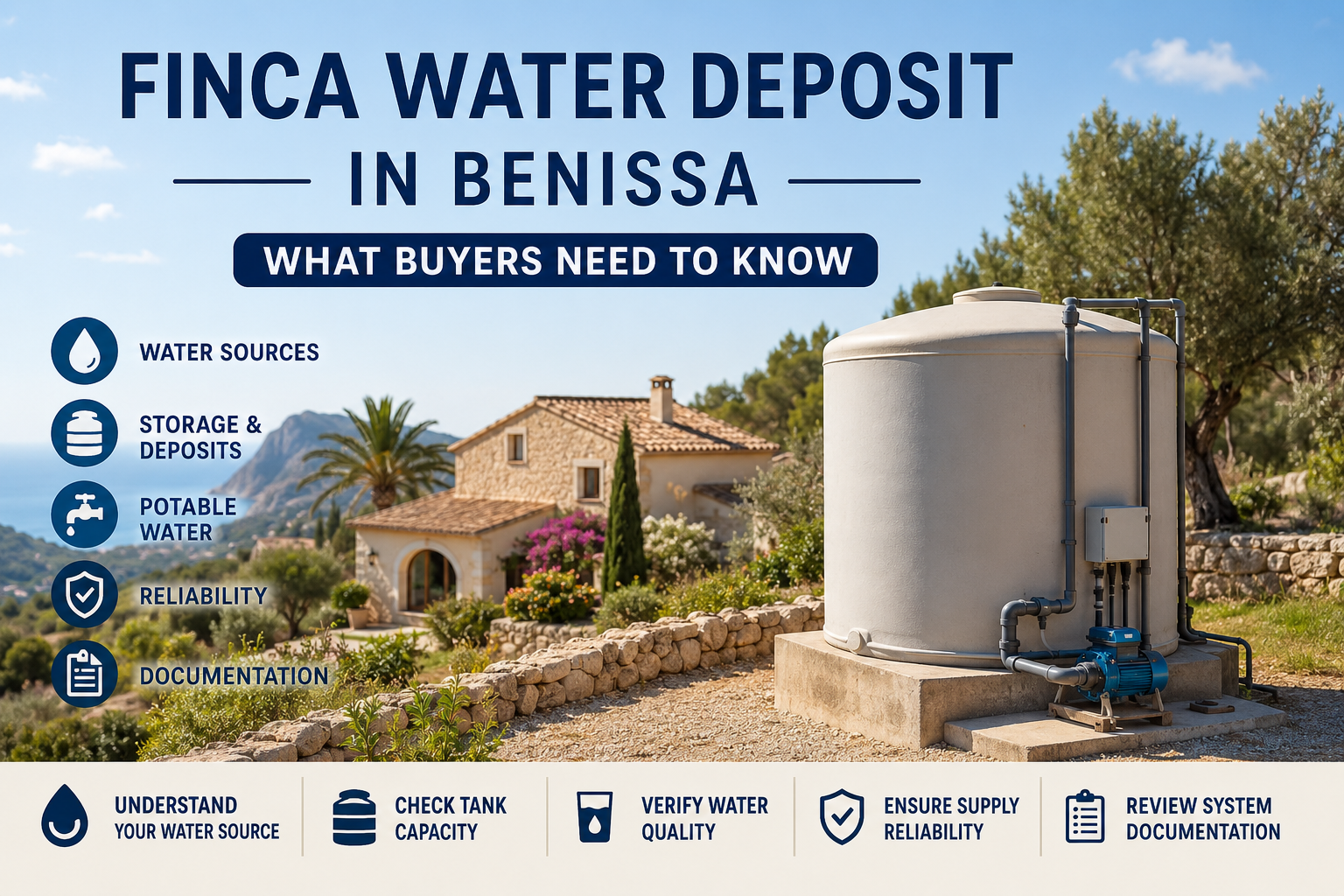
Finca Water Deposit in Benissa: What Buyers Need to Know
Introduction
A water deposit in a finca is not unusual when buying a rural property in Benissa. In Spanish property listings, you may see terms such as depósito de agua, depósito de agua en finca rústica, aljibe or depósito de almacenamiento. These terms describe water-storage infrastructure, but they do not necessarily tell you where the water comes from, whether it is potable or how dependable the supply is.
That distinction matters.
A finca in areas such as Benimarco, Pedramala, Buenavista or the countryside behind Benissa Costa can have a very different water arrangement from a villa on a fully serviced urbanised street. Even properties relatively close to the coast can have different utility arrangements depending on their exact location, infrastructure and history.
Benissa's municipal drinking-water system itself has a distinctive local characteristic: Aigües de Benissa states that the municipality's public drinking-water supply comes entirely from groundwater, with supply wells located in Benissa and neighbouring municipalities. That is very different from saying that an individual rural property has its own private well or borehole.
The important question when buying a finca is therefore not simply:
“Does the finca have a water deposit?”
It is:
“Where does the water come from, how is it stored and distributed, is it suitable for its intended use, and is the whole system reliable and properly documented?”
For buyers, five questions should be answered before making a decision:
-
Where does the water come from?
-
How much water can the deposit store?
-
Is the water suitable for drinking?
-
How reliable is the supply and filling system?
-
Can the water source and installation be properly evidenced and, where relevant, professionally verified?
This guide explains how water deposits work on fincas in Benissa, what to check during a viewing and due diligence, and why a deposit should be assessed as part of the property's complete utility system.
Expert Tip: A well-designed and properly maintained water-storage system can work perfectly well for a rural property. A large tank with an unreliable source, poor pump, leaks or unclear documentation is a very different proposition.
Water Deposit on a Finca: At a Glance
| Question | Short answer |
|---|---|
| Is a water deposit a problem? | Not necessarily. The complete system matters. |
| Does a water deposit mean there is no mains water? | No. A property can have both. |
| Can the water be used for drinking? | Potentially, but do not assume it. |
| Is a larger tank always better? | No. Source, consumption and refill arrangements matter too. |
| Should the system be inspected before buying? | Yes. Particularly if the source or installation is unclear. |
| Is a well the same as having a verified water supply? | No. The source and relevant rights or authorisations may need separate verification. |
| Can a finca be connected to mains water later? | Potentially, but this must be established for the individual property. |
Table of Contents
-
What Is a Water Deposit on a Finca?
-
How Does a Finca Get Its Water?
-
Is Water From a Finca Deposit Safe to Drink?
-
How Large Should a Finca Water Deposit Be?
-
How Does a Water Deposit Work in Everyday Finca Life?
-
Water Deposits and Mains Water in Benissa
-
Buying a Finca With a Water Deposit: What Should You Check?
-
Documents and Information to Request Before Buying
-
Water Deposit: Advantages and Disadvantages
-
How Much Does a Finca Water Deposit Cost to Run?
-
Water Deposits, Swimming Pools and Gardens
-
Water and Other Finca Utilities
-
Real-Life Finca Water Deposit Examples in Benissa
-
Finca Water Deposit Buyer Checklist
-
Frequently Asked Questions
-
Final Thoughts: Is a Water Deposit a Problem When Buying a Finca?
What Is a Water Deposit on a Finca?
A water deposit is essentially a tank or cistern used to store water before it is used by the property.
In Spanish, you may encounter:
-
Depósito de agua
-
Depósito de agua en finca rústica
-
Aljibe
-
Cisterna
-
Depósito de almacenamiento
The terminology can vary depending on the age, construction and history of the property.
A traditional finca may have an underground aljibe, while a more modern rural property may use a purpose-built concrete or polyethylene tank.
The most important point is that the deposit is storage.
It does not automatically tell you the source of the water.
Water deposit vs water supply
A useful way to understand a finca's system is to separate it into four stages:
Source → Storage → Distribution → Use
For example:
Mains water → Deposit → Pump → House
Or:
Tanker delivery → Deposit → Pump → House
Or:
Rainwater collection → Cistern → Pump → Irrigation
A property could therefore have a water deposit and still be connected to mains water.
Conversely, a property could have a very large deposit but no direct mains connection.
This is why the phrase “water deposit” should never be treated as a complete description of the property's water supply.
Why water deposits are common on rural properties
Fincas historically developed differently from properties within fully serviced areas.
Rural properties may have:
-
Older water-storage infrastructure
-
Underground cisterns
-
Larger plots requiring irrigation
-
Different utility infrastructure
-
Agricultural or former agricultural uses
-
Water systems that have been modified over the years
In Benissa, this is particularly relevant when looking at rural properties away from more densely serviced urban areas.
A finca in Pedramala, Benimarco or the countryside behind Benissa Costa can have a very different utility arrangement from an apartment or villa within a fully serviced urbanisation.
Common types of water deposits
| Type | Typical characteristics | What buyers should check |
|---|---|---|
| Underground cistern | Hidden below ground | Access, waterproofing, cleaning and condition |
| Above-ground tank | Visible storage tank | Material, condition, fittings and capacity |
| Concrete deposit | Often found in older or purpose-built systems | Cracks, waterproofing and internal condition |
| Polyethylene tank | Modern, lightweight storage | Age, UV exposure, fittings and capacity |
| Traditional aljibe | Historic underground cistern | Structure, access, cleaning, pump and modern plumbing |
A traditional aljibe can be an interesting feature of an older finca, but its age means the buyer should understand exactly how it is being used today.
Important: Never assume that an old aljibe is suitable for drinking water simply because it has historically been used for household water.
How Does a Finca Get Its Water?
A water deposit only makes sense when you know how it is filled.
There are several possible arrangements.
Mains water stored in a deposit
Some properties have a mains-water connection but use a deposit as part of their internal water-storage system.
The basic arrangement may be:
Mains supply → Deposit → Pump/pressure system → Property
The deposit may provide a reserve or form part of the property's pressure and distribution arrangement.
The exact installation varies, so buyers should establish where the meter, connection and tank are located and how the system operates.
Water delivered by tanker
Some rural properties use delivered water.
A tanker fills the deposit when required, after which a pump distributes the stored water around the property.
This can be a perfectly workable arrangement where the property has sufficient storage, practical tanker access and a reliable delivery process.
The practical questions are:
-
Who supplies the water?
-
How is it ordered?
-
How frequently is it delivered?
-
How much does the property normally require?
-
Is there a record of previous deliveries?
-
Is the delivered water intended for potable use?
-
Is the same water used for the house, pool and garden?
Do not rely solely on the seller saying that “water comes by tanker”. Establish the complete process.
Rainwater collection
Some fincas collect rainwater from roofs or other surfaces and direct it towards a cistern.
Rainwater collection can be useful for certain non-potable applications, but collected rainwater is not automatically suitable for drinking.
The collection surface, tank, treatment and distribution system all matter.
Well or borehole water
A finca may have a well or borehole.
This requires particular care during due diligence.
The physical existence of a well does not by itself establish the property's legal or administrative position concerning the water source.
The Confederación Hidrográfica del Júcar provides specific procedures for private use of groundwater, including small-volume groundwater uses and the registration of certain water uses. It also distinguishes between different types of concessions and authorisations depending on the source and intended use.
This does not mean that every existing well on a finca is problematic. It means that buyers should distinguish between:
“There is a well.”
and:
“The property's position concerning the well and water use has been verified.”
If a property relies on groundwater, ask for the relevant documentation and obtain professional advice where necessary.
Shared water systems
Some rural properties may have water arrangements involving shared infrastructure or sources.
Where this occurs, establish:
-
Who owns the infrastructure
-
Who maintains it
-
Who pays for maintenance
-
How water is allocated
-
Whether there are written agreements
-
Whether the arrangement transfers with the property
-
Whether there are any relevant rights or obligations
A shared physical connection should not be assumed to mean that the legal and financial arrangements are straightforward.
Fincas using more than one water source
Some properties have a combination of systems.
For example:
Mains water → deposit → house
plus:
Rainwater → separate tank → garden
Or:
Delivered water → deposit → house and pool
The more complex the system, the more important it is to understand the pipework and controls.
The basic finca water system
A useful way to visualise the system is:
Water source → Deposit → Pump → Filtration/Treatment → House / Garden / Pool
Before buying, ask the seller or technician to physically show you each stage.
Common Mistake: Buyers sometimes see a water tank and immediately assume they have understood the property's water system. The tank is only one part of that system.
Is Water From a Finca Deposit Safe to Drink?
Not necessarily.
The word “deposit” describes storage, not water quality.
Spanish drinking-water rules establish requirements for water intended for human consumption, including its quality, control and supply. Real Decreto 3/2023 defines consumption water broadly and covers water supplied through networks as well as water supplied through cisterns and mobile deposits. The legislation also establishes quality requirements and control points through the supply chain.
For a private finca, however, you should not assume that water is potable merely because it reaches the taps.
What does “potable water” mean?
Potable water means water that is suitable for human consumption.
That is different from water that is merely suitable for:
-
Garden irrigation
-
Cleaning
-
Toilet flushing
-
Agricultural use
-
Other non-potable applications
The intended use matters.
Why the source of the water matters
Consider four examples:
| Water source | Automatically safe to drink? | What to establish |
|---|---|---|
| Mains drinking-water supply | Do not assume the private installation changes nothing | Check the property installation and any storage/treatment |
| Tanker delivery | Not automatically | Confirm intended use and relevant quality information |
| Rainwater | No | Treatment and testing would be needed for potable use |
| Well/borehole | No | Source, quality, relevant status and treatment need checking |
Even when the original source is treated drinking water, the property's private storage and internal plumbing can affect the water that reaches the taps.
Why the condition of the deposit matters
A deposit should be inspected for:
-
Cracks
-
Leaks
-
Damaged covers
-
Poor access
-
Sediment
-
Dirt
-
Algae or biological growth
-
Corrosion where relevant
-
Deteriorated pipework
-
Poorly maintained fittings
The age of the tank is not necessarily the decisive issue. Its present condition and use are more important.
Water testing and filtration
If the water supply is not straightforward, consider obtaining a water-quality analysis from an appropriately qualified laboratory.
Depending on the source and intended use, a system may include:
-
Sediment filtration
-
Carbon filtration
-
UV treatment
-
Other treatment equipment
The appropriate treatment depends on the results and the source of the water.
A filtration system should not be treated as a substitute for understanding the source.
Questions buyers should ask about drinking water
Ask:
-
Is the water used for drinking?
-
Where does it come from?
-
Has it been tested?
-
When was it last tested?
-
Is treatment installed?
-
Who maintains the treatment system?
-
Does the deposit store drinking water or irrigation water?
-
Does the same tank supply the pool or garden?
-
Are there separate tanks or pipe circuits?
Warning: Never assume that water stored in a finca deposit is suitable for drinking. If the source or quality is uncertain, obtain appropriate professional advice and testing before using it as drinking water.
How Large Should a Finca Water Deposit Be?
There is no universal “correct” tank size for a finca.
The appropriate capacity depends on how the property is used.
Understanding water capacity in litres
Water tanks are commonly described by capacity.
For example:
-
10,000 litres = 10 m³
-
20,000 litres = 20 m³
-
50,000 litres = 50 m³
A 50,000-litre deposit therefore holds five times as much water as a 10,000-litre deposit.
But bigger does not automatically mean better.
What determines household water consumption?
The main factors include:
-
Number of occupants
-
Permanent or holiday use
-
Number of bathrooms
-
Frequency of showers and baths
-
Washing machine use
-
Dishwasher use
-
Garden size
-
Irrigation requirements
-
Swimming pool requirements
-
Outdoor taps
-
Frequency of entertaining
-
Water-saving measures
A two-person holiday home with a low-maintenance garden can have very different requirements from a six-person property occupied throughout the summer.
Why there is no single ideal tank size
Imagine two properties.
Finca A
-
Two occupants
-
Used mainly at weekends
-
Small garden
-
No substantial irrigation
-
20,000-litre deposit
Finca B
-
Six occupants
-
Regular summer occupation
-
Large garden
-
Extensive irrigation
-
Swimming pool
-
50,000-litre deposit
The larger tank does not necessarily mean Finca B has the better water system.
The source, refill arrangements and consumption are equally important.
What do 10,000, 20,000 or 50,000 litres actually mean?
| Deposit size | Capacity | Practical interpretation |
|---|---|---|
| 10,000 litres | 10 m³ | Smaller reserve; consumption needs careful management |
| 20,000 litres | 20 m³ | Moderate storage for many domestic situations |
| 50,000 litres | 50 m³ | Substantial storage where larger reserves are useful |
These are capacity comparisons, not recommendations.
The correct size should be assessed against the property's actual consumption and refill arrangements.
How long will the deposit last?
A simple starting point is:
Available water ÷ average daily consumption = theoretical storage duration
For example, if a 20,000-litre deposit contained 20,000 litres and a household used 500 litres per day, the theoretical storage would be 40 days.
That calculation is only illustrative.
Real properties are more complicated because consumption changes with:
-
Occupancy
-
Irrigation
-
Pool top-ups
-
Seasonal conditions
-
Leaks
-
Cleaning
-
Outdoor use
Historical tanker deliveries and the seller's actual usage records are therefore more useful than a theoretical calculation alone.
Expert Tip: Ask the seller not only “How big is the tank?” but also “How long does it normally last?” That second question often tells you more.
How Does a Water Deposit Work in Everyday Finca Life?
A finca water system can become straightforward once you understand it.
The deposit stores water. A pump or pressure system then moves that water through the property's plumbing.
How the deposit is filled
Depending on the property, the tank may be filled by:
-
Mains water
-
Tanker delivery
-
Rainwater
-
A well or borehole
-
A combination of sources
Ask the seller to demonstrate the process.
If a tanker is required, check whether the tanker can physically reach the filling point.
This is particularly important for rural properties with:
-
Narrow access roads
-
Steep drives
-
Tight gates
-
Limited turning space
-
Long distances between the road and tank
A theoretically convenient tanker supply can become much less convenient if the delivery vehicle cannot access the property properly.
Water pumps and household pressure
A pump may be needed to provide sufficient pressure to the property.
During a viewing, listen for unusual pump noises and ask:
-
How old is the pump?
-
Has it been replaced?
-
Where is it located?
-
Is there a backup?
-
What happens if the pump fails?
-
What pressure does the system normally provide?
A full deposit does not guarantee good household water pressure.
This is particularly relevant in larger fincas, multi-storey houses and properties where several bathrooms may be used simultaneously.
What happens if the pump fails?
Ask the seller to explain the failure scenario.
Depending on the system, a pump failure could mean:
-
No water at taps
-
Low or no pressure
-
Garden irrigation stopping
-
Pool systems being affected
-
Water remaining in the tank but being inaccessible to the house
A buyer should know whether a replacement pump is readily available and whether the system has protective controls.
Common Mistake: Checking that a tank is full without checking whether the pump can reliably move the water through the property.
Filters and treatment systems
Where filtration or treatment equipment is installed, establish:
-
What it does
-
Why it was installed
-
How often filters are changed
-
Who services it
-
Whether maintenance records exist
What happens if the deposit runs empty?
Possible consequences include:
-
No water at taps
-
Loss of pressure
-
Pump problems
-
Garden irrigation stopping
-
Pool filling or top-up being unavailable
Ask whether the system has level sensors, automatic shut-off or other safeguards where appropriate.
Planning water supplies during summer
Summer is particularly important in the Costa Blanca.
A holiday finca may go from minimal consumption to several people using:
-
Multiple showers
-
Toilets
-
Washing machines
-
Dishwashers
-
Outdoor taps
-
Pool facilities
-
Irrigation
A tank that appears generous during winter may be used much more quickly in July and August.
How rural living differs from having direct mains water
With a straightforward mains connection, the owner generally thinks about water consumption and utility bills.
With a storage-based system, the owner may also need to think about:
-
Tank level
-
Refilling
-
Pump maintenance
-
Filtration
-
Water quality
-
Emergency reserves
This is not necessarily a disadvantage. It is simply part of understanding rural property ownership.
Water Deposits and Mains Water in Benissa
Does the finca have mains water?
This should be answered specifically for the property.
Do not rely on phrases such as:
-
“Water nearby”
-
“Water available”
-
“Connection possible”
-
“Mains water in the area”
These phrases can mean very different things.
A property can be close to a water main without being connected to it.
“Water available nearby” vs “water connected”
There is a major difference between:
A. Mains water connected to the property
and:
B. A mains-water network existing somewhere nearby
The first describes an existing connection.
The second does not necessarily establish that a connection to the property is available, technically feasible, permitted or economically practical.
How to establish whether a property is connected
During due diligence, look for evidence such as:
-
Water bills
-
Existing supply contract
-
Meter
-
Connection point
-
Utility information
-
Seller documentation
-
Information from the relevant provider
-
Physical inspection of the installation
The exact evidence will depend on the property.
Can a finca potentially be connected to mains water?
Potentially, but this must be assessed property by property.
Factors can include:
-
Location
-
Existing network
-
Distance
-
Infrastructure
-
Technical feasibility
-
Property circumstances
-
Requirements of the relevant provider or authority
-
Applicable planning and utility rules
There is no sensible blanket statement that every finca can, or cannot, be connected.
Why buyers should verify this rather than rely on the property listing
A property listing is a marketing document, not a substitute for technical and legal due diligence.
For a finca in Benissa, particularly in rural areas such as Pedramala or Benimarco, the exact location can make a substantial difference to the utility arrangement.
Important: Do not value a finca on the assumption that mains water can be connected in the future until the relevant feasibility, requirements and costs have been checked.
Buying a Finca With a Water Deposit: What Should You Check?
The water system should form part of the buyer's technical and documentary due diligence.
Identify the water source
Write down exactly where the water comes from.
Do not accept simply:
“The property has water.”
Instead establish:
“The property receives water from X, stores it in Y and distributes it through Z.”
Confirm the deposit capacity
Ask for:
-
Capacity in litres
-
Approximate age
-
Location
-
Type of construction
-
Whether it is one tank or several
If the capacity is unknown, consider having it professionally assessed where necessary.
Inspect the physical condition
Look for:
-
Cracks
-
Dampness
-
Leaks
-
Corrosion
-
Poor covers
-
Damaged access points
-
Sediment
-
Signs of previous repairs
An underground tank may require a more specialist inspection than a visible above-ground tank.
Check the pump and filtration system
Establish:
-
Pump condition
-
Pressure system
-
Filter type
-
Treatment equipment
-
Service history
-
Replacement history
Establish whether the water is potable
Ask for evidence rather than relying on assumptions.
Where appropriate, consider independent water testing.
Ask how the deposit is normally filled
If it is tanker-filled, ask:
-
Who delivers it?
-
How often?
-
Where does the tanker stop?
-
Where is the filling point?
-
How long does a delivery last?
-
Are invoices available?
Ask about water deliveries and previous usage
Previous delivery records can provide useful practical information.
They may help show:
-
Frequency of filling
-
Seasonal demand
-
Typical consumption
-
Whether the current system meets the household's needs
Check for leaks
Ask whether the owner has experienced:
-
Falling tank levels
-
Wet areas
-
Pump cycling
-
Unexpected water consumption
-
Plumbing leaks
A tank that needs unusually frequent filling may have a problem elsewhere in the system.
Establish what the deposit supplies
Determine whether it feeds:
-
House
-
Pool
-
Garden
-
Irrigation
-
Outdoor taps
-
Other buildings
Check whether domestic and irrigation systems are separate
If there are separate circuits, establish exactly what each one supplies.
This can be particularly useful where a property has a large garden or agricultural land.
Check the water source and relevant rights or authorisations
This is particularly important for:
-
Wells
-
Boreholes
-
Springs
-
Groundwater
-
Shared water arrangements
The Confederación Hidrográfica del Júcar provides different procedures for groundwater use depending on the circumstances, including concessions and certain small-volume uses. It also provides information about checking the status of water uses.
A physical water source should therefore not be treated as proof that the property's position concerning that source is fully established.
Check whether the system is documented
This is particularly important if the installation is substantial or has been modified.
Ask whether plans, invoices, technical documents or other evidence exist.
Ask about future mains-water options
If mains water is not currently connected, ask what is known about the possibility of future connection.
Do not assume.
A Simple Finca Water Risk Framework
One of the easiest ways to assess a water system is to classify the situation after the initial inspection.
| Situation | Initial assessment | What to do |
|---|---|---|
| Mains connected + functioning deposit | Lower concern | Verify the installation and bills |
| Tanker supply + substantial tank + delivery records | Potentially workable | Review reliability and running costs |
| Tanker supply + relatively small tank | Investigate | Establish refill frequency and access |
| Unknown water source | Serious question | Establish the source before proceeding |
| Well/borehole with unclear status | Investigate professionally | Verify the relevant water position |
| Tank showing significant leakage | Lower concern | Obtain a repair assessment |
| Unreliable pump | Lower concern | Obtain a repair or replacement estimate |
| Water quality unknown | Lower concern | Obtain appropriate testing/advice |
| Shared supply with unclear rights or costs | Lower concern | Establish the arrangement and obligations |
This is not a legal classification. It is a buyer decision-making framework.
A red flag does not necessarily mean “walk away”. It means:
Do not proceed on assumptions. Investigate the issue before committing.
Documents and Information to Request Before Buying
The documentation required will vary depending on the property and water arrangement.
The objective is to distinguish between evidence that water exists and evidence concerning the legal, administrative or technical status of the source and installation.
Water bills and tanker delivery records
These can help establish how the property obtains water and how frequently it needs refilling.
For a tanker-supplied finca, request recent invoices where available.
Existing water contracts or utility information
Where mains water exists, ask for relevant supply information.
A bill showing consumption is useful evidence, but the buyer should still establish what infrastructure actually serves the property.
Water-quality information or test results
Where water is used for human consumption and its source or storage arrangement is unusual, ask whether relevant testing has been carried out.
A historical test is useful information, but it should not automatically be treated as proof of current water quality.
Technical documentation where relevant
Depending on the installation, this might include:
-
Tank specifications
-
Pump information
-
Installation invoices
-
Filtration documentation
-
Technical plans
-
Maintenance records
-
Relevant permits or authorisations
-
Water-use documentation where applicable
Not every finca will have the same documentation.
Property plans
Plans can help identify:
-
Tank location
-
Pipe routes
-
Pump rooms
-
Utility areas
-
Water-related installations
Nota Simple and Catastro
The Registro de la Propiedad and Catastro provide important property information, but neither should automatically be treated as a complete technical description of every water installation.
A water deposit physically existing on a property does not mean that every aspect of its installation or use has necessarily been recorded in the same way in every document.
Information from the relevant water authority or provider
Where there is uncertainty about:
-
Connection
-
Supply
-
Contract
-
Infrastructure
-
Water source
-
Well or borehole status
seek confirmation from the relevant organisation.
Expert Tip: For a rural property, think in terms of a chain of evidence: physical system + utility evidence + property documentation + professional checks. No single document is guaranteed to answer every question.
Water Deposit: Advantages and Disadvantages
A water deposit is not inherently good or bad.
Its value depends on how well the complete system works.
Advantages of having a water deposit
Potential advantages include:
-
Water storage
-
A reserve on the property
-
Greater flexibility
-
Useful infrastructure for rural properties
-
Ability to manage water where direct supply arrangements differ
-
Potential separation of domestic and irrigation supplies
Potential disadvantages
Potential disadvantages include:
-
Need for refilling
-
Pump dependency
-
Tank maintenance
-
Water-quality considerations
-
Limited storage
-
Potential delivery costs
-
Potential repair or replacement costs
When a water deposit should not concern a buyer
A deposit should generally be viewed positively when:
-
Its capacity is known
-
The source is clear
-
The system is reliable
-
The tank is in good condition
-
The pump works correctly
-
Water quality is appropriate for its intended use
-
Filling arrangements are practical
-
The installation is properly understood and documented
When a water deposit deserves further investigation
Pay particular attention when:
-
Nobody can explain where the water comes from
-
The tank capacity is unknown
-
The deposit has visible damage
-
The pump repeatedly fails
-
Water quality is uncertain
-
The property depends entirely on tanker deliveries but has little storage
-
There are unexplained leaks
-
Documentation is missing
-
A well or borehole exists but its status is unclear
-
The seller makes assumptions about a future mains connection
-
A shared water arrangement has unclear costs or obligations
Common Mistake: Rejecting a finca simply because it has a water deposit can be just as unhelpful as ignoring a poorly understood water system because “the property has water”.
How Much Does a Finca Water Deposit Cost to Run?
There is no reliable single figure for the running cost of a finca water deposit.
The cost depends on the property's source, consumption and equipment.
Water delivery costs
If the property relies on tanker deliveries, the cost can vary according to factors such as:
-
Supplier
-
Delivery volume
-
Distance
-
Access
-
Frequency
-
Seasonal demand
For this reason, avoid relying on a generic internet price.
Ask the seller for recent invoices where possible.
A useful way to compare properties is to calculate:
Annual water-delivery cost = number of deliveries × verified cost per delivery
Then consider how that cost changes during periods of higher occupancy.
Electricity for pumps
A pumped system uses electricity.
The actual cost depends on:
-
Pump size
-
Pump efficiency
-
Operating time
-
Water pressure
-
Frequency of use
-
Electricity tariff
Cleaning and maintenance
Tanks may require periodic inspection and cleaning appropriate to their design and use.
Filters and treatment equipment may also require servicing.
Repairs
Potential repairs include:
-
Pumps
-
Valves
-
Pipework
-
Tank fittings
-
Pressure equipment
-
Filtration systems
-
Electrical components
Potential infrastructure upgrades
Older fincas may eventually need improvements.
Examples could include:
-
Replacing an old pump
-
Improving filtration
-
Repairing a tank
-
Separating domestic and irrigation circuits
-
Adding level monitoring
-
Improving access to the tank
-
Replacing outdated pipework
Because installation costs are property-specific, obtain quotations before assigning a value to any proposed upgrade.
Water Deposits, Swimming Pools and Gardens
One of the most important practical questions is:
What exactly does the water deposit supply?
Domestic water vs irrigation water
A property may use different water sources or systems for:
-
Household consumption
-
Garden irrigation
-
Pool top-up
-
Agricultural use
Do not assume that one water supply is intended for every purpose.
Supplying a swimming pool
A swimming pool can substantially increase water demand, particularly when filling, topping up or carrying out maintenance.
Ask:
-
How was the pool originally filled?
-
What water source is used for top-ups?
-
Is there a separate water arrangement?
-
Is the pool supplied from the domestic deposit?
-
How much water has historically been required?
Garden irrigation
A large Mediterranean garden can have significant seasonal water requirements.
A property with mature planting, lawns, fruit trees or extensive irrigation can consume considerably more water than a low-maintenance garden.
Why buyers need to establish whether systems are separate
A well-designed system may separate:
Domestic supply
from:
Irrigation supply
This can make management easier.
But every property is different.
How a large garden can change water requirements
When viewing a finca, do not look only at the house.
Look at:
-
Garden size
-
Number of irrigated zones
-
Trees
-
Lawns
-
Hedges
-
Vegetable gardens
-
Agricultural land
-
Pool
-
Outdoor showers
The water system should be assessed against the property as a whole.
Water and Other Finca Utilities
Water rarely exists in isolation.
A rural property may have a complete utility system involving water, electricity, wastewater and renewable energy.
Water supply and septic tanks
A finca without a conventional sewer connection may rely on a septic or wastewater treatment system.
The two systems should be assessed separately.
Water coming into the property and wastewater leaving the property are different issues.
Internal link opportunity: Finca Septic Tanks: What Buyers Need to Know
Water and electricity
Pumps, pressure systems and treatment equipment require electricity.
If the property has an unusual electricity supply, this becomes particularly important.
For example, establish what happens to the water supply during a power cut.
Water and solar power
Solar panels can reduce dependence on the electricity grid, but a solar installation does not automatically guarantee that the water pump can operate under every condition.
Ask how the pump is powered and what happens when the electricity supply is interrupted.
Internal link opportunity: Solar Power for a Finca
Understanding the complete rural utility system
For a finca, consider the system as:
Water in → Electricity → House → Wastewater out
Then add:
Pool + Garden + Irrigation + Internet + Security
This broader approach is more useful than checking individual utilities separately.
Real-Life Finca Water Deposit Examples in Benissa
The following are illustrative Benissa-style scenarios, not claims about specific properties or transactions. They are designed to show how a buyer should analyse different water arrangements.
Example: A finca with a 20,000-litre deposit
Imagine a two-bedroom finca used primarily as a holiday home.
It has:
-
Two occupants most of the year
-
Heavier use during summer
-
A modest garden
-
A swimming pool
-
A 20,000-litre deposit
-
Tanker delivery when required
The key question is not whether 20,000 litres sounds large.
The important questions are:
-
How quickly does the household use the water?
-
How much does the garden require?
-
Does the pool share the supply?
-
How frequently does the tank need filling?
-
Can a tanker reach the property easily?
If historical records show that the tank comfortably supports normal use, the system may be perfectly practical.
Example: A finca with a 50,000-litre deposit
Now imagine a larger rural property with a 50,000-litre deposit.
It sounds impressive.
But suppose the property also has:
-
Six occupants
-
A large garden
-
Extensive irrigation
-
Swimming pool
-
Regular summer occupation
The larger capacity does not automatically mean the property has an excellent water supply.
A large tank is only useful if:
-
It is in good condition.
-
It can be filled reliably.
-
The source is suitable.
-
The pump works.
-
The water is appropriate for its intended use.
Example: A traditional finca with an underground aljibe
A traditional Benissa finca may contain an old underground aljibe.
This can be part of the property's character and history.
But buyers should establish:
-
Structural condition
-
Access
-
Capacity
-
Cleaning history
-
Waterproofing
-
Pump condition
-
Pipework
-
Current use
-
Whether it is used for potable or non-potable water
A historic installation can be perfectly serviceable, but it should not be judged by appearance alone.
Example: A finca with a deposit and mains-water connection
This arrangement is fundamentally different from a property with no mains connection.
For example:
Mains supply → Deposit → Pump → House
Here, the deposit may function primarily as storage within the property's water system.
The buyer should still establish:
-
Where the mains connection is
-
Where the meter is
-
Whether the supply is active
-
Whether the deposit is necessary for pressure
-
What happens if the pump fails
-
Whether the property can operate directly from the mains under the existing configuration
The precise answer will depend on the installation.
Example: A finca with a private well or borehole
Suppose a property in the Benissa countryside is marketed as having “its own water”.
The property may physically have a well, pump and storage tank.
That is useful information, but it is not enough on its own.
The buyer should establish:
-
What type of source it is
-
How the water is extracted
-
What the water is used for
-
Whether the water quality has been checked where appropriate
-
What documentation exists concerning the water use
-
Whether the source and relevant rights or authorisations have been verified
The Confederación Hidrográfica del Júcar specifically provides procedures for groundwater uses and information concerning registration and concessions.
This is a good example of why “the property has water” and “the water system has been properly verified” are two different statements.
Finca Water Deposit Buyer Checklist
Use this checklist when viewing or carrying out due diligence on a finca in Benissa.
Water source
-
What is the water source?
-
Is the property connected to mains water?
-
Is water delivered by tanker?
-
Is there a well or borehole?
-
Is rainwater collected?
-
Are multiple water sources used?
-
Is there a shared water arrangement?
Deposit
-
How large is the deposit?
-
What is its capacity in litres?
-
Where is it located?
-
What type of tank is it?
-
How old is it?
-
Is its condition satisfactory?
-
Are there signs of leaks?
-
Is access for inspection possible?
-
Can the tank be cleaned and serviced?
Water quality
-
Is the water potable?
-
What is the intended use of the water?
-
Has the water been tested where appropriate?
-
Is filtration installed?
-
Is treatment installed?
-
Are maintenance records available?
Operation
-
How is the deposit filled?
-
How often is it filled?
-
How long does a normal fill last?
-
Is there a pump?
-
Does the pump work correctly?
-
Is there a pressure system?
-
What happens during a power cut?
-
What happens if the deposit runs empty?
-
Is there any backup arrangement?
Property use
-
Does the system supply the house?
-
Does it supply the swimming pool?
-
Does it supply the garden?
-
Does it supply irrigation?
-
Are domestic and irrigation systems separate?
-
Is there agricultural land with additional water requirements?
Documentation
-
Are water bills available?
-
Are tanker invoices available?
-
Is there a water contract?
-
Is there technical documentation?
-
Are plans available?
-
Is there information about the water source?
-
Is there documentation concerning any well or borehole?
-
Has the relevant provider or authority been contacted where necessary?
Future plans
-
Is mains water available nearby?
-
Is a future connection being considered?
-
Has technical feasibility been established?
-
Have potential costs been verified?
-
Are there any restrictions or requirements that need professional advice?
Frequently Asked Questions About Finca Water Deposits
What is a water deposit on a finca?
A water deposit is a tank or cistern used to store water at a property. It is a storage system rather than a description of the water source. The water may come from mains supply, tanker delivery, rainwater, groundwater or another arrangement, depending on the property.
Why do fincas in Benissa have water deposits?
Rural properties can have different utility arrangements from properties within fully serviced urban areas. Older fincas may also retain traditional cisterns or other storage infrastructure. The exact reason should be established for each property.
Does a water deposit mean the finca has no mains water?
No. A finca can have both mains water and a deposit. The deposit may be used for storage within the property's internal system. Always establish whether the property has an active mains connection rather than assuming from the presence of a tank.
Can you drink water from a finca water tank?
Not automatically. Drinking-water suitability depends on the source, storage conditions, treatment and quality. Spanish drinking-water legislation establishes requirements for water intended for human consumption, but buyers should assess the specific property's system rather than assume that stored water is potable.
Where does water for a finca usually come from?
Possible sources include mains water, tanker deliveries, rainwater and groundwater from a well or borehole. Some properties use more than one source.
How large should a finca water deposit be?
There is no universal ideal size. Capacity should be considered alongside household size, occupancy, garden, irrigation, swimming pool, usage patterns and how easily the tank can be refilled.
How often does a finca water tank need filling?
There is no standard interval. It depends on the tank capacity, water source, number of occupants and consumption. Historical delivery records can provide a much better indication than a theoretical calculation.
Can a finca water deposit collect rainwater?
Yes, some properties use rainwater collection systems. However, collected rainwater should not automatically be assumed to be suitable for drinking. Its intended use and treatment requirements need to be established.
Can a finca be connected to mains water later?
Potentially, but this depends on the individual property, available infrastructure, technical feasibility and the requirements of the relevant provider or authority. Never assume that a future connection is guaranteed.
Is a water deposit legal on rural property?
The existence of a tank does not by itself answer every legal or technical question about an installation. The status of the specific water source, installation and property should be checked where relevant.
Where a property relies on groundwater, the Confederación Hidrográfica del Júcar has specific procedures covering different forms of private water use, including groundwater uses and registration.
Regulations and requirements can change, so professional advice may be appropriate.
Is a well the same as having a legal water supply?
No. A physical well demonstrates that a water source exists; it does not by itself establish the property's legal or administrative position concerning that source.
The relevant documentation, water-use status and applicable requirements should be checked for the individual property.
What should I check when buying a finca with a water tank?
Check the water source, capacity, physical condition, pump, filtration, water quality, filling arrangements, consumption history, documentation and whether mains water is connected or potentially available.
If there is a well, borehole or shared water arrangement, investigate the source and relevant rights or obligations separately.
Does a finca water deposit need to be cleaned?
The appropriate cleaning and maintenance depends on the tank, its construction, the water source and its intended use. Buyers should ask when it was last inspected or cleaned and obtain professional advice where necessary.
How can I tell if a finca water tank is leaking?
Warning signs can include unexplained loss of water, unusually frequent filling, damp areas, water around the tank, persistent pump operation or unexplained increases in consumption. A proper inspection may be required to identify the cause.
What happens if the water pump fails?
It depends on the installation. A pump failure can result in low or no water pressure even when the deposit itself contains water. Ask where the pump is located, how old it is, whether it has been maintained and how quickly it could be repaired or replaced.
Can a water deposit supply both the house and swimming pool?
It can, depending on the property's design. However, buyers should establish whether the house, pool, garden and irrigation systems share the same storage and whether this creates additional demand on the deposit.
Can a tanker reach every finca?
No assumption should be made. Rural access can involve narrow roads, steep drives, gates and limited turning space. If tanker delivery is essential, physically establish how the delivery vehicle reaches the filling point.
What is an aljibe on a Spanish finca?
An aljibe is traditionally a cistern used to store water. Many older rural properties have underground or masonry water-storage structures. Their present condition, access, plumbing, pump and intended use should be checked before relying on them.
What is the difference between an aljibe and a modern water tank?
Both can provide water storage, but an aljibe is typically a traditional cistern, often built into or below the property, while a modern tank may be a purpose-built concrete, plastic or polyethylene storage vessel. The important issue is not the name but the condition and suitability of the installation.
Can two rural properties share the same water source?
Potentially, depending on the arrangement. If a property relies on shared water infrastructure, the buyer should establish ownership, maintenance responsibilities, costs, usage arrangements and any relevant rights or obligations before purchase.
How do I calculate how long a water tank will last?
As a starting point:
Tank capacity ÷ average daily consumption = theoretical storage duration
But this is only an estimate. Garden irrigation, swimming pools, seasonal occupation, leaks and other uses can substantially change consumption.
Should I test the water before buying a finca?
Where the source or quality is uncertain, independent water testing can be a sensible part of due diligence. This is particularly relevant where the property uses a private source, unusual storage arrangement or water that is not clearly established as suitable for human consumption.
Does a water deposit affect the value of a finca?
Not in isolation. A reliable, well-maintained water system can be a practical advantage. A poorly understood or unreliable system can create uncertainty and potential costs. The effect on value depends on the complete property and the alternatives available to buyers.
Is buying a finca without mains water a problem?
Not necessarily. Many buyers are comfortable with rural utility systems. The important issue is whether the alternative supply is reliable, suitable for the property's intended use, practical to operate and properly understood before purchase.
Final Thoughts: Is a Water Deposit a Problem When Buying a Finca?
A water deposit in a finca should not automatically be treated as a problem.
For many rural properties, water storage is simply part of how the water system works.
The better question is whether the complete water system makes sense for the property.
Before buying, establish:
-
Where the water comes from
-
How much can be stored
-
How the tank is filled
-
Whether the water is suitable for its intended use
-
How the water is pumped around the property
-
What happens if the pump fails
-
How much water the property normally consumes
-
Whether the pool and garden share the same supply
-
Whether mains water is connected
-
What documentation exists
-
Whether any well, borehole or shared water arrangement has been properly investigated
-
Whether any legal or technical questions require specialist advice
This is particularly important when comparing rural properties in different parts of Benissa. A finca in Pedramala may have a different water arrangement from one in Benimarco, Buenavista, Fanadix or another part of the municipality. Proximity to the coast does not, by itself, tell you exactly how a property's utilities are configured.
The key principle is simple:
The important question is not simply whether a finca has a water deposit. It is whether the entire water system is reliable, appropriate for the property's use, properly maintained and sufficiently documented.
For a buyer, the strongest evidence comes from combining the physical inspection with utility records, property documentation and professional checks where appropriate.
If a property has a large deposit, a clear source, reliable pumping, appropriate water quality, practical filling arrangements and good documentation, there may be little reason to be concerned simply because the property uses stored water.
If nobody can clearly explain where the water comes from, how the system works or what documentation supports it, that is when the issue deserves much closer attention.
Regulations, utility arrangements and technical requirements can change. Water sources, wells, boreholes, connections and installations can also be property-specific. Where the position is uncertain, buyers should obtain appropriate advice from the relevant authority and qualified professionals.
Buying a finca in Benissa?
When viewing a finca, ask to see the complete water system rather than simply asking whether the property “has water”.
A thorough rural-property review should consider the water supply alongside electricity, wastewater, access, building legality, occupancy documentation, land classification and the property's overall condition.
Understanding these details before making an offer can help you compare fincas more accurately and avoid unexpected costs or uncertainty after completion.
Telio Homes specialises in property in Benissa and the surrounding Costa Blanca North area. If you are considering buying a finca, you can contact Telio Homes to discuss a property, arrange a viewing and identify the questions that should be investigated during the purchase process.
If you are selling a finca, understanding the water system is equally important. Clear information about the source, storage, documentation and operation can make it easier for prospective buyers to understand the property and carry out their due diligence.
Expert Tip: For any finca, do not judge the water system by the size of the tank alone. Judge it by the complete chain: source → storage → pump → distribution → use → documentation.