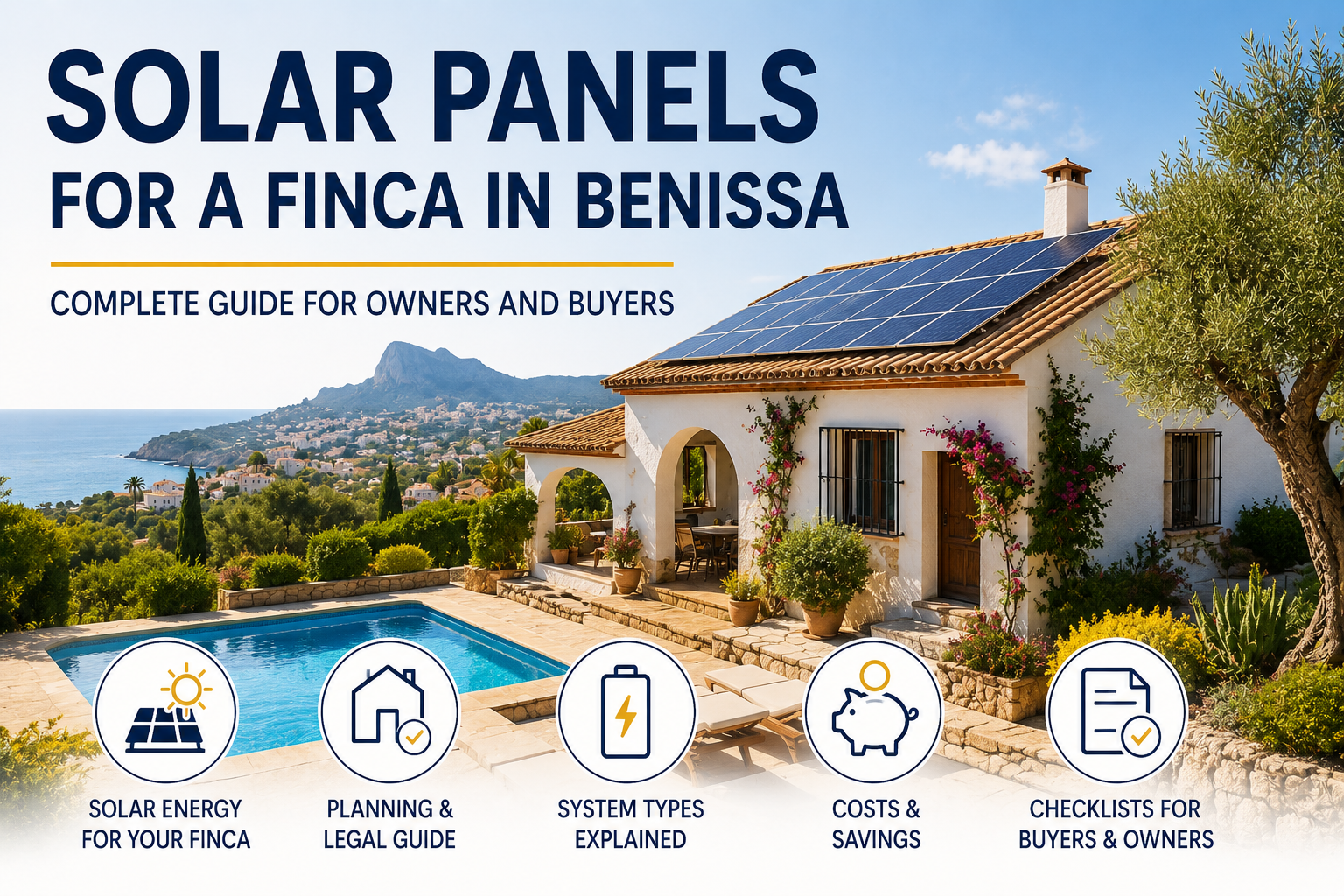
Solar Panels for a Finca in Benissa: Complete Guide for Owners and Buyers
Introduction
Solar panels for a finca in Benissa can be an attractive way of generating electricity, particularly for countryside properties with swimming pools, air conditioning, electric water heating, pumps, workshops or other significant electricity demands.
But installing solar on a finca is not simply a question of putting panels on the roof.
The right system depends on how the property is used, how much electricity it consumes, when that electricity is consumed, the available roof or land, shading, the condition of the building, whether the property is connected to the electricity grid and whether battery storage is appropriate.
There is also an important distinction for anyone buying or selling a countryside property:
The legal status of the finca and the administrative status of its solar installation are related, but they are not the same thing.
A property can have a legally established house with an old or poorly documented photovoltaic system. Equally, a property can have solar panels without that fact proving that every building, extension, swimming pool or other element of the finca is legally documented.
For buyers, this makes solar panels a due-diligence issue, not simply a desirable feature.
This guide explains solar energy for fincas in Benissa, including grid-connected, hybrid and off-grid systems, batteries, electricity generation, planning considerations, swimming pools, second homes, existing installations, documentation, maintenance, insurance and the questions buyers and sellers should ask.
It is particularly relevant to properties in areas such as Benissa Costa, La Fustera, San Jaime, Fanadix, Buenavista, Benimarco and Pedramala.
Important: Planning, electrical and autoconsumo requirements can change. This guide is intended as practical property information, not legal, tax or electrical advice. Before installing or purchasing a solar system, confirm the current requirements with the Ajuntament de Benissa, the Generalitat Valenciana and the appropriate qualified professionals.
Table of Contents
Are Solar Panels a Good Option for a Finca in Benissa?
Why Benissa is well suited to solar energy
Benissa and the wider Costa Blanca North are naturally attractive locations for solar photovoltaic generation, but the amount of electricity a particular finca can produce depends on much more than the climate.
The property's orientation, roof angle, shading, available installation area and electricity consumption all matter.
Fincas can also offer an advantage because they often have more roof or outdoor space than apartments and compact urban properties.
That does not mean that the largest possible system is automatically the best one.
A well-designed installation should be based on the property's electricity consumption and the owner's objectives.
Why fincas can benefit from solar panels
A typical countryside property may have several electricity-intensive systems operating at the same time.
These can include:
-
swimming pool filtration;
-
pool pumps;
-
pool heating;
-
air conditioning;
-
electric water heating;
-
refrigeration;
-
irrigation pumps;
-
electric gates;
-
garden lighting;
-
workshops;
-
agricultural equipment;
-
internet and security systems;
-
electric vehicle charging.
This makes a finca very different from an apartment occupied by one or two people.
Solar can be particularly effective when electricity consumption is shifted towards daylight hours.
For example, pool filtration, certain appliances, hot-water systems or EV charging may be scheduled during periods when the photovoltaic system is producing electricity.
Expert Tip: Do not start with "How many panels can I fit on the roof?" Start with "How much electricity does this property use, and when does it use it?"
Solar panels for permanent homes versus second homes
Two fincas of similar size can have completely different electricity profiles.
Permanent home
A permanently occupied finca generally has more consistent demand throughout the year.
Consumption may include:
-
cooking;
-
refrigeration;
-
hot water;
-
heating and cooling;
-
lighting;
-
laundry;
-
pool equipment;
-
home office equipment.
This regular demand can make direct use of solar electricity easier.
Second home
A second home may have relatively low consumption when empty but very high demand when occupied.
Summer occupation may coincide with:
-
air conditioning;
-
pool use;
-
increased hot-water demand;
-
more cooking;
-
longer periods of occupancy;
-
EV charging.
This makes the timing of consumption especially important.
A system designed around maximum summer consumption could produce substantial surplus during periods when the property is empty.
Factors that determine how much solar energy a finca can produce
| Factor | Why it matters |
|---|---|
| Roof orientation | Influences how much sunlight reaches the panels |
| Roof angle | Affects the generation profile |
| Shading | Trees, buildings, chimneys and other obstacles can reduce production |
| Available space | Determines how much equipment can be installed |
| Electricity consumption | Determines how much generation can be used |
| Swimming pool | Adds recurring electricity demand |
| Air conditioning | Can significantly increase summer consumption |
| Battery storage | Allows some solar generation to be used later |
| Grid connection | Provides electricity when solar production is insufficient |
Can You Install Solar Panels on a Finca in Benissa?
Potentially, yes — but the answer depends on the property and the proposed installation.
This is especially important in Benissa because the municipality contains different types of land and properties, including countryside properties subject to rural planning considerations.
Why the property's planning status matters
Before installing solar panels, establish the planning status of the property and the location where the equipment is proposed.
A finca may be situated on:
-
urban land;
-
urbanised residential land;
-
land affected by particular planning or environmental constraints.
The planning treatment of an existing roof-mounted installation can differ from that of a new ground-mounted structure.
The Ajuntament de Benissa's Urban Planning Department is responsible for matters including licences, activities and urban-development control. Its current planning information also shows that the municipality has planning documents and a new General Structural Plan in progress.
This is one reason property owners should check the current position rather than relying on advice given several years ago.
Solar panels on a finca on rural or non-urbanised land
A rustic plot should not be treated as an unrestricted area where any type of installation can automatically be constructed.
The proposed location matters.
There is a meaningful difference between:
-
installing panels on an existing house;
-
mounting panels on an existing structure;
-
creating a new supporting structure;
-
installing panels elsewhere on the land.
Planning, environmental and technical considerations can differ.
This is particularly relevant to fincas around Benimarco, Pedramala and the inland countryside of Benissa, where properties can have large plots and multiple existing structures.
Roof-mounted solar panels
Roof-mounted panels can be attractive because they use existing building space.
Before installation, however, check:
-
roof condition;
-
structural suitability;
-
waterproofing;
-
orientation;
-
shading;
-
access;
-
cable routes;
-
location of the inverter and battery.
If a roof needs significant renovation, installing panels first may create unnecessary additional work later.
Common Mistake: Installing a photovoltaic system on an ageing roof and subsequently discovering that the roof needs substantial repair or replacement.
Ground-mounted solar panels
Ground-mounted systems can provide additional flexibility where suitable space exists.
However, the fact that a finca has a large plot does not automatically mean that panels can be placed anywhere on it.
The proposed installation may need to be considered in relation to:
-
planning status;
-
location;
-
supporting structures;
-
access;
-
visual impact;
-
environmental constraints;
-
electrical infrastructure.
The municipality publishes planning information and urban-environment ordinances, including material relating to non-urbanised land.
Planning permission and municipal requirements
Do not rely on a generic statement such as "solar panels don't need planning permission".
The applicable municipal procedure depends on the works, property and installation.
The correct approach is to ask the municipality or appropriately qualified professional:
-
What planning procedure applies?
-
Is the proposed location permitted?
-
Is a licence, declaration or other municipal procedure required?
-
Are there additional planning or environmental considerations?
-
What documents must be supplied after completion?
Why requirements should be confirmed before installation
Solar installations are also subject to electrical and autoconsumo requirements.
The Generalitat Valenciana maintains administrative procedures for low-voltage photovoltaic autoconsumo installations, including procedures covering installation, modification, change of ownership, deregistration and registration in the relevant administrative register.
At national level, Spain's autoconsumo framework is governed by legislation including Real Decreto 244/2019, which has been amended since its original publication; the BOE's consolidated version records an update published on 21 March 2026.
Important: Always check the rules that apply at the time of the installation. A procedure that applied to an older solar system may not be the procedure applicable to a new installation today.
What Types of Solar Systems Can You Have on a Finca?
The three broad approaches are grid-connected, hybrid and off-grid.
| System | Grid connection | Battery | Main advantage | Main consideration |
|---|---|---|---|---|
| Grid-connected | Yes | Optional | Straightforward and flexible | Still relies on the grid when solar is unavailable |
| Hybrid | Usually yes | Yes | Greater self-consumption and storage | Higher cost and complexity |
| Off-grid | No | Normally essential | Energy independence | Requires careful year-round system design |
Grid-connected solar systems
A grid-connected photovoltaic system remains connected to the public electricity network.
When the solar panels are generating electricity, the finca can use that electricity.
When solar generation is insufficient, electricity can come from the grid.
Where the installation is configured for surplus, excess generation can also be exported under the applicable regulatory and contractual arrangements.
For many fincas that already have a reliable grid connection, this is the simplest starting point.
Solar panels with battery storage
A battery stores some electricity generated during periods of solar production for use later.
For example:
Day: Solar panels → House + Battery
Evening: Battery → House
The value of the battery depends heavily on how the property uses electricity.
Hybrid solar systems
A hybrid system combines solar panels, battery storage and a grid connection.
It can be particularly attractive for a finca where the owner wants to increase self-consumption without abandoning the security of the grid.
However, one important point is often misunderstood:
A grid-connected solar system does not automatically provide electricity during a power cut.
Backup operation requires compatible equipment and an installation specifically designed to provide it.
If backup power is important, ask the installer exactly which circuits remain powered during a grid outage and for how long under the proposed system.
Completely off-grid solar systems
An off-grid finca does not depend on the public grid for normal electricity supply.
The system normally requires:
-
sufficient photovoltaic generation;
-
battery storage;
-
suitable inverter capacity;
-
energy management;
-
careful load planning;
-
contingency arrangements.
An off-grid system therefore needs to be designed around periods of lower solar production, not just ideal summer conditions.
Which system is most suitable for a Benissa finca?
For a finca that already has a reliable electricity connection, a grid-connected or hybrid system will often be more practical than deliberately disconnecting from the grid.
An off-grid system may make sense where grid connection is unavailable, impractical or unusually difficult.
The right answer depends on the individual property.
How Does a Solar Panel System Work?
A photovoltaic system converts sunlight into electricity that the property can use.
The basic flow is:
Sun → Solar Panels → Inverter → House
With storage:
Sun → Solar Panels → Inverter → House
** ↓**
** Battery**
** ↓**
** House**
And, where applicable:
Solar Panels → House → Electricity Grid
Solar panels
Photovoltaic panels convert sunlight into direct-current electricity.
The number and specification of the panels determine the system's generation capacity.
The panels are only one part of the installation.
The inverter
The inverter converts the electricity generated by the panels into electricity suitable for the property's electrical system.
It is one of the most important components to inspect when buying a finca with an existing installation.
Record:
-
manufacturer;
-
model;
-
capacity;
-
serial number;
-
installation date;
-
warranty;
-
monitoring arrangements.
Battery storage
A battery stores electricity for later use.
Its usefulness depends on the relationship between solar production and household consumption.
A battery is not automatically necessary simply because a property has solar panels.
Household electricity consumption
The value of solar generation depends partly on how much of it the property can use.
For example, a finca could produce substantial electricity at midday while nobody is at home.
That electricity may then be stored, exported under the applicable arrangements or otherwise managed by the system.
The electricity grid
The grid supplies electricity when the solar system cannot meet demand.
This is particularly useful:
-
at night;
-
during periods of poor solar production;
-
during high-demand periods;
-
when the battery is depleted.
What happens to unused solar electricity?
Depending on the system configuration, surplus electricity may be:
-
stored in a battery;
-
exported to the electricity grid;
-
subject to an applicable compensation arrangement;
-
curtailed where the system is designed not to export.
Spain's national autoconsumo framework distinguishes between installations with and without surplus, with the applicable arrangements determined by the installation and regulatory requirements.
How Many Solar Panels Does a Finca in Benissa Need?
There is no reliable answer based simply on the size of the house.
A 150 m² finca can have a completely different electricity requirement from another 150 m² finca.
Why the size of the property is not the only factor
Consider two properties.
Finca A
-
occasional use;
-
efficient appliances;
-
small swimming pool;
-
moderate air conditioning;
-
no electric vehicle.
Finca B
-
permanent occupation;
-
extensive air conditioning;
-
electric hot water;
-
large pool;
-
EV charging;
-
workshop equipment.
The second property could require a substantially different system.
Typical electricity consumption of a finca
The best starting point is the property's actual electricity consumption.
Review:
-
annual consumption;
-
monthly consumption;
-
summer consumption;
-
winter consumption;
-
periods of high demand;
-
periods when the property is empty.
If you are buying the finca, ask the seller for recent electricity bills where appropriate and with the necessary privacy considerations.
Actual consumption is far more useful than estimating demand purely from floor area.
Finca with air conditioning
Air conditioning can significantly increase summer electricity consumption.
The timing matters.
Cooling demand often occurs during daylight hours, which can make photovoltaic generation particularly useful for a property occupied during the day.
Finca with a swimming pool
Pool filtration and pumps create recurring electricity demand.
Where practical, some pool operation can be scheduled during daylight hours so that more electricity is consumed directly from the solar system.
Finca with an electric vehicle
An EV can create a substantial but flexible electricity load.
Where charging can be scheduled during solar-production hours, the vehicle can become another way of using generated electricity directly.
Larger countryside properties
Large fincas may have additional electricity demand from:
-
guest accommodation;
-
multiple refrigeration systems;
-
workshops;
-
agricultural equipment;
-
irrigation;
-
electric gates;
-
extensive outdoor lighting;
-
water pumps.
Why a professional assessment is important
A professional solar assessment should consider both consumption and expected generation.
Ask for:
-
proposed installed capacity;
-
expected annual generation;
-
expected monthly generation;
-
expected self-consumption;
-
expected surplus;
-
battery capacity, if applicable;
-
assumptions used;
-
equipment specifications.
Property features and likely electricity demand
| Property feature | Potential effect |
|---|---|
| Permanent occupation | More consistent year-round demand |
| Summer-only use | Strong seasonal demand |
| Swimming pool | Recurring pump and filtration demand |
| Air conditioning | Higher summer electricity use |
| Electric water heating | Adds electrical demand |
| EV | Potentially significant but flexible demand |
| Guest accommodation | Additional household consumption |
| Workshop | Intermittent high loads |
| Irrigation | Pump-related demand |
| Off-grid operation | Requires more careful energy management |
How Much Do Solar Panels Cost for a Finca in Benissa?
There is no responsible universal price for solar panels on a finca.
The final cost depends on the complete system.
What determines the installation cost?
Factors can include:
-
panel type and number;
-
inverter;
-
battery;
-
mounting system;
-
roof complexity;
-
electrical infrastructure;
-
cable runs;
-
access;
-
structural work;
-
installation labour;
-
monitoring equipment;
-
planning and administrative work;
-
grid-related requirements where applicable.
A straightforward roof installation can therefore be very different from a countryside installation involving several buildings, long cable runs or ground-mounted equipment.
Cost of solar panels
Panels are only one component of the overall investment.
When comparing equipment, look at:
-
manufacturer;
-
model;
-
power rating;
-
efficiency;
-
product warranty;
-
performance warranty.
A cheaper panel is not automatically a better choice.
Cost of batteries
Battery storage can materially increase the installation cost.
The relevant question is not simply:
"How much does a battery cost?"
It is:
"How much of the battery's capacity will this property actually use?"
A second home with modest evening consumption may have a different battery requirement from a permanently occupied finca.
Inverter and other equipment
The inverter is a critical part of the installation.
The quotation should identify the exact:
-
inverter model;
-
capacity;
-
battery compatibility;
-
monitoring system;
-
warranty;
-
backup functionality, if offered.
Installation and electrical work
Installation complexity can vary significantly on fincas.
Examples include:
-
detached buildings;
-
difficult roof access;
-
long cable routes;
-
older electrical infrastructure;
-
separate electrical boards;
-
equipment located away from the main house.
Possible planning and administrative costs
Ask precisely what the quotation includes.
For example:
-
Which municipal procedures are included?
-
Who submits them?
-
Is electrical certification included?
-
Is registration included?
-
Is grid paperwork included?
-
Who communicates with the distributor?
-
What documentation will the owner receive?
Why solar quotations can vary significantly
Two quotations with the same number of panels can represent very different installations.
| Item | What to compare |
|---|---|
| Panels | Exact manufacturer and model |
| Installed capacity | Total photovoltaic capacity |
| Inverter | Model, capacity and warranty |
| Battery | Capacity, usable capacity and warranty |
| Mounting | System and roof/ground specification |
| Electrical work | Exact scope |
| Administration | Procedures included |
| Certification | Documentation supplied |
| Monitoring | Hardware and software |
| Warranty | Panel, inverter, battery and installation |
| After-sales service | Maintenance and support |
Warning: Never compare solar quotations solely by the number of panels or the headline price.
How Much Electricity Can Solar Panels Generate in Benissa?
Benissa's solar conditions can make photovoltaic generation attractive, but there is no single production figure that applies to every finca.
Actual output depends on the system and site.
Solar production during summer
Summer generally provides strong solar-generation conditions.
For many Benissa properties, this is also when electricity demand can be high because of:
-
air conditioning;
-
swimming pools;
-
holiday occupancy;
-
refrigeration;
-
hot water.
That combination can be favourable because solar production and electricity consumption may occur at similar times.
Solar production during winter
Winter production follows a different pattern.
Daylight conditions change and the property may also have different electricity requirements.
A permanent home should therefore be assessed using the full annual production profile rather than a summer-only estimate.
The effect of orientation and shading
Roof orientation is important.
A south-facing roof can be favourable, but the best design depends on the property's geometry and consumption pattern.
Shading is equally important.
Potential sources include:
-
mature trees;
-
neighbouring buildings;
-
chimneys;
-
walls;
-
roof structures;
-
terrain.
A professional assessment should consider shading throughout the relevant solar day rather than simply checking whether the roof looks sunny at midday.
Daytime production versus nighttime consumption
This is one of the most important concepts to understand.
Solar panels produce electricity during daylight.
Households also consume electricity at night.
Without storage, electricity produced at midday cannot simply be saved for later use.
It must either be consumed, stored or handled through the applicable grid/export arrangement.
How to read a professional production estimate
A good proposal should distinguish between:
-
installed capacity;
-
estimated generation;
-
self-consumed electricity;
-
exported electricity;
-
electricity purchased from the grid.
Do not treat estimated production as guaranteed production.
Actual output can vary because of:
-
weather;
-
shading;
-
dirt;
-
temperature;
-
equipment performance;
-
system downtime;
-
changes to the property;
-
panel ageing.
Do You Need Batteries for a Finca?
Not necessarily.
A battery can be highly useful, but whether it is worthwhile depends on how the property consumes electricity.
What a solar battery does
A battery stores electricity generated during periods of solar production so that some of it can be used later.
For example:
12:00: Solar generation exceeds immediate demand → battery charges.
20:00: Solar generation has stopped → battery can discharge to the house.
Advantages of battery storage
Potential benefits include:
-
increased use of self-generated electricity;
-
reduced reliance on purchased electricity at certain times;
-
greater evening flexibility;
-
useful storage for some second-home patterns;
-
backup capability where the system is designed for it.
When a battery can be particularly useful
Consider battery storage where:
-
evening consumption is high;
-
daytime occupancy is low;
-
the property has significant overnight demand;
-
greater energy independence is important;
-
the property is off-grid.
Batteries for second homes
A second home can present a more complicated battery case.
If the property is empty for much of the year, a large battery may not be fully utilised.
During occupied periods, however, particularly in summer, storage can allow daytime solar generation to be used later in the day.
The decision should therefore be based on the property's actual consumption pattern.
Batteries for off-grid fincas
For an off-grid property, battery storage is generally a fundamental part of the system.
The property needs electricity when the panels are not producing.
Battery capacity therefore becomes part of the core energy design rather than simply an optional upgrade.
When a battery may not be necessary
A battery may be less important where:
-
daytime electricity use is high;
-
the owner can consume much of the solar generation directly;
-
surplus arrangements are suitable;
-
evening consumption is relatively low.
What Happens to Excess Solar Electricity?
Excess solar electricity is generation that the property does not use immediately.
Depending on the installation, several things can happen.
Using solar electricity in the property
Direct self-consumption is usually the simplest use.
For example:
Solar → Pool pump → Electricity consumed immediately
or:
Solar → Air conditioning → Electricity consumed immediately
This avoids exporting that particular electricity.
Sending surplus electricity to the grid
Where the installation is configured and registered for surplus, electricity can be exported to the grid.
The applicable administrative and contractual arrangements need to be established for the individual system.
Compensation for surplus electricity
Spain's autoconsumo framework allows qualifying installations to use mechanisms for compensation of surplus electricity under the applicable conditions.
The amount credited for exported electricity should not be assumed to be identical to the retail price paid when purchasing electricity from the grid.
This distinction matters when assessing the financial case for solar.
Storing surplus electricity in a battery
A battery can store surplus electricity for later use.
This can be useful where:
-
the property has substantial evening demand;
-
daytime generation exceeds immediate consumption;
-
the owner wants to increase self-consumption.
Why this matters for second-home owners
A second home may generate significant solar electricity while nobody is at the property.
The system should therefore be designed with periods of low occupancy in mind.
A sensible energy-management hierarchy may be:
-
Use electricity directly in the property.
-
Charge the battery where appropriate.
-
Export eligible surplus electricity.
-
Manage remaining generation according to the system configuration.
Solar Panels for a Finca with a Swimming Pool
Swimming pools are particularly relevant when considering solar energy for a finca in Benissa.
This is especially true in areas such as Benissa Costa, La Fustera, Fanadix, San Jaime and Buenavista, where many properties are used extensively during the warmer months.
How much electricity can a pool use?
There is no universal figure.
Consumption depends on:
-
pump size;
-
filtration schedule;
-
pool size;
-
water features;
-
pool heating;
-
cleaning equipment;
-
circulation requirements;
-
season of use.
A basic pool filtration system can have a very different electricity profile from a heated pool with additional pumps.
Pool pumps and filtration
Pool filtration can often be scheduled during daylight hours, subject to the pool manufacturer's or specialist's recommendations.
This creates a natural opportunity to use solar electricity directly.
The aim is not simply to reduce the number of hours the pump operates. It is to determine whether its normal operating schedule can be aligned intelligently with solar production.
Pool heating
Pool heating can create a substantially larger electricity demand.
If a property uses an electrically powered pool heat pump, this should be included in the solar system design from the beginning.
Ignoring pool heating can result in an installation that looks appropriately sized on paper but is insufficient for the property's actual consumption.
Combining pool use with daytime solar production
A Benissa finca can potentially have several flexible daytime loads at once:
-
pool filtration;
-
pool pumps;
-
air conditioning;
-
hot-water systems;
-
EV charging.
This is one reason solar can be particularly interesting for a summer property.
Solar panels and air conditioning at the same time
Air conditioning demand often occurs during the same part of the day when solar generation is available.
This creates a useful match between production and consumption.
For a finca with a swimming pool and substantial air conditioning, ask the installer to model summer daytime consumption, rather than relying only on annual electricity figures.
Expert Tip: A solar system can be particularly effective when the property can use the electricity while it is being generated. Pool operation and daytime cooling can help create exactly that pattern.
Solar Panels for a Second Home in Benissa
Second homes have a distinctive electricity profile.
A property may be almost empty for weeks or months and then have substantial electricity consumption during holidays.
How second-home electricity consumption differs
A second home may have:
-
low base consumption when empty;
-
high summer consumption;
-
short periods of intensive occupancy;
-
pool equipment operating while nobody is present;
-
heavy air-conditioning use after arrival.
The timing of electricity use therefore matters as much as the annual total.
What happens when the property is empty?
An apparently empty finca may still consume electricity through:
-
refrigerators;
-
internet equipment;
-
alarms;
-
security systems;
-
pool equipment;
-
water systems;
-
electric gates;
-
standby equipment.
This background load should be considered when designing the system.
Is battery storage worthwhile?
It can be, but it should be assessed individually.
A battery may be useful if the property generates electricity during the day and then consumes a meaningful amount during the evening.
But a large battery is not automatically sensible simply because the property has solar panels.
Solar panels for holiday homes
Holiday-home owners should consider:
-
occupancy periods;
-
pool operation;
-
air conditioning;
-
hot water;
-
cleaning;
-
EV charging;
-
guest behaviour.
Solar energy and holiday rentals
Solar can be a useful feature for a holiday rental, but owners should avoid describing the property as having "free electricity".
Solar does not eliminate all electricity costs.
The property still has:
-
the initial installation cost;
-
equipment maintenance;
-
potential replacement costs;
-
grid electricity costs when solar is insufficient;
-
applicable administrative and contractual considerations.
How to maximise daytime solar consumption
Where practical, flexible loads can be scheduled around solar production.
These may include:
-
pool filtration;
-
water heating;
-
EV charging;
-
washing machines;
-
dishwashers;
-
selected appliances.
Buying a Finca with Existing Solar Panels: What Should You Check?
This is one of the most important sections for anyone purchasing a countryside property in Benissa.
A solar installation should be treated as an asset requiring its own technical, ownership and documentary due diligence.
Are the solar panels included in the sale?
Do not simply assume that every piece of equipment physically attached to the property is included.
The sale documentation should make the position clear.
This is particularly important if:
-
the system was installed by a previous owner;
-
equipment is leased;
-
panels are financed;
-
a third party owns part of the installation;
-
a maintenance company has an ongoing agreement.
Who owns the installation?
Ask for evidence of ownership.
Useful documents can include:
-
installation invoice;
-
installation contract;
-
financing agreement;
-
lease agreement;
-
warranty documentation.
If the seller cannot establish ownership, resolve the issue before completion.
How old is the system?
The age of the installation helps determine:
-
remaining warranties;
-
equipment condition;
-
likely technology;
-
possible replacement requirements;
-
whether the system has subsequently been modified.
An older system is not automatically a bad system, but the buyer should understand what they are acquiring.
What is the installed capacity?
Ask for the installed photovoltaic capacity.
Do not confuse:
-
panel capacity;
-
inverter capacity;
-
battery capacity.
They are different specifications.
What inverter is installed?
Record:
-
manufacturer;
-
model;
-
serial number;
-
rated output;
-
installation date;
-
warranty;
-
monitoring system.
The inverter can be particularly important when assessing an older installation.
Is there a battery?
If a battery exists, establish:
-
manufacturer;
-
model;
-
nominal capacity;
-
usable capacity;
-
installation date;
-
warranty;
-
condition;
-
ownership;
-
compatibility with the inverter.
Is the system connected to the electricity grid?
Establish whether the property has:
-
grid-connected solar;
-
hybrid solar;
-
an off-grid system;
-
solar with surplus export;
-
solar configured without surplus export.
Do not rely solely on what the seller or estate agent calls the system.
Is the installation properly documented?
Request the relevant technical and administrative documentation.
Depending on the system, this may include:
-
electrical certification;
-
technical documentation;
-
autoconsumo documentation;
-
registration information;
-
grid connection documentation.
The Generalitat Valenciana has specific administrative procedures for autoconsumo installations, including processes for changes of ownership and registration.
Are electrical certificates available?
Ask for the relevant Certificado de Instalación Eléctrica and any other applicable documentation.
The exact documentation depends on the characteristics of the installation.
Are warranties and invoices available?
Request:
-
original installation invoice;
-
panel warranty;
-
inverter warranty;
-
battery warranty;
-
installer warranty;
-
maintenance records.
Has the system been modified?
This is easily overlooked.
A system may originally have contained a small number of panels and later been expanded.
Ask:
-
Who carried out the modification?
-
When?
-
What equipment was added?
-
Was the inverter upgraded?
-
Was a battery added?
-
Was the installation documentation updated?
-
Was the relevant administrative procedure completed where required?
Can the monitoring account be transferred?
If the system has an app or online monitoring platform, ask whether the seller can transfer access to the buyer.
Historical monitoring can be useful because it may show:
-
generation;
-
system faults;
-
production patterns;
-
periods of downtime.
The buyer should establish how ownership and access to the monitoring platform will be transferred.
Is the system financed or leased?
This question is essential.
Ask whether any equipment is subject to:
-
finance;
-
lease;
-
rental;
-
maintenance contract;
-
third-party ownership.
A buyer should not discover after completion that part of the solar system is subject to a continuing financial obligation.
Does the system provide electricity during a blackout?
Do not assume that it does.
A conventional grid-connected photovoltaic system may shut down during a grid outage for safety reasons.
If backup power is advertised, ask:
-
Which equipment provides backup?
-
Which circuits are protected?
-
Is the battery involved?
-
Does the whole property remain powered?
-
How long can backup last under expected loads?
Should the installation be inspected before buying?
For a significant finca purchase, a professional solar or electrical inspection can be worthwhile.
A qualified professional can assess matters that may not be visible during a normal property viewing.
Existing solar system: buyer due-diligence table
| Check | Why it matters | Appropriate verification |
|---|---|---|
| Ownership | Establishes what the buyer is acquiring | Seller/lawyer |
| Panels | Age, model and condition | Solar technician |
| Inverter | Capacity and remaining useful life | Solar technician |
| Battery | Capacity, age and warranty | Solar technician |
| Electrical certificate | Evidence of applicable electrical certification | Qualified professional |
| Autoconsumo documentation | Helps establish administrative status | Qualified professional |
| Grid connection | Relevant to supply and surplus arrangements | Installer/distributor |
| Financing/lease | Could create continuing obligations | Seller/lawyer |
| Monitoring | Provides useful operating information | Seller/installer |
| Warranties | Important after completion | Seller/installer |
| Modifications | Expansions may require separate assessment | Solar technician |
| Insurance | Confirms appropriate property cover | Insurer |
Warning: A row of modern-looking solar panels is not evidence that the system is fully documented, correctly connected or technically satisfactory.
Solar Panels and the Legal Documentation of a Finca
Why the property's existing legal status matters
A buyer should investigate the legal status of the finca independently of the solar installation.
Property due diligence may include:
-
title information;
-
planning status;
-
occupancy documentation where applicable;
-
extensions;
-
swimming pool;
-
agricultural structures;
Solar should be treated as an additional, separate due-diligence question.
Documentation relating to the solar installation
Depending on the installation, request:
-
installation invoice;
-
technical documentation;
-
electrical certificate;
-
autoconsumo information;
-
grid documentation;
-
inverter documentation;
-
battery documentation;
-
warranties;
-
monitoring information;
-
maintenance records.
Electrical certification
The Generalitat Valenciana's current autoconsumo procedures distinguish different administrative routes according to the characteristics of the installation and include technical and electrical documentation requirements.
Benissa's own IBI ordinance is also useful evidence of why documentation matters. The published ordinance provides a solar-energy-related IBI reduction for qualifying installations and states that photovoltaic installations must be legally implemented and supported by the required certification; the ordinance specifies a minimum installed photovoltaic power for the relevant benefit.
This does not mean every solar installation automatically qualifies for the reduction. The current municipal ordinance and its conditions should be checked directly before relying on it.
Autoconsumo documentation
Where applicable, establish the administrative status of the installation.
The Valencian administrative system includes procedures covering installation, modification and change of ownership for qualifying autoconsumo installations.
This is particularly relevant when a finca changes owner.
Grid connection documentation
Where the system exports electricity or has specific grid-related arrangements, establish what documentation exists.
The applicable requirements depend on the installation's characteristics and connection.
Why buyers should obtain professional verification
There are three separate questions:
1. Is the house legally documented?
This is a property/planning question.
2. Is the solar installation technically sound?
This is an electrical/technical question.
3. Is the solar installation appropriately documented and connected?
This is an administrative and technical question.
One answer does not automatically answer the other two.
Important: The presence of solar panels does not automatically make a finca illegal, nor does it automatically prove that the finca or solar installation is fully legal. Treat the property and solar system as separate due-diligence matters.
Maintaining Solar Panels on a Finca
Solar systems generally require less routine intervention than many conventional energy systems, but they should not simply be installed and forgotten.
What should owners monitor?
Keep an eye on:
-
electricity production;
-
inverter status;
-
battery performance;
-
error messages;
-
unusual drops in generation;
-
physical damage;
-
shading caused by growing vegetation.
Monitoring software can make it easier to identify a problem before it becomes a major failure.
Do solar panels need cleaning?
They can accumulate:
-
dust;
-
pollen;
-
leaves;
-
bird deposits;
-
other surface contamination.
The impact depends on the location and severity of contamination.
A finca surrounded by trees or agricultural land may require more attention than a clean urban roof.
Cleaning should be carried out safely and in accordance with the manufacturer's or installer's recommendations.
What about the inverter?
The inverter should be monitored for:
-
error messages;
-
unusual shutdowns;
-
abnormal temperatures;
-
loss of communication;
-
unexplained production changes.
Because the inverter is a key component, its age should be recorded.
What about batteries?
Battery maintenance depends heavily on the technology and manufacturer.
Keep:
-
installation records;
-
warranty;
-
technical documentation;
-
monitoring information;
-
service records.
Do not assume that every battery system has the same maintenance requirements.
What happens as the system gets older?
A buyer of an older finca should consider the age of:
-
panels;
-
inverter;
-
batteries;
-
mounting equipment;
-
monitoring equipment.
The panels may still function while other components are approaching replacement.
That is why the age of the whole system matters, not just the age of the panels.
Solar Panels, Insurance and Property Ownership
Solar equipment should also be considered as part of the property's insurance arrangements.
Ask the insurer whether the installation is covered
Depending on the policy, confirm whether cover extends to:
-
photovoltaic panels;
-
inverter;
-
batteries;
-
mounting equipment;
-
associated electrical equipment.
Do not assume that an existing building policy automatically covers every component.
Consider physical risks
A property owner may want to discuss cover for risks such as:
-
storm damage;
-
accidental damage;
-
electrical damage;
-
fire;
-
theft;
-
water damage affecting associated equipment.
The appropriate cover depends on the policy and insurer.
Tell the insurer about major changes
If a solar system is installed after the original property insurance policy was issued, ask the insurer whether the policy needs to be updated.
Keep copies of:
-
invoices;
-
certificates;
-
equipment specifications;
-
installation documents.
These records can also be valuable when selling the property.
Does Solar Energy Increase the Value of a Finca in Benissa?
Solar energy can make a finca more attractive to certain buyers, but it should not be treated as an automatic increase in market value.
Can solar make a finca more attractive to buyers?
Potentially.
A buyer may value:
-
lower reliance on purchased electricity;
-
modern energy infrastructure;
-
battery storage;
-
documented equipment;
-
potential operating-cost savings;
-
greater energy independence.
The effect depends on the quality of the installation and the overall property.
Solar as a property marketing advantage
A properly documented photovoltaic installation should be described accurately.
For example:
"Photovoltaic solar installation with battery storage."
is much more informative than:
"Solar panels."
The buyer should be able to understand what is actually installed.
Why documented installations are more valuable
A buyer can have much greater confidence where the seller can provide:
-
invoices;
-
certificates;
-
technical specifications;
-
warranties;
-
monitoring information;
-
installation records;
-
electricity bills.
Documentation reduces uncertainty.
Does the cost of solar equal added property value?
No.
If an owner spends €20,000 on a solar installation, it does not automatically follow that the property's market value increases by €20,000.
Property value depends on the entire property:
-
location;
-
land;
-
views;
-
condition;
-
building legality;
-
layout;
-
pool;
-
privacy;
-
infrastructure;
-
market demand;
-
presentation.
Solar is one component of the overall proposition.
When installing solar before selling a finca may make sense
It may be worth considering where:
-
electricity consumption is significant;
-
the installation is technically appropriate;
-
the property is likely to appeal to buyers who value energy efficiency;
-
the system can be properly documented;
-
the owner expects to benefit from it before selling.
However, a seller should compare solar with other potential pre-sale investments.
Depending on the property, buyers may place greater value on:
-
resolving missing documentation;
-
repairing essential defects;
-
improving the pool;
-
painting;
-
landscaping;
-
improving presentation;
Expert Tip: Before spending heavily on solar immediately before selling, assess the entire property and ask which improvements are most likely to increase buyer confidence and marketability.
Solar Panels on a Finca: Buyer Checklist
Use this checklist when purchasing a finca with an existing solar system.
-
Confirm the solar system is included in the sale
-
Confirm who owns the installation
-
Check the installation date
-
Check total installed panel capacity
-
Identify the panel manufacturer and models
-
Identify the inverter manufacturer and model
-
Confirm whether a battery is installed
-
Record battery capacity and age
-
Request original invoices
-
Request warranties
-
Request technical documentation
-
Request electrical certification
-
Check autoconsumo documentation
-
Check grid connection documentation
-
Review recent electricity bills
-
Check whether the system has been modified or expanded
-
Ask whether any equipment is financed or leased
-
Check whether the monitoring account can be transferred
-
Confirm whether backup electricity is actually available
-
Arrange a professional technical inspection where appropriate
-
Confirm any alterations or extensions to the solar installation
-
Ask the insurer whether the installation is covered
Documents worth requesting
| Document | Why it matters |
|---|---|
| Installation invoice | Evidence of installation and useful ownership information |
| Electrical certificate | Evidence of applicable electrical certification |
| Technical documentation | Shows how the system was designed |
| Panel specifications | Identifies equipment |
| Inverter documentation | Identifies key conversion equipment |
| Battery documentation | Establishes storage characteristics |
| Warranty documents | Shows remaining protection |
| Autoconsumo documentation | Helps establish administrative status |
| Grid documentation | Relevant where grid connection/export is involved |
| Electricity bills | Helps assess real-world operation |
| Monitoring records | Can reveal historical generation and faults |
| Finance/lease agreement | Establishes whether obligations remain |
| Maintenance records | Shows servicing and previous issues |
Solar Panel Installation Checklist for Finca Owners
Before requesting quotations
-
Review the property's electricity consumption
-
Check summer and winter consumption separately
-
Identify periods when the property is empty
-
Check the roof condition
-
Check orientation
-
Check potential shading
-
Identify pool-related electricity use
-
Identify air-conditioning demand
-
Identify electric hot-water demand
-
Identify EV charging requirements
-
Establish whether off-grid operation is genuinely required
-
Consider whether a battery is appropriate
-
Check whether the electrical installation may need upgrading
Before signing an installation contract
-
Compare more than one detailed quotation
-
Check exact equipment specifications
-
Check panel warranties
-
Check inverter warranties
-
Check battery warranties
-
Confirm installation works included
-
Confirm electrical works included
-
Confirm structural works included, if required
-
Confirm administrative responsibilities
-
Confirm who handles applicable registration or legalisation
-
Confirm grid-related responsibilities where applicable
-
Confirm what documentation will be supplied after completion
-
Confirm after-sales support
-
Confirm whether monitoring is included
-
Confirm whether backup power is included if required
After installation
-
Obtain electrical certificates
-
Keep the invoice
-
Keep all warranties
-
Keep technical documentation
-
Keep equipment manuals
-
Keep autoconsumo documentation
-
Keep grid documentation where applicable
-
Confirm applicable municipal procedures have been completed
-
Photograph the installed equipment
-
Record serial numbers
-
Set up monitoring access
-
Keep future maintenance records
-
Inform your insurer if appropriate
Real-Life Finca Examples in Benissa
The following scenarios are illustrative examples based on common property situations, rather than guaranteed outcomes or quotations. Their purpose is to show how the decision-making process can differ between fincas.
Example 1: A 3-bedroom finca with a swimming pool
Imagine a three-bedroom finca in the Benissa countryside with:
-
private swimming pool;
-
air conditioning;
-
permanent electricity connection;
-
regular summer occupation.
The correct starting point is not the number of bedrooms.
The owner should first examine electricity bills and establish when electricity is consumed.
If pool filtration and air conditioning operate primarily during daylight hours, direct solar consumption could be significant.
The battery decision would then depend on evening and overnight consumption.
Lesson: Size the system around the property's electricity profile, not the number of bedrooms.
Example 2: A second-home finca used mainly in summer
Consider a finca near Benissa Costa used for several weeks or months each year.
Winter electricity demand may be relatively low.
During summer:
-
air conditioning increases;
-
the pool is operating;
-
the property is occupied more intensively;
-
hot-water demand rises.
Solar production can therefore coincide with some of the property's highest electricity consumption.
The owner should nevertheless consider what happens to surplus generation when the property is empty.
Lesson: A second home should be designed around its actual occupancy pattern.
Example 3: An off-grid countryside property
Imagine a more isolated finca where connection to the public electricity grid is unavailable or impractical.
The system must be designed around year-round requirements.
Battery storage becomes central because the property cannot simply purchase electricity from the grid when solar production is insufficient.
The owner may also need contingency planning for extended periods of low solar generation.
Lesson: Off-grid solar is a complete energy system, not simply a larger collection of panels.
Example 4: Buying a finca with an existing solar system
Imagine a buyer viewing a finca in Pedramala.
The property has:
-
photovoltaic panels;
-
inverter;
-
batteries.
The listing describes the property as "solar powered".
The buyer should then request:
-
installation documentation;
-
invoices;
-
electrical certification;
-
autoconsumo information;
-
equipment specifications;
-
warranties;
-
electricity bills;
-
monitoring information.
A qualified technician can then assess the equipment.
Lesson: Never value an existing solar installation solely from what can be seen during a viewing.
Example 5: A finca with an old solar system
Imagine a finca with panels installed many years ago.
The panels appear functional, but the inverter is old and the seller cannot immediately locate the original paperwork.
This does not automatically mean the system is defective.
But the buyer should establish:
-
the system's capacity;
-
equipment age;
-
remaining warranties;
-
documentation;
-
historical production;
-
whether subsequent modifications were made.
Lesson: An older installation may still be useful, but its age and documentation should form part of the negotiation and due diligence.
Example 6: Finca with solar, pool, air conditioning and an EV
Consider a modern second home in Benissa Costa.
The property has:
-
swimming pool;
-
air conditioning;
-
electric water heating;
-
EV charger.
Several of these loads can potentially operate during daylight hours.
Instead of simply increasing battery capacity, the system designer could first examine how much consumption can be shifted into the solar-production period.
Lesson: Energy management can be as important as adding more hardware.
Example 7: Seller considering solar before putting the finca on the market
A seller is preparing a finca for sale.
The property has high summer electricity consumption, but also some outstanding maintenance and documentation issues.
Installing solar may be attractive, but it should be compared with other potential investments.
If buyers are likely to be more concerned about building documentation, condition, pool maintenance or presentation, those matters may deserve priority.
Lesson: Solar should form part of the property's overall sales strategy, not automatically be treated as the best pre-sale investment.
Is Solar Energy Worth It for Your Finca in Benissa?
For many property owners, solar energy is worth serious consideration.
But there is no universal answer.
When solar is likely to make sense
Solar deserves particular consideration where:
-
electricity consumption is meaningful;
-
the property has good solar exposure;
-
suitable roof or installation space exists;
-
daytime consumption is significant;
-
the owner expects to retain the property;
-
pool and air-conditioning loads are substantial;
-
the system can be properly documented.
When battery storage may be worthwhile
A battery may be particularly useful where:
-
evening consumption is high;
-
daytime occupancy is limited;
-
self-consumption is a priority;
-
the property has substantial overnight demand;
-
backup capability is required;
-
the property is off-grid.
When an off-grid system may be appropriate
Off-grid solar may make sense where:
-
grid electricity is unavailable;
-
connecting to the grid is impractical;
-
energy independence is a primary objective.
It requires significantly more careful design than an ordinary grid-connected installation.
Situations where solar may not be the best investment
Solar may be less compelling where:
-
electricity consumption is very low;
-
the property is rarely occupied;
-
the roof needs substantial renovation;
-
significant shading exists;
-
installation complexity is disproportionate;
-
the owner intends to sell immediately;
-
more important property issues remain unresolved.
Questions to ask before making a decision
-
How much electricity does the property use?
-
When is that electricity consumed?
-
How much does the pool use?
-
How much electricity does air conditioning use?
-
How much electricity is used for hot water?
-
Is the roof suitable?
-
Is there significant shading?
-
Is the property connected to the grid?
-
Do I need a battery?
-
What happens to surplus electricity?
-
What happens during a power cut?
-
What municipal procedure applies?
-
What electrical certification is required?
-
What documentation will I receive?
-
Is the system insured?
-
If I am buying, does the seller actually own the system?
-
If I am selling, will the installation genuinely improve the property's marketability?
Frequently Asked Questions About Solar Panels and Fincas in Benissa
Can I install solar panels on a finca in Benissa?
Potentially, yes. The applicable requirements depend on the property, land classification, proposed location and characteristics of the installation. Roof-mounted and ground-mounted systems can involve different planning considerations. Benissa's Urban Planning Department handles planning and licensing matters, so the current municipal position should be confirmed before work begins.
Do I need planning permission for solar panels?
Do not assume that the answer is always yes or always no. The applicable procedure depends on the works and property. Benissa's Urban Planning Department is responsible for licensing and urban-development control, so the proposed installation should be checked with the municipality or an appropriately qualified professional.
Can I install solar panels on rural land?
Potentially, but rural land is subject to planning rules and the proposed location and design matter. Installing panels on an existing building can raise different questions from constructing a new ground-mounted installation. Always check the current rules applying to the specific property.
Can a finca be completely off-grid?
Yes, a property can be designed as an off-grid energy system. However, this normally requires sufficient photovoltaic generation, battery storage, suitable inverter capacity and careful energy management. Backup planning is also important for periods of low solar production.
How much do solar panels cost in Benissa?
There is no single reliable price. Costs depend on the panels, inverter, battery, mounting system, electrical work, roof or ground conditions, installation complexity and applicable administrative requirements. The best approach is to obtain detailed quotations identifying the exact equipment and scope of work.
How many solar panels does a finca need?
There is no standard number. The appropriate system depends on electricity consumption, orientation, shading, available space, battery storage, desired self-consumption and whether the property remains connected to the grid.
Do I need a battery?
Not necessarily. A battery can be useful where evening consumption is significant or daytime occupancy is limited. It becomes much more important for most off-grid systems.
Can solar panels power a swimming pool?
Yes. Photovoltaic electricity can supply pool pumps, filtration equipment and other electrically powered pool systems. Pool heating can create a substantially larger electricity demand and should be included in the solar system design.
Can solar panels run air conditioning?
Yes. Solar photovoltaic electricity can power air-conditioning equipment. This can be particularly useful because cooling demand often occurs during daylight hours when solar generation is available.
Do solar panels provide electricity during a blackout?
Not automatically. Many standard grid-connected photovoltaic systems shut down when the grid fails. Backup electricity requires equipment and system configuration specifically designed for that purpose, such as a compatible battery and inverter arrangement. Ask the installer exactly which circuits are protected during an outage.
What happens to excess solar electricity?
Depending on the installation, surplus electricity can be stored in a battery, exported to the grid under the applicable arrangements or managed by a system designed not to export. Spain's autoconsumo framework establishes the relevant regulatory categories and conditions.
Are solar panels worthwhile for a second home?
They can be, particularly where summer electricity consumption is high because of air conditioning, swimming pools and occupancy. The system should nevertheless be designed around the property's actual usage rather than maximum theoretical consumption.
What should I check when buying a finca with solar panels?
Check ownership, installation date, panel and inverter specifications, battery details, invoices, warranties, electrical certification, autoconsumo documentation, grid information, electricity bills, monitoring access and any finance or lease agreements. A professional inspection can provide additional reassurance.
How can I tell if existing solar panels are properly documented?
Request the relevant technical, electrical and administrative documents from the seller. The Generalitat Valenciana maintains procedures for autoconsumo installations, including registration and changes of ownership for qualifying systems.
What happens to the solar installation when I sell the finca?
The sale documentation should clearly establish that the installation is included and identify who owns it. The buyer should receive the relevant equipment, documentation and warranties, and any finance, lease or third-party ownership arrangements should be resolved before completion.
Can a solar installation be transferred to a new owner?
Depending on the installation and its administrative status, changes of ownership can require the appropriate documentation and procedure. The Generalitat Valenciana specifically provides an administrative procedure covering change of ownership for qualifying autoconsumo installations.
Can I add more panels to an existing installation?
Potentially, but an extension should not be treated as simply adding panels to the roof. The existing inverter, electrical installation, structural arrangements and administrative documentation should be assessed before modifications are made.
Can I add a battery to an existing solar system?
Potentially. Compatibility between the existing inverter, battery and electrical installation must be checked. An older system may require additional equipment or upgrading before battery storage can be added.
Does solar energy affect property insurance?
It can. Owners should ask their insurer whether photovoltaic panels, batteries and associated equipment are covered and whether the insurer needs details of the installation. Keep invoices, certificates and equipment specifications.
Can solar panels increase the value of a finca?
They can make a property more attractive to some buyers, particularly when the installation is modern, appropriately sized and well documented. However, installation cost should not automatically be treated as an equivalent increase in market value.
What documents should the seller provide?
Ideally, the buyer should receive the installation invoice, technical documentation, electrical certification, equipment specifications, warranties and applicable autoconsumo and grid documentation. Where relevant, monitoring information, maintenance records and finance or lease documents should also be reviewed.
Is there an IBI benefit for solar panels in Benissa?
Benissa's published IBI ordinance contains a solar-energy-related reduction for qualifying installations, subject to specified conditions, documentation and deadlines. The ordinance also requires qualifying photovoltaic installations to be legally implemented and supported by the required certification. Because municipal tax ordinances can change, owners should check the current ordinance and conditions directly with the Ajuntament de Benissa before relying on a benefit.
Final Thoughts: Solar Panels and Fincas in Benissa
Solar energy can be a valuable feature of a finca in Benissa, particularly where the property has significant electricity consumption from air conditioning, swimming pools, hot water, pumps, EV charging or other equipment.
But the best solar system is not necessarily the one with the most panels or the largest battery.
The right system depends on:
-
how the finca is used;
-
how much electricity it consumes;
-
when electricity is consumed;
-
the roof and site conditions;
-
shading;
-
whether a battery is appropriate;
-
whether the property is grid-connected;
-
how surplus electricity is handled;
-
the applicable planning and electrical requirements.
For buyers, an existing solar installation should be treated as part of the property's due diligence.
Check:
-
who owns it;
-
what equipment is installed;
-
how old it is;
-
whether it has been modified;
-
whether warranties remain;
-
whether financing or leasing is involved;
-
whether monitoring can be transferred;
-
what documentation exists;
-
whether the system is appropriately connected and certified.
Most importantly, do not confuse the legal status of the property with the legal or administrative status of the solar installation.
The house, extensions, swimming pool, water supply, septic system, land and solar installation should each be considered on their own merits.
Benissa's planning framework is also evolving. The municipality published information in July 2026 concerning public consultation on the initial version of its General Structural Plan, reinforcing the importance of checking current planning information rather than relying on historic assumptions.
For owners, the decision should be based on actual electricity consumption and a detailed technical proposal.
For buyers, solar can be an attractive property feature, but only when its technical condition, ownership and documentation are understood.
For sellers, a properly documented solar installation can strengthen the property's presentation, but it should be considered alongside the property's overall condition, legal documentation and market positioning.
If you are buying or selling a finca in Benissa Costa, La Fustera, San Jaime, Fanadix, Buenavista, Benimarco or Pedramala, the solar system is only one part of the wider property picture.
The most successful property decisions come from understanding the whole finca — its location, planning status, construction, infrastructure, condition, running costs and market position — before committing to a purchase or investment.
If you are considering buying or selling a finca in Benissa, Telio Homes can help you understand the property from a local real-estate perspective, including the questions worth asking about existing solar installations and other countryside-property infrastructure.
Looking to sell? Request a Benissa property valuation. Looking to buy? Speak to Telio Homes about available fincas and the due-diligence questions you should ask before making an offer.