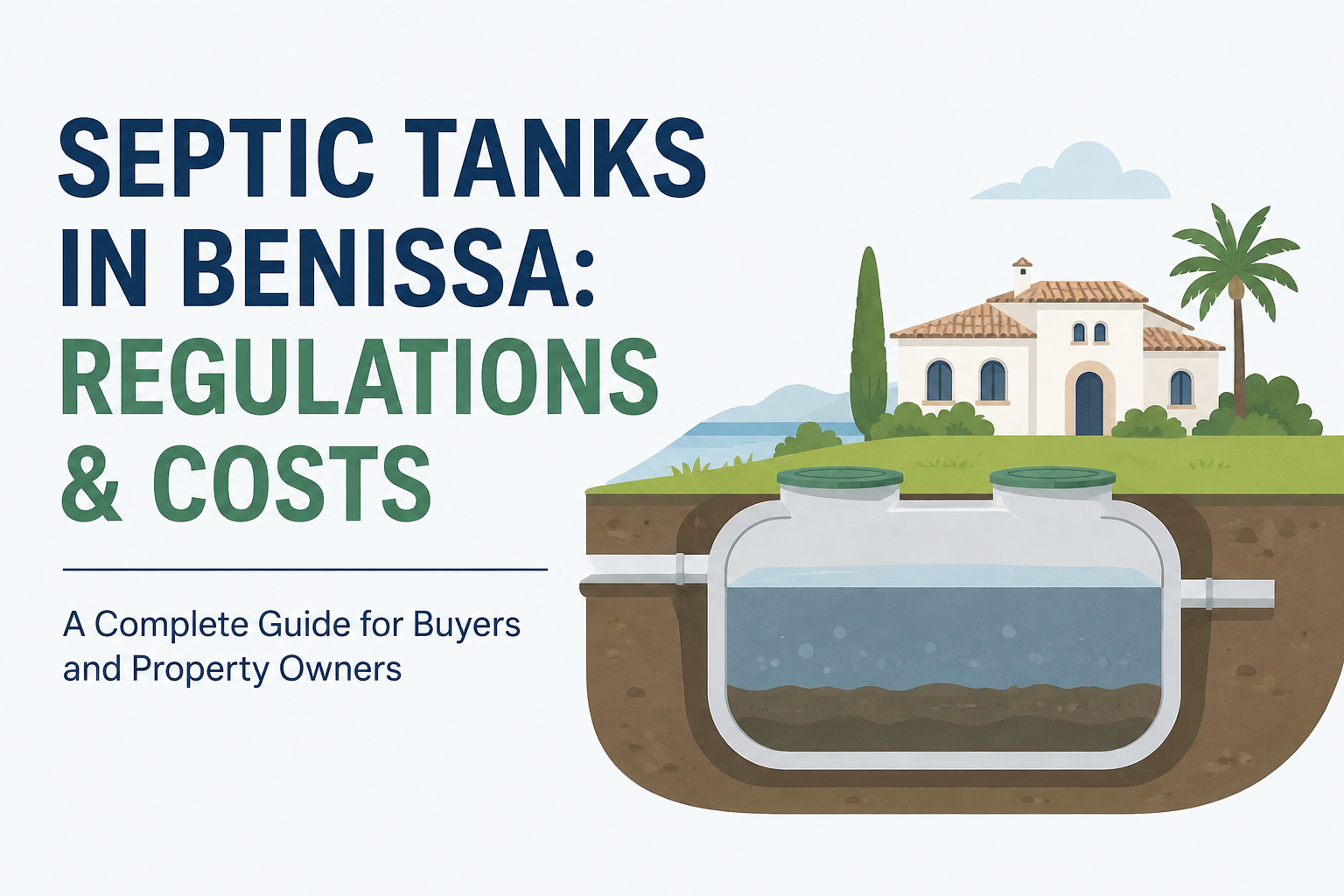
Septic Tanks in Benissa: Regulations, Costs and What Property Owners Need to Know
Introduction
Septic tanks in Benissa are an important consideration when buying, owning, renovating or selling a finca, casa de campo or other property that is not connected to the public sewer network.
This is particularly relevant to countryside properties in areas such as Benimarco, Pedramala, Fanadix, Buenavista and parts of Benissa Costa, where wastewater arrangements can vary significantly from one property to another.
The important point is that finding a septic tank on a property does not, by itself, establish whether the complete wastewater system is legally authorised, technically suitable or adequately documented.
For a buyer, the real questions are:
-
What wastewater system is installed?
-
Is the property connected to the public sewer network?
-
If not, what private treatment system is being used?
-
Where does the treated wastewater go?
-
Is the discharge arrangement authorised where required?
-
Is the installation documented?
-
Is the system suitable for the property's occupancy?
-
Is it functioning correctly?
-
Could it affect habitation documentation, financing or a future sale?
Spanish water legislation regulates wastewater discharges separately from the physical installation itself. The Water Act generally prohibits direct or indirect discharges capable of contaminating the public hydraulic domain unless the required prior administrative authorisation has been obtained. The Confederación Hidrográfica del Júcar specifically explains that this can include indirect discharge to a water body through infiltration into the ground.
That distinction is critical when buying a rural property.
Important: Water, environmental, planning and property regulations can change. This guide is intended as general property information, not legal, engineering or environmental advice. For a specific property, the applicable requirements should be confirmed with the relevant authority and, where appropriate, an architect or technical engineer, wastewater specialist and Spanish property lawyer.
Table of Contents
Septic Tanks in Benissa: What You Need to Know
A septic tank is a private wastewater installation used by properties that are not connected to the public sewer network. However, the term "septic tank" is often used loosely in property conversations.
A property described as having a septic tank could actually have:
-
a conventional septic tank;
-
a septic tank with additional biological filtration;
-
a biological wastewater treatment plant;
-
an oxidation-total treatment system;
-
a sealed holding tank;
-
an older cesspit or pozo negro;
-
a communal private wastewater system; or
-
a connection to the public sewer network.
These systems are not interchangeable.
The most important distinction
A wastewater treatment system and the discharge of wastewater from that system are separate questions.
For example, a property may have a modern treatment plant, but that does not automatically tell you whether its final discharge arrangement is authorised.
The Confederación Hidrográfica del Júcar states that wastewater discharged to the public hydraulic domain, including indirect discharge to a water body through infiltration into the ground, requires prior discharge authorisation.
This means that a buyer should investigate the complete wastewater chain:
House → wastewater pipes → treatment system → outlet → final destination → relevant authorisation/documentation
Expert Tip: When buying a finca in Benissa, do not stop at the question, "Does the property have a septic tank?" Ask, "What happens to the wastewater after it leaves the tank?"
Spanish terminology buyers should know
International buyers often encounter Spanish terms during legal and technical due diligence.
| Spanish term | General meaning |
|---|---|
| Fosa séptica | Septic tank |
| Fosa estanca | Sealed wastewater holding tank |
| Pozo negro | Cesspit/older wastewater pit terminology |
| Depuradora | Wastewater treatment plant |
| Depuradora biológica | Biological treatment plant |
| Aguas residuales | Wastewater |
| Vertido | Discharge |
| Autorización de vertido | Discharge authorisation |
| Alcantarillado | Sewerage |
| Red de saneamiento | Sewer network |
| Dominio Público Hidráulico | Public hydraulic domain |
| EDAR | Wastewater treatment plant |
Understanding these terms can make conversations with a Spanish architect, lawyer, installer or public authority much easier.
Why Do Some Properties in Benissa Have Septic Tanks?
Rural and Countryside Properties
Private wastewater systems are particularly relevant to certain rural and countryside properties where public sewerage infrastructure is not available.
These can include:
-
fincas;
-
casas de campo;
-
isolated villas;
-
properties on larger plots;
-
older countryside houses;
-
properties originally constructed before sewer infrastructure reached the area.
This is one reason wastewater due diligence is particularly important when buying rustic property in Benissa.
A finca in Pedramala may have a very different infrastructure arrangement from a property in a developed urbanisation. The same applies to properties in Benimarco, Fanadix, Buenavista and parts of Benissa Costa.
The location alone, however, does not establish what wastewater system a property has.
Properties Without a Mains Sewer Connection
A common misunderstanding is that a property with mains water must also have mains sewerage.
That is not necessarily the case.
Water supply and wastewater disposal are separate infrastructure questions.
A property can have:
-
mains water and private wastewater treatment;
-
private water and mains sewerage;
-
both mains water and mains sewerage;
-
neither public connection;
-
or a combination involving communal infrastructure.
Always establish the actual situation for the individual property.
Older Properties in Benissa
Older properties can require additional investigation because wastewater installations may have been:
-
installed many years ago;
-
modified by previous owners;
-
replaced in stages;
-
maintained without comprehensive documentation;
-
built under older technical requirements.
It is therefore possible to encounter a property where the owner knows exactly where the tank is but cannot produce the original installation documents.
That does not automatically mean the installation is illegal.
Equally, its age or continued use does not prove compliance.
Does Every Rural Property in Benissa Need a Septic Tank?
No.
A rural property does not automatically have to use a septic tank.
Depending on the location and circumstances, a property may have:
-
public sewerage;
-
a private wastewater treatment system;
-
a communal private system;
-
a sealed wastewater tank;
-
another technically designed arrangement.
The individual property's infrastructure, planning circumstances and wastewater destination must be established.
Common Mistake: Never assume "rustic property = septic tank". Confirm the actual wastewater system and connection status.
What Is a Septic Tank?
A septic tank is an underground wastewater tank in which solids settle and wastewater undergoes an initial treatment process before the liquid moves to the next stage of the system.
The exact performance depends on the technology installed.
How a Septic Tank Works
In a conventional system:
-
Domestic wastewater enters the tank.
-
Heavier solids settle at the bottom.
-
Grease and lighter materials float towards the top.
-
Anaerobic biological processes break down part of the organic material.
-
The liquid effluent leaves the tank.
-
It may then undergo additional treatment or move to the authorised final discharge arrangement.
The final step is critical.
A septic tank is not the same thing as permission to discharge wastewater.
Septic Tank vs Cesspit
These terms are often confused.
| System | Main purpose | Wastewater leaves the tank? | Key consideration |
|---|---|---|---|
| Septic tank | Settling and primary biological treatment | Generally yes | Treatment and final discharge |
| Sealed holding tank / fosa estanca | Storage | No, if genuinely sealed | Regular emptying |
| Biological treatment plant | More advanced treatment | Usually yes | Treatment, maintenance and discharge |
| Mains sewer | Public wastewater collection | Yes | Connection to public infrastructure |
A sealed holding tank is fundamentally a storage system, while a septic tank is designed to provide treatment.
That distinction matters when buying a property because operating costs and regulatory considerations can be very different.
Septic Tank vs Pozo Negro
The term pozo negro is sometimes used loosely in Spain to describe older wastewater pits or cesspit-type arrangements.
It should not automatically be treated as a modern septic tank.
If a seller describes a property as having a pozo negro, a buyer should establish exactly what physical system is present and how wastewater is managed.
Do not assume the terminology used in a property listing accurately describes the installed technology.
Septic Tank vs Biological Treatment Plant
A biological treatment plant generally provides additional treatment compared with a basic septic tank.
Depending on the technology, it may use:
-
aeration;
-
biological treatment;
-
clarification;
-
filtration;
-
pumps;
-
compressors;
-
other treatment stages.
A modern treatment plant can therefore be more sophisticated than a conventional septic tank, but that does not mean every biological plant is automatically suitable or authorised for every property.
The relevant questions remain:
What system is installed? How does it perform? Where does the treated wastewater go? What documentation exists?
Septic Tank vs Mains Drainage
Mains drainage means the property is connected to a public wastewater collection system.
A private wastewater system means the property owner has responsibility for the private installation and its maintenance, subject to the applicable regulatory framework.
This can affect:
-
servicing;
-
pumping;
-
repairs;
-
electricity consumption;
-
inspections;
-
documentation;
-
replacement;
-
environmental compliance;
-
future property sales.
Are Septic Tanks Legal in Benissa?
Why There Is No Simple Yes-or-No Answer
The question "Are septic tanks legal in Benissa?" is too broad for a simple yes or no.
The relevant circumstances can include:
-
how the installation was constructed;
-
the planning status of the property;
-
the type of wastewater treatment;
-
the property's location;
-
the discharge destination;
-
whether groundwater or the public hydraulic domain could be affected;
-
applicable technical requirements;
-
municipal requirements;
-
existing authorisations;
-
the date and circumstances of installation.
A properly designed and authorised private wastewater system is fundamentally different from an old installation that discharges inadequately treated wastewater without the necessary authorisation.
The Difference Between a Septic Tank and Wastewater Discharge
This is one of the most important concepts for property buyers.
The septic tank is the installation.
The discharge is what happens to the wastewater afterwards.
Under Article 100 of the Spanish Water Act, direct or indirect discharges capable of contaminating continental waters or other elements of the public hydraulic domain are generally prohibited unless the required prior administrative authorisation has been obtained.
The CHJ specifically states that wastewater discharge into the public hydraulic domain can include indirect discharge to a water body through infiltration into the ground.
What this means for a buyer
Finding a tank in the garden is only the beginning.
You also need to establish:
-
whether there is a treatment stage;
-
where the effluent goes;
-
whether the destination is lawful;
-
whether an authorisation exists where required;
-
whether the installation corresponds to the documentation.
When Water Authority Authorisation May Be Required
The Confederación Hidrográfica del Júcar (CHJ) is particularly relevant to Benissa because the municipality lies within the Júcar river basin.
The CHJ currently provides procedures for wastewater discharges to the public hydraulic domain, including simplified declarations for certain smaller urban or urban-equivalent discharges and general procedures for larger or industrial discharges.
Its guidance expressly states that prior discharge authorisation is required where wastewater is discharged to the public hydraulic domain, including indirect discharge to a water body through infiltration in the ground.
Where groundwater or aquifers could be affected, the Spanish Water Act also contains specific provisions concerning infiltration and protection of groundwater.
The precise position should therefore be established for the individual property rather than inferred from the presence of a tank.
Why an Existing Septic Tank Is Not Automatically Legal
Three assumptions should be avoided:
"It has been there for 20 years, so it must be legal."
Not necessarily.
"The previous owner installed it, so the paperwork must be correct."
Not necessarily.
"The property is registered, so the septic system must be authorised."
Again, not necessarily.
Property registration, planning status and wastewater discharge authorisation are separate issues.
A system can physically exist and operate while its documentary position remains unclear.
Warning: Never rely solely on the seller, estate agent, neighbour or installer to establish the legal status of a wastewater system. Documentary and technical verification are much safer.
Septic Tank Regulations in Benissa
There is no single "Benissa septic tank law". The relevant framework can involve national water legislation, Valencian sanitation legislation, hydraulic authority procedures and local planning requirements.
Spanish Water Regulations
The Texto Refundido de la Ley de Aguas, approved by Royal Legislative Decree 1/2001, provides the principal national framework for discharges affecting the public hydraulic domain.
Article 100 establishes the general prohibition on direct or indirect discharges capable of contaminating continental waters or other elements of the public hydraulic domain without the required prior administrative authorisation. Article 101 sets out the role and content of discharge authorisations.
Article 102 also addresses situations where a discharge could cause infiltration or storage of substances capable of contaminating aquifers or groundwater.
The detailed requirements can depend on the discharge and receiving environment.
Valencian Community Regulations
The Valencian Community has its own sanitation and wastewater framework, including the Ley 2/1992 de Saneamiento de las Aguas Residuales de la Comunidad Valenciana.
EPSAR, the Entitat Pública de Sanejament d'Aigües Residuals de la Comunitat Valenciana, has responsibilities relating to wastewater sanitation and treatment.
EPSAR also recognises circumstances involving individual or collective treatment installations and states that, for the relevant sanitation-charge benefit, such installations must be operating, manage their sludge and comply with the conditions of the applicable discharge authorisation.
This is another reason why an owner should keep documentary evidence relating to the wastewater installation.
The Role of the Ayuntamiento de Benissa
The Ayuntamiento de Benissa can be relevant to the planning and construction side of a wastewater project.
Depending on the circumstances, questions can include:
-
whether works require municipal approval;
-
planning classification;
-
the location of the proposed installation;
-
excavation and construction;
-
relationship with existing buildings;
-
other local planning requirements.
The correct municipal procedure should be confirmed before starting work.
The Role of the Confederación Hidrográfica del Júcar
For Benissa properties, the CHJ can be particularly important when wastewater reaches or could affect the public hydraulic domain.
Its current procedures include discharge authorisations and declarations for wastewater discharges.
The authority's guidance is particularly relevant to properties where the proposed or existing discharge involves infiltration into the ground.
The Role of EPSAR
EPSAR manages and regulates aspects of wastewater sanitation and treatment within the Valencian Community.
Its current procedures include authorisations for treated sanitation discharges to the public hydraulic domain.
EPSAR also has specific procedures concerning wastewater from individual treatment installations and direct deliveries of domestic wastewater from septic tanks or accumulation tanks to public treatment plants.
The authority involved in a particular case depends on the type and destination of the discharge.
Why Professional Advice May Be Necessary
Different professionals answer different parts of the problem.
Architect or technical engineer
Useful for assessing:
-
the physical installation;
-
the relationship with the building;
-
proposed replacement works;
-
technical suitability;
-
planning and building documentation.
Wastewater specialist
Useful for:
-
identifying the treatment technology;
-
locating hidden components;
-
assessing condition;
-
checking pumps and treatment stages;
-
preparing replacement proposals;
-
explaining maintenance requirements.
Property lawyer
Useful for:
-
reviewing authorisations;
-
interpreting legal documentation;
-
assessing planning and property risks;
-
incorporating appropriate protections into a purchase contract;
-
determining who should resolve a legal or documentary issue.
Expert Tip: For a significant rural-property purchase, the strongest due-diligence process is often multidisciplinary. A lawyer, technical professional and wastewater specialist do not necessarily answer the same questions.
Do You Need Permission to Install a Septic Tank in Benissa?
There is no single permission that applies identically to every property.
The requirements depend on the proposed installation and the property's circumstances.
Planning and Building Requirements
Installing or replacing a wastewater system can involve construction and excavation.
Depending on the project, you may need to address:
-
municipal planning requirements;
-
works approval;
-
technical documentation;
-
land classification;
-
location and setbacks;
-
excavation;
-
associated pipework;
-
electrical works.
Do not start construction until the applicable requirements have been confirmed.
Wastewater Discharge Authorisation
Where wastewater is discharged to the public hydraulic domain, the CHJ states that prior discharge authorisation is required.
The authorisation can establish conditions for the quality and quantity of the discharge and the treatment infrastructure required.
Where the discharge is into a municipal sewer or collector, the competent local or regional authority may instead be relevant under the applicable framework.
Technical Documentation
Depending on the project, documentation can include:
-
site plans;
-
technical drawings;
-
system specifications;
-
capacity calculations;
-
wastewater treatment information;
-
discharge arrangements;
-
manufacturer documentation;
-
environmental or hydraulic information.
The precise documents required should be established for the project rather than copied from another property.
Property-Specific Requirements
Two neighbouring properties can have different requirements.
This is particularly relevant in the Benissa countryside, where terrain, plot characteristics, existing infrastructure and planning circumstances can vary considerably.
A solution suitable for one finca may not be suitable for another.
Why You Should Check Before Starting Work
A sensible sequence is:
-
Identify the existing wastewater arrangement.
-
Establish whether mains sewerage is available.
-
Identify the proposed wastewater technology.
-
Establish the final discharge destination.
-
Determine which authorities are involved.
-
Obtain the necessary technical documentation.
-
Secure applicable approvals and authorisations.
-
Carry out the installation.
-
Keep all final documentation and certificates.
Buying a Property in Benissa With a Septic Tank
A septic tank is not automatically a reason to reject a property.
For some fincas, a private wastewater system is simply part of the infrastructure.
The issue is whether you understand exactly what you are buying.
What Buyers Should Check Before Signing
Before signing a reservation agreement or private purchase contract, establish:
-
the type of wastewater system;
-
whether mains sewerage is available;
-
whether the property is connected;
-
where the treatment system is located;
-
the technology installed;
-
approximate capacity;
-
final discharge arrangement;
-
available authorisations;
-
maintenance history;
-
current condition;
-
possible replacement requirements.
If important questions remain unanswered, discuss them with your lawyer before committing to the purchase.
Is the Septic System Documented?
Ask for documentary evidence rather than relying on verbal explanations.
Potential documents include:
-
installation plans;
-
technical documentation;
-
invoices;
-
manufacturer information;
-
municipal documents;
-
discharge authorisations;
-
maintenance records;
-
pumping records;
-
repair invoices.
A missing document does not automatically establish illegality.
It does, however, increase uncertainty.
Where Does the Treated Wastewater Go?
This is one of the most important questions.
Possible arrangements can include:
-
connection to a public sewer;
-
a treatment system followed by an authorised discharge;
-
a sealed holding tank requiring emptying;
-
another private wastewater arrangement.
If nobody can explain where the wastewater ultimately goes, the buyer should treat that as a significant due-diligence question.
Is the System Appropriate for the Property?
Capacity should be considered in relation to the property's actual use.
Think about:
-
number of bedrooms;
-
number of occupants;
-
permanent versus seasonal use;
-
holiday-rental occupancy;
-
number of bathrooms;
-
kitchen use;
-
pool and outdoor facilities;
-
expected wastewater volumes.
A system designed for a small weekend house may not be appropriate for a large property accommodating numerous holiday guests.
What About Holiday Rental Properties?
This deserves particular attention in Benissa.
A property used occasionally by two people has a different wastewater demand from a four- or five-bedroom villa occupied by a large family or holiday group.
If a property is marketed or operated as a holiday rental, the wastewater system should be assessed against its actual or intended occupancy, not simply the number of people living there during the owner's winter visits.
This is a technical question for the relevant professional, but it is an important issue for investors.
Is the System in Good Working Condition?
Look for:
-
unpleasant smells;
-
slow drainage;
-
sewage backing up;
-
standing wastewater;
-
unusually wet ground;
-
unexplained lush vegetation;
-
repeated pumping;
-
pump alarms;
-
electrical failures;
-
damaged covers;
-
cracked chambers.
These symptoms do not identify the exact fault by themselves. They indicate that further investigation may be warranted.
Could the System Affect Habitation Documentation?
Potentially.
If a property requires particular wastewater infrastructure to support its residential use or habitation documentation, an inadequate or undocumented wastewater system can become relevant.
This is why wastewater should be reviewed alongside the property's broader building legality and habitation documentation.
Could It Affect a Mortgage or Bank Valuation?
Potentially, although there is no universal rule that a septic tank prevents mortgage finance.
A lender or valuer may consider:
-
property condition;
-
legal status;
-
documentation;
-
infrastructure;
-
marketability;
-
outstanding technical issues.
An unresolved wastewater problem could therefore lead to additional questions during financing.
The bank's decision remains specific to the property and lender.
What If There Is a Public Sewer Nearby?
Do not assume that the existence of a sewer nearby automatically answers the question.
A buyer should establish:
-
whether the property can connect;
-
whether connection is technically feasible;
-
whether connection is required;
-
whether the relevant authority considers the property within the service area;
-
what connection works or costs would be involved.
This is particularly relevant where an older private system exists close to established urban infrastructure.
Who Should Inspect the System?
For a simple service or maintenance question, a specialist wastewater company may be appropriate.
For a purchase involving uncertainty about legality, planning or habitation documentation, consider combining:
-
a technical architect or engineer;
-
a wastewater specialist;
-
a property lawyer.
Documents to Request Before Buying
Property Documentation
The wastewater system should be reviewed alongside the normal property due diligence.
Documents may include:
-
Escritura
-
planning documentation;
-
building legality documentation;
-
habitation documentation where applicable;
-
licences and permits;
-
existing technical reports.
Septic System Documentation
Ask specifically for:
-
technical documentation;
-
installation information;
-
system model and manufacturer;
-
capacity;
-
plans;
-
installation invoices;
-
authorisations;
-
discharge documentation where applicable;
-
maintenance records;
-
pumping invoices;
-
repair records;
-
replacement documentation.
Document checklist
| Document | Why it matters |
|---|---|
| Escritura | Establishes registered property information |
| Nota Simple | Provides key Registry information |
| Catastro | Helps identify property and building data |
| System plans | Helps establish the installation's location |
| Technical project | Shows design and specifications where applicable |
| Installation documents | Helps establish what was actually installed |
| Authorisation | Evidence of relevant administrative approval |
| Discharge documentation | Helps establish the legal wastewater destination where applicable |
| Maintenance records | Shows servicing and pumping history |
| Manufacturer information | Identifies equipment and maintenance requirements |
| Technical inspection | Provides independent evidence of current condition |
Professional Reports
Where uncertainty exists, consider obtaining:
Architect or technical engineer report
To assess the property, installation, technical suitability and proposed works.
Wastewater inspection
To identify:
-
system type;
-
physical condition;
-
capacity;
-
tanks and chambers;
-
pumps;
-
outlet arrangements;
-
maintenance requirements;
-
potential replacement issues.
Lawyer's due diligence
To determine:
-
what documents exist;
-
whether authorisations are required;
-
whether missing documentation creates legal risk;
-
how any issue should be dealt with contractually.
What Should a Septic Tank Inspection Include?
A useful inspection should go beyond:
"There is a tank and it appears to work."
Depending on the system and safe access, the inspection should seek to establish:
-
Where the system is located.
-
What type of system is installed.
-
How wastewater enters it.
-
Whether there are multiple chambers.
-
Whether pumps or electrical components are present.
-
What treatment stages exist.
-
Where effluent leaves the system.
-
Whether there are signs of leakage or overflow.
-
Whether the system appears appropriately sized.
-
What maintenance has been carried out.
-
What documentation corresponds to the installation.
-
Whether further technical or legal investigation is recommended.
A professional should carry out any inspection that involves opening tanks or confined wastewater chambers.
Safety Warning: Never enter a septic tank, cesspit or wastewater chamber yourself. Such spaces can contain dangerous gases and present a serious confined-space hazard.
Septic Tank Due-Diligence Checklist for Benissa Property Buyers
Use this checklist before completing a purchase where private wastewater treatment is involved.
-
Identify the wastewater system.
-
Confirm whether mains sewerage is available.
-
Confirm whether the property is actually connected.
-
Locate the tank or treatment plant.
-
Establish the exact system type.
-
Establish approximate capacity.
-
Determine where treated wastewater goes.
-
Ask whether the system includes additional biological treatment.
-
Request installation documentation.
-
Request relevant authorisations.
-
Check discharge documentation where applicable.
-
Review maintenance and pumping records.
-
Arrange a professional technical inspection.
-
Check habitation documentation.
-
Consider the property's actual occupancy and use.
-
Consider holiday-rental use if relevant.
-
Check whether a public sewer is nearby.
-
Identify potential replacement costs.
-
Obtain written quotations if replacement appears likely.
-
Obtain legal advice where the regulatory position is unclear.
-
Consider appropriate contractual protection before signing.
A simple buyer risk framework
| Finding | Indicative due-diligence position |
|---|---|
| Public sewer connection confirmed | Generally simpler infrastructure |
| Modern private treatment system with clear documentation | Lower uncertainty |
| Older system with good maintenance records | Investigate further |
| System operating but paperwork incomplete | Further documentary investigation |
| Unknown discharge destination | Significant issue requiring investigation |
| Evidence of wastewater surfacing or uncontrolled discharge | Significant technical/environmental concern |
| Damaged or undersized system | Technical issue requiring assessment |
| Nobody can identify the system or its discharge route | Significant due-diligence gap |
These categories are a practical risk framework, not legal classifications. The final assessment depends on the property and professional findings.
How Much Does a Septic Tank Cost in Benissa?
There is no single reliable "Benissa septic tank price".
Costs can vary considerably according to:
-
system type;
-
capacity;
-
excavation;
-
ground conditions;
-
access for machinery;
-
distance from the property;
-
pipework;
-
pumps;
-
electrical supply;
-
treatment technology;
-
engineering;
-
permissions and administrative work;
-
discharge arrangements;
-
landscaping and reinstatement.
Current published regional prices provide useful indicators, but they should not be presented as fixed Benissa prices.
A specialist currently publishing prices for Valencia states that complete septic-tank installations commonly fall around €4,000–€6,000, while its published equipment pricing starts from approximately €3,900 for certain treatment units.
Another current published guide gives indicative equipment/installation ranges of approximately €3,500–€4,500 for traditional double-chamber systems, €4,500–€5,500 for systems with biological filtration and from approximately €4,500 for oxidation-total systems, depending on size and specification.
These are Valencian regional indicators, not quotations for Benissa.
For cleaning, a current Alicante market guide reports approximately €134–€226, with an average of €174 for the service it tracks. A separate national guide reports a broader average of approximately €275. These figures are market-platform estimates rather than regulated tariffs.
Indicative cost guide
| Item | Current published indicator | Important qualification |
|---|---|---|
| Treatment unit | From about €3,900 for some systems | Equipment pricing; specification varies |
| Complete installation | About €4,000–€6,000 in one Valencia supplier's published range | Regional indicator, not Benissa-specific |
| Traditional systems | About €3,500–€4,500 in one published Valencia guide | Type, capacity and installation conditions vary |
| Biological filtration | About €4,500–€5,500 in one published Valencia guide | Regional published range |
| Cleaning/emptying | About €134–€226 in one Alicante market guide | Actual local quotation varies |
| Repairs | No meaningful universal figure | Depends on the fault |
| Replacement | Project-specific | Excavation, treatment, pipework and approvals can materially change the cost |
| Technical/professional work | Project-specific | Depends on the system and regulatory requirements |
What can make a Benissa installation more expensive?
A countryside property can involve additional costs where there is:
-
difficult machinery access;
-
rocky ground;
-
long pipe runs;
-
significant excavation;
-
sloping terrain;
-
pumping requirements;
-
landscaping to reinstate;
-
complicated discharge arrangements;
-
technical or administrative work.
Expert Tip: If a buyer is negotiating because an old wastewater system may need replacement, do not simply assume that the cost is €5,000. Obtain a site-specific quotation.
How Often Does a Septic Tank Need Maintenance?
There is no single emptying interval that applies to every septic system in Benissa.
The appropriate frequency depends on:
-
tank size;
-
treatment technology;
-
number of occupants;
-
seasonal use;
-
wastewater volume;
-
sludge accumulation;
-
manufacturer requirements;
-
maintenance history;
-
applicable authorisation conditions.
Emptying and Servicing
A system should be serviced according to its design and maintenance requirements.
Keep:
-
invoices;
-
pumping records;
-
inspection reports;
-
repair records;
-
replacement documentation.
These records can also be useful when selling the property.
Professional Inspections
An inspection can be particularly useful when:
-
buying a property;
-
selling a property;
-
the system is old;
-
documentation is missing;
-
the property is being renovated;
-
the system has experienced repeated failures;
-
the property is changing from occasional use to permanent or rental use.
Signs of a Failing System
Potential warning signs include:
-
unpleasant odours;
-
slow drains;
-
sewage backing up;
-
wet or saturated ground;
-
wastewater surfacing;
-
unexplained vegetation growth;
-
frequent emergency pumping;
-
alarms;
-
pump failures;
-
damaged inspection covers.
These signs require investigation rather than a quick assumption about the cause.
What Should Not Go Into a Septic System?
Avoid putting inappropriate materials into the system, including:
-
large quantities of cooking oil;
-
paints;
-
solvents;
-
fuels;
-
aggressive chemicals;
-
wipes;
-
sanitary products;
-
non-biodegradable materials.
Excessive use of chemicals can also interfere with biological treatment.
What About Rainwater?
Rainwater should not automatically be treated as part of the domestic wastewater system.
Connecting large roof drainage flows to a septic system can introduce substantial volumes of water that the system was not designed to handle.
The property's drainage arrangement should therefore be assessed separately.
What About Swimming-Pool Water?
Pool water should not simply be assumed to belong in the domestic wastewater system.
Backwashing, draining or discharging pool water can involve significant volumes and potentially different chemical characteristics.
The correct disposal arrangement should be established for the individual property.
Why Regular Maintenance Matters
Good maintenance can help:
-
reduce blockages;
-
identify failures early;
-
maintain treatment performance;
-
extend equipment life;
-
reduce emergency pumping;
-
maintain records;
-
identify issues before a property sale.
Common Septic Tank Problems in Older Benissa Properties
Old or Undersized Systems
A system designed for a small weekend property may no longer be suitable if the house has become:
-
a permanent home;
-
a large family residence;
-
a holiday rental;
-
a multi-bedroom villa.
The property's current use should therefore be considered when assessing the system.
Damaged Tanks or Pipes
Age, ground movement, roots, excavation and heavy vehicle loads can affect:
-
tanks;
-
lids;
-
inlet pipes;
-
outlet pipes;
-
inspection chambers;
-
pumps;
-
electrical equipment.
Poor Maintenance
Neglected systems can experience:
-
excessive sludge;
-
blocked pipes;
-
pump failure;
-
odours;
-
poor treatment;
-
drainage problems.
Unknown Discharge Arrangements
This can be one of the most important due-diligence problems.
An owner may know that wastewater leaves the tank but not know exactly where it goes.
That is not sufficient information for a buyer.
Missing Documentation
A system can operate for many years without a complete documentary file.
This is why technical operation and legal documentation should be assessed separately.
Systems That May Need Updating
An older system is not automatically unlawful simply because it is old.
However, if it is being substantially modified or replaced, current requirements may become relevant.
Do not assume that a new system can simply reproduce an old installation.
Replacing a Septic Tank in Benissa
When Replacement May Be Necessary
Replacement may become appropriate when:
-
the tank is structurally damaged;
-
capacity is inadequate;
-
treatment is insufficient;
-
pumps repeatedly fail;
-
the system cannot be economically repaired;
-
wastewater is not being properly managed;
-
the existing arrangement creates a regulatory issue;
-
a technical project requires a different solution.
Assessing the Existing System
Before replacing it, establish:
-
What is installed?
-
Where is it located?
-
What is its capacity?
-
How does it operate?
-
Where does the effluent go?
-
What documentation exists?
-
What approvals or authorisations apply to the replacement?
Choosing a Modern Wastewater Treatment System
Depending on the property, potential solutions can include:
-
improved septic systems;
-
septic systems with biological filtration;
-
biological treatment plants;
-
oxidation-total systems;
-
sealed holding tanks;
-
other professionally designed wastewater solutions.
The correct solution cannot be selected solely from a product catalogue.
The system should be appropriate for:
-
occupancy;
-
site conditions;
-
terrain;
-
available space;
-
access;
-
wastewater volume;
-
treatment requirements;
-
final discharge arrangement;
-
applicable regulations.
Technical Design and Professional Advice
A technical professional can assess:
-
site conditions;
-
wastewater generation;
-
available land;
-
topography;
-
access;
-
existing infrastructure;
-
proposed discharge;
-
treatment requirements.
Permissions and Authorisations
Before construction, establish whether the project requires:
-
municipal planning or works approval;
-
technical documentation;
-
hydraulic authority procedures;
-
discharge authorisation;
-
other sector-specific approvals.
The CHJ currently provides formal procedures for wastewater discharge authorisation.
Installation
Installation can involve much more than placing a tank underground.
Depending on the design, works can include:
-
excavation;
-
tank installation;
-
inlet and outlet pipework;
-
treatment equipment;
-
electrical connections;
-
pumps;
-
inspection chambers;
-
discharge infrastructure;
-
reinstatement.
Testing and Documentation
Once completed, retain:
-
technical documents;
-
plans;
-
invoices;
-
certificates;
-
authorisations;
-
photographs;
-
manufacturer information;
-
maintenance instructions;
-
servicing records.
A complete file can be extremely valuable when the property is eventually sold.
Septic Tanks and Selling a Property in Benissa
Should Sellers Resolve Problems Before Marketing?
Not necessarily every problem.
However, sellers should understand the condition and documentation of their wastewater system before marketing the property.
This is especially sensible for:
-
fincas;
-
older countryside houses;
-
properties without mains sewerage;
-
properties with private treatment systems;
-
properties where documentation is incomplete.
Discovering a wastewater issue after accepting an offer can place the seller in a weaker negotiating position.
What Will a Buyer's Lawyer Ask For?
Depending on the transaction, a buyer's lawyer may ask about:
-
wastewater infrastructure;
-
sewer connection;
-
septic/treatment system;
-
authorisations;
-
technical documentation;
-
discharge arrangements;
-
habitation documentation;
-
maintenance.
The exact scope varies from transaction to transaction.
How Missing Documentation Can Affect a Sale
Missing documents can lead to:
-
additional enquiries;
-
technical inspections;
-
legal reviews;
-
requests for further evidence;
-
delays;
-
contractual conditions;
-
price negotiations.
Missing documentation does not automatically make a property unsaleable.
It creates uncertainty that needs to be addressed.
How Septic Tank Problems Can Affect Negotiations
Suppose a buyer discovers that the wastewater system may require replacement.
Possible commercial solutions could include:
-
The seller completes the work before completion.
-
The buyer accepts the issue and negotiates a price adjustment.
-
The parties agree specific contractual protection.
-
The parties obtain additional technical evidence before deciding.
The appropriate solution depends on the property and the legal advice received.
Preparing Your Property for Due Diligence
A seller should ideally assemble a property documentation file before marketing.
Include:
-
escritura;
-
Nota Simple;
-
Catastro information;
-
planning and building documents;
-
habitation documentation;
-
septic/treatment system documents;
-
maintenance invoices;
-
authorisations;
-
relevant technical reports.
This can make the sale process considerably smoother.
Real Benissa Property Scenarios
The following examples are anonymised and illustrative. They are designed to show how septic-tank issues can arise during property due diligence and are not presented as specific client transactions or legal precedents.
A Finca in Pedramala Without Mains Sewerage
A buyer is considering a finca in Pedramala.
The property is not connected to mains sewerage and has a private wastewater system.
The buyer initially sees the absence of a sewer connection as a problem.
That conclusion is premature.
The correct questions are:
-
What system is installed?
-
Is it suitable for the house?
-
How is wastewater treated?
-
Where does the effluent go?
-
What documentation exists?
-
What maintenance has been carried out?
The absence of mains sewerage is not, by itself, proof that a property is defective.
An Older Finca in Benimarco With an Undocumented System
An older finca has a functioning tank, but the seller cannot find the original installation documents.
The buyer should not automatically conclude that the system is illegal.
Instead, the buyer could request:
-
technical identification of the system;
-
maintenance evidence;
-
available municipal documentation;
-
discharge documentation where applicable;
-
professional advice.
The investigation may establish that the system is straightforward, or it may reveal the need for remedial work.
A Benissa Property Where the Existing System Needs Replacement
A technical inspection identifies an ageing wastewater system that may be approaching the end of its useful life.
Rather than negotiating based on a guess, the parties obtain a written quotation for replacement.
This gives the buyer and seller a much stronger basis for deciding whether to:
-
proceed;
-
renegotiate;
-
replace the system;
-
or include appropriate contractual protection.
A La Fustera Property With a Public Sewer Nearby
A property in or near La Fustera has a private wastewater system, while a public sewer appears to be available nearby.
The buyer asks:
"Does the property have to connect?"
That cannot be answered simply by looking at a map.
The parties need to establish:
-
whether the property can connect;
-
whether connection is required;
-
what infrastructure is available;
-
what the municipal position is;
-
what technical works would be needed.
A Holiday Rental With High Seasonal Occupancy
A four-bedroom countryside property has an older private wastewater system.
The owner uses it for occasional holidays, but the proposed buyer intends to operate it as a holiday rental.
The relevant question is no longer simply:
"Does the tank currently work?"
The buyer should establish whether the system is appropriate for the property's intended occupancy and wastewater demand.
A Sale Delayed by Wastewater Documentation
A seller accepts an offer on a rural property.
During legal due diligence, the buyer's lawyer requests information about the wastewater system.
The seller knows there is a tank but cannot locate the documentation or explain the discharge route.
The buyer requests a technical inspection and further documentation.
The transaction is delayed.
It may still complete successfully, but the lesson is important:
Resolve documentation questions before they become transaction questions.
Septic Tank Checklist for Benissa Sellers
Before marketing a property with private wastewater treatment:
-
Identify the wastewater system.
-
Establish whether mains sewerage is available.
-
Confirm whether the property is connected.
-
Locate the tank or treatment plant.
-
Find installation documentation.
-
Identify the system type and capacity.
-
Locate relevant authorisations.
-
Check discharge documentation where applicable.
-
Gather maintenance and pumping records.
-
Identify known faults.
-
Consider a professional inspection.
-
Check habitation documentation.
-
Consider whether the system is appropriate for the property's current use.
-
Obtain a replacement quotation if necessary.
-
Investigate missing authorisations with the appropriate professional.
-
Prepare documentation for buyer due diligence.
-
Discuss significant technical or legal issues with a professional.
-
Decide whether resolving a problem before marketing makes commercial sense.
Seller Tip: The best time to discover a wastewater problem is before you have an accepted offer, not during the final stages of the sale.
Frequently Asked Questions About Septic Tanks in Benissa
Are septic tanks legal in Benissa?
A septic tank is not automatically illegal because it is located on a rural property. The relevant question is whether the complete installation and wastewater arrangement comply with the applicable planning, technical and environmental requirements. Where wastewater is discharged to the public hydraulic domain, the Spanish Water Act generally requires prior discharge authorisation.
Do rural properties in Benissa need septic tanks?
No. Some rural properties have private wastewater systems, while others may have public or communal sewerage arrangements. The actual infrastructure must be checked for each property.
What are the septic tank regulations in Benissa?
The regulatory framework can involve Spanish water legislation, the Reglamento del Dominio Público Hidráulico, Valencian sanitation legislation, municipal planning requirements and procedures involving the Confederación Hidrográfica del Júcar or EPSAR, depending on the property and wastewater arrangement.
Do I need permission to install a septic tank in Benissa?
Potentially. Depending on the project, municipal planning or works approval, technical documentation and wastewater discharge authorisation may be relevant. The applicable requirements should be established before construction.
Who regulates septic tanks in Benissa?
Different authorities can have different responsibilities. The Ayuntamiento de Benissa can be relevant to planning and works. The Confederación Hidrográfica del Júcar is relevant to certain discharges affecting the public hydraulic domain, while EPSAR has responsibilities within the Valencian sanitation and wastewater-treatment framework.
Does a septic tank require wastewater discharge authorisation?
Not every wastewater arrangement is identical. However, the CHJ states that wastewater discharged to the public hydraulic domain, including indirect discharge to a water body through infiltration into the ground, requires prior discharge authorisation.
What is the difference between a septic tank and a biological treatment plant?
A conventional septic tank primarily provides settling and initial biological treatment. A biological treatment plant normally incorporates additional treatment processes. The exact performance depends on the technology installed.
What is the difference between a fosa séptica and a fosa estanca?
A fosa séptica is designed to treat wastewater to some degree, while a fosa estanca is a sealed holding tank designed to store wastewater for subsequent emptying. They have different operating and maintenance implications.
What is a pozo negro?
Pozo negro is a Spanish term often used for older cesspit-type wastewater arrangements. It should not automatically be treated as equivalent to a modern septic tank. If a property is described as having one, the actual installation should be identified by a professional.
Can I buy a Benissa property with an old septic tank?
Yes, potentially. An old septic tank is not automatically a reason to reject a property. Buyers should investigate its condition, capacity, discharge arrangement and documentation before committing to the purchase.
What if my Benissa property has no septic tank but also has no mains sewer?
The property still needs a lawful and technically appropriate wastewater solution. The correct system depends on the property's circumstances, and the proposed arrangement should be assessed before installation or alteration.
What if there is a public sewer near my Benissa property?
Do not assume that proximity automatically means the property must or can connect. Confirm the actual sewer availability, connection feasibility, municipal requirements and likely costs for the individual property.
Can a septic system be used for a holiday rental?
Potentially, but the system should be appropriate for the property's actual or intended occupancy and wastewater generation. A system serving occasional private use may require different assessment when the property is used intensively as a holiday rental.
Can rainwater be connected to a septic tank?
Rainwater should not automatically be connected to a domestic wastewater system. Large volumes of stormwater can affect system performance and capacity. The property's drainage arrangements should be assessed separately.
Can swimming-pool water go into a septic system?
Pool water should not simply be discharged into a domestic wastewater system without assessing the volume, chemicals and applicable disposal requirements. Pool drainage should be considered separately.
How can I check whether a septic tank is authorised?
Request the available installation and discharge documentation from the seller and have the information checked against the relevant municipal and, where applicable, hydraulic authority records. A technical professional and property lawyer can help establish whether the documents correspond to the installation actually present.
How much does it cost to replace a septic tank in Benissa?
There is no fixed Benissa price. Current published Valencia figures put some complete installations around €4,000–€6,000, while the actual cost can vary significantly depending on system type, capacity, excavation, access, terrain, pipework, treatment and administrative requirements.
How often should a septic tank be emptied?
There is no universal interval. It depends on the tank, treatment technology, occupancy, wastewater volume and sludge accumulation. Follow the system's maintenance requirements and retain records of professional servicing and emptying.
Can a septic tank affect a property's habitation documentation?
It can, depending on the property's circumstances and the requirements applicable to its residential use and documentation. An inadequate, undocumented or problematic wastewater system can become relevant during a technical or legal review.
Can septic tank problems delay a property sale?
Yes. Missing documentation, uncertainty about the discharge arrangement, technical defects or a potential requirement for replacement can lead to additional enquiries, inspections and negotiations.
Should I inspect a septic tank before buying a finca?
For an older finca or a property without mains sewerage, a professional inspection can be very worthwhile. It can identify problems that may not be visible during a normal property viewing.
What documents should I request when buying a property with a septic tank?
Request the property's normal legal documentation together with any available septic-system plans, technical documentation, installation information, authorisations, discharge documentation, maintenance records, pumping invoices, repair records and manufacturer information.
What should a septic tank inspection report contain?
Ideally, it should identify the system type, location, apparent condition, capacity where it can reasonably be established, treatment stages, pipework and discharge arrangement, together with any defects or recommendations for further investigation.
Can I replace an old septic tank with a biological treatment plant?
Potentially, but the appropriate replacement depends on the property, wastewater volumes, site conditions, treatment requirements and applicable approvals. A replacement should be professionally designed rather than selected solely on price.
Final Advice for Benissa Property Owners and Buyers
A septic tank should not automatically be a reason to avoid a Benissa property.
Private wastewater systems are part of the reality of owning certain rural and countryside properties, particularly where public sewerage is unavailable.
The important issue is understanding the complete wastewater arrangement.
For buyers, that means looking beyond the words "septic tank" and establishing:
-
what system is installed;
-
how it works;
-
how much wastewater it can handle;
-
where the effluent goes;
-
whether the discharge arrangement is authorised where required;
-
whether the installation is appropriately documented;
-
whether it is maintained;
-
whether it is suitable for the property's intended use;
-
whether replacement may be necessary.
For sellers, the objective is slightly different: identify potential technical and documentary issues before they become buyer enquiries.
This is particularly important for older fincas and properties in areas such as Benimarco, Pedramala, Fanadix, Buenavista, La Fustera and parts of Benissa Costa, where individual properties can have very different infrastructure arrangements.
The most important principle is simple:
Do not judge a Benissa property by the fact that it has a septic tank. Judge it by the condition, suitability, documentation and complete wastewater discharge arrangement.
Regulations and administrative procedures can change, so property owners should confirm current requirements with the relevant authority and seek professional advice where the circumstances are unclear.
Buying or Selling a Property in Benissa?
If you are buying a finca with a septic system, selling a rural property with private wastewater treatment, or trying to understand how a wastewater issue could affect a property's value or saleability, investigate the matter early.
Telio Homes specialises in the Benissa and Costa Blanca North property market and works with buyers and sellers dealing with the practical issues that arise during rural-property transactions.
The right approach is to combine local property knowledge with independent legal and technical due diligence.
A septic tank does not have to make a property complicated. But an unknown septic tank, an unexplained discharge or missing documentation is something worth investigating before you sign.
Editorial and Legal Note
This article is intended as general property information for owners, buyers and sellers in Benissa. It is not a substitute for legal, planning, engineering or environmental advice.
Spanish and Valencian regulations can change, and the requirements for an individual wastewater system depend on its location, design, discharge arrangement, property circumstances and applicable legislation.
The official regulatory framework should therefore always be checked at the time of the proposed installation, replacement or property transaction.
Last reviewed: August 2026