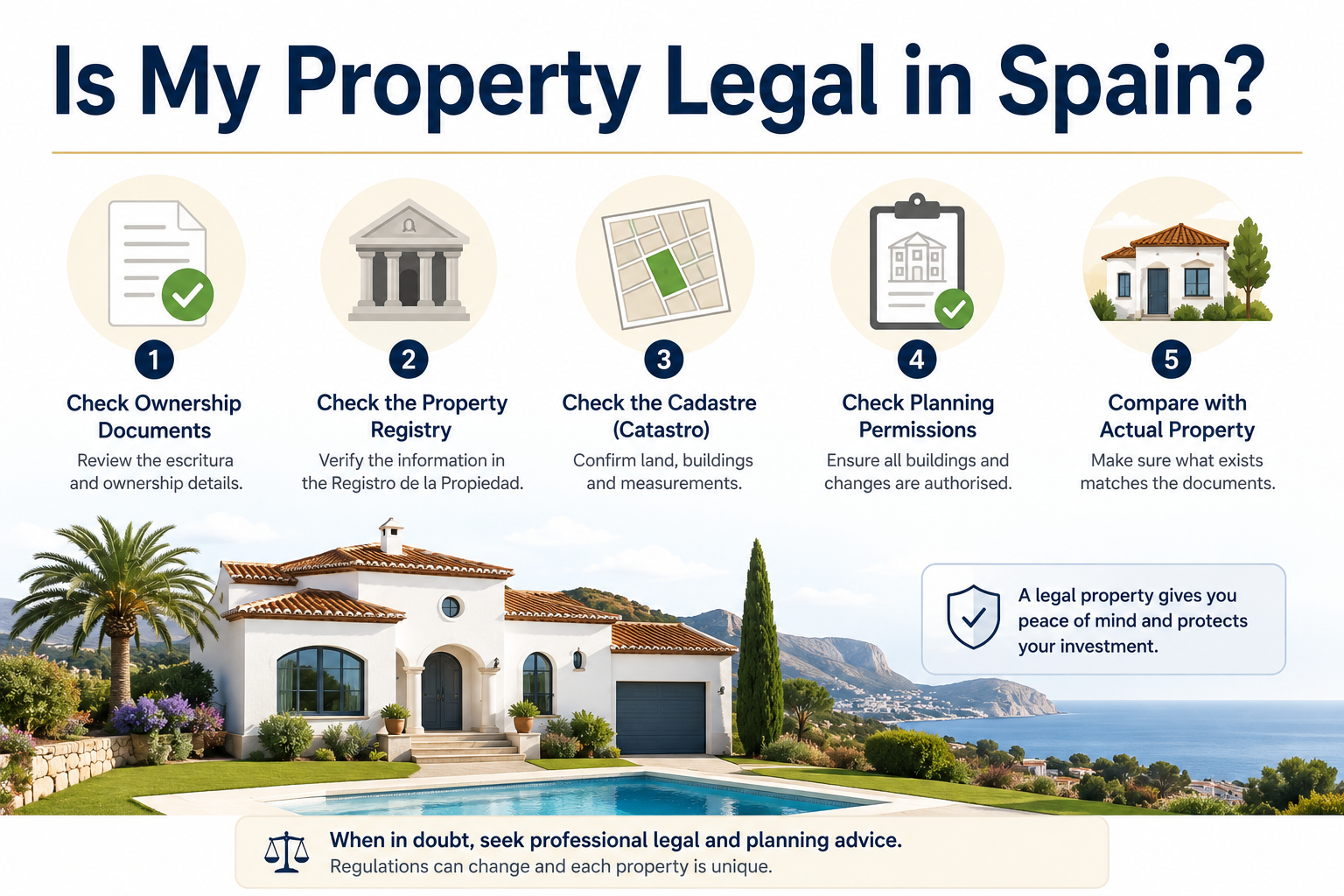
Is My Property Legal in Spain? A Complete Benissa Property Legality Guide
Introduction
If you own or are considering buying a property in Benissa, one of the most important questions you can ask is: is my property legal in Spain?
The answer is not always as simple as checking the escritura (title deed), looking at the Catastro or confirming that IBI has been paid for many years.
A property can be correctly owned and registered while still having discrepancies between the legal documentation, the physical building and the planning permissions that apply to it. An extension, swimming pool, enclosed terrace, garage conversion, guest annex or additional building may have a different planning history from the original house.
This matters particularly in Benissa because the municipality contains very different types of property. A villa in Benissa Costa, La Fustera or San Jaime may require a different planning assessment from a finca in Benimarco or Pedramala. Coastal restrictions, urbanisation-specific planning, rural-land rules, access, water and wastewater arrangements can all affect the due-diligence process.
This guide explains property legality in Spain from a practical buyer's, seller's and property-owner's perspective, with particular attention to Benissa and the Costa Blanca North.
Important: This article provides general information, not legal, architectural, planning or tax advice. Spanish and Valencian legislation can change. The legal position of an individual property depends on its location, planning classification, history, documentation and physical condition. Where there is a significant discrepancy or potential planning issue, obtain advice from an appropriately qualified lawyer, architect, técnico or the relevant authority.
Quick answer: Is my property legal in Spain?
A property should not be considered fully compliant simply because it has an escritura, appears in the Registro de la Propiedad, appears in Catastro or has paid IBI for many years. A proper legality check compares ownership, registration, cadastral information, planning permissions, the physical construction and the property's authorised use. In Benissa, rural and coastal properties can require additional planning and technical checks.
Table of Contents
-
What Does It Mean for a Property to Be Legal in Spain?
-
The 5 Checks You Need to Make
-
Does My Escritura Prove My Property Is Legal?
-
Does the Registro de la Propiedad Prove My Property Is Legal?
-
Does Catastro Prove My Property Is Legal?
-
Does Paying IBI Mean My Property Is Legal?
-
How to Check if Your Property Is Legal in Spain: Step by Step
-
What If the Property Does Not Match the Documents?
-
What Happens If a Property Was Built Without Planning Permission?
-
What Does “Fuera de Ordenación” Mean?
-
Property Legality on Rural Land in Benissa
-
How to Check Property Legality in Benissa
-
Documents to Check Before Buying or Selling a Property
-
Property Legality: Document Comparison Table
-
Common Property Legality Problems in Spain
-
Can You Sell a Property That Has a Legal Problem?
-
Can You Buy a Property With a Legal Problem?
-
20-Point Property Legality Checklist
-
Real Benissa Property Legality Examples
-
Common Myths About Property Legality in Spain
-
Frequently Asked Questions
-
What Should I Do If I Am Not Sure My Property Is Legal?
-
Conclusion
What Does It Mean for a Property to Be Legal in Spain?
The phrase “legal property” is used frequently in Spanish property sales, but it can mean several different things.
For practical due diligence, it is much more useful to separate the question into five areas:
-
Who owns the property?
-
What is registered?
-
What physically exists?
-
What has been authorised under planning rules?
-
What can the property legally be used for?
These questions overlap, but they are not interchangeable.
Property ownership vs planning legality
The first question is:
Who legally owns the property?
That is principally a title and registration issue.
The second is:
Was the property, and everything built on it, authorised under the applicable planning rules?
That is a planning and building-control issue.
A person can therefore legally own a building while there is still a planning problem affecting part of the construction.
For example, imagine a villa in Benissa that is correctly registered to the seller and described in the escritura as a 170 m² house. If a later extension added another 35 m², the seller can still own the property. The separate question is whether that additional construction was properly authorised and whether the documentation accurately reflects it.
Planning legality vs habitability
There is another important distinction:
Is the property legally authorised for the use being made of it?
A building can have an ownership history without that automatically answering every question about its authorised use as a dwelling.
In the Valencian Community, occupation of completed dwellings is governed by the applicable urban-planning framework, and the relevant documentation or declaration of responsibility depends on the circumstances. The current Valencian planning legislation should therefore be checked rather than relying on a generic statement that a property is “habitable”.
This distinction becomes especially important if a property is:
-
being sold as a home;
-
being renovated;
-
being divided into separate accommodation;
-
being converted from another use;
-
or intended for tourist accommodation.
What does “fully legal” actually mean?
A useful way to assess property legality is to use this five-part framework:
| Area | Main question |
|---|---|
| Ownership | Who legally owns the property? |
| Registration | What does the Registro say? |
| Physical property | What actually exists on the land? |
| Planning | What construction and uses have been authorised? |
| Use | Is the present or intended use authorised? |
A property can be satisfactory in one category and require further investigation in another.
Why one document cannot prove everything
There is no single document that answers every property-legality question.
The escritura is important for ownership and the transaction.
The Registro records property rights and registered information.
Catastro is an administrative register containing cadastral information.
Planning records answer different questions about construction and land use.
A technical inspection answers yet another question: what actually exists on the ground?
That is why a proper legality check is a comparison exercise, not a search for one “legal certificate”.
Expert Tip: The most useful question is not “Does the property appear in Catastro?” It is: “Can we reconcile the property as it exists today with its ownership, cadastral and planning documentation?”
The 5 Checks You Need to Make
The most reliable approach is to assess property legality through five connected checks.
1. Check who legally owns the property
Start with the title documentation and current Registro information.
Check:
-
Registered owner or owners
-
Ownership percentages
-
Mortgages
-
Usufructs
-
Easements
-
Other registered rights
-
Restrictions or limitations
-
Whether the seller has the legal capacity to sell
The Registro de la Propiedad's Nota Simple identifies the property, registered rights holders and the nature, extent and limitations of those rights. It is informative; a formal certification is the document that provides official evidentiary value regarding the contents of the register.
2. Check what is registered
Look carefully at:
-
Plot description
-
Registered surface
-
Built surface
-
Number of buildings
-
Number of floors
-
Stated use
-
Ancillary buildings
-
Registered charges
-
Restrictions and rights
Do not simply check that the address looks correct.
Compare the description with the property you are actually standing in.
3. Check what Catastro records
Catastro is an administrative register managed by the Spanish Ministry of Finance. It contains information about urban, rural and special-property assets and can provide information such as location, cadastral reference, surface, use and cartography.
The cadastral reference is particularly useful because it is the official identifier used to locate the property within the cadastral system.
4. Check what the Town Hall has authorised
This is where planning due diligence becomes essential.
Depending on the property and the works carried out, investigate:
-
Original building licence
-
Subsequent licences
-
Extensions
-
Major reform works
-
Swimming pool
-
Outbuildings
-
Change of use
-
Planning declarations or authorisations
-
Legalisation procedures
-
Planning enforcement
The applicable Valencian planning framework distinguishes between different types of planning intervention, including acts requiring a licence and certain acts subject to a declaration of responsibility. The exact requirement depends on the work, property and circumstances.
5. Compare the paperwork with the physical property
This is the step that is most easily overlooked.
Walk through the property and identify everything that has been constructed or materially changed.
Check:
-
Main house
-
Guest accommodation
-
Garage
-
Storage buildings
-
Terraces
-
Porches
-
Enclosed areas
-
Swimming pool
-
Pergolas
-
Extensions
-
Converted garages
-
Additional bedrooms
-
Additional bathrooms
-
Retaining walls
-
Other permanent structures
A difference does not automatically mean that something is illegal.
It means the difference needs to be understood.
The Benissa Property Legality Matrix
A useful practical way to classify findings is:
| Check | Green | Amber | Red |
|---|---|---|---|
| Registro vs physical property | Consistent | Difference requires explanation | Major undocumented construction |
| Catastro vs physical property | Consistent | Area or structure differs | Significant discrepancy |
| Planning permission | Documentation located | Documentation incomplete | No evidence or known issue |
| Swimming pool | Authorisation documented | Status unclear | Known planning problem |
| Rural classification | Clear | Further planning check needed | Significant restriction/problem |
| Occupation/use | Documentation consistent | Requires verification | Use potentially unauthorised |
| Planning history | No known issue | Further investigation needed | Active/enforceable issue |
These are practical due-diligence categories, not legal classifications. A qualified professional must determine the actual legal position.
Does My Escritura Prove My Property Is Legal?
What information is contained in the escritura?
The escritura is an important property document. It records the transaction and the property description used for the relevant legal act.
It may contain:
-
Parties to the transaction
-
Property description
-
Ownership
-
Purchase price
-
Cadastral reference
-
Existing charges
-
Property surface
-
Building description
It is essential in a property transaction.
What the escritura does not prove
An escritura does not automatically prove that every physical element of a property complies with planning regulations.
For example, an escritura might describe a 180 m² house.
The property today might also contain:
-
a 30 m² enclosed terrace;
-
a separate garage;
-
a swimming pool;
-
an additional extension.
The fact that all of these elements sit on the same property does not by itself prove that they were all authorised.
Why buyers and sellers should not rely on the escritura alone
For a buyer, relying solely on the escritura can leave important questions unanswered.
For a seller, discovering discrepancies only after accepting an offer can lead to delays, renegotiation or additional technical and legal work.
Key takeaway: An escritura provides important ownership and transaction information, but it does not automatically establish complete planning compliance for every construction or alteration.
Does the Registro de la Propiedad Prove My Property Is Legal?
What is the Registro de la Propiedad?
The Registro de la Propiedad records acts and contracts relating to ownership and other real rights over property. It is one of the most important sources of information during Spanish property due diligence.
What is a Nota Simple?
A Nota Simple is an informative extract from the Registro.
It normally identifies:
-
the registered property;
-
the registered owner or owners;
-
rights such as ownership, mortgage or usufruct;
-
the nature and extent of those rights;
-
registered limitations or restrictions.
The Colegio de Registradores confirms that a Nota Simple has informative value, whereas a formal certification provides evidentiary value concerning the contents of the register.
What information should you check?
Compare the Nota Simple with:
-
Escritura
-
Catastro
-
Property location
-
Plot size
-
Built area
-
Number of buildings
-
Ownership
-
Charges
-
Easements and other registered rights
Pay particular attention to differences in surface area.
What the Registro does not necessarily confirm
Registration should not be treated as a universal planning certificate.
A registered property description can exist alongside a later physical alteration that requires separate investigation.
This is why planning records and the physical property must also be considered.
What if the Registro and the physical property are different?
Do not immediately conclude that the property is illegal.
Establish:
-
What the Registro says.
-
What Catastro says.
-
What physically exists.
-
What planning records show.
-
Whether the difference has already been regularised.
-
Whether further action is required.
Does Catastro Prove My Property Is Legal?
What is the Catastro?
The Catastro Inmobiliario is an administrative register managed by the Spanish Ministry of Finance. Registration in Catastro is compulsory and free, and the system is separate from the Registro de la Propiedad.
What information does Catastro provide?
Depending on the property and access level, cadastral information can include:
-
Cadastral reference
-
Location
-
Parcel surface
-
Building information
-
Use or destination
-
Construction characteristics
-
Cartography
The public can access non-protected cadastral information such as location, cadastral reference, surface, use and cartography.
Why Catastro and Registro can be different
Catastro and Registro perform different functions.
There is a formal system for coordination between them, including georeferenced graphic information intended to improve certainty regarding location, boundaries and surface area. However, a lack of coordination or a discrepancy between records should be investigated rather than automatically interpreted as proof of illegality.
What if the Catastro shows a building that is not in the Registro?
Possible explanations include:
-
Historic construction
-
Later alteration
-
Registration issue
-
Cadastral update not reflected elsewhere
-
Different methods of describing the property
-
Structure requiring planning investigation
The correct response is:
Find out why the records differ.
What if the physical property is larger than Catastro?
Again, investigate rather than assume.
A technical measurement may be useful where floor-area differences are material.
A qualified professional may then need to determine whether:
-
the additional area is authorised;
-
documentation is missing;
-
the cadastral information needs updating;
-
the construction has a different legal status;
-
or another procedure is appropriate.
Does Paying IBI Mean My Property Is Legal?
What IBI is
IBI is the Spanish local property tax.
Paying IBI demonstrates that the property is being dealt with for local taxation purposes.
It does not, by itself, establish planning compliance.
Why paying IBI does not equal planning permission
Tax administration and planning control are different functions.
A property can therefore appear in cadastral information and generate IBI while a separate planning issue remains to be investigated.
Why this is a common misconception among foreign property owners
Foreign owners sometimes hear:
“We've had electricity for years.”
or:
“We have paid IBI since the house was built.”
or:
“It is in Catastro.”
These facts may be relevant, but none should be treated as a complete planning certificate.
What you should check instead
For a property in Benissa, establish the relationship between:
Registro + Catastro + planning records + physical property + authorised use.
Myth: “I have paid IBI for 20 years, so my house must be legal.”
Reality: Tax registration and planning authorisation are different matters.
How to Check if Your Property Is Legal in Spain: Step by Step
This is the core practical process.
Step 1: Obtain the escritura
Find the latest escritura or escrituras relevant to the property.
If you are selling, gather the documentation before marketing the property.
If you are buying, ask to review the relevant title documentation during due diligence.
Step 2: Request a recent Nota Simple
Check:
-
Owner
-
Property description
-
Surface
-
Charges
-
Restrictions
-
Registered rights
A Nota Simple reflects the registered information at the time it is issued, so an up-to-date document is preferable when a transaction is underway.
Step 3: Check the Catastro
Locate the property using its cadastral reference.
Compare:
-
Parcel
-
House
-
Other buildings
-
Surface
-
Mapping
Step 4: Confirm the cadastral reference
Make sure the cadastral reference actually belongs to the property you are investigating.
This is particularly important for rural properties, where a property can involve multiple parcels or historic descriptions.
Step 5: Compare registered and cadastral floor areas
Create a simple comparison:
| Source | Plot | Built area | Other structures |
|---|---|---|---|
| Escritura | Check | Check | Check |
| Registro | Check | Check | Check |
| Catastro | Check | Check | Check |
| Physical measurement | Check | Check | Check |
A difference is not automatically a legal problem.
It is a due-diligence flag.
Step 6: Identify all buildings and structures on the plot
Do not inspect only the main house.
Look for:
-
Garage
-
Storage room
-
Guest accommodation
-
Swimming pool
-
Terrace
-
Porch
-
Pergola
-
Agricultural building
-
Workshop
-
Annex
-
Walls
-
Other permanent structures
Step 7: Check building licences and planning permissions
Find out which works were authorised.
For a property that has been altered several times, there may be several relevant licences, declarations or planning records.
Step 8: Check the property's planning history
Where a discrepancy exists, investigate whether there has been:
-
A planning licence
-
A declaration of responsibility
-
A legalisation procedure
-
A planning enforcement procedure
-
A change of use
-
A technical report
-
Another municipal procedure
Step 9: Check occupation and habitability documentation
If the property is intended to be used as a dwelling, investigate the relevant occupation documentation and current requirements.
Do not assume that an old certificate automatically answers every present-day question about use, renovation or tourist accommodation.
Step 10: Compare everything with the property as it exists today
This is where technical inspection can become important.
Plans, aerial photographs and cadastral maps can be useful, but they do not necessarily replace an inspection of the actual property.
Step 11: Investigate any discrepancies
Classify each finding:
-
Minor documentation difference
-
Cadastral discrepancy
-
Registration issue
-
Missing document
-
Planning issue
-
Potential unauthorised construction
-
Use/habitability issue
-
Boundary issue
-
Access/easement issue
Step 12: Obtain professional confirmation where necessary
Professional advice is particularly important where the issue could affect:
-
Value
-
Mortgageability
-
Renovation
-
Resale
-
Occupation
-
Tourist use
-
Planning enforcement
Property Legality Checklist: Before committing to a purchase or listing a property for sale, make sure you know which documents exist, which do not, and which discrepancies still need professional investigation.
What If the Property Does Not Match the Documents?
Discrepancies are not unusual in Spanish property transactions.
The important question is what caused the discrepancy and what consequences, if any, follow from it?
The house is larger than the Registro
Possible explanations include:
-
Extension
-
Different measurement
-
Historic alteration
-
Unregistered declaration of works
-
Documentation issue
The next step is investigation.
The house is larger than Catastro
Possible explanations include:
-
Cadastral information not updated
-
Different measurement methodology
-
Later construction
-
Historic structure
-
Cadastral discrepancy
Again, investigate.
The house is larger than both
This deserves closer attention.
If the additional area represents an extension or other construction, investigate the planning history.
An extension is missing
Ask:
-
When was it built?
-
Was there a licence?
-
Was the work declared?
-
Is there a planning record?
-
Was it subsequently regularised?
-
Is it compatible with the applicable planning rules?
-
Is further action required?
A swimming pool is missing
A pool should not be treated simply as landscaping.
Its planning and documentary status should be checked separately, particularly where it was added after the original house.
A garage or outbuilding is missing
A detached garage, storage building or agricultural structure may have a different planning history from the main dwelling.
Its authorised use also matters.
A terrace has been enclosed
An enclosed terrace can represent a physical alteration to the building.
Do not assume that because it is now part of the interior, it automatically has the same planning status as the original house.
A garage has been converted into living accommodation
This can raise questions about:
-
Change of use
-
Building compliance
-
Occupation
-
Planning authorisation
-
Registration
-
Habitability
Additional bedrooms or bathrooms were created
Internal alterations are not automatically irrelevant.
Whether particular works require authorisation depends on the nature of the work and the rules applicable to the property.
Important: A discrepancy is a reason to investigate, not automatic proof that the construction is illegal.
What Happens If a Property Was Built Without Planning Permission?
What constitutes unauthorised construction?
A planning problem can arise when construction or a use has taken place without the required authorisation, or when works do not comply with the conditions of the authorisation that was granted.
Under the current Valencian framework, the administration can take measures to restore planning legality where works or uses contravene the applicable planning rules.
Planning enforcement
Planning enforcement is separate from the private sale contract.
If a planning problem exists, changing ownership does not necessarily make the underlying problem disappear.
This is particularly important for buyers.
The current Valencian planning framework states that measures for restoring planning legality can have a real effect on the property and can reach third-party purchasers.
A buyer therefore needs to understand the planning position before committing to the purchase.
Can unauthorised works be legalised?
Sometimes.
But:
“Can be legalised” is not the same as “is already legal”.
Whether legalisation is possible depends on matters such as:
-
Planning classification
-
Applicable planning rules
-
Nature of the construction
-
Date of construction
-
Location
-
Protected status
-
Planning history
-
Technical compliance
-
Municipal and regional procedures
A professional should determine this for the individual property.
What happens when enforcement periods expire?
This is one of the most misunderstood areas of Spanish property law.
The current Valencian TRLOTUP states that, in certain circumstances, the administration's action to order restoration is subject to a 15-year period. However, the same article expressly excludes certain categories from that period, including suelo no urbanizable, as well as certain public-domain, protected and heritage situations. The applicable period can also depend on the law in force when the works were completed.
This is particularly important for Benissa because many properties are located outside conventional urban areas.
The next point is even more important.
Why an old building is not automatically “legal”
Article 256 of the current Valencian framework expressly states that the mere passage of the relevant 15-year period does not legalise works or constructions that were carried out contrary to planning law. While the planning violation persists, the legislation restricts further works to the extent provided by the applicable regime.
So the statement:
“It is more than 15 years old, therefore it is legal.”
is not a safe conclusion.
When restoration of legality may be required
Where works are not legalisable, or are not legalised through the applicable procedure, the restoration process can require physical measures such as demolition or restoration of the affected property or use.
The consequences depend heavily on the individual circumstances.
Why the exact circumstances matter
A property's:
-
location;
-
land classification;
-
date of construction;
-
planning history;
-
protected status;
-
nature of the works;
-
and applicable legislation
can all change the legal analysis.
Legal caution: Never tell a buyer or seller that an unauthorised building “becomes legal after 15 years”. In the Valencian Community, that statement is too simplistic and can be wrong, particularly for rural land and protected situations.
What Does “Fuera de Ordenación” Mean?
Simple explanation of the term
Fuera de ordenación describes a planning situation concerning existing buildings or constructions that are incompatible, or not fully compatible, with the applicable planning framework.
It does not necessarily mean the same thing as an actively unauthorised building.
Is a property in “fuera de ordenación” automatically illegal?
Not necessarily.
A building may have been lawfully constructed under an earlier planning regime and later become incompatible with a new planning framework.
Conversely, an unauthorised building can have a different legal history and requires its own analysis.
The current Valencian framework requires planning instruments to identify buildings that fall into the strict fuera de ordenación regime. In that regime, only works of mere conservation are generally permitted; the law also provides a separate transitional regime for buildings that are not fully compatible but do not fall within the strictest category.
Why the distinction matters
A buyer should establish:
-
Why the property has this status
-
Whether the whole building or only part is affected
-
Which works are permitted
-
Whether existing use can continue
-
Whether renovation is possible
-
Whether extensions are possible
-
Whether the status affects resale or financing
Can you sell a property in this situation?
Potentially, yes.
But the buyer needs to understand exactly what is being transferred and what restrictions apply.
A sale does not automatically remove a planning classification.
Can you renovate it?
Do not assume so.
Under Article 206, buildings in the strict fuera de ordenación category are subject to a restrictive regime, while other buildings that are not fully compatible with the planning framework can fall under a different transitional regime. The precise rules depend on the applicable planning instrument and the property's circumstances.
Why professional planning advice may be necessary
The words fuera de ordenación should trigger investigation, not an automatic conclusion.
A lawyer or architect should review the planning documentation and explain what the status means for the specific property.
Property Legality on Rural Land in Benissa
Rural property is one of the areas where generic Spanish property advice can become misleading.
Benissa has a significant market for detached fincas and countryside properties, including properties in areas such as Benimarco and Pedramala.
For these properties, the question is not simply:
“Is there already a house?”
It is:
“What is the planning status of this parcel, what was authorised historically, what exists today, and what can legally be done with it now?”
Why rural properties require additional checks
On rural land, you may need to investigate:
-
Land classification
-
Original construction
-
Extensions
-
Agricultural buildings
-
Swimming pools
-
Water supply
-
Wastewater
-
Access
-
Easements
-
Environmental restrictions
-
Minimum plot requirements
-
Planning history
The Valencian planning framework contains specific rules for non-urbanisable land, including restrictions concerning division and segregation of rural land.
What is suelo rústico?
Suelo rústico is commonly used to describe rural land. Valencian planning legislation uses the concept of suelo no urbanizable and establishes specific rules for development and uses on this type of land.
The precise classification of an individual parcel matters more than the label used informally in a property advert.
What planning restrictions can apply?
Depending on the parcel, restrictions can concern:
-
Building
-
Extensions
-
New structures
-
Agricultural use
-
Access
-
Water
-
Wastewater
-
Environmental protection
-
Flood risk
-
Infrastructure
-
Landscape
-
Protected land
-
Coastal restrictions
-
Minimum plot requirements
The exact rules must be established for the individual parcel.
Existing houses on rural land
An existing house does not automatically mean that a new house could be constructed there today.
This distinction is critical.
A dwelling can have a particular historical status while the rules governing new construction on the same land are much more restrictive.
Extensions to rural properties
Before extending a finca in Benissa, check:
-
Land classification
-
Existing legally recognised built area
-
Applicable building parameters
-
Previous licences
-
Planning history
-
Current planning framework
-
Environmental or sectoral restrictions
Swimming pools on rural land
A swimming pool should be treated as a separate construction element for due diligence.
Do not assume that because the main house is legal, the pool is automatically authorised.
Agricultural buildings and outbuildings
A building described as a storage, agricultural or auxiliary structure should not automatically be treated as a dwelling.
The authorised use matters.
Converting such a structure into living accommodation can raise separate planning and occupation questions.
Minimum plot considerations
Plot size can be important for rural development, but there is no universal “10,000 m² means you can build” rule that should be applied blindly to every Benissa property.
The applicable planning classification, planning instrument, historical position and current rules must be checked.
The Valencian framework also regulates the division and segregation of rural land and prohibits certain forms of urbanistic parcelation on non-urbanisable land.
Water and electricity
Having electricity connected does not itself establish planning legality.
The same applies to water.
For rural properties, investigate:
-
Public water connection
-
Private supply
-
Water deposits
-
Wells where relevant
-
Electricity connection
-
Existing infrastructure documentation
Septic tanks and wastewater
Wastewater arrangements deserve particular attention in rural property transactions.
Check:
-
Existing septic system
-
Authorisations where applicable
-
Technical condition
-
Discharge arrangements
-
Whether upgrading is required
-
Whether the property can satisfy the relevant occupation requirements
Boundaries and access
Rural property due diligence should also consider whether the physical boundaries correspond with the legal and cadastral descriptions.
Check:
-
Fences and walls
-
Neighbouring boundaries
-
Access roads
-
Rights of way
-
Utility easements
-
Shared access
-
Potential boundary disputes
The fact that a fence has existed for many years does not by itself prove that the fence marks the legally recognised boundary.
Protected land and environmental restrictions
A rural parcel may also be affected by environmental, landscape, water, forestry, coastal or other sectoral rules.
A cadastral map alone cannot answer these questions.
Why the age of a finca does not tell the whole story
A finca may be decades old.
That tells you something about its history, but not necessarily its complete legal status.
The date of construction must be considered alongside:
-
planning rules in force at the time;
-
later planning changes;
-
the parcel's classification;
-
the nature of the construction;
-
and any enforcement or legalisation history.
Why every rural property needs individual verification
Never assess the legality of a Benissa finca solely from its age, plot size, IBI history, electricity connection or Catastro entry.
How to Check Property Legality in Benissa
Benissa deserves a more detailed approach than generic “check the documents” advice because its planning history and mix of urban, coastal and rural property can materially affect the analysis.
Start with the property's Registro information
Obtain a current Nota Simple and compare it with the escritura.
Check the Catastro
Confirm:
-
Cadastral reference
-
Plot
-
Building footprint
-
Surface
-
Recorded use
-
Cartography
The Catastro provides access to cadastral mapping and descriptive information through its electronic services.
Identify the property's exact location and classification
Do not stop at the postal address.
The precise parcel matters.
Two properties that appear close together can have different planning circumstances.
Understand Benissa's planning history
This is an important local point that generic Spanish property guides often miss.
Official Valencian planning documentation identifies PGOU-1982 as the current general planning instrument for Benissa. It also records that the 1982 plan regained effect following the Supreme Court's annulment of the 2003 PGOU.
That history matters because property owners and buyers should not assume that a planning document from 2003 automatically represents the planning framework currently applicable to the municipality.
The applicable planning framework can also include more specific planning instruments and modifications affecting particular areas.
This means that a proper Benissa property legality check should establish:
-
Which planning instrument applies to the parcel.
-
How the parcel is classified.
-
Whether it falls within a more specific planning area.
-
Which planning rules applied when relevant works were carried out.
-
Whether later planning changes affect the property.
The Valencian planning system also maintains an official register of planning instruments, including their approval information and changes affecting their validity or application.
Check whether a specific urbanisation or area has its own planning history
This matters in established residential areas.
For example, properties in areas such as San Jaime, La Fustera, Fanadix and Buenavista should not automatically be treated as identical simply because they are all within the wider Benissa Costa property market.
The exact planning instrument, parcel classification and development history should be established for the property concerned.
Consider coastal restrictions
For properties close to the coast, planning due diligence may need to go beyond municipal planning.
Potential considerations can include:
-
Coastal protection
-
Public maritime-terrestrial domain
-
Coastal easements
-
Setback restrictions
-
Environmental protection
-
Access to the coast
-
Other sectoral limitations
A sea view does not tell you the legal planning status of the land around the property.
This is particularly relevant when buying or extending properties in coastal parts of Benissa.
Check municipal licences
Ask what permissions exist for:
-
Original construction
-
Extensions
-
Pool
-
Outbuildings
-
Structural alterations
-
Change of use
-
Major renovations
Check planning history where relevant
If there is a discrepancy, ask whether the property has ever been subject to:
-
Planning enforcement
-
Legalisation
-
Applications
-
Orders
-
Technical reports
-
Other municipal proceedings
Check occupation and habitability documentation
Where the property is used as a dwelling, check the relevant occupation documentation and current requirements.
Do not assume that a document proving occupation at one point in time automatically establishes that every later alteration or current use is authorised.
Separate building legality from tourist-rental legality
A property can be suitable for residential use while still requiring separate checks before being used for tourist accommodation.
The legality of the building and the legality of a particular commercial or tourist use are not necessarily the same question.
For a holiday-home owner, investigate both:
“Is the property legally constructed and usable?”
and:
“Is the intended tourist use permitted and properly registered/licensed under the current rules?”
When to involve an architect or lawyer
Professional advice is particularly sensible where:
-
The property is rural
-
There are undocumented extensions
-
Built areas differ significantly
-
A pool is undocumented
-
There has been a change of use
-
There has been planning enforcement
-
The property is close to the coast
-
The property has several buildings
-
The buyer needs a mortgage
-
The property will be renovated
-
The property will be used for tourism
Why Benissa properties should not be assessed using generic Spanish advice alone
Spanish property planning is not governed by one single set of rules applied identically everywhere.
National legislation, Valencian legislation, municipal planning and sectoral regulations can all be relevant.
For Benissa, the specific parcel and its planning history matter.
Local insight: A villa in an established residential area such as San Jaime or La Fustera should not automatically be assessed in exactly the same way as a detached finca in Pedramala or Benimarco. The property type, land classification, planning history, coastal or environmental constraints and surrounding infrastructure can materially change the due-diligence questions.
Documents to Check Before Buying or Selling a Property
A useful property-legality file can include the following.
Escritura
Confirms important title and transaction information.
Nota Simple
Shows current registered ownership, rights and registered limitations.
Catastro information
Useful for checking cadastral identification, mapping, surfaces and recorded characteristics.
Building licence
Check whether the original construction and relevant later works were authorised.
Planning documentation
Especially important for:
-
Extensions
-
Structural alterations
-
Changes of use
-
Outbuildings
-
Other significant works
Licence or authorisation of occupation
Check the relevant documentation for residential occupation and whether current requirements are satisfied.
Technical certificates
Depending on the property, this can include technical documentation relating to:
-
Construction
-
Works
-
Energy
-
Occupation
-
Other applicable requirements
Documentation for extensions
An extension should have its own planning history where relevant.
Swimming pool documentation
Establish whether the pool was authorised and how it is reflected in the relevant documentation.
Rural-property documentation
For fincas, investigate additional information concerning:
-
Land classification
-
Water
-
Wastewater
-
Agricultural structures
-
Access
-
Boundaries
-
Easements
-
Environmental restrictions
-
Planning history
Property Legality: Document Comparison Table
| Document | What it tells you | What it does not necessarily prove |
|---|---|---|
| Escritura | Ownership and transaction/property description | Complete planning compliance |
| Registro | Registered rights, ownership and registered property information | Planning compliance of every physical element |
| Catastro | Cadastral location, reference, surface, use and mapping | Planning authorisation |
| Building licence | Authorised works covered by the licence | That later alterations were authorised |
| Occupation documentation | Relevant evidence concerning authorised occupation/use | Ownership |
| Planning records | Planning status, applications, permissions or enforcement history | Everything contained in private documents |
| Physical inspection | What actually exists | Whether every element is legally authorised |
| Technical report | Professional assessment of physical/planning matters within its scope | A substitute for every administrative or legal determination |
What each source is best for
| Question | Escritura | Registro | Catastro | Town Hall/planning records | Technical inspection |
|---|---|---|---|---|---|
| Who owns it? | ✓ | ✓ | — | — | — |
| What parcel is it? | ✓ | ✓ | ✓ | — | ✓ |
| What buildings are recorded? | ✓ | ✓ | ✓ | ✓ | ✓ |
| Was construction authorised? | — | Not necessarily | — | ✓ | Helps assess |
| What physically exists? | — | — | Limited | — | ✓ |
| Is the present use authorised? | — | Not necessarily | — | ✓ | Helps assess |
| What planning restrictions apply? | — | — | — | ✓ | Helps interpret |
| Are boundaries consistent? | Partly | ✓ | ✓ | — | ✓ |
The central lesson is simple:
No single document answers every legality question.
Common Property Legality Problems in Spain
| Problem | Why it matters | What to investigate |
|---|---|---|
| Undocumented extension | Possible planning issue | Licence and planning history |
| Pool not documented | Possible planning issue | Pool authorisation and documentation |
| Different floor areas | Documentation discrepancy | Technical comparison |
| Rural property | Additional planning restrictions | Land classification and planning |
| Missing occupation documentation | Use/habitability issue | Applicable requirements |
| Unauthorised building | Potential enforcement issue | Planning/legal status |
| Missing outbuilding | Possible planning issue | Original authorisation |
| Converted garage | Potential change-of-use issue | Planning and occupation status |
| Enclosed terrace | Physical alteration | Authorisation and current status |
| Additional bedroom/bathroom | May indicate alteration or change of use | Works history and documentation |
| Unclear boundary | Potential ownership/access dispute | Registro, Catastro and technical boundary review |
| Unclear access | Potential easement issue | Title, planning and physical access |
| Rural wastewater issue | Occupation/infrastructure concern | Septic system and applicable requirements |
| Coastal location | Additional restrictions may apply | Coastal and sectoral planning |
Can You Sell a Property That Has a Legal Problem?
What happens during the sale process?
A property with a documentation or planning issue may potentially be sold, but the issue should be understood before the transaction progresses too far.
A sale does not automatically cure a planning problem.
How buyer lawyers identify discrepancies
A buyer's lawyer may compare:
-
Escritura
-
Nota Simple
-
Catastro
-
Planning information
-
Technical documentation
-
Physical property
The more detailed the buyer's due diligence, the more likely discrepancies will be identified.
How problems can affect negotiations
A buyer who discovers an undocumented extension may ask for:
-
Price reduction
-
Legalisation before completion
-
Additional guarantees
-
Contract amendments
-
Retention of funds
-
Technical reports
-
More time for due diligence
How legality issues can delay completion
Problems often take longer to resolve when discovered late.
This can involve communication between:
-
Seller
-
Buyer
-
Lawyers
-
Architect
-
Town Hall
-
Notary
-
Registro
-
Other professionals
When it is better to investigate before listing
For sellers, early investigation is usually preferable.
If you know there is a significant difference between the physical house and its documentation, discovering it after accepting an offer is a poor time to begin investigating.
What sellers should disclose
Sellers should provide accurate information about the property and avoid making unsupported statements about legality.
Instead of saying:
“Everything is completely legal.”
when the documentation has not been checked, establish what has actually been verified.
How early due diligence can reduce problems
Before marketing, consider creating a seller's property file containing:
-
Escritura
-
Recent Nota Simple
-
Catastro
-
Plans
-
Licences
-
Occupation documentation
-
Pool documentation
-
Extension documentation
-
Relevant technical reports
For sellers who discover documentation problems, it can also be useful to understand the wider process through [Missing Documentation], [Illegal Extensions], [Pool Legalisation] and [Property Checks Before Buying].
Can You Buy a Property With a Legal Problem?
Why buyers need to understand exactly what the problem is
Not all discrepancies have the same consequences.
For example:
Problem A: A relatively small cadastral discrepancy that can be corrected.
Problem B: A substantial rural extension whose planning status is uncertain.
These are not equivalent risks.
The buyer needs to understand what the problem is, whether it can be resolved and what the consequences are if it cannot.
Potential mortgage implications
Mortgage lenders perform their own risk assessment.
A planning or documentation discrepancy can therefore create additional questions or affect the lender's willingness to finance a property.
Do not assume that a bank will treat every property in the same way.
Potential renovation implications
If you intend to renovate or extend a property, planning status becomes even more important.
A buyer may be prepared to accept an existing issue but discover later that the desired extension or change of use cannot be authorised.
Potential resale implications
The next buyer will eventually perform their own due diligence.
A problem ignored today can therefore become a problem at resale.
What should be checked before signing a reservation contract?
Ideally establish at least:
-
Who owns the property
-
What is registered
-
What Catastro shows
-
What physically exists
-
Whether significant extensions exist
-
Whether there are known planning issues
-
Whether the intended use is permitted
-
Whether occupation documentation is available
-
Whether access and boundaries are clear
-
Whether the buyer's lawyer is satisfied with the preliminary information
When should you obtain independent legal or technical advice?
Before committing substantial money where a significant planning issue exists.
For higher-risk properties, particularly rural properties, professional technical and legal due diligence should be considered before a reservation or private purchase contract becomes difficult to unwind.
20-Point Property Legality Checklist
Ownership
☐ Escritura obtained
☐ Owner confirmed
☐ Nota Simple obtained
Registration
☐ Registered property details checked
☐ Plot size checked
☐ Built area checked
Catastro
☐ Cadastral reference confirmed
☐ Catastro information checked
☐ Built area compared
Planning
☐ Building licence checked
☐ Extensions checked
☐ Pool checked
☐ Outbuildings checked
☐ Planning history checked
Use
☐ Property use confirmed
☐ Occupation documentation checked
☐ Habitability requirements checked
Physical property
☐ All structures identified
☐ Actual floor area compared
☐ Boundaries checked
☐ Discrepancies investigated
Rural properties
☐ Land classification checked
☐ Rural planning restrictions checked
☐ Water/wastewater arrangements checked
Expert Tip: Save copies of the documents you checked and record the date of each document. Property information can change, and a proper due-diligence file is much more useful when you can demonstrate exactly what was checked and when.
Real Benissa Property Legality Examples
The following are anonymised illustrative scenarios based on common property due-diligence situations, not representations about any particular client or property.
Example 1: A villa larger than the Registro
Situation:
A villa in an established Benissa residential area appears to be approximately 220 m².
What the documents showed:
The registered description appeared smaller.
What was discovered:
A later alteration had changed the physical layout and increased the constructed area.
Why it mattered:
The discrepancy needed to be understood before the buyer's lawyer could complete due diligence.
What needed to be checked:
The works history, planning authorisation, technical measurements and whether the documentation could be reconciled.
Lesson:
A difference between physical and registered area is a question to investigate, not an automatic declaration of illegality.
Example 2: An undocumented swimming pool
Situation:
A villa in Benissa Costa has a swimming pool that does not appear clearly in the available documentation.
What the documents showed:
The main house appeared in the property records.
What was discovered:
The pool had a separate history from the original construction.
Why it mattered:
The buyer wanted to know whether the pool created a separate planning issue.
What needed to be checked:
The pool's planning documentation and its relationship with the property records.
Lesson:
The planning status of the main house and the pool should not automatically be treated as identical.
Example 3: An enclosed terrace
Situation:
A property in the La Fustera area has an enclosed terrace that is now used as part of the interior accommodation.
What the documents showed:
The original property description did not obviously reflect the alteration.
What was discovered:
The physical property differed from the original configuration.
Why it mattered:
The buyer intended to renovate the property further.
What needed to be checked:
The date and nature of the work, applicable authorisation and whether the existing configuration affected future works.
Lesson:
A seemingly simple enclosure can become important when a buyer intends to renovate or finance the property.
Example 4: A rural finca with several structures
Situation:
A finca in the Benimarco or Pedramala area contains a main house, garage, storage building and other structures.
What the documents showed:
Different records described the property in different ways.
What was discovered:
Not every structure had the same documentary history.
Why it mattered:
Rural land can involve additional planning and sectoral restrictions.
What needed to be checked:
Land classification, planning history, building authorisations, authorised uses, water, wastewater, access and the status of each structure.
Lesson:
For rural property, the due-diligence exercise should cover the whole parcel, not just the main house.
Example 5: “But I've paid IBI for 20 years”
Situation:
An owner believes long-term payment of IBI proves the property is legal.
What the documents showed:
The property was recorded for tax purposes.
What was discovered:
A separate planning question remained concerning a later alteration.
Why it mattered:
Tax registration and planning authorisation answer different questions.
What needed to be checked:
Planning documentation rather than relying solely on IBI records.
Lesson:
IBI is evidence of taxation, not a substitute for planning due diligence.
Example 6: A legality issue discovered before selling
Situation:
A seller prepares to market a Benissa property and discovers that the physical house is larger than the registered description.
What the documents showed:
A difference existed between the documentation and the current property.
What was discovered:
The issue had not previously been investigated.
Why it mattered:
It was identified before a buyer paid a reservation deposit.
What needed to be checked:
A professional review before the property entered advanced negotiations.
Lesson:
Early due diligence gives sellers more time and more options.
Common Myths About Property Legality in Spain
“If it's in Catastro, it's legal.”
Not necessarily.
Catastro is an administrative cadastral register. Its information is important, but cadastral registration should not be treated as universal planning authorisation.
“If it's in the Registro, everything is legal.”
Not necessarily.
The Registro provides important information about registered rights and property descriptions, but it is not a substitute for planning due diligence.
“I pay IBI, so my property is legal.”
No.
IBI is taxation. Planning compliance is a separate question.
“It's more than 15 years old, so it's legal.”
No.
In the Valencian Community, the current framework does not say that an unauthorised construction becomes legal merely because 15 years have passed. The 15-year restoration period has important exceptions, including certain rural and protected land, and Article 256 expressly states that the passage of the period does not itself legalise the construction.
“The previous owner built it, so it's their responsibility.”
Not necessarily.
Planning measures can affect the property itself and may therefore remain relevant to subsequent owners.
“The electricity and water are connected, so it's legal.”
No.
Utility connections are not a universal planning certificate.
“The estate agent said it was legal, so I don't need to check.”
An estate agent can help identify documentation, coordinate a transaction and explain practical property issues, but formal legal, technical and planning determinations should be made by the appropriate professionals or authorities.
Common Mistake: Treating the word “legal” as a single status. In practice, property legality is a combination of ownership, registration, construction, planning and authorised use.
Frequently Asked Questions About Property Legality in Spain
1. How do I know if my property is legal in Spain?
You need to compare the property's ownership and registration documents with Catastro, planning authorisations, occupation documentation and the physical property. No single document proves every aspect of legality.
2. Does the escritura prove my house is legal?
No. The escritura is an important ownership and transaction document, but it does not automatically prove that every extension, pool, outbuilding or alteration complies with planning regulations.
3. Does the Registro de la Propiedad prove a property is legal?
The Registro provides important information about registered ownership, rights and the registered property. It should form part of a broader planning and physical-property check. A Nota Simple is informative, while a formal certification provides evidentiary value regarding the register.
4. Does Catastro prove a house is legal?
No. Catastro records administrative cadastral information, including physical characteristics and mapping, but cadastral information should not be treated as proof that every construction has planning authorisation.
5. Does paying IBI make a property legal?
No. Paying IBI does not itself establish planning compliance.
6. What happens if my house is larger than the Registro says?
First establish why. It could be a measurement or documentation difference, or it could reflect an extension or other alteration. A technical and documentary comparison may be required.
7. Can I sell an illegal property in Spain?
A property with a planning or documentation problem may potentially be sold, but the exact circumstances matter. The issue should be understood and properly addressed before proceeding.
8. Can an illegal property be legalised?
Sometimes, but not always. Legalisation depends on the property's planning classification, the nature and history of the works, applicable planning rules and other circumstances.
9. Does a property become legal after 15 years?
No. The current Valencian framework provides a 15-year restoration period in certain circumstances, but that period has significant exceptions and does not itself legalise unauthorised construction. In particular, the current Article 255 excludes certain situations including soil classified as non-urbanisable, while Article 256 expressly states that the passage of the period does not legalise the works.
10. What does “fuera de ordenación” mean?
It describes a planning situation concerning certain existing buildings or constructions that are incompatible, or not fully compatible, with the applicable planning framework. The consequences depend on the planning status and applicable rules.
11. Can I renovate an illegal extension?
Do not assume that you can. The permitted works depend on the property's legal and planning status. Professional planning advice should be obtained before undertaking significant works.
12. Can I obtain a mortgage on a property with planning problems?
It depends on the lender, property and nature of the issue. A planning discrepancy can create additional underwriting and legal questions.
13. How do I check whether a swimming pool is legal?
Check the planning documentation and compare it with the physical pool. Do not assume that the legality of the main house automatically establishes the legality of the pool.
14. How do I check whether a finca in Benissa is legal?
Start with the escritura, Nota Simple and Catastro, then establish the land classification and applicable planning framework. Compare every building and structure on the land with the relevant authorisations. Rural properties may require additional checks concerning water, wastewater, boundaries, access, environmental restrictions and planning history.
15. How can I check the planning classification of my Benissa property?
Start by identifying the exact parcel and cadastral reference, then consult the applicable municipal and Valencian planning information. Benissa's planning history is particularly important because official Valencian documentation identifies PGOU-1982 as the current general planning instrument following the annulment of the 2003 PGOU.
16. What if the Catastro, Registro and physical property all show different areas?
Do not assume the property is illegal. First establish why the differences exist. The explanation may involve measurement, cadastral updating, historic construction, registration or planning. Where the difference is significant, a technical and legal review is advisable.
17. Does a pool need to be registered separately?
A pool is a separate physical construction element and its planning status should be checked. Whether and how it appears in different property records can vary, so the relevant planning documentation should be reviewed rather than relying on one database.
18. Can I buy a property in Benissa if the house is not registered correctly?
Potentially, but you should understand the discrepancy before committing to the purchase. The consequences depend on whether the issue concerns registration, Catastro, planning, construction, use or another matter.
19. Can I get a mortgage if my property has an undocumented extension?
It depends on the lender and the nature of the extension. A discrepancy can create additional valuation, legal or underwriting questions, so buyers should investigate it before relying on mortgage finance.
20. Can I sell a finca if an extension is not documented?
A sale may be possible, but the extension's planning and documentary status should be understood before marketing or accepting an offer. Rural property can involve additional restrictions that make assumptions particularly risky.
21. Does a rural house in Benissa need a minimum plot size?
Plot size can be important, but there is no single figure that can safely be applied to every rural property. The parcel's classification, applicable planning instrument, historical status and proposed use all need to be considered.
22. What happens if my house was built before the current planning rules?
The date of construction can be important, but it does not answer the whole question. You may need to establish which rules applied when the building or alteration was carried out, what its status became under later planning and whether any current restrictions apply.
23. Can I renovate a property in “fuera de ordenación”?
It depends on the precise planning status. The Valencian framework distinguishes between strict fuera de ordenación and buildings that are not fully compatible but fall under a different transitional regime. Professional advice should be obtained before planning significant works.
24. Is a legal house automatically legal for holiday rental?
No. Building legality and the legality of a particular tourist use are separate questions. A property owner should check both the planning status of the building and the current requirements governing the intended tourist activity.
25. Who can confirm whether my property is legally compliant?
Different professionals answer different questions. A lawyer can provide legal advice, an architect or other qualified technical professional can assess relevant technical and planning matters, and the Town Hall or competent authority can determine matters within its administrative powers. Telio Homes can assist with property and transaction due diligence, but it does not replace formal legal or technical advice.
What Should I Do If I Am Not Sure My Property Is Legal?
If you are an owner
Do not ignore a discrepancy.
Start by collecting:
-
Escritura
-
Nota Simple
-
Catastro
-
Existing licences
-
Plans
-
Occupation documentation
-
Pool documentation
-
Extension documentation
-
Other relevant reports
Then compare them with the physical property.
If you are preparing to sell
Investigate potential issues before accepting an offer.
This is particularly important if:
-
The house has been extended
-
The property is rural
-
There are several buildings
-
A pool was added later
-
The property has changed use
-
Documents are old
-
The physical property differs materially from the escritura or Registro
-
There are questions about boundaries or access
A seller who identifies an issue early has more time to understand the situation and explain it accurately to potential buyers.
For sellers who discover documentation problems, it can also be useful to understand the wider process through [Missing Documentation], [Illegal Extensions], [Pool Legalisation] and [Property Checks Before Buying].
If you are considering buying
Do not rely solely on statements such as:
-
“The house is completely legal.”
-
“The previous owner had no problems.”
-
“It is in Catastro.”
-
“We have always paid IBI.”
-
“The house is more than 15 years old.”
-
“The electricity and water are connected.”
Instead, ask for the evidence behind the statement.
When professional advice is recommended
Professional advice is particularly important where there is:
-
A substantial extension
-
An undocumented pool
-
A rural property
-
A change of use
-
A significant Registro/Catastro discrepancy
-
An enforcement history
-
A question about legalisation
-
A question about renovation
-
A mortgage involved
-
A coastal location
-
A boundary or access issue
-
Proposed tourist use
The roles should remain clear:
Telio Homes — property and market expertise
Telio Homes can help identify documentation issues, coordinate the transaction, explain practical implications for a sale or purchase and help connect the property information with the local market.
Lawyer, architect or Town Hall — formal legal, technical and planning determination
These professionals or authorities should provide formal advice or determinations within their respective areas of competence.
Conclusion: Is My Property Legal in Spain?
If you are asking “is my property legal in Spain?”, the safest answer is not found in one document.
A proper property legality assessment should bring together:
-
Ownership
-
Registro de la Propiedad
-
Catastro
-
Planning permissions
-
The physical property
-
Authorised use and occupation
-
Planning history
-
Land classification and, where relevant, coastal or environmental restrictions
This is particularly important in Benissa, where the property market includes established residential and coastal areas such as San Jaime, La Fustera, Fanadix and Buenavista, alongside rural properties in areas such as Benimarco and Pedramala.
The same rule should never be applied blindly to every property.
A discrepancy does not automatically mean that a property is illegal. Equally, an escritura, Catastro entry, IBI history, electricity connection or the age of a building does not automatically prove full planning compliance.
The objective is to establish why the documents and the physical property match — or why they do not — and what that means for the owner or buyer.
Benissa also illustrates why local planning knowledge matters. The municipality's current planning framework has a distinctive history, with official Valencian documentation identifying the 1982 PGOU as the current general planning instrument following the annulment of the 2003 PGOU.
That means property legality should be assessed against the planning framework applicable to the specific parcel and the relevant date, rather than through generic rules found online.
Spanish and Valencian planning legislation can change, and significant legal or technical questions should always be checked against the rules applicable to the individual property at the time.
Need help understanding a Benissa property?
If you are thinking of selling a property in Benissa and are unsure whether the documentation accurately reflects the property, addressing the issue before marketing can save considerable time later.
If you are buying, early due diligence can help you understand the property before committing to the transaction.
Telio Homes specialises in Benissa property and can help you organise the property information, identify potential documentation issues and coordinate the appropriate professionals when a formal legal or technical assessment is required.
For further guidance, explore the Benissa Property Guide for information about property registration, Catastro, building legality, occupation documentation, rural property, boundaries and other aspects of buying and selling property in Benissa.
Official Sources and Further Reading
Registro de la Propiedad
The Colegio de Registradores explains what a Nota Simple contains, its informative nature and the difference between a Nota Simple and a formal certification.
Dirección General del Catastro
The official Catastro portal explains cadastral references, cadastral information, mapping and the distinction between Catastro and the Registro de la Propiedad.
Catastro–Registro coordination
The official Catastro information explains the system for coordinating cadastral and registered graphic information.
Valencian planning legislation
The consolidated Decreto Legislativo 1/2021, de 18 de junio, contains the Valencian framework for territory, urban planning and landscape. The BOE consolidated version records its latest published update on 2 July 2026.
Particular provisions relevant to this guide include:
-
Article 206 — fuera de ordenación
-
Articles 250–254 — planning enforcement and legalisation procedures
-
Article 255 — restoration-action period and exceptions
-
Article 256 — status after the applicable period
-
Article 257 — restoration of planning legality
Benissa planning
Official Valencian documentation identifies PGOU-1982 as the planning instrument currently applicable to Benissa, following the judicial annulment of PGOU-2003.
This is why property-specific planning research is essential when assessing legality in Benissa.