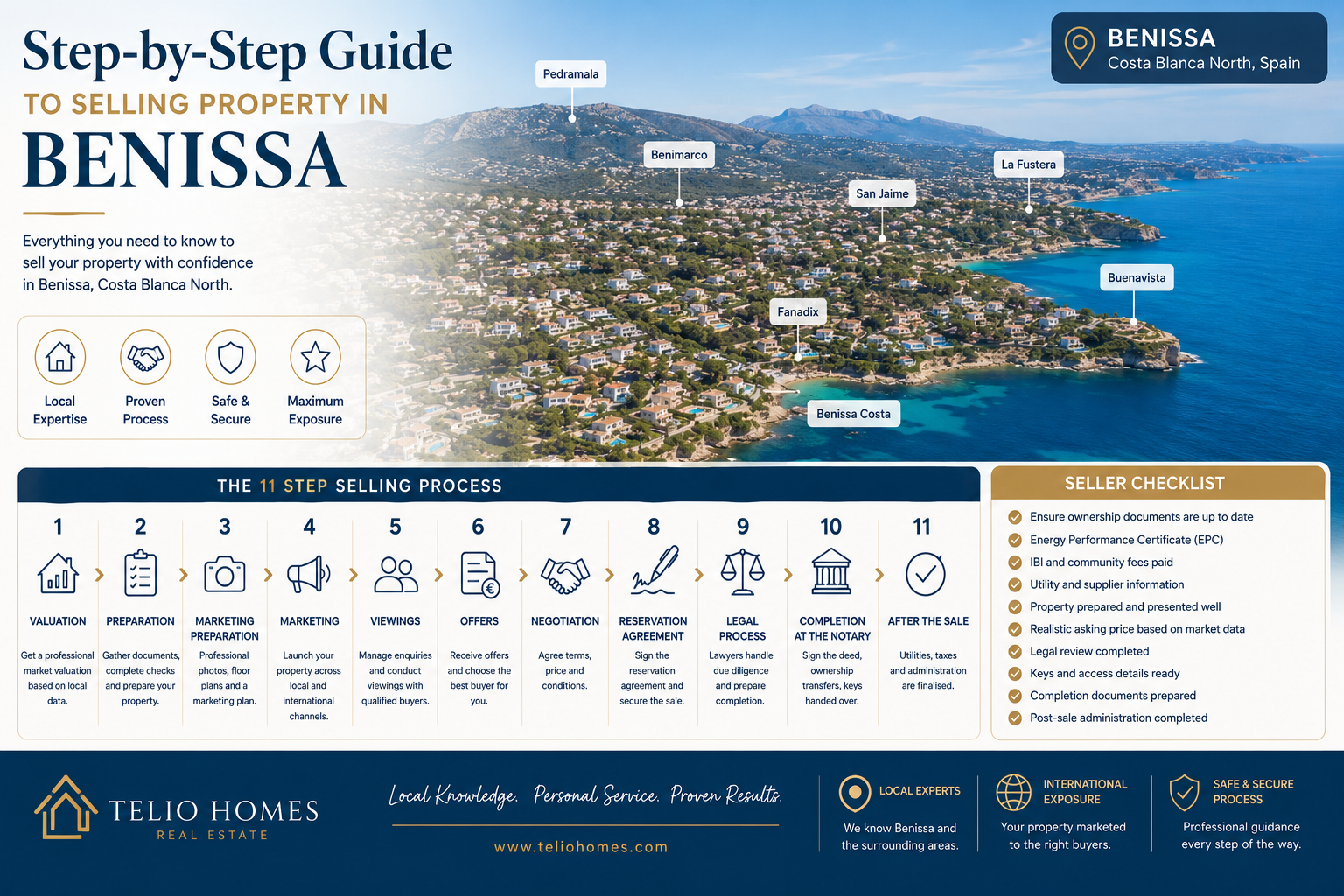
Step-by-Step Selling Guide Benissa
Selling a property is one of the most significant financial decisions you'll make. Whether you're selling a holiday home, a permanent residence, an investment property or a traditional finca, understanding the process from the outset can save time, reduce stress and help you achieve the best possible outcome.
This Step-by-Step Selling Guide Benissa explains every stage of the selling journey—from deciding to sell and preparing your property to signing before the notary and completing the final administrative tasks. You'll also find practical advice, local insights, expert tips, comparison tables and checklists to help you avoid common pitfalls.
At Telio Homes, we've helped homeowners sell properties throughout Benissa Costa, La Fustera, San Jaime, Fanadix, Buenavista, Pedramala and Benimarco. One lesson remains consistent: successful sales are rarely the result of luck. They are usually achieved through careful preparation, realistic pricing and experienced guidance from the very beginning.
If you're planning to sell property in Benissa, this guide will help you understand what to expect and how to prepare with confidence.
Quick Summary
Selling a property in Benissa generally follows these eleven steps:
- Decide to sell.
- Prepare your property.
- Gather the required documentation.
- Obtain a professional valuation.
- Choose an experienced estate agent.
- Market the property.
- Negotiate and accept an offer.
- Sign the reservation agreement.
- Complete legal due diligence.
- Sign before the notary.
- Finalise post-sale administration.
Most successful sales have one thing in common: preparation begins well before the property is advertised.
Table of Contents
- Selling Property in Benissa at a Glance
- Step 1 – Decide to Sell
- Step 2 – Prepare Your Property
- Step 3 – Gather the Required Documents
- Step 4 – Obtain a Professional Property Valuation
- Step 5 – Choose the Right Estate Agent
- Step 6 – Market Your Property
- Step 7 – Receive and Negotiate Offers
- Step 8 – Reservation Agreement
- Step 9 – Legal Process
- Step 10 – Completion at the Notary
- Step 11 – After the Sale
- Common Problems That Delay Sales
- Selling Property from Abroad
- Selling an Inherited Property
- Selling a Property with Tenants
- Frequently Asked Questions
Selling Property in Benissa at a Glance
If you're looking for the short version, this is the typical order in which most property sales progress.
| Step | What Happens |
|---|---|
| 1 | Decide to sell and define your goals |
| 2 | Prepare the property for marketing |
| 3 | Gather legal documentation |
| 4 | Obtain a professional valuation |
| 5 | Appoint an estate agent |
| 6 | Launch the marketing campaign |
| 7 | Negotiate and accept an offer |
| 8 | Sign the reservation agreement |
| 9 | Complete legal due diligence |
| 10 | Sign before the notary |
| 11 | Finalise post-completion administration |
Expert Tip
Many homeowners believe finding a buyer is the hardest part of selling. In reality, preparing the property correctly and ensuring the legal documentation is in order are often the biggest factors in achieving a smooth transaction.
Step 1 – Decide to Sell
Every successful property sale starts with a clear objective. Understanding why you're selling will influence your pricing strategy, preferred timescale and negotiation approach.
Common reasons include:
- Moving permanently.
- Downsizing.
- Relocating abroad.
- Releasing equity.
- Selling an investment property.
- Managing an inherited property.
- Reducing ongoing ownership costs.
Being clear about your priorities allows you and your advisers to make better decisions throughout the selling process.
Understand the Benissa Property Market
Benissa is one of the Costa Blanca North's most desirable property markets, attracting buyers from across Europe. Demand varies depending on location, property type, condition and market conditions.
Rather than viewing Benissa as one market, it's more useful to understand the different buyer profiles across its neighbourhoods.
| Area | Typical Buyer Priorities |
|---|---|
| La Fustera | Walking distance to the beach, holiday rentals, sea views |
| San Jaime | Golf, established residential areas, year-round living |
| Benissa Costa | Modern villas close to amenities |
| Pedramala | Privacy, panoramic countryside and sea views |
| Benimarco | Traditional fincas and larger plots |
| Fanadix | Quiet residential environment |
| Buenavista | Spacious villas for families and second-home owners |
Understanding what buyers value in your specific area helps determine both pricing and marketing strategy.
Telio Homes Insight
One issue we regularly observe is that sellers compare their property with homes in different parts of Benissa rather than within their immediate neighbourhood.
A modern villa within walking distance of La Fustera beach will appeal to a different buyer than a traditional finca in Pedramala. Even if both properties have similar living space, their market value may differ significantly because buyers are looking for different lifestyles.
Should You Wait for Higher Prices?
Many homeowners wonder whether they should delay selling in the hope that prices will continue to rise.
While property values may increase over time, waiting also involves ongoing costs such as:
- Property tax (IBI)
- Insurance
- Maintenance
- Utilities
- Community fees where applicable
Instead of trying to predict future market movements, consider:
- Your personal circumstances.
- Current buyer demand.
- Comparable properties already on the market.
- Seasonal trends.
- Your long-term financial objectives.
A professional valuation based on current market conditions is generally far more useful than relying on national headlines or anecdotal information.
Is Now the Right Time to Sell?
Ask yourself the following questions.
| Question | If Yes | If No |
|---|---|---|
| Do you know your property's approximate value? | Continue planning | Arrange a valuation |
| Is your paperwork organised? | Continue | Gather missing documents |
| Is your home ready for photography? | Prepare for marketing | Complete improvements |
| Are you comfortable with current market conditions? | Proceed | Seek local advice |
If you answered "yes" to most of these questions, you're likely well prepared to begin the selling process.
Step 2 – Prepare Your Property
First impressions matter.
Today's buyers often make decisions online before arranging a viewing, meaning your property's presentation can directly influence enquiry levels.
Preparing your property doesn't necessarily require expensive renovations. In many cases, simple improvements provide the greatest return.
Consider:
- Decluttering living areas.
- Completing minor repairs.
- Cleaning thoroughly.
- Tidying outdoor spaces.
- Maintaining the swimming pool.
- Improving kerb appeal.
- Maximising natural light.
A well-presented property photographs better, attracts more qualified buyers and often spends less time on the market.
Home Presentation Checklist
Before arranging photography, check the following:
- □ Windows cleaned
- □ Garden maintained
- □ Swimming pool clean
- □ Outdoor furniture arranged
- □ Personal items reduced
- □ Minor repairs completed
- □ Interior well lit
- □ Neutral presentation where possible
Small improvements often create a stronger first impression than expensive renovations.
Professional Photography Matters
Most buyers begin their search online.
Professional photography can significantly improve click-through rates and increase viewing enquiries.
A comprehensive marketing package may include:
- Professional interior photography
- Exterior photography
- Drone photography (where appropriate)
- Floor plans
- Lifestyle images
- Video walkthroughs
Properties marketed with high-quality visuals generally receive more attention than those relying on basic mobile phone photographs.
What Buyers Notice First
When viewing an online listing, buyers often focus on:
- Main exterior photograph.
- Swimming pool.
- Outdoor living areas.
- Views.
- Kitchen.
- Main bedroom.
- Bathrooms.
- Floor plan.
For this reason, your strongest images should always appear first.
Telio Homes Insight
We frequently find that sellers underestimate the importance of outdoor spaces. In Benissa, terraces, swimming pools, gardens and sea or countryside views often have as much influence on buyer interest as the interior itself.
Well-presented outdoor photographs can dramatically improve the number of enquiries received during the first weeks of marketing.
Professional Marketing vs Basic Marketing
| Professional Marketing | Basic Marketing |
|---|---|
| Professional photography | Mobile phone photos |
| Floor plans | No floor plans |
| Drone imagery | Limited exterior images |
| Detailed descriptions | Brief descriptions |
| International exposure | Limited marketing |
| Qualified buyers | Unqualified enquiries |
| Regular feedback | Minimal communication |
Investing in professional presentation from the outset usually provides a stronger return than making repeated price reductions later.
Common Mistake
Some sellers postpone preparing their property until after marketing begins.
In reality, the first few weeks of exposure are often when the greatest number of active buyers see a new listing. Launching with professional photography, complete documentation and a realistic asking price gives your property the strongest possible start.
Step 3 – Gather the Required Documents
Preparing the correct documentation before your property goes on the market is one of the most effective ways to avoid delays later in the transaction.
Many sales take longer than necessary because essential paperwork is only requested after a buyer has been found. Organising these documents in advance gives buyers greater confidence and allows your lawyer to begin work immediately once an offer is accepted.
Expert Tip
Buyers are generally more comfortable making an offer when they know the property's documentation has already been reviewed. Preparation demonstrates transparency and can help prevent unexpected issues during legal due diligence.
Essential Documents for Selling Property in Benissa
The exact documentation required depends on the property, but sellers are commonly asked to provide:
-
Title Deed (Escritura)
-
Recent Nota Simple from the Land Registry
-
Valid Energy Performance Certificate (EPC)
-
Latest IBI (property tax) receipt
-
Community fee information (where applicable)
-
Utility bills
-
Passport or national ID
-
NIE number (if applicable)
-
Mortgage information (if the property is financed)
-
Habitation documentation where applicable
-
Building licences or certificates for recent alterations
If you're selling through a Spanish lawyer, they will confirm exactly which documents are needed for your specific circumstances.
When Should You Obtain Each Document?
| Document | Before Marketing | Before Accepting an Offer | Before Completion |
|---|---|---|---|
| Title Deed | ✓ | ✓ | ✓ |
| Nota Simple | ✓ | ✓ | ✓ |
| Energy Performance Certificate | ✓ | ✓ | ✓ |
| Passport / ID | ✓ | ✓ | ✓ |
| NIE (where applicable) | ✓ | ✓ | ✓ |
| Latest IBI Receipt | ✓ | ✓ | ✓ |
| Utility Bills | ✓ | ✓ | ✓ |
| Mortgage Information | Recommended | ✓ | ✓ |
| Community Fee Statement | Recommended | ✓ | ✓ |
Preparing these documents early helps minimise last-minute requests and demonstrates that the property is ready to proceed.
Documents for Non-Resident Sellers
Many Benissa homeowners live outside Spain and only visit their property during holidays.
If you are selling from abroad, additional arrangements may be required, including:
-
Tax representation where appropriate.
-
A Power of Attorney if someone will sign on your behalf.
-
Updated contact information.
-
Overseas bank details for receiving sale proceeds.
Planning these arrangements early helps avoid unnecessary travel or delays later in the process.
Telio Homes Insight
Many overseas owners assume they can begin gathering paperwork once a buyer is found.
In practice, obtaining certain documents can take longer than expected, particularly if they require updates from public authorities or third parties. Starting the process before marketing often saves valuable time later.
Required Documents Checklist
Before advertising your property, check that you have:
-
□ Title Deed
-
□ Recent Nota Simple
-
□ Valid Energy Performance Certificate
-
□ Latest IBI receipt
-
□ Community fee information (if applicable)
-
□ Utility bills
-
□ Passport or ID
-
□ NIE (where applicable)
-
□ Mortgage details (if relevant)
-
□ Information relating to any recent building works
The more organised your paperwork is before marketing begins, the smoother the legal process is likely to be after accepting an offer.
Need help understanding the paperwork?
Read our Required Documents for Selling Property in Benissa guide for a detailed explanation of each document, why it matters and how to obtain it.
Step 4 – Obtain a Professional Property Valuation
Setting the right asking price is one of the most important decisions you'll make when selling your property.
Price your home too high and it may remain on the market for months with little interest.
Price it too low and you risk selling below its true market value.
A professional valuation aims to find the balance between attracting qualified buyers and achieving the best possible sale price.
Why an Accurate Valuation Matters
A realistic asking price can help:
-
Generate more enquiries.
-
Increase viewing requests.
-
Attract serious buyers.
-
Reduce time on the market.
-
Encourage stronger negotiations.
-
Minimise repeated price reductions.
The first few weeks after a property is listed are often when buyer interest is highest. Launching at the correct price gives you the greatest opportunity to take advantage of that initial exposure.
How Estate Agents Assess Market Value
Professional valuations are based on evidence rather than guesswork.
Factors commonly considered include:
-
Comparable properties currently for sale.
-
Recent completed transactions where available.
-
Buyer demand.
-
Property condition.
-
Exact location within Benissa.
-
Plot size.
-
Built area.
-
Orientation.
-
Views.
-
Privacy.
-
Swimming pool.
-
Parking.
-
Build quality.
-
Legal status.
-
Current competition.
A valuation reflects today's market—not what the owner originally paid or the cost of improvements completed many years ago.
Local Insight
Two neighbouring villas can achieve noticeably different prices.
Features such as uninterrupted sea views, south-facing orientation, walking distance to the beach, privacy, modernisation and outdoor living space often influence buyer demand more than square metres alone.
Asking Price vs Achieved Sale Price
Many homeowners compare their property with the highest advertised prices they find online.
However, asking prices and achieved sale prices are not the same.
An asking price reflects what a seller hopes to achieve.
A market valuation considers:
-
Comparable properties.
-
Current competition.
-
Buyer demand.
-
Property presentation.
-
Local market conditions.
Pricing solely by comparing your home with the highest-priced listings may result in fewer enquiries and a longer selling period.
Common Mistake
Some sellers increase their asking price because a neighbour achieved a high sale price several years ago.
Markets evolve continuously. Professional valuations should always be based on current evidence rather than historic sales alone.
Understanding Buyer Price Bands
Most property portals allow buyers to search within price ranges.
For example:
-
Up to €500,000
-
€500,000–€750,000
-
€750,000–€1,000,000
-
Above €1 million
A relatively small adjustment to your asking price may place your property within a different search bracket and increase its visibility to buyers.
Pricing decisions should always be based on market evidence, but understanding how buyers search online is another useful consideration.
Real Example
Example
A homeowner in La Fustera requested a valuation after noticing several nearby villas advertised for over €1 million.
At first glance, the properties appeared comparable.
However, a detailed review identified important differences in:
-
Sea views.
-
Plot size.
-
Renovation quality.
-
Walking distance to the beach.
-
Outdoor entertaining areas.
Rather than simply matching the highest asking prices, the property was marketed at a realistic figure supported by market evidence.
The result was strong buyer interest during the first weeks of marketing, helping to avoid multiple price reductions later.
Telio Homes Insight
One of the biggest valuation mistakes we encounter is comparing properties across different neighbourhoods.
A modern villa in La Fustera and a traditional finca in Pedramala may offer similar living space, but buyers are attracted by very different lifestyles. Accurate valuations always consider the property's immediate location and target buyer profile.
What Influences Property Value in Benissa?
| Factor | Potential Influence |
|---|---|
| Location | Very High |
| Sea views | Very High |
| Walking distance to amenities | High |
| Property condition | High |
| Plot size | High |
| Swimming pool | Medium to High |
| Energy efficiency | Increasingly Important |
| Privacy | Medium to High |
| Modern kitchens and bathrooms | High |
| Legal documentation | Essential |
Every property is unique, which is why professional valuations combine objective market evidence with local experience.
Need to know what your property is worth today?
Before deciding on an asking price, obtain a professional valuation based on comparable properties, current buyer demand and your property's individual characteristics.
Step 5 – Choose the Right Estate Agent
Selecting an estate agent is about far more than choosing someone to advertise your property.
A good agent becomes your adviser, negotiator and coordinator throughout the entire transaction.
Their role typically includes:
-
Advising on market value.
-
Preparing the marketing strategy.
-
Organising professional photography.
-
Managing enquiries.
-
Conducting viewings.
-
Qualifying buyers.
-
Negotiating offers.
-
Coordinating with lawyers.
-
Assisting through to completion.
An experienced local estate agent can also provide valuable insight into buyer behaviour, neighbourhood demand and current market conditions.
Exclusive vs Non-Exclusive Listings
One of the first decisions you'll make is whether to appoint an agent exclusively or instruct several agencies simultaneously.
| Exclusive Listing | Non-Exclusive Listing |
|---|---|
| One coordinated marketing strategy | Multiple agencies marketing independently |
| Consistent pricing | Greater risk of inconsistent pricing |
| Clear communication | Communication may become fragmented |
| Greater investment in marketing | Marketing effort can vary between agencies |
| Single point of contact | Multiple contacts to manage |
There is no universal answer. The right approach depends on your priorities, property type and marketing strategy.
Questions Every Seller Should Ask an Estate Agent
Before making your decision, ask:
| Question | Why It Matters |
|---|---|
| How many properties have you sold in Benissa during the last 12 months? | Demonstrates local experience. |
| Who will conduct the viewings? | Buyers value knowledgeable representatives. |
| Will you use professional photography and drone images? | Presentation influences enquiry levels. |
| Which countries do most of your buyers come from? | Benissa attracts an international audience. |
| How often will you provide feedback? | Good communication supports better decisions. |
| How do you qualify buyers? | Reduces unnecessary viewings. |
| What support do you provide after an offer is accepted? | The transaction continues well beyond marketing. |
Telio Homes Insight
The most successful property sales are rarely the result of marketing alone.
Strong communication between the seller, estate agent, lawyer and buyer throughout the transaction often makes the difference between a smooth completion and a delayed sale.
Seller Decision Checklist
Before placing your property on the market, ask yourself:
-
□ Do you understand your property's likely market value?
-
□ Is your documentation organised?
-
□ Is your property ready for photography?
-
□ Have you selected an experienced local estate agent?
-
□ Do you understand the likely selling costs?
-
□ Are your expectations aligned with current market conditions?
If you've answered "yes" to most of these questions, you're well positioned to begin marketing your property.
Still comparing estate agents?
Read our guide to Choosing an Estate Agent in Benissa to understand what to look for, which questions to ask and how different marketing strategies can influence the success of your sale.
Step 6 – Market Your Property
Once your property is fully prepared, professionally photographed and correctly priced, it's time to present it to the market.
An effective marketing strategy is about much more than uploading a listing to a property portal. The objective is to ensure your property reaches the right buyers, in the right countries, with the right presentation.
For properties in Benissa, many buyers come from countries such as the United Kingdom, the Netherlands, Belgium, Germany, France and Scandinavia. Your marketing should reflect this international audience.
Build a Strong Marketing Strategy
A professional marketing campaign should include:
- High-quality professional photography
- Drone photography (where appropriate)
- Accurate floor plans
- Detailed property descriptions
- Lifestyle-focused imagery
- Video tours
- International property portals
- Estate agency website
- Social media promotion
- Buyer database marketing
Each element helps buyers understand the property's value before they even arrange a viewing.
Digital Marketing Has Changed Buyer Behaviour
Today's buyers often spend weeks researching online before contacting an estate agent.
They compare:
- Similar properties
- Local amenities
- Nearby beaches
- Restaurants
- Schools
- Walking distances
- Satellite imagery
- Google Street View (where available)
- Airport connections
- Market reports
By the time many buyers request a viewing, they already have a detailed understanding of the local area.
This means your property's online presentation should answer as many questions as possible before the viewing takes place.
Telio Homes Insight
Many enquiries are won or lost before a buyer ever visits Benissa.
Clear photography, honest descriptions, accurate floor plans and comprehensive property information help attract serious buyers while reducing enquiries from people whose expectations don't match the property.
Professional Marketing vs Basic Marketing
| Professional Marketing | Basic Marketing |
|---|---|
| Professional photography | Mobile phone images |
| Drone photography | Limited exterior photos |
| Accurate floor plans | No floor plans |
| Detailed property description | Short generic description |
| International exposure | Limited portal exposure |
| Buyer qualification | Every enquiry treated equally |
| Regular seller feedback | Minimal communication |
Professional marketing isn't simply about attracting more enquiries—it helps attract better-qualified enquiries.
What Makes a Property Listing Stand Out?
The best-performing listings usually include:
- A compelling headline.
- An accurate and detailed description.
- Professional photographs taken in good weather.
- Floor plans.
- Honest information about the property's condition.
- High-quality images of outdoor living areas.
- Local lifestyle information.
- Clear details about parking, swimming pools and views.
Avoid exaggerating features. Buyers appreciate transparency, and accurate listings build trust from the beginning.
Preparing for Viewings
Once marketing begins, viewings should be organised efficiently.
Before each appointment:
- Open curtains and shutters.
- Ensure every room is tidy.
- Switch on lights where appropriate.
- Remove unnecessary clutter.
- Clean terraces and swimming pool.
- Ventilate the property.
- Secure pets if necessary.
Small details create a better overall impression.
What Buyers Often Notice During a Viewing
Although every buyer is different, many pay particular attention to:
- Natural light
- Signs of damp
- Window condition
- Privacy
- Outdoor entertaining areas
- Swimming pool condition
- Storage space
- Maintenance standards
- Views
- Overall atmosphere
These practical details often influence purchasing decisions as much as décor.
Common Mistake
Some sellers follow buyers around during viewings to explain every feature of the property.
Most buyers prefer time to explore the home at their own pace and discuss their impressions privately. Allowing the estate agent to lead the viewing often creates a more comfortable experience for everyone involved.
Step 7 – Receive and Negotiate Offers
Receiving an offer is an exciting milestone, but it is rarely the end of the process.
A successful negotiation balances achieving the best possible price with selecting the buyer most likely to complete the purchase successfully.
Understanding Different Types of Offers
Not every offer should be judged solely on price.
Consider:
- The buyer's financial position.
- Whether they are a cash buyer.
- Whether mortgage finance is required.
- Preferred completion date.
- Conditions attached to the offer.
- Furniture or appliances included.
- Flexibility regarding timescales.
A slightly lower offer from a financially secure buyer may represent less risk than a higher offer with uncertain financing.
Comparing Different Types of Offers
| Offer Type | Advantages | Things to Consider |
|---|---|---|
| Cash Buyer | Often faster completion | Legal checks still required |
| Mortgage Buyer | Larger buyer pool | Mortgage approval may take longer |
| Full Asking Price | Strong starting position | Review all conditions carefully |
| Below Asking Price | Opportunity to negotiate | Compare with market evidence |
| Conditional Offer | May suit some circumstances | Understand every condition before accepting |
Negotiating Beyond the Purchase Price
Negotiations often involve more than the headline price.
Topics may include:
- Completion date.
- Included furniture.
- Fixtures and fittings.
- Repair requests.
- Deposit amount.
- Access before completion.
- Conditions relating to mortgage approval.
Maintaining open communication usually leads to better outcomes than focusing exclusively on price.
Telio Homes Insight
The smoothest negotiations often occur when both buyer and seller understand each other's priorities.
For example, a seller who values a quick completion may accept a slightly lower offer from a cash buyer, while another seller may prefer a higher price even if the transaction takes longer.
Should You Accept the First Offer?
Many sellers assume the first offer should automatically be rejected.
In reality, every situation is different.
Consider:
- How long the property has been on the market.
- Current buyer demand.
- Feedback from previous viewings.
- The buyer's financial position.
- Competing properties currently available.
A strong first offer from a qualified buyer can sometimes be the best opportunity available.
Expert Tip
Negotiation should be based on evidence rather than emotion.
Ask your estate agent to explain:
- How the offer compares with current market conditions.
- Whether similar buyers are actively searching.
- How realistic it is to expect a stronger offer.
Objective advice helps support informed decisions.
Step 8 – Reservation Agreement
Once an offer has been accepted, the next stage is usually the reservation agreement.
This agreement confirms the intention of both parties to proceed with the purchase under agreed terms while legal due diligence begins.
The exact format varies depending on the transaction and the advice provided by the lawyers involved.
What Is a Reservation Agreement?
A reservation agreement generally records:
- Agreed purchase price.
- Deposit amount.
- Details of the buyer and seller.
- Property information.
- Proposed completion timetable.
- Conditions agreed by both parties.
Although the terminology may differ between transactions, the purpose is to provide clarity while the legal process progresses.
Buyer Due Diligence
Following the reservation agreement, the buyer's lawyer will normally begin reviewing:
- Ownership.
- Land Registry information.
- Planning documentation.
- Outstanding debts or charges.
- Community information (where applicable).
- Utility matters.
- Other legal documentation relevant to the property.
Responding promptly to reasonable requests for information helps keep the transaction moving efficiently.
What Happens Between the Reservation Agreement and Completion?
This period may appear quiet from the seller's perspective, but a considerable amount of work takes place behind the scenes.
Typical activities include:
- Lawyers reviewing legal documentation.
- Mortgage arrangements (if applicable).
- Updated Land Registry searches.
- Confirming property boundaries where required.
- Preparing completion documentation.
- Agreeing a completion date.
- Coordinating with the notary.
Maintaining regular communication with both your estate agent and lawyer helps identify potential issues before they become delays.
Telio Homes Insight
Most delays occur because a document is requested late or because additional information becomes necessary after legal checks have started.
Preparing documentation before marketing significantly reduces the likelihood of these issues arising.
Reservation Agreement Checklist
Before signing, make sure you understand:
- □ Purchase price.
- □ Deposit amount.
- □ Completion timetable.
- □ Conditions attached to the agreement.
- □ Responsibilities of both parties.
- □ What happens if unexpected issues arise.
If anything is unclear, ask your lawyer to explain it before signing.
Want to understand this stage in more detail?
Read our guide to the Reservation Agreement Process in Spain, where we explain deposits, legal checks and what both buyers and sellers should expect before completion.
Step 9 – Complete the Legal Process
Once the reservation agreement has been signed, the legal stage begins. Although much of the work happens behind the scenes, this is one of the most important phases of the transaction.
During this stage, the lawyers acting for the buyer and seller verify that the property can be transferred legally and that all necessary documentation is in order.
A well-prepared property usually progresses through this stage far more smoothly than one where documents only begin to be gathered after an offer has been accepted.
What Does Your Lawyer Do?
Your lawyer's role is to protect your interests and coordinate the legal aspects of the sale.
Typical responsibilities include:
- Reviewing ownership documentation.
- Confirming the seller has the legal right to sell.
- Checking the Land Registry records.
- Reviewing planning and building documentation.
- Identifying outstanding charges or debts.
- Liaising with the buyer's lawyer.
- Preparing documentation for completion.
- Coordinating with the notary.
If issues arise, your lawyer will explain the available options and recommend the most appropriate course of action.
Land Registry and Cadastre – Why Both Matter
Many international owners are surprised to discover that Spain has two separate property records.
Registro de la Propiedad (Land Registry)
The Land Registry records:
- Legal ownership.
- Registered rights.
- Mortgages.
- Charges affecting the property.
Its primary purpose is to provide legal certainty regarding ownership.
Catastro (Cadastre)
The Cadastre contains administrative information, including:
- Property boundaries.
- Land classification.
- Plot size.
- Building characteristics.
- Tax-related information.
Although both records should ideally match the physical property, discrepancies occasionally occur—particularly with older homes or properties that have been altered over time.
Good to Know
Minor differences between the Land Registry and the Cadastre do not automatically prevent a sale. However, identifying them early usually makes the legal process simpler and reduces the likelihood of last-minute surprises.
Rural Properties May Require Additional Checks
Benissa is renowned for its traditional fincas and countryside villas.
Older rural properties can sometimes require additional legal or technical checks before completion, for example:
- Historic extensions.
- Guest accommodation.
- Swimming pools.
- Agricultural buildings.
- Water supply arrangements.
- Septic systems.
- Rights of access.
- Planning documentation.
Many rural homes have no significant issues at all, but arranging these checks before marketing helps buyers proceed with greater confidence.
Telio Homes Insight
We often find that rural properties benefit from an early legal review, even when owners believe everything is already in order. Resolving small administrative issues before marketing is generally quicker and less stressful than addressing them during negotiations.
Mortgage Redemption
If your property is subject to an existing mortgage, your lawyer and lender will coordinate the redemption process.
This typically involves:
- Obtaining the outstanding mortgage balance.
- Confirming the repayment amount.
- Arranging repayment on completion.
- Removing the mortgage from the Land Registry after completion.
Most sellers do not need to manage this process themselves, but understanding how it works helps avoid unnecessary concern.
Legal Process Checklist
Before completion, ensure the following have been addressed:
- □ Ownership confirmed.
- □ Land Registry reviewed.
- □ Cadastre reviewed (where appropriate).
- □ Outstanding mortgage arrangements confirmed.
- □ Community fees confirmed.
- □ Property tax information available.
- □ Completion documentation prepared.
- □ Completion date agreed.
Step 10 – Completion at the Notary
Completion day is when ownership of the property is formally transferred to the buyer.
In Spain, this normally takes place before a Spanish Notary, who oversees the signing of the public deed and ensures the legal formalities have been completed.
For most sellers, this is the final major milestone in the transaction.
Who Attends the Notary Appointment?
Depending on the transaction, those present may include:
- The buyer.
- The seller.
- Their lawyers (where applicable).
- Bank representatives (if required).
- The notary.
- An interpreter, if necessary.
If you cannot attend personally, a representative may be able to sign on your behalf if a valid Power of Attorney has been arranged.
What Happens on Completion Day?
Although every transaction is different, completion usually follows a similar sequence:
- Final documentation is checked.
- The purchase funds are confirmed.
- The public deed is signed.
- Ownership transfers to the buyer.
- Keys are handed over.
- The seller receives the sale proceeds, subject to any agreed deductions.
Once the deed has been signed, the transaction is generally considered complete.
What to Bring on Completion Day
Documents
- Passport or national ID.
- NIE (where applicable).
- Bank account details.
- Power of Attorney documentation (if applicable).
Property Items
- Property keys.
- Garage remotes.
- Alarm codes.
- Community access cards.
- Instruction manuals where available.
Administrative Information
- Final utility meter readings.
- Utility provider contact details.
- Any additional documents requested by your lawyer.
Preparing these items in advance helps completion day proceed efficiently.
Completion Day Checklist
Before leaving the notary's office, confirm that:
- □ The deed has been signed.
- □ Funds have been transferred as agreed.
- □ Keys have been handed over.
- □ Utility meter readings have been recorded.
- □ Any agreed documentation has been exchanged.
Telio Homes Insight
Completion day is usually much calmer than sellers expect.
When the preparation has been done properly, the appointment often lasts less than an hour. Most of the important work has already taken place during the legal process.
Step 11 – After the Sale
Although ownership has transferred, there are still a few administrative matters to complete.
Taking care of these promptly helps bring the transaction to a clean conclusion.
Post-Completion Tasks
Depending on your circumstances, these may include:
- Cancelling utility accounts.
- Informing your insurance provider.
- Updating your correspondence address.
- Cancelling direct debits where appropriate.
- Confirming mortgage redemption (if applicable).
- Keeping copies of all completion documents.
- Discussing any tax obligations with your adviser.
After-Sale Checklist
- □ Utilities updated or cancelled.
- □ Insurance provider informed.
- □ Community administrator notified (if required).
- □ Copies of legal documents retained.
- □ Mortgage redemption confirmed.
- □ Tax advice obtained where appropriate.
Keeping your documentation organised after completion can make future administrative or tax matters considerably easier.
Common Problems That Delay Property Sales
Even straightforward transactions can experience delays.
Fortunately, many of the most common issues can be identified and addressed before the property is marketed.
Common Selling Problems and How to Reduce the Risk
| Challenge | Possible Impact | How to Prepare |
|---|---|---|
| Missing documentation | Legal delays | Gather paperwork before marketing |
| Unrealistic asking price | Limited buyer interest | Obtain a professional valuation |
| Unregistered alterations | Additional legal work | Review documentation early |
| Outstanding mortgage | Delayed completion | Request redemption figures in advance |
| Buyer finance delays | Longer transaction | Ensure buyers are financially qualified |
| Poor presentation | Fewer enquiries | Prepare the property before photography |
Common Delay Checklist
Before marketing your property, check for the following:
- □ Missing ownership documents.
- □ Expired Energy Performance Certificate.
- □ Outstanding community fees.
- □ Existing mortgage.
- □ Unregistered alterations.
- □ Planning discrepancies.
- □ Missing utility information.
- □ Boundary uncertainties.
- □ Outstanding local taxes.
Identifying these issues early gives you time to resolve them before they affect a potential sale.
What Happens If the Sale Falls Through?
Although most agreed sales complete successfully, some transactions do not proceed.
Common reasons include:
- Mortgage refusal.
- Buyer changing their plans.
- Legal issues identified during due diligence.
- Unexpected survey findings.
- Inability to agree revised terms.
- Extended delays causing one party to withdraw.
If a sale falls through:
- Understand why it happened.
- Resolve any identified issues.
- Review your pricing or marketing strategy if appropriate.
- Relaunch the property promptly where suitable.
A setback does not necessarily indicate a problem with the property itself. Often, a different buyer with different circumstances completes the purchase successfully.
Selling Property from Abroad
Many Benissa property owners live overseas for much or all of the year.
Selling remotely is often entirely possible with careful planning.
You may need to consider:
- Appointing a lawyer.
- Granting a Power of Attorney if appropriate.
- Arranging digital communication.
- Coordinating document signing.
- Confirming overseas banking arrangements.
Planning these steps early can make the process significantly easier.
Selling an Inherited Property
Inherited homes are common in Benissa, particularly holiday properties that have remained within the same family for many years.
Before marketing an inherited property, ensure that:
- Ownership has been transferred correctly.
- Relevant inheritance formalities have been completed.
- Documentation is fully updated.
- The property is legally ready to be sold.
Because every inheritance is different, professional legal advice is essential before proceeding.
Selling a Property with Existing Tenants
If your property is currently rented, additional considerations may apply.
These may include:
- Existing tenancy agreements.
- Notice requirements.
- Access for viewings.
- Rental deposits.
- The buyer's intentions regarding the tenancy.
The correct approach depends on the individual circumstances and current legislation, so legal advice should always be obtained before marketing a tenanted property.
Common Seller Mistakes to Avoid
Even experienced homeowners can make avoidable mistakes.
Some of the most common include:
- Waiting too long to prepare documentation.
- Choosing an unrealistic asking price.
- Ignoring small maintenance issues.
- Using poor-quality photography.
- Being unavailable for viewings.
- Responding slowly to offers.
- Assuming every interested buyer is financially qualified.
- Forgetting post-sale administration.
Avoiding these mistakes can save time, reduce stress and improve the overall selling experience.
Expert Tips for a Successful Sale
The smoothest property sales usually have three things in common:
- Preparation begins early.
- The asking price reflects current market conditions.
- Communication remains clear throughout the transaction.
Telio Homes Insight
Many of the easiest transactions we've experienced began weeks before the property appeared online. Sellers who organised their documents, completed small maintenance jobs and agreed a realistic pricing strategy were often able to move from accepted offer to completion with fewer unexpected delays.
Frequently Asked Questions
How long does it usually take to sell a property in Benissa?
The timeframe varies depending on factors such as the property's location, condition, asking price and current market demand. Well-presented properties priced realistically often attract interest more quickly than homes that require significant work or are priced above market expectations.
What documents do I need to sell my property?
Most sellers will need:
- Title Deed (Escritura)
- Recent Nota Simple
- Energy Performance Certificate (EPC)
- Latest IBI receipt
- Community fee information (if applicable)
- Utility bills
- Passport or ID
- NIE (where applicable)
Your lawyer will advise if additional documentation is required.
Can I sell my property if I live outside Spain?
Yes. Many overseas owners successfully sell their properties without returning to Spain. Depending on your circumstances, you may choose to appoint a lawyer and grant a Power of Attorney so they can complete certain formalities on your behalf.
Should I accept the first offer?
Not necessarily.
The best offer is not always the highest.
Consider:
- The buyer's financial position.
- Whether mortgage finance is required.
- Proposed completion date.
- Conditions attached to the offer.
- Current market conditions.
An experienced estate agent can help you evaluate the overall strength of an offer.
Can I sell my property before my mortgage has been repaid?
Yes.
If there is an outstanding mortgage, it is normally redeemed during the completion process. Your lawyer and lender will coordinate the necessary arrangements.
Can I continue living in the property until completion?
In most cases, yes.
Ownership transfers when the completion takes place before the notary. Until then, the property normally remains under the seller's control unless another arrangement has been agreed in writing.
What happens if legal issues are discovered?
Many legal issues can be resolved before completion.
Your lawyer will explain the situation, advise on the available options and work with the other parties to resolve the matter where possible.
Preparing documentation before marketing significantly reduces the likelihood of unexpected legal delays.
What if my buyer withdraws?
Although disappointing, it does happen.
The best approach is to:
- Understand why the sale did not proceed.
- Resolve any issues identified.
- Relaunch the property if appropriate.
- Continue marketing to qualified buyers.
Many properties successfully sell shortly afterwards.
Can I sell an inherited property?
Yes.
However, ownership should first be transferred correctly and any inheritance-related legal formalities completed before marketing begins.
Can I sell a property that needs renovation?
Absolutely.
Many buyers actively look for renovation projects.
Being transparent about the property's condition helps attract buyers whose expectations match the opportunity.
Do I need to remove all furniture before completion?
Not necessarily.
Furniture can be included in the sale if both parties agree.
Any items remaining with the property should be clearly documented before completion.
Who chooses the completion date?
The completion date is usually agreed jointly by the buyer and seller after consultation with their lawyers and any lender involved.
Flexibility from both parties often helps the transaction progress more smoothly.
Do I need to be present at the notary?
Not always.
If appropriate arrangements have been made, including a valid Power of Attorney, your legal representative may be able to sign on your behalf.
What taxes should sellers consider?
Tax obligations depend on individual circumstances, including residency status and the nature of the sale.
Because tax rules vary, always seek advice from a qualified tax adviser before completion.
What is the most important factor in achieving a successful sale?
Preparation.
Sellers who organise their documentation, present their property professionally, obtain a realistic valuation and communicate openly throughout the transaction generally enjoy a smoother selling experience.
Continue Reading
To help you through every stage of selling your property, explore these related guides:
- Property Valuation in Benissa – Learn how professionals assess market value and what influences pricing.
- Required Documents for Selling Property in Benissa – Discover which documents you'll need before marketing your home.
- Selling Costs in Benissa – Understand the typical costs involved when selling property in Spain.
- Choosing an Estate Agent in Benissa – Learn what to look for when selecting an estate agent.
- Exclusive vs Non-Exclusive Listings – Compare the advantages of different marketing approaches.
- Professional Property Photography – Find out why presentation has a significant impact on buyer enquiries.
- Home Staging Tips for Benissa Sellers – Prepare your property to make the strongest first impression.
- Capital Gains Tax When Selling Property in Spain – An overview of the tax considerations for sellers.
- Plusvalía Tax Explained – Understand how this municipal tax may affect your sale.
- Reservation Agreement Guide – Learn what happens after your offer has been accepted.
- The Spanish Notary Process – Understand what to expect on completion day.
- Selling Property from Abroad – A practical guide for overseas owners.
- Benissa Property Market Report – Stay informed about local market trends and buyer demand.
Final Thoughts
Selling a property in Benissa is more than a legal transaction—it's a process that combines preparation, market knowledge and informed decision-making.
Whether you're selling a coastal apartment, a luxury villa, a traditional finca or an investment property, taking the time to prepare properly can make a significant difference to both the selling experience and the final outcome.
The most successful sellers typically have four things in common:
- They organise their documentation before marketing begins.
- They price their property realistically using current market evidence.
- They present their home professionally to attract qualified buyers.
- They work with experienced local professionals throughout the process.
While every sale is unique, understanding each stage—from valuation and marketing to negotiation, legal due diligence and completion—allows you to approach the process with confidence and minimise the risk of unnecessary delays.
By following the guidance in this step-by-step selling guide, you'll be well prepared to navigate the selling journey and make informed decisions at every stage.
Ready to Take the Next Step?
If you're considering selling your property in Benissa, your first step should be understanding its current market value and ensuring you're fully prepared before it reaches the market.
At Telio Homes, we specialise in helping homeowners throughout Benissa, La Fustera, San Jaime, Pedramala, Benimarco, Fanadix, Buenavista and the wider Costa Blanca North.
Whether you simply want an initial valuation, have questions about the selling process or would like expert guidance tailored to your property, we're here to help you make informed decisions with confidence.