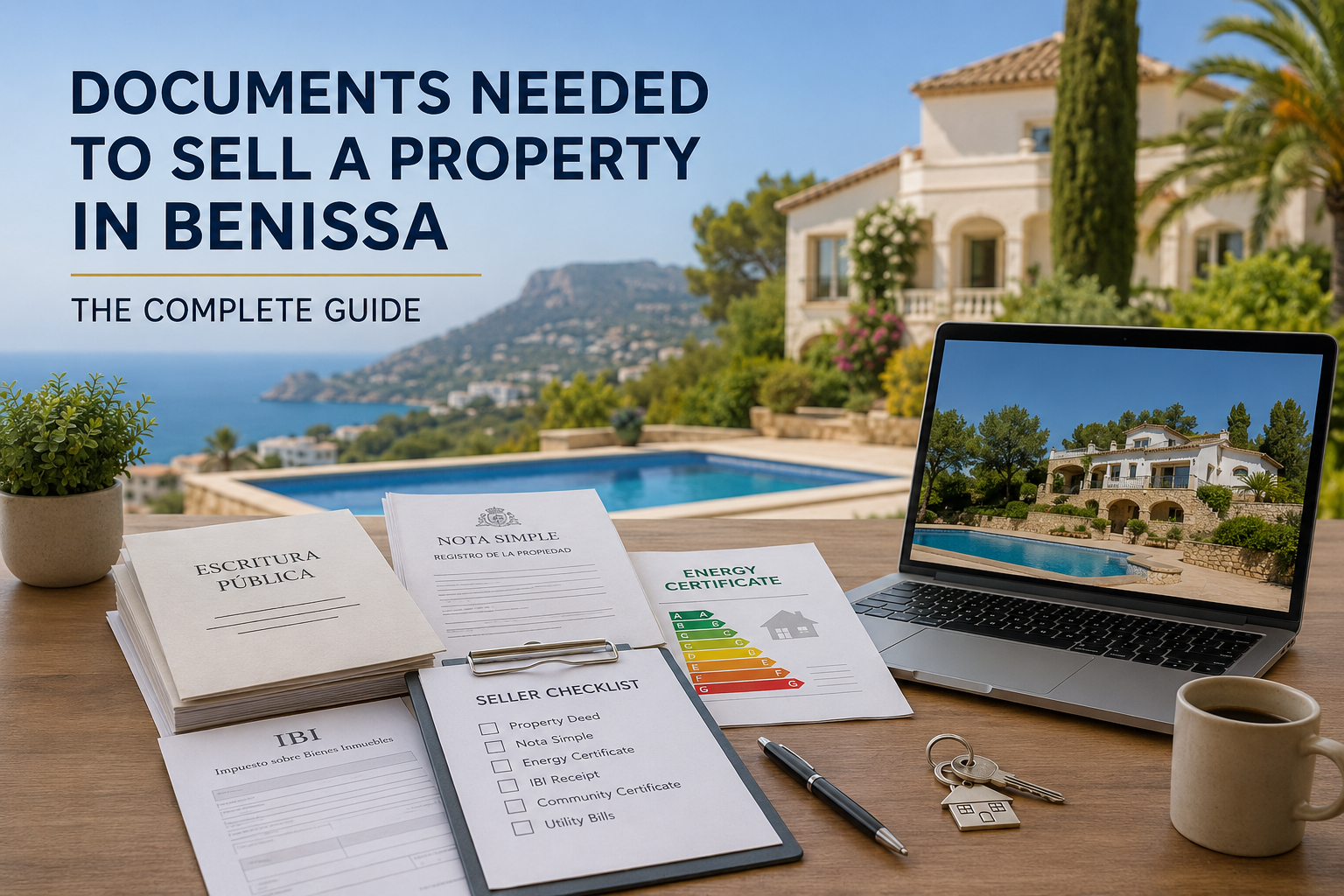
Required Documents for Selling a Property in Benissa
Selling a property in Benissa is about far more than finding the right buyer. Before your villa, apartment or finca reaches the market, you'll need to ensure that your legal paperwork is complete, accurate and up to date.
Having the documents needed to sell a property in Benissa ready before marketing your home can significantly reduce delays, avoid unexpected legal issues and give buyers greater confidence in the transaction. Whether you own a modern apartment in Benissa Costa, a villa in San Jaime, or a traditional finca in Pedramala, preparing your documentation early is one of the smartest steps you can take.
Many sellers only discover missing paperwork after accepting an offer. At that point, obtaining replacement documents, correcting Land Registry records or legalising historic alterations can delay completion by weeks—or, in some cases, cause a buyer to walk away.
This comprehensive guide explains the documents needed to sell property in Spain, with a particular focus on Benissa and the Costa Blanca North. You'll learn:
- Which documents are legally required
- Which documents buyers and lawyers usually request
- Where to obtain each document
- Typical processing times
- Common mistakes that delay property sales
- Additional paperwork for rural properties, inherited homes and holiday rentals
- Practical advice based on real situations commonly encountered in Benissa
Whether you're planning to sell in the coming weeks or simply preparing for the future, this guide will help you approach the process with confidence.
Important
Spanish property regulations and administrative procedures can change. This guide is intended as practical information rather than legal or tax advice. Always consult a qualified lawyer or other relevant professional regarding your individual circumstances.
Quick Answer
What documents are needed to sell a property in Benissa?
Most sellers will typically need:
- Title Deed (Escritura Pública)
- Updated Nota Simple
- Valid Energy Performance Certificate (EPC)
- Latest IBI receipt
- Passport or national ID
- NIE number (foreign owners)
- Mortgage documentation (if applicable)
- Community Certificate (where applicable)
- Utility bills
- Building licences or renovation documents (where applicable)
Depending on the property, additional documents may be required for swimming pools, extensions, tourist licences, inherited properties or rural fincas.
Table of Contents
- Why You Should Prepare Your Documents Before Listing
- Complete Checklist of Documents Required to Sell a Property in Benissa
- Additional Documents Required in Certain Situations
- Where to Obtain Each Document
- Typical Costs and Processing Times
- Common Documentation Problems That Delay Property Sales
- Benissa Case Studies
- How Telio Homes Helps Sellers Prepare Their Documentation
- Seller's Document Checklist
- Frequently Asked Questions
- Conclusion
Why You Should Prepare Your Documents Before Listing
Preparing your paperwork before advertising your property is one of the simplest ways to make the selling process smoother.
Many owners focus on presentation, photography and choosing an estate agent, yet overlook the documentation until a buyer has already been found. By then, any missing paperwork can slow down legal checks, postpone completion dates and create unnecessary uncertainty.
International buyers—who make up a significant proportion of the Benissa property market—often instruct an independent lawyer immediately after signing a reservation agreement. One of the lawyer's first tasks is to verify the property's legal documentation.
If essential documents are missing or inconsistent, the transaction may pause while the issues are investigated and resolved.
Benefits of Preparing Early
| Benefit | Why It Matters |
|---|---|
| Faster legal process | Lawyers can begin due diligence immediately. |
| Greater buyer confidence | Buyers see a well-prepared property and seller. |
| Fewer surprises | Missing paperwork is identified before negotiations. |
| Reduced risk of delays | Replacement documents can be obtained in advance. |
| Stronger negotiating position | Buyers are less likely to request extensions or renegotiate due to documentation issues. |
Avoid Delays During the Selling Process
Documentation problems are among the most common reasons property transactions are delayed in Spain.
Typical issues include:
- An expired Energy Performance Certificate.
- A missing Licence of Second Occupation where one is required.
- Unregistered extensions or swimming pools.
- Outstanding community fees.
- Missing mortgage redemption information.
- Differences between the Land Registry and the Cadastre.
Most of these issues can be resolved, but obtaining replacement documents or correcting official records may take time.
Real Agent Insight
At Telio Homes, one of the most common issues we encounter is owners discovering that alterations carried out many years ago—such as enclosing a naya, extending a terrace or modifying a swimming pool—were never fully reflected in the property's official records. Identifying these issues before marketing often prevents weeks of unnecessary delays later in the transaction.
Build Buyer Confidence
Buying property abroad is a significant financial commitment.
Many purchasers in Benissa come from the UK, the Netherlands, Belgium, Germany and France, and may be unfamiliar with Spanish legal procedures.
When sellers can immediately provide the requested documentation, buyers generally feel more comfortable progressing with the purchase.
Good preparation demonstrates that:
- ownership is clear,
- taxes have been paid,
- documentation is organised,
- the seller is cooperative,
- and there are no obvious legal concerns.
This often helps maintain momentum throughout the sale.
Did You Know?
Many buyers ask their lawyer to review key documents before arranging a structural survey or transferring significant funds. Having your paperwork ready can therefore speed up the entire buying process.
Reduce Legal Risks
No two properties are exactly alike.
Benissa has a diverse housing stock, ranging from modern apartments to luxury coastal villas and traditional countryside fincas.
Older homes—particularly in areas such as Benimarco, Pedramala and parts of Fanadix—may have been extended or renovated over several decades.
Before completion, lawyers commonly compare information from several official sources, including:
- the Title Deed,
- the Land Registry,
- the Cadastre,
- planning records,
- and, where applicable, occupancy or building licences.
If inconsistencies are identified, additional clarification may be required before the transaction can proceed.
Common Examples
- A swimming pool appears on site but not in the official records.
- The built area differs between the Cadastre and the Land Registry.
- A guest apartment has never been formally documented.
- Ownership details have not been updated following an inheritance.
Addressing these issues before marketing is almost always easier than resolving them after accepting an offer.
Warning
Never assume that because alterations were completed many years ago they are automatically reflected in the property's legal documentation. Historic discrepancies are often only discovered during the buyer's legal due diligence.
Speed Up Completion at the Notary
The final stage of a Spanish property sale normally takes place before a notary.
Before completion, the buyer's legal representative will usually confirm that all required documentation has been reviewed.
If everything is in order, the signing process can proceed smoothly.
If important paperwork is still outstanding, however, the completion date may need to be postponed while missing documents are obtained.
Preparing your documents before listing your property helps ensure that:
- legal checks begin sooner,
- mortgage lenders receive the information they require,
- buyers have fewer unanswered questions,
- completion dates are easier to schedule,
- and last-minute complications are minimised.
Real Agent Insight
Owners often ask us when they should start preparing their paperwork.
Our recommendation is simple:
Begin before your property is photographed or advertised.
By carrying out a document review at the start of the selling process, you can resolve most issues quietly in the background while your property is being prepared for the market, rather than under the pressure of an agreed sale.
Common Mistakes Sellers Make
Avoid these common pitfalls:
- Waiting until an offer has been accepted to gather documents.
- Assuming old certificates are still valid.
- Forgetting about documentation for renovations or swimming pools.
- Not checking whether community fees are fully paid.
- Misplacing the original Title Deed.
- Assuming the Land Registry and Cadastre always contain identical information.
Before You List Your Property: Quick Checklist
Before instructing an estate agent, make sure you have:
☐ Located your Title Deed.
☐ Requested an updated Nota Simple.
☐ Checked whether your EPC is still valid.
☐ Found your latest IBI receipt.
☐ Gathered recent utility bills.
☐ Checked whether any renovations require supporting documentation.
☐ Confirmed whether community fees are fully paid.
☐ Spoken to your lawyer if your property has unusual circumstances, such as inheritance, co-ownership or recent alterations.
Complete Checklist of Documents Required to Sell a Property in Benissa
One of the first questions sellers ask is:
"What documents do I actually need to sell my property?"
The answer depends on several factors, including the type of property, its age, whether it has been renovated, and how it is owned. A modern apartment in Benissa Costa may require a different set of supporting documents from a rural finca in Pedramala.
The table below provides a quick overview before we look at each document in detail.
At a Glance: Documents Required
| Document | Usually Required | Who Requests It | Why It Matters |
|---|---|---|---|
| Title Deed (Escritura Pública) | ✓ | Buyer, lawyer, notary | Confirms ownership |
| Updated Nota Simple | ✓ | Buyer's lawyer | Confirms legal status |
| Energy Performance Certificate (EPC) | ✓ | Estate agent, buyer | Required for marketing in most cases |
| Licence of Second Occupation | Often | Buyer, lawyer | Confirms lawful residential use where applicable |
| Latest IBI Receipt | ✓ | Buyer's lawyer | Confirms local property tax payments |
| Community Certificate | If applicable | Buyer | Shows community fees are paid |
| Passport / NIE | ✓ | Notary | Verifies identity |
| Mortgage Documentation | If applicable | Lawyer, bank | Enables mortgage redemption |
| Utility Bills | Usually | Buyer | Assists with account transfers |
| Cadastre Information | ✓ | Lawyer | Verifies property details |
| Building & Renovation Documents | If applicable | Lawyer | Confirms authorised alterations |
| Tourist Licence | If applicable | Buyer | Important for holiday rental properties |
Title Deed (Escritura Pública)
What is it?
The Escritura Pública is the official notarial deed signed when you purchased your property.
It records key legal information, including:
- The registered owner or owners.
- The legal description of the property.
- The date of purchase.
- The purchase price recorded at the time.
- The property's boundaries and description.
- Any rights attached to the property.
Although ownership is also registered with the Spanish Land Registry, the Title Deed remains one of the most important documents throughout the selling process.
Why is it required?
The buyer's lawyer and the notary use the Title Deed to verify:
- who legally owns the property;
- whether multiple owners must sign;
- how the property is described;
- whether ownership matches the Land Registry.
Where can I obtain it?
If you still have the original deed, keep it somewhere safe.
If it has been lost, a certified copy can usually be requested through a Spanish notary.
Many owners are surprised to discover that replacing a lost Title Deed is often much easier than expected, provided sufficient information about the original purchase is available.
Real Benissa Example
A British couple selling a villa in San Jaime contacted Telio Homes after discovering they had misplaced their original Title Deed during a house move.
Fortunately, a certified copy was obtained before the property was marketed. By resolving the issue early, the legal process continued without delaying completion.
Expert Tip
Scan your Title Deed and keep a digital copy together with your other property documents. While the original should always be retained, electronic copies are often useful during the initial stages of a sale.
Updated Nota Simple
What is a Nota Simple?
The Nota Simple is an official information document issued by the Spanish Land Registry.
Unlike the Title Deed, which records the original purchase transaction, the Nota Simple provides an up-to-date summary of the property's current legal position.
It usually includes:
- Registered owner(s).
- Property description.
- Plot details.
- Mortgages.
- Charges or encumbrances.
- Easements.
- Registration information.
Why do buyers request it?
For most transactions, the buyer's lawyer requests a recent Nota Simple shortly after the reservation agreement is signed.
It allows them to verify that:
- ownership is correct;
- no unexpected charges exist;
- mortgages are correctly recorded;
- the legal description matches expectations.
Where can you obtain one?
A Nota Simple can usually be requested:
- directly from the Spanish Land Registry;
- through your lawyer;
- through your estate agent;
- via authorised online Land Registry services.
Because it reflects the property's current legal position, a recently issued copy is generally preferred.
Nota Simple vs Title Deed
| Title Deed | Nota Simple |
|---|---|
| Official purchase deed | Current Land Registry extract |
| Signed before a notary | Issued by the Land Registry |
| Proves ownership | Summarises registered legal information |
| Permanent legal document | Informational document reflecting current records |
Important
A Nota Simple does not replace the Title Deed. Both documents serve different purposes during the sale.
Energy Performance Certificate (EPC)
What is an EPC?
The Energy Performance Certificate (Certificado de Eficiencia Energética) measures the energy efficiency of a property.
It assigns a rating from A (most efficient) to G (least efficient) and includes recommendations that could improve energy performance.
Is it legally required?
In most cases, yes.
Residential properties offered for sale generally require a valid Energy Performance Certificate before they are marketed.
There are limited exceptions, but most villas, apartments and townhouses in Benissa will need one.
How long is it valid?
Energy Performance Certificates are generally valid for up to 10 years, unless significant alterations affecting energy efficiency have been carried out.
Always confirm that your certificate remains valid before marketing your property.
How is it obtained?
A qualified energy assessor visits the property to inspect elements such as:
- external walls;
- insulation;
- windows;
- heating systems;
- cooling systems;
- hot water production.
Following the inspection, the certificate is prepared and registered in accordance with the applicable regional procedures.
Real Benissa Example
A villa owner in La Fustera instructed Telio Homes to market their property in early spring.
Because the Energy Performance Certificate had already been arranged before professional photography was booked, the property could be launched immediately without waiting for additional paperwork.
Common Mistake
Many sellers assume the certificate obtained when they purchased the property is still valid years later. Always check the issue date before listing your home.
Licence of Second Occupation (Licencia de Segunda Ocupación)
What is it?
The Licence of Second Occupation confirms that a residential property meets the administrative requirements for occupation.
Depending on the property's history and the applicable regional procedures, you may also hear the term Cédula de Habitabilidad.
Although these terms are often used interchangeably, the exact requirements depend on the autonomous community and the age of the property.
Is it always required?
Not necessarily.
Whether this document is required depends on factors such as:
- the type of property;
- when it was built;
- its administrative history;
- current regional regulations;
- the buyer's circumstances.
Your lawyer can advise whether it will be required in your particular transaction.
Why do buyers ask for it?
A buyer's lawyer may request it because it can be relevant for:
- utility contracts;
- mortgage applications;
- confirming lawful residential occupation;
- legal due diligence.
Common Issues
Older properties sometimes present challenges such as:
- expired licences;
- licences issued under previous regulations;
- missing documentation;
- later extensions not reflected in the original paperwork.
These issues do not necessarily prevent a sale, but identifying them early gives you more time to deal with them.
Real Agent Insight
Properties built decades ago in areas such as Buenavista, Fanadix and Pedramala often require a little more investigation because documentation standards have changed over the years.
That doesn't mean there is a problem—it simply means sellers should begin preparing their paperwork well before marketing starts.
Latest IBI (Property Tax) Receipt
What is IBI?
IBI (Impuesto sobre Bienes Inmuebles) is the annual municipal property tax payable by property owners in Spain.
The tax is administered by the local council.
Why is it requested?
The buyer's lawyer will usually ask for the latest receipt to confirm:
- the property's cadastral reference;
- ownership information;
- recent payment status.
Providing it early helps avoid unnecessary requests later.
Practical Tip
Keep at least the latest two or three IBI receipts together with your property records. Although the most recent receipt is normally sufficient, previous years can occasionally help answer historical queries.
Community of Owners Certificate (Where Applicable)
If your property forms part of an apartment block, gated development or urbanisation with shared facilities, the buyer's lawyer will usually request a Community Certificate.
What does it confirm?
The certificate generally confirms:
- community fees are paid;
- there are no outstanding debts (or specifies any that exist);
- any approved extraordinary charges;
- details issued by the community administrator.
Why is it important?
Outstanding community debts can complicate the transaction.
Obtaining the certificate before a buyer requests it demonstrates good preparation and often speeds up the legal review.
Real Benissa Example
An apartment owner in Benissa Costa requested their Community Certificate before the property was listed. When an overseas buyer made an offer, the document was already available, helping the legal process progress without delay.
Who Usually Requests Each Document?
| Document | Estate Agent | Buyer's Lawyer | Bank | Notary |
|---|---|---|---|---|
| Title Deed | ✓ | ✓ | ✓ | |
| Nota Simple | ✓ | ✓ (if financing) | ✓ | |
| EPC | ✓ | ✓ | ||
| IBI Receipt | ✓ | ✓ | ||
| Community Certificate | ✓ | |||
| Mortgage Information | ✓ | ✓ | ✓ | |
| Identification Documents | ✓ | ✓ |
This table illustrates why organising your paperwork before marketing your property is so valuable. Different professionals request documents at different stages, and having everything ready helps keep the transaction moving smoothly.
Owner Identification
Before a property can be legally transferred in Spain, the identity of every seller must be verified.
This is a standard part of the conveyancing process and ensures that the person signing the sale deed is legally entitled to sell the property.
Passport or National Identity Card
Every owner named on the Title Deed should provide valid identification.
Depending on your nationality, this will normally be:
- A valid passport
- A Spanish national identity card (DNI)
If there are multiple owners, each person must provide their own identification.
Important
Check the expiry date of your passport well before the planned completion date. An expired passport can delay the signing at the notary.
NIE Number
Foreign owners will normally also need their Número de Identificación de Extranjero (NIE).
The NIE is your Spanish tax identification number and is used throughout the property buying and selling process.
Your lawyer and the notary will usually require it before completion.
Power of Attorney
Many Benissa property owners spend much of the year abroad.
If you cannot travel to Spain to complete the sale, you may appoint another person to sign on your behalf using a Power of Attorney (POA).
This is common when sellers:
- Live permanently overseas
- Are unable to travel
- Own several properties
- Prefer their lawyer to complete the transaction
The Power of Attorney must be properly prepared and legally valid for use in Spain.
Real Benissa Example
A Dutch couple who owned a holiday villa in La Fustera were unable to return to Spain before completion.
By arranging a Power of Attorney several weeks beforehand, their lawyer was able to sign on their behalf, allowing the sale to complete on schedule.
Mortgage Documentation
If there is an outstanding mortgage secured against your property, additional documentation will normally be required.
Having this information available early helps your lawyer calculate exactly how the mortgage will be redeemed from the sale proceeds.
Mortgage Redemption Statement
Your lender can provide a statement confirming:
- Outstanding balance
- Interest payable
- Redemption amount
- Administration fees (where applicable)
- Validity period of the quotation
These figures allow everyone involved to prepare accurately for completion.
Mortgage Cancellation
Repaying the mortgage is only one part of the process.
The mortgage must also be formally cancelled in the Land Registry.
Your lawyer or notary will explain how this administrative process works and what documentation is required.
Common Mistake
Many owners believe that making the final mortgage payment automatically removes the mortgage from the Land Registry.
In reality, the legal registration of the cancellation is usually a separate process.
Expert Tip
If your mortgage is nearly repaid, request redemption figures as soon as you decide to sell rather than waiting until a buyer has been found.
Utility Bills
Although utility bills are not always a legal requirement, they are extremely useful during the sale.
Most buyers appreciate receiving copies of recent bills because they simplify the transfer of accounts after completion.
Typical documents include:
- Electricity
- Water
- Gas (where applicable)
- Internet (optional)
These documents help confirm:
- Property address
- Supply account numbers
- Meter information
- Supplier details
Cadastre (Catastro)
Many overseas buyers confuse the Cadastre with the Land Registry.
Although both contain information about your property, they serve different purposes.
Understanding the difference is important because buyers' lawyers often compare both records during legal due diligence.
What is the Cadastre?
The Spanish Cadastre is an administrative register used primarily for taxation purposes.
It records information such as:
- Plot boundaries
- Land area
- Built area
- Property reference number
- Construction details
Cadastre vs Land Registry
| Cadastre | Land Registry |
|---|---|
| Administrative record | Legal ownership record |
| Used mainly for taxation | Used mainly to prove legal rights |
| Records physical characteristics | Records ownership and legal charges |
| Managed separately | Managed separately |
Ideally, both records should be consistent.
Why is this important?
One of the most common issues affecting older properties is a difference between:
- The physical property
- The Cadastre
- The Land Registry
- The Title Deed
Examples include:
- Larger built area than officially recorded
- Swimming pool not shown
- Enclosed terrace omitted
- Additional guest accommodation
These differences do not automatically prevent a sale, but they should be investigated before marketing.
Real Agent Insight
We frequently see properties where the owner's understanding of the property differs slightly from the official records.
Identifying these discrepancies before accepting an offer gives sellers time to obtain professional advice and avoid unnecessary pressure later.
Building Licences and Renovation Documents
Many homes in Benissa have been improved over the years.
Examples include:
- Swimming pools
- Outdoor kitchens
- Enclosed naya terraces
- Garages
- Guest apartments
- Extensions
- Pergolas
- Storage buildings
Where significant works have been carried out, buyers often ask whether supporting documentation exists.
Why do buyers ask?
The buyer's lawyer wants to understand whether:
- Appropriate permissions were obtained where required
- Technical certificates exist
- Alterations have been reflected in the official records
- There are any obvious legal issues
Common Alterations
Swimming Pools
Swimming pools are one of the most frequently discussed items during legal due diligence.
Depending on the property's history, buyers may ask about:
- Planning documentation
- Technical certificates
- Registration
- Updates to official records
This is especially common with older villas and fincas.
Enclosed Nayas
Across Benissa, many owners have enclosed open terraces to create additional living space.
If this work has altered the property's built area, buyers may ask whether it has been properly documented.
Guest Accommodation
Independent guest apartments are highly desirable but often generate additional legal questions.
The buyer's lawyer may wish to confirm:
- How the accommodation was created
- Whether any permissions were required
- Whether official records reflect the current layout
Outdoor Improvements
Other improvements that sometimes generate documentation requests include:
- Covered terraces
- Carports
- Summer kitchens
- Boundary walls
- Storage rooms
Warning
Never assume that because work was carried out many years ago it automatically appears in the property's official records.
Tourist Licence Documentation
If your property has been used as holiday accommodation, buyers frequently ask whether a tourist licence exists.
Providing the relevant documentation helps buyers understand the property's current position.
Why is it important?
Holiday rental regulations can change over time.
Some buyers specifically look for properties with an established rental history, while others simply want confirmation of the property's status.
Providing accurate documentation avoids misunderstandings.
Important
Whether a tourist licence can be transferred or whether a new application is required depends on the regulations in force at the time of sale. Buyers should always seek up-to-date legal advice.
Additional Documents for Rural Properties
Benissa has a large number of beautiful countryside properties.
Selling a finca often involves additional legal checks compared with selling a modern apartment or villa.
Septic Tank Documentation
Many rural homes are not connected to the public sewer network.
Instead, they rely on private wastewater systems.
Buyers may ask for:
- Technical information
- Maintenance records
- Available approvals
- Installation details
Water Supply
Unlike urban properties, rural homes may obtain water through:
- Irrigation communities
- Private wells
- Water deposits
- Shared supplies
Buyers often want to understand how the property's water supply operates and what ongoing responsibilities exist.
Access Rights
Many countryside properties are accessed via shared or private roads.
Lawyers commonly check whether access rights are properly documented.
Easements
Some rural properties are affected by easements relating to:
- Access
- Utilities
- Water
- Neighbouring land
Where these exist, buyers generally expect clear information before committing to the purchase.
Agricultural Land
Where farmland forms part of the property, buyers may ask about:
- Agricultural use
- Irrigation arrangements
- Boundaries
- Existing agreements
Rural Property vs Urban Property
| Issue | Apartment | Villa | Finca |
|---|---|---|---|
| Community Certificate | ✓ | Sometimes | Rarely |
| Septic Tank | ✗ | Sometimes | Often |
| Water Rights | ✗ | Rarely | Often |
| Agricultural Land | ✗ | Rarely | Often |
| Shared Access | Rarely | Sometimes | Frequently |
Additional Documents Required in Certain Situations
Some property sales require further documentation because of the way the property is owned or how it was acquired.
Inherited Property
Inherited properties often require additional paperwork, including:
- Inheritance deed
- Proof that inheritance has been completed
- Updated Land Registry records
- Relevant tax documentation
If the inheritance has not yet been fully registered, additional legal work may be required before completion.
Company-Owned Property
Where the seller is a company rather than an individual, buyers may request:
- Company registration documents
- Authority to sell
- Directors' powers
- Corporate resolutions where applicable
Non-Resident Sellers
Owners who do not live permanently in Spain may need to provide additional documentation relating to their tax status.
Requirements vary depending on the seller's circumstances and current legislation.
Professional legal or tax advice should always be obtained.
Recently Renovated Properties
If major renovation work has recently been completed, buyers may ask for:
- Completion certificates
- Technical reports
- Architect's documentation
- Updated records
- Building licences where applicable
Having these documents ready before marketing begins helps avoid unnecessary questions later.
Decision Tree: Missing a Document?
If you're missing paperwork, don't panic. Most issues can be resolved with the right advice.
| Missing Document | First Step |
|---|---|
| Title Deed | Request a certified copy from a notary. |
| Nota Simple | Order a new copy from the Land Registry. |
| EPC | Book an assessment with a qualified energy assessor. |
| Community Certificate | Contact the community administrator. |
| Mortgage Information | Request redemption figures from your lender. |
| Building Documentation | Speak to your lawyer or a qualified technician before marketing. |
Where to Obtain Each Document
Knowing where to obtain each document can save valuable time once you decide to sell your property.
Some documents can be obtained within a few hours, while others may take several weeks depending on the circumstances.
The table below provides a practical overview.
| Document | Where to Obtain It | Typical Processing Time* |
|---|---|---|
| Title Deed (copy) | Spanish Notary | A few days to 2 weeks |
| Nota Simple | Spanish Land Registry | Often same day to a few days |
| Energy Performance Certificate | Qualified energy assessor | Usually 2–7 days |
| IBI Receipt | Benissa Town Hall or SUMA (if applicable) | Often immediate if available online |
| Community Certificate | Community administrator | A few days |
| Mortgage Redemption Statement | Mortgage lender | Several days to 2 weeks |
| Utility Bills | Utility provider or online account | Usually immediate |
| Cadastre Information | Spanish Cadastre | Often immediate online |
| Building Documentation | Architect, technician or local authority | Varies significantly |
| Tourist Licence Information | Relevant regional authority | Varies |
*Processing times are indicative only and can vary depending on the authority involved, holiday periods and individual circumstances.
Typical Costs
Many sellers are surprised to learn that obtaining the necessary documentation is relatively inexpensive compared with the overall value of the property.
Some documents are free, while others involve professional fees.
| Document | Typical Cost |
|---|---|
| Nota Simple | Low administrative fee |
| EPC | Professional fee payable to the energy assessor |
| Community Certificate | May be included or subject to an administration fee |
| Mortgage Redemption Statement | Usually provided by the lender (charges may apply) |
| Certified Copy of Title Deed | Notarial fee |
| Building Documentation | Depends on the work required |
Rather than focusing solely on the cost, consider the value of having everything prepared before a buyer is found. Resolving documentation issues early is usually far less stressful than dealing with them during negotiations.
When Should You Start Collecting Your Documents?
Ideally, you should begin before your property is photographed or advertised.
Many sellers wait until they receive an offer, but by then the legal process has already begun.
Starting early allows you to resolve any issues without the pressure of an agreed completion date.
Recommended Timeline
| Stage | Recommended Action |
|---|---|
| Before choosing an estate agent | Locate your Title Deed and identification documents. |
| Before professional photography | Check whether your EPC is still valid. |
| Before marketing begins | Obtain a recent Nota Simple and IBI receipt. |
| While the property is on the market | Gather community documents, mortgage information and renovation paperwork. |
| Once an offer is accepted | Provide the full document pack to your lawyer. |
| Before completion | Confirm that all original documents are available for signing. |
Document Validity Guide
Not every document remains valid indefinitely.
Some are permanent, while others should be updated before marketing your property.
| Document | Does it Expire? | Notes |
|---|---|---|
| Title Deed | No | Permanent legal document |
| Nota Simple | No fixed expiry, but obtain a recent copy | Buyers usually prefer an up-to-date version |
| EPC | Usually valid for up to 10 years | Check issue date before marketing |
| Passport | Yes | Must be valid at completion |
| Community Certificate | Effectively time-sensitive | Usually requested close to completion |
| Mortgage Redemption Statement | Yes | Valid only for a limited period set by the lender |
Common Documentation Problems That Delay Property Sales
Most property sales in Benissa proceed without major complications.
However, when delays occur, they are often caused by documentation rather than the buyer or seller.
Understanding the most common issues allows you to address them before they become obstacles.
1. Differences Between the Land Registry and the Cadastre
One of the most frequent issues involves inconsistencies between official records.
For example:
- The Land Registry records a built area of 180 m², while the Cadastre shows 205 m².
- A swimming pool appears on the property but is missing from one of the records.
- A terrace has been enclosed without the documentation being updated.
These discrepancies do not necessarily prevent a sale, but they usually require clarification by the seller's legal adviser.
2. Missing Documentation for Alterations
Older villas in Benissa have often been improved over many years.
Examples include:
- New swimming pools
- Extended terraces
- Guest accommodation
- Outdoor kitchens
- Garages
- Storage rooms
If supporting documentation cannot be located, the buyer's lawyer may ask additional questions before advising their client to proceed.
3. Expired Energy Performance Certificate
A surprisingly common issue is an EPC that expired years earlier.
Because many owners only sell once every decade or more, it is easy to assume the certificate is still valid.
Checking this before marketing avoids unnecessary delays.
4. Lost Title Deed
Although the original Title Deed is an important legal document, losing it does not usually prevent a sale.
A certified copy can normally be obtained through a Spanish notary.
The key is allowing enough time before completion.
5. Outstanding Community Fees
Apartment owners occasionally discover unpaid community charges shortly before completion.
These can usually be resolved, but identifying the issue early avoids last-minute negotiations.
6. Mortgage Redemption Delays
Lenders sometimes require time to prepare redemption figures.
Requesting them only after contracts have been signed may create unnecessary pressure.
Real Agent Insight
The majority of documentation issues we encounter are administrative rather than legal.
In many cases, the property itself is perfectly saleable—the paperwork simply needs updating or organising.
A proactive document review before marketing can often prevent weeks of avoidable delay.
Benissa Case Studies
The following examples illustrate situations commonly encountered in the local property market.
The details have been simplified to protect client confidentiality.
Case Study 1 – Missing Pool Documentation
A seller in San Jaime had owned their villa for more than twenty years.
During legal due diligence, the buyer's lawyer noticed that the swimming pool was not fully reflected in the available documentation.
Because the issue was identified before exchange, the seller's adviser had sufficient time to investigate the records and provide the necessary clarification.
The sale completed successfully without affecting the agreed completion date.
Lesson: Review documentation for significant alterations before putting your property on the market.
Case Study 2 – Expired EPC
A villa owner in La Fustera instructed an estate agent to begin marketing immediately.
Fortunately, the Energy Performance Certificate was checked during the preparation stage and found to have expired.
A new certificate was arranged before the property launch, avoiding delays later.
Lesson: Check expiry dates before photography and marketing begin.
Case Study 3 – Rural Finca Documentation
A traditional finca in Pedramala included a private water supply and septic tank.
The buyers, who were relocating from Northern Europe, wanted to understand exactly how the property's services operated.
By preparing the available documentation in advance and answering questions early, the sellers helped maintain buyer confidence throughout the transaction.
Lesson: Rural properties often require more explanation than urban homes.
Case Study 4 – Inherited Property
Several family members inherited a property in Benissa Costa.
Before marketing the home, their lawyer confirmed that the inheritance process and Land Registry records had been fully updated.
This meant that, once a buyer was found, there were no unexpected ownership issues to resolve.
Lesson: Complete inheritance formalities before listing wherever possible.
Seller's Pre-Marketing Checklist
Before your property goes live, ask yourself the following:
Legal Documents
- ☐ Title Deed located
- ☐ Recent Nota Simple obtained
- ☐ Passport and NIE available
- ☐ Mortgage information requested (if applicable)
Property Documentation
- ☐ EPC checked
- ☐ Latest IBI receipt available
- ☐ Community Certificate requested (if applicable)
- ☐ Utility bills organised
Alterations
- ☐ Renovation paperwork located
- ☐ Swimming pool documentation checked
- ☐ Guest accommodation documentation reviewed
- ☐ Cadastre and Land Registry information compared where appropriate
Rural Properties
- ☐ Septic tank information available
- ☐ Water supply details prepared
- ☐ Access rights understood
Completing this checklist before marketing can significantly reduce the likelihood of delays once a buyer is found.
How Telio Homes Helps Sellers Prepare Their Documentation
Preparing your documents before marketing your property doesn't just reduce stress—it can also help your sale progress more smoothly once a buyer is found.
At Telio Homes, we encourage sellers to begin the legal preparation process as early as possible. While we are not a law firm and do not provide legal advice, we work closely with experienced independent lawyers, notaries, architects and other property professionals to help ensure sellers know which documents are likely to be required.
Our role includes helping sellers:
- Understand which documents are typically needed before marketing.
- Identify missing paperwork early in the process.
- Coordinate with legal professionals where appropriate.
- Prepare properties for photography and viewings while documentation is being organised.
- Keep buyers informed throughout the transaction.
- Reduce avoidable delays caused by missing information.
Early preparation allows everyone involved—seller, buyer, lawyer and notary—to work more efficiently.
Expert Tip
The best time to organise your paperwork is before your property goes on the market, not after you've accepted an offer.
Complete Seller's Document Checklist
Use this checklist before listing your property.
Ownership
- ☐ Original Title Deed (Escritura Pública)
- ☐ Recent Nota Simple
- ☐ Passport or ID
- ☐ NIE (if applicable)
Property
- ☐ Valid Energy Performance Certificate (EPC)
- ☐ Latest IBI receipt
- ☐ Community Certificate (if applicable)
- ☐ Utility bills
Mortgage
- ☐ Mortgage redemption statement (if applicable)
Renovations
- ☐ Building licences (where applicable)
- ☐ Architect's certificates (where applicable)
- ☐ Swimming pool documentation
- ☐ Extension documentation
Rural Property
- ☐ Septic tank information
- ☐ Water supply documentation
- ☐ Access rights (if applicable)
Holiday Rental
- ☐ Tourist licence documentation (if applicable)
Special Circumstances
- ☐ Inheritance documentation
- ☐ Company ownership documents
- ☐ Power of Attorney (if required)
If you've ticked every item that applies to your property, you're likely to be well prepared for the legal stages of selling.
Frequently Asked Questions
What documents do I need to sell a property in Benissa?
In most cases you'll need your Title Deed, a recent Nota Simple, a valid Energy Performance Certificate, your latest IBI receipt, identification documents, and any additional paperwork relevant to your property, such as community, mortgage or renovation documents.
Can I market my property before I have every document?
In many cases, yes. However, it's strongly recommended to begin collecting your paperwork before marketing starts. Missing documentation can delay the sale once a buyer is found.
What happens if I've lost my Title Deed?
A certified copy can normally be obtained through a Spanish notary. Losing the original deed does not usually prevent you from selling your property.
Is the Nota Simple the same as the Title Deed?
No.
The Title Deed records the original purchase before a notary, while the Nota Simple is an up-to-date summary of the property's legal information held by the Land Registry.
How old can a Nota Simple be?
There is no legal expiry date, but buyers and their lawyers generally prefer a recently issued copy because it reflects the property's current legal status.
How long is an Energy Performance Certificate valid?
An EPC is generally valid for up to 10 years, provided no significant changes affecting the property's energy performance have been made. Always verify the validity of your certificate before marketing your property.
Do I need a Licence of Second Occupation?
Requirements vary depending on the property's age, location, administrative history and current regulations. Your lawyer can advise whether it is required in your specific case.
What if I still have a mortgage?
Your lender will normally provide a mortgage redemption statement showing the amount required to repay the loan on completion.
Do buyers check the Cadastre?
Yes.
Buyers' lawyers often compare the Cadastre, the Land Registry and the Title Deed to ensure the property's details are consistent.
Can unregistered alterations delay a sale?
Potentially, yes.
If significant alterations are not reflected in the official records, the buyer's lawyer may request further clarification before advising their client to proceed.
Do I need to provide utility bills?
They're not always legally required, but they help buyers transfer services into their own name after completion.
What if the property is inherited?
Additional documentation is often required. It's usually advisable to complete the inheritance process and update the Land Registry before marketing the property.
Can I sell my property if I live abroad?
Yes.
Many overseas owners sell successfully every year. If you cannot attend the completion in Spain, a properly prepared Power of Attorney may allow someone to sign on your behalf.
Do rural properties require additional documentation?
Often they do.
Depending on the property, buyers may ask about septic tanks, water supplies, access rights, easements or agricultural land.
When should I start preparing my documents?
Ideally, as soon as you decide to sell.
Preparing your paperwork before photography and marketing gives you the best chance of avoiding delays later.
Key Takeaways
Before listing your property in Benissa:
- Gather your legal documentation early.
- Check whether your EPC is still valid.
- Obtain an up-to-date Nota Simple.
- Locate your Title Deed.
- Organise tax, mortgage and community documents.
- Review paperwork for any renovations or extensions.
- Seek professional legal advice if your property has unusual circumstances.
A well-prepared seller inspires confidence, reduces delays and helps the transaction progress more smoothly.
Conclusion
Selling a property in Benissa involves more than agreeing a price. Having the correct documentation ready before your home goes on the market can make a significant difference to the speed and efficiency of the entire process.
By organising your paperwork early, checking for inconsistencies and addressing any missing documentation before accepting an offer, you'll place yourself in a stronger position to move forward with confidence.
Whether you're selling a modern apartment overlooking the Mediterranean, a family villa in Benissa Costa or a traditional countryside finca, preparation is one of the most valuable investments you can make.
If you're unsure which documents apply to your property, seek advice early. Identifying potential issues before marketing begins is almost always easier than resolving them during the legal stages of the sale.
Ready to Sell Your Property in Benissa?
If you're thinking about selling your property in Benissa or the surrounding Costa Blanca North area, Telio Homes can help you prepare for a smooth and successful sale.
We can guide you through the selling process, explain the documentation typically required, and connect you with trusted independent legal and technical professionals where needed.
Get in touch today to arrange a no-obligation property consultation and take the first step towards a well-prepared sale.