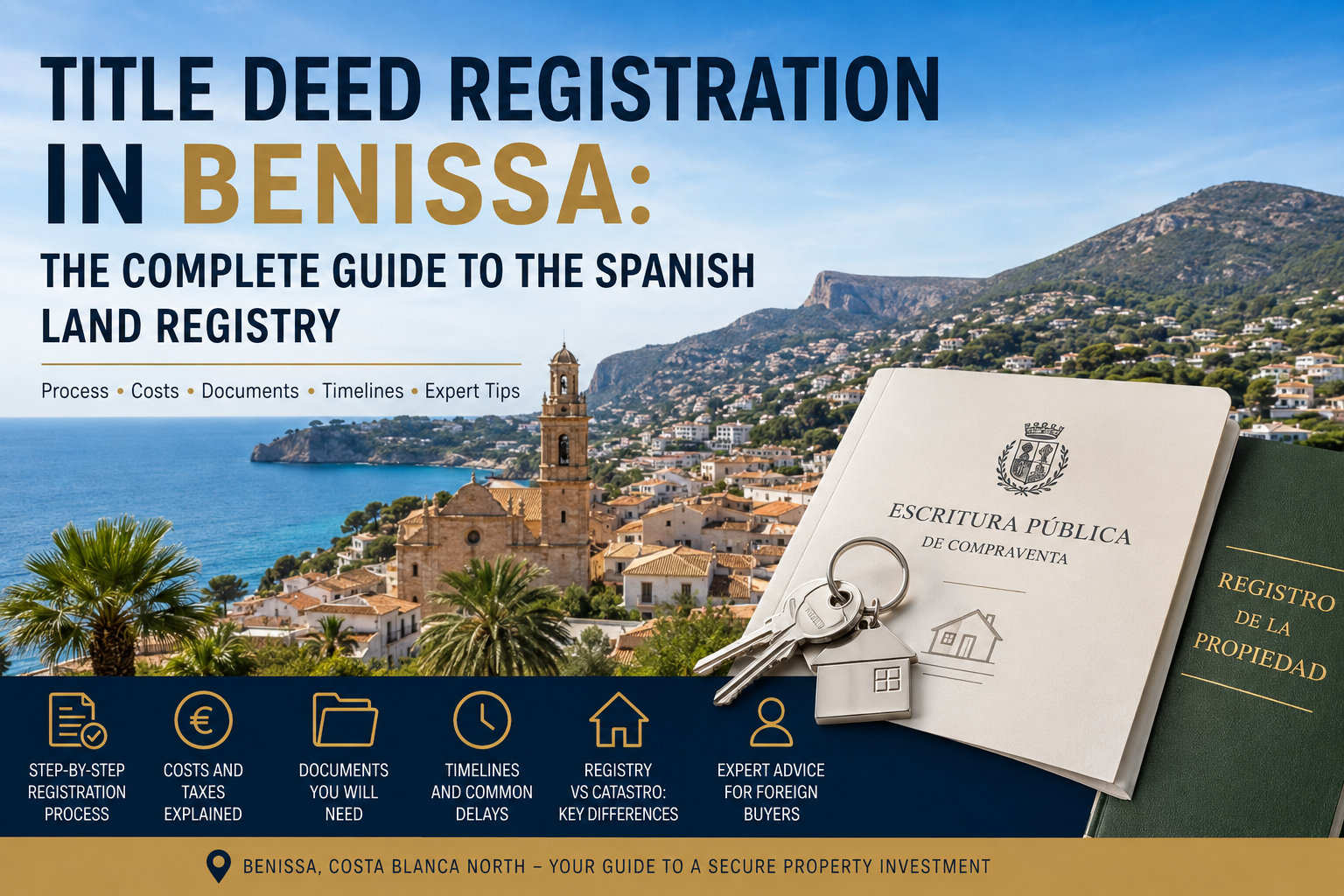
Title Deed Registration in Benissa: Complete Guide for Property Buyers
Buying a property in Benissa is an exciting milestone, whether you're purchasing a holiday villa in La Fustera, a traditional finca in Benimarco, an apartment near the coastline, or a family home in San Jaime. However, completing the purchase at the notary is not the final step.
To fully protect your ownership, your title deed must be registered with the Land Registry (Registro de la Propiedad).
Many international buyers believe they automatically become the registered owner the moment they sign the purchase deed before the notary. While signing the deed transfers ownership between buyer and seller, registration provides public legal protection and officially records you as the owner in the Spanish Land Registry.
This distinction is extremely important. Registration safeguards your rights, makes future sales easier, facilitates mortgage applications, and provides greater legal certainty for you and your heirs.
In this comprehensive guide, you'll learn:
- What title deed registration actually means
- The difference between signing before a notary and registration
- How the registration process works in Benissa
- Which documents are required
- Typical costs and timeframes
- Common problems that delay registration
- The difference between the Land Registry and the Catastro
- How foreign buyers register property
- How to verify your property has been correctly registered
Whether you're buying your first home in Spain or adding another property to your portfolio, understanding the registration process helps ensure your investment is properly protected from day one.
Table of Contents
- What Is Title Deed Registration?
- How the Title Deed Registration Process Works in Benissa
- Which Land Registry Covers Benissa?
- Documents Required for Title Deed Registration
- How Long Does Registration Take?
- Costs of Title Deed Registration
- Common Problems That Delay Registration
- Land Registry vs Catastro
- How to Check Whether Your Property Is Registered
- Can Foreign Buyers Register Property?
- What Happens If You Do Not Register?
- Frequently Asked Questions
- Expert Tips for a Smooth Registration Process
- Conclusion
What Is Title Deed Registration?
Quick Answer
Title deed registration is the process of recording ownership of a property in the Spanish Land Registry after signing the purchase deed before a notary. Registration provides legal certainty, public protection of ownership and creates the official record of who owns the property.
What is an Escritura Pública?
An Escritura Pública de Compraventa is the official purchase deed signed before a Spanish notary.
It is the legal document that records:
- the identity of the buyer and seller
- the agreed purchase price
- a description of the property
- payment method
- existing mortgages or charges
- any special conditions of the sale
The notary's role is not to represent either party. Instead, they act as an impartial public official responsible for ensuring that:
- both parties understand the transaction
- legal formalities are followed
- the deed complies with Spanish law
- the identity and legal capacity of everyone signing have been verified
Once signed, the deed becomes an official public document.
However, signing the deed is not the same as registering ownership.
Important
The notary confirms the legality of the transaction but does not automatically make you the registered owner. Registration is a separate administrative process carried out by the Land Registry after the deed has been signed and the relevant taxes have been paid.
Practical Example
Imagine you purchase a villa in Fanadix.
You and the seller meet at the notary in Benissa, sign the Escritura Pública and receive the keys.
Legally, ownership has transferred between you and the seller.
The next step is registering that deed with the Land Registry so that your ownership becomes part of the official public register.
Without this step, your ownership is not reflected in the Registry's records, even though you have signed the deed.
What Does Registration Mean?
Registration means entering the details of the signed title deed into the Spanish Land Registry (Registro de la Propiedad).
Once registration has been completed, the Registry records:
- the owner's name
- property description
- legal boundaries
- ownership rights
- mortgages
- easements
- legal charges affecting the property
This public record provides legal certainty for buyers, banks, lawyers and future purchasers.
It also creates a strong presumption that the registered owner is the lawful owner of the property.
For this reason, almost every property purchase in Benissa is registered shortly after completion.
What Registration Protects
Registration helps protect you against:
- competing ownership claims
- fraudulent sales
- registration of incompatible rights
- future ownership disputes
- uncertainty during resale
It also makes due diligence much easier whenever the property is sold again.
Why Registration Is Important
Although Spanish law does not generally make registration compulsory for every private purchase, registering your ownership is considered essential in practice.
For most buyers, there are very few situations where delaying or avoiding registration offers any benefit.
Proof of Ownership
The Land Registry provides official evidence that you own the property.
Lawyers, banks and buyers routinely request a Nota Simple from the Registry when verifying ownership.
Without registration, proving ownership can become more complicated.
Protection Against Third Parties
One of the biggest advantages of registration is legal protection.
Spanish property law gives significant legal effect to rights recorded in the Land Registry.
If ownership has not been registered, resolving disputes with third parties can become more complex.
Registration therefore adds an important layer of legal security.
Easier Future Sale
When you decide to sell your property in areas such as:
- Benissa Costa
- Buenavista
- Pedramala
- La Fustera
- San Jaime
the buyer's lawyer will almost certainly obtain an up-to-date Nota Simple.
If your ownership has already been properly registered, the sale usually progresses much more smoothly.
Failure to register may delay:
- legal checks
- mortgage approval
- completion
- exchange of documents
Mortgage Security
Banks rely heavily on Land Registry records.
If you finance your purchase with a Spanish mortgage, the lender will normally require:
- registration of your ownership
- registration of the mortgage itself
Without registration, obtaining mortgage finance can become extremely difficult.
Inheritance Benefits
Registration also helps your family.
When ownership has been correctly recorded, future inheritance procedures are generally more straightforward.
Your heirs can more easily identify:
- registered ownership
- mortgages
- charges
- legal descriptions
This reduces uncertainty during probate and succession.
Expert Tip
Keep both your registered title deed and an updated Nota Simple in a safe place.
The registered deed proves how you acquired the property, while the Nota Simple provides an up-to-date snapshot of the property's current legal status. Having both documents readily available can save valuable time if you later sell, refinance or transfer ownership.
How the Title Deed Registration Process Works in Benissa
Although every transaction is slightly different, the registration process generally follows the same sequence.
Whether you are purchasing a villa in La Fustera, a townhouse in Benissa Pueblo or a countryside finca in Pedramala, these are the typical steps after completion.
Step 1 – Sign the Title Deed Before the Notary
Completion takes place at the notary's office.
The notary:
- verifies identities
- reviews the deed
- confirms legal compliance
- witnesses signatures
- authorises the public deed
After signing:
- ownership transfers between buyer and seller
- keys are usually handed over
- payment is completed
This marks the legal completion of the purchase, but not the end of the process.
Step 2 – Obtain the Authorised Copy of the Deed
After completion, the notary prepares the authorised copy (Copia Autorizada) of the signed deed.
This official version is required for:
- paying property taxes
- Land Registry submission
- mortgage registration
- future legal procedures
Many buyers never collect this document personally because their lawyer or gestor handles the process on their behalf.
Step 3 – Pay the Required Property Taxes
Before registration can proceed, the applicable taxes must be settled.
Depending on the transaction, this may include:
- Property Transfer Tax (ITP) for most resale properties
- VAT (IVA) on qualifying new-build purchases
- Stamp Duty (AJD), where applicable
Payment receipts are required before the Land Registry will normally finalise registration.
Warning
Tax legislation changes periodically. The applicable taxes, rates and exemptions depend on your individual circumstances and the type of property being purchased. Always confirm the latest requirements with your lawyer or tax adviser.
Step 4 – Submit the Deed to the Land Registry
Once taxes have been paid, the authorised deed is submitted to the Land Registry.
In Benissa, this submission is usually handled by:
- your lawyer
- the notary (electronically in many cases)
- a gestor acting on your behalf
The Registry records the application and begins its legal examination.
Step 5 – Registry Examination
The Land Registrar carefully checks:
- ownership history
- legal description
- tax compliance
- existing charges
- mortgages
- restrictions
- consistency with previous registrations
If any issues are identified, registration may be temporarily suspended until they are resolved.
Common examples include:
- missing documentation
- inconsistencies in names
- errors in the deed
- discrepancies between Registry records and the property's legal description
Step 6 – Property Registration
Once all checks have been successfully completed, the Land Registry officially records the buyer as the new owner.
From this point onwards:
- ownership becomes part of the public register
- legal protection is strengthened
- future transactions become much simpler
- the Registry reflects the property's updated ownership history
Title Deed Registration Timeline
| Stage | Typical Action |
|---|---|
| 1 | Sign deed before the notary |
| 2 | Obtain authorised copy of the deed |
| 3 | Pay applicable property taxes |
| 4 | Submit documents to the Land Registry |
| 5 | Registry examines the documentation |
| 6 | Ownership is officially registered |
| 7 | Mortgage registered (if applicable) |
| 8 | Obtain updated Nota Simple |
| 9 | Receive registered title deed |
Step 7 – Mortgage Registration (If Applicable)
If you are financing your purchase with a Spanish mortgage, the mortgage must also be registered with the Land Registry.
This is separate from registering your ownership, although both registrations are usually processed together.
The lender's mortgage becomes a registered charge against the property, giving the bank security for the loan. Until the mortgage has been correctly registered, the registration process is not fully complete.
In most purchases involving finance, your lawyer, bank and a gestoría work together to coordinate:
- Payment of taxes
- Registration of your ownership
- Registration of the mortgage
- Payment of Land Registry fees
- Collection of the final registered documents
Expert Tip
If you buy with a mortgage, ask your lawyer or bank for confirmation once both the ownership and mortgage have been registered. Do not assume the process has finished simply because you have moved into the property.
Step 8 – Receive the Updated Nota Simple
After registration has been completed, you should obtain an updated Nota Simple Informativa.
A Nota Simple is an extract from the Land Registry that summarises the property's current legal status.
It typically confirms:
- Registered owner(s)
- Property description
- Registry reference
- Mortgages
- Easements
- Legal charges
- Restrictions affecting the property
Although it is not a title deed, it is one of the most commonly requested property documents in Spain.
For example, if you later decide to sell your villa in San Jaime or refinance a property in La Fustera, the buyer's lawyer or bank will almost certainly request a recent Nota Simple.
Internal Link Opportunity: Land Registry (Registro) Guide
Step 9 – Receive the Registered Title Deed
Once the Land Registry has completed registration, the authorised title deed is returned with registration details showing that ownership has been recorded.
Your lawyer or gestor will normally provide:
- The registered Escritura Pública
- Proof of tax payment
- Land Registry invoices
- Updated Nota Simple
- Any remaining completion documents
Keep these documents together in a safe place.
If you later sell the property, transfer it to family members or use it as security for finance, these documents will be required.
Important
Before considering the purchase fully complete, make sure you have received:
✓ Registered title deed
✓ Updated Nota Simple
✓ Tax payment receipts
✓ Mortgage documentation (if applicable)
✓ Registry fee invoices
Which Land Registry Covers Benissa?
Many overseas buyers assume there is one central Land Registry for the whole Costa Blanca.
In reality, Spain is divided into numerous Land Registry districts, each responsible for properties within a defined geographical area.
If you buy property in Benissa, your deed must be registered in the Registry responsible for that particular property.
Your lawyer or notary will know which office has jurisdiction.
What Is the Land Registry?
The Registro de la Propiedad is an official public register that records legal rights relating to real estate.
Its main functions include recording:
- Ownership
- Mortgages
- Easements
- Court orders
- Embargoes
- Restrictions
- Certain other legal rights affecting property
The Registry provides legal certainty by making these rights publicly accessible.
Anyone with a legitimate interest can usually request basic Registry information, such as a Nota Simple.
The Land Registry Does Not
The Registry does not:
- Calculate taxes
- Approve planning permission
- Issue building licences
- Value properties
- Resolve boundary disputes on site
- Replace the Catastro
Many first-time buyers confuse these different public bodies.
How Properties Are Identified
Every registered property has its own Registry identification details.
These identify:
- The Registry district
- Volume
- Book
- Page
- Property number (Finca Registral)
This is different from the Cadastral Reference (Referencia Catastral) used by the Catastro.
Both references relate to the same property but serve different legal purposes.
Example
A villa in Buenavista may have:
- A Land Registry property number
- A Cadastral Reference
- A postal address
- A local planning reference
All four identify the same property in different public systems.
Land Registry vs Local Town Hall
Many buyers believe ownership registration takes place at Benissa Town Hall.
It does not.
The Ayuntamiento de Benissa is responsible for local administrative matters such as:
- Urban planning
- Building licences
- Local taxes (including IBI)
- Municipal records
- Planning permissions
The Land Registry is a completely separate institution.
| Land Registry | Town Hall |
|---|---|
| Ownership records | Planning permission |
| Mortgages | Local taxes |
| Easements | Building licences |
| Legal charges | Municipal administration |
| Registered owners | Urban planning |
Can You Visit the Registry Yourself?
Yes.
Property owners can visit the relevant Land Registry office personally.
However, in practice many buyers appoint:
- Their lawyer
- A gestor
- Their legal representative
This is particularly common for overseas buyers who return home shortly after completion.
Today, many requests and communications can also be handled electronically.
Did You Know?
Many international buyers never visit the Land Registry themselves. Their lawyer completes the entire registration process after completion while they have already returned to the UK, the Netherlands, Belgium, Germany or elsewhere.
Documents Required for Title Deed Registration
Registration cannot proceed until the necessary documents have been submitted.
Missing or incorrect paperwork is one of the most common causes of delays.
Documents from the Notary
The principal document is the authorised copy of the signed deed.
This contains:
- Details of buyer and seller
- Property description
- Purchase price
- Legal declarations
- Signature of the notary
Without this document, registration cannot take place.
Tax Payment Receipts
Before the Registry finalises registration, evidence is normally required that the applicable property taxes have been paid.
Examples include:
- Property Transfer Tax (ITP)
- VAT (IVA), where applicable
- Stamp Duty (AJD), where applicable
Always keep copies of these receipts.
They may also be needed for future legal or tax matters.
Identification Documents
The Registry or your legal representative may require copies of identification documents, such as:
- Passport
- NIE number
- Proof of identity
- Company documentation (if purchasing through a company)
Ensure your personal details exactly match those appearing in the title deed.
Even minor spelling differences can delay registration.
Mortgage Documentation
If financing the purchase, additional documents may include:
- Mortgage deed
- Bank documentation
- Loan details
- Mortgage registration forms
Most buyers never handle these directly because the lender coordinates the process.
Additional Documents for Foreign Buyers
Foreign purchasers may also need:
- NIE certificate
- Power of Attorney (if someone signs on their behalf)
- Certified translations where required
- Company documents (if applicable)
If you purchased remotely using a Power of Attorney, your lawyer will normally submit the required documentation during registration.
Internal Link Opportunity: Buying Property with a Power of Attorney
Documents Checklist
| Document | Usually Provided By | Required? |
|---|---|---|
| Authorised Title Deed | Notary | Yes |
| Passport | Buyer | Yes |
| NIE Number | Buyer | Yes |
| Tax Payment Receipt | Lawyer/Gestor | Yes |
| Mortgage Deed | Bank | If applicable |
| Power of Attorney | Lawyer | If applicable |
| Company Documents | Buyer | If applicable |
| Updated Nota Simple | Registry | After registration |
Expert Checklist
Before your lawyer submits the registration, confirm that:
✓ Your name is correctly spelled.
✓ Passport details match the deed.
✓ NIE number is correct.
✓ Purchase price is correctly recorded.
✓ Property description matches what you purchased.
✓ Mortgage details are accurate.
✓ Taxes have been paid.
✓ All signatures are complete.
How Long Does Title Deed Registration Take?
One of the questions buyers ask most often is:
"How long before I become the registered owner?"
The answer depends on several factors, including the complexity of the transaction, whether there is a mortgage and whether any issues arise during the Registry's review.
Typical Timeline
For a straightforward residential purchase in Benissa, registration commonly takes several weeks, although more complex transactions can take longer.
The overall process usually includes:
- Completion before the notary.
- Payment of applicable taxes.
- Submission to the Land Registry.
- Legal examination by the Registrar.
- Registration of ownership.
- Mortgage registration (if applicable).
- Return of the registered deed.
Rather than focusing on an exact number of days, buyers should ensure that every stage has been properly completed.
Typical Registration Timeframes
| Stage | Typical Timing |
|---|---|
| Completion before notary | Day of purchase |
| Tax payment | Shortly after completion |
| Registry submission | After taxes are settled |
| Registry examination | Varies depending on workload |
| Ownership registration | After successful examination |
| Updated Nota Simple | Following registration |
| Registered deed returned | After registration is completed |
Important
Processing times vary throughout the year and depend on the complexity of the file. Your lawyer or gestor can provide a more accurate estimate based on your individual purchase.
Factors That Can Cause Delays
Most registrations proceed smoothly.
However, delays can occur if problems are discovered during the Registry examination.
Common causes include:
Incorrect deeds
Examples include:
- Incorrect names
- Wrong passport number
- Missing signatures
- Errors in property descriptions
Missing documents
Registration cannot be completed if essential documents are missing.
These may include:
- Tax receipts
- Mortgage documentation
- Identification
- Powers of Attorney
Tax issues
If taxes have not been correctly declared or paid, registration may be delayed until the issue has been resolved.
Registry workload
Some periods of the year are busier than others.
Higher volumes of registrations may increase processing times.
Planning irregularities
Where alterations, extensions or other building works have not been correctly documented, additional legal work may be required before registration can proceed.
This is one reason buyers should carry out thorough legal due diligence before purchasing, particularly for older villas or countryside properties in areas such as Pedramala or Benimarco, where historic alterations may exist.
Costs of Title Deed Registration in Benissa
One of the most common questions buyers ask after completion is:
"How much will title deed registration cost?"
The total cost depends on several factors, including:
- The purchase price
- Whether the property is mortgaged
- The complexity of the transaction
- Whether you appoint a lawyer or gestor
- The applicable taxes
Unlike estate agency fees, Land Registry fees are regulated rather than freely negotiated.
It is important to distinguish between:
- Registration costs
- Professional fees
- Taxes associated with the purchase
These are separate expenses, even though they are often settled together after completion.
Land Registry Fees
The Land Registry charges a fee for recording your ownership.
The amount is generally based on the value and nature of the transaction and is set according to official fee scales.
The Registry fee covers the work involved in:
- Reviewing the documentation
- Verifying legal compliance
- Recording ownership
- Registering mortgages (where applicable)
- Issuing the registered entry
Your lawyer or gestor will usually pay this on your behalf before providing the final completion statement.
Legal Fees
Many buyers appoint an independent lawyer to oversee the purchase and registration process.
Typical legal services include:
- Reviewing contracts
- Carrying out legal due diligence
- Checking the Land Registry
- Coordinating with the notary
- Paying taxes
- Submitting documents for registration
- Obtaining the final registered deed
While buyers are not legally required to instruct a lawyer, independent legal advice is strongly recommended, particularly for overseas purchasers.
Expert Tip
If you're buying from abroad, choose a lawyer who regularly handles property transactions in the Marina Alta area. Local experience can help identify issues such as planning irregularities, rural land restrictions and discrepancies between the Land Registry and the Catastro before they become costly problems.
Gestoría Fees
A gestoría is an administrative service that carries out paperwork on behalf of clients.
They commonly assist with:
- Tax submissions
- Registration procedures
- Mortgage documentation
- Administrative formalities
Some buyers instruct a gestor directly.
Others use one recommended by their lawyer or mortgage lender.
If you are obtaining a Spanish mortgage, the bank may appoint a gestor to coordinate parts of the post-completion process.
Mortgage Registration Costs
If you finance your purchase with a mortgage, additional registration work is required.
This may include:
- Registering the mortgage deed
- Administrative processing
- Additional Registry entries
The exact costs depend on the financing arrangement and current legislation.
Before completion, ask your lawyer or lender for a detailed estimate of all mortgage-related expenses.
Taxes Related to Registration
Although taxes are not Land Registry fees, they are an essential part of the registration process.
Depending on the purchase, these may include:
- Property Transfer Tax (ITP) for most resale properties.
- VAT (IVA) on qualifying new-build properties.
- Stamp Duty (AJD) where applicable.
The applicable tax depends on the type of property, the transaction and the legislation in force at the time of purchase.
Important
Spanish tax legislation changes periodically. Always rely on current professional advice rather than historic rates or online examples.
Registration Cost Comparison Table
| Cost Category | Mandatory | Typical Purpose |
|---|---|---|
| Land Registry fee | Yes | Register ownership |
| Property taxes | Yes | Required before registration |
| Lawyer's fee | Recommended | Legal advice and representation |
| Gestoría fee | Optional / Common | Administrative processing |
| Mortgage registration | If applicable | Register lender's security |
Typical Buyer Responsibilities After Completion
| Task | Usually Handled By |
|---|---|
| Pay purchase taxes | Lawyer or gestor |
| Submit deed for registration | Lawyer or gestor |
| Register mortgage | Bank / gestor |
| Obtain registered deed | Lawyer |
| Obtain updated Nota Simple | Lawyer or buyer |
Warning
The cheapest conveyancing service is not always the best value.
Experienced local professionals can often identify issues before completion that may otherwise delay registration or lead to expensive legal work later.
Common Problems That Delay Registration
Most residential purchases in Benissa are registered without difficulty.
However, certain legal or administrative issues can delay the process.
Knowing these in advance helps buyers avoid unnecessary complications.
Errors in the Title Deed
Even small mistakes can prevent registration.
Examples include:
- Incorrect spelling of names
- Wrong passport number
- Incorrect NIE
- Missing signatures
- Incorrect purchase price
- Typographical errors
Most errors can be corrected, but doing so may require additional notarial documentation.
Outstanding Charges
Before purchasing, your lawyer should verify whether the property is subject to:
- Mortgages
- Embargoes
- Court orders
- Easements
- Other registered charges
Some charges are cancelled before completion.
Others remain attached to the property and require further investigation.
Obtaining an up-to-date Nota Simple before buying is therefore essential.
Internal Link Opportunity: Property Checks Before Buying
Planning or Building Irregularities
This is one of the most significant issues affecting older villas and countryside properties.
Examples include:
- Extensions that were never properly declared.
- Swimming pools built without the appropriate permissions.
- Guest accommodation missing the required documentation.
- Outbuildings that do not match the registered description.
- Renovations that were never incorporated into the title deed.
Properties in rural areas such as Benimarco and Pedramala often have a long history of alterations, making careful legal due diligence particularly important.
Registration is not necessarily impossible, but additional documentation or legal steps may be required.
Internal Link Opportunity: Building Legality
Internal Link Opportunity: Pool Legalisation
Internal Link Opportunity: Illegal Extensions
Differences Between the Land Registry and the Catastro
A very common issue is that the property's legal description does not match the Catastro.
Examples include:
- Different plot sizes
- Incorrect built area
- Missing swimming pool
- Incorrect boundaries
- Buildings missing from one record
These discrepancies are relatively common in older properties and often need to be resolved before future sales.
We'll explain the differences in detail later in this guide.
Missing Tax Documentation
The Registry cannot usually complete registration until the necessary tax documentation has been submitted.
Missing receipts or incomplete tax forms can delay completion.
For this reason, buyers should retain copies of every payment made after completion.
Boundary Discrepancies
Boundary issues occasionally arise where:
- Historic measurements differ.
- Neighbouring plots overlap.
- Registry plans differ from cadastral plans.
- Fences do not follow the legal boundary.
These situations are more likely to affect larger countryside properties than modern apartments or urban villas.
Professional surveying may sometimes be required.
Internal Link Opportunity: Property Boundaries
Common Registration Delays and Solutions
| Problem | Possible Solution |
|---|---|
| Incorrect deed | Correct through the notary |
| Missing signatures | Execute supplementary documentation |
| Outstanding mortgage | Arrange cancellation before completion |
| Missing tax receipt | Submit proof of payment |
| Registry/Catastro mismatch | Update records through the appropriate procedure |
| Boundary issue | Obtain survey and legal advice |
| Planning irregularity | Resolve documentation before resale |
Common Mistake
Many buyers believe that because they received the keys on completion, every legal formality has finished.
In reality, several important post-completion steps—including tax payment, registration and document verification—still need to be completed before the transaction is fully finalised.
Land Registry vs Catastro
These two public records are frequently confused, especially by overseas buyers.
Although both relate to property, they serve completely different purposes.
Understanding the distinction can help you avoid costly misunderstandings.
What Is the Land Registry?
The Land Registry (Registro de la Propiedad) records the legal status of a property.
It focuses on rights rather than taxation.
The Registry records:
- Ownership
- Mortgages
- Easements
- Legal charges
- Restrictions
- Court orders affecting property
When buying a home in Benissa, this is the register that confirms who legally owns the property.
What Is the Catastro?
The Catastro Inmobiliario is Spain's cadastral database.
It is mainly used for:
- Property taxation
- Administrative purposes
- Mapping
- Property identification
- Municipal valuation
The Catastro contains physical information such as:
- Plot size
- Built area
- Property use
- Building outline
- Cadastral reference
It is maintained independently of the Land Registry.
Key Differences
Although the Land Registry and Catastro often contain similar information, they are created for different legal purposes.
Land Registry vs Catastro
| Land Registry | Catastro |
|---|---|
| Legal ownership | Physical description |
| Mortgages | Plot measurements |
| Easements | Building footprints |
| Charges | Cadastral mapping |
| Legal rights | Tax administration |
| Ownership history | Property valuation data |
Why Both Records Should Match
Ideally, both records should describe the same property accurately.
If differences exist, they may create additional work during:
- Future sales
- Mortgage applications
- Inheritance
- Major renovations
Examples include:
- The Catastro showing a swimming pool that is not reflected in the Registry.
- The Registry showing an older built area than the current house.
- Different plot sizes recorded in each database.
These discrepancies do not always prevent a sale, but they should be investigated.
Expert Tip
Before purchasing an older villa or finca in Benissa, ask your lawyer to compare the Land Registry, Catastro and the property's physical reality. Resolving discrepancies before completion is generally much easier than correcting them after you become the owner.
Did You Know?
It is not unusual for properties that have been owned by the same family for decades to contain differences between the Land Registry and the Catastro. Renovations, extensions or historic surveying methods can all contribute to these discrepancies.
How to Check Whether Your Property Is Registered
After completing your purchase, it is sensible to verify that registration has been successfully completed.
Although your lawyer will usually confirm this, understanding how to check the records yourself provides additional peace of mind.
Requesting a Nota Simple
The simplest way to confirm registration is by obtaining an up-to-date Nota Simple.
This document provides a summary of the property's current legal status, including the registered owner and any recorded charges.
You can request a Nota Simple through the appropriate Land Registry, or your lawyer can obtain one on your behalf.
Checking Ownership Details
When reviewing the Nota Simple, check that:
- Your full name is correct.
- All registered owners are listed.
- The property description matches the title deed.
- The Registry reference corresponds to your property.
Even minor errors should be brought to your lawyer's attention promptly.
Checking Existing Charges
The Nota Simple will also show whether the property is subject to registered charges, such as:
- Mortgages
- Easements
- Embargoes
- Other legal rights affecting the property
If you expected a mortgage to have been cancelled or another charge to have been removed, this is the place to verify it.
What to Do if Something Is Incorrect
If you notice an error:
- Contact your lawyer or legal representative.
- Obtain copies of the relevant documents.
- Ask whether a correction deed or additional documentation is required.
- Do not ignore discrepancies, especially if you plan to sell or refinance the property in the future.
Resolving errors early is usually quicker and less expensive than leaving them until a later transaction.
Can Foreign Buyers Register Property in Benissa?
Yes. Foreign nationals can register property in Benissa in the same way as Spanish citizens, provided the purchase has been completed correctly and the required legal and tax formalities have been fulfilled.
Whether you are buying a holiday apartment in La Fustera, a luxury villa in San Jaime, or a countryside finca in Pedramala, the registration process follows the same legal principles.
Many buyers from the UK, the Netherlands, Belgium, Germany, France and other countries purchase property in Benissa every year, with registration typically handled by their lawyer after completion.
Buying Through a Lawyer
The majority of international buyers appoint an independent Spanish property lawyer.
A lawyer can:
- Carry out legal due diligence.
- Review the purchase contract.
- Verify ownership.
- Check for charges or planning issues.
- Coordinate with the notary.
- Pay the relevant taxes.
- Submit the title deed for registration.
- Obtain the registered deed and updated Nota Simple.
For overseas buyers who are unfamiliar with Spanish property law, this significantly reduces the risk of costly mistakes.
Internal Link Opportunity: Property Checks Before Buying
Buying with Power of Attorney
Many overseas buyers cannot remain in Spain long enough to complete every administrative step.
In these situations, they may grant their lawyer or another trusted representative a Power of Attorney (Poder Notarial).
This allows the representative to:
- Sign documents (where authorised).
- Pay taxes.
- Register the title deed.
- Collect the registered documentation.
- Deal with administrative formalities after completion.
A Power of Attorney can be particularly useful if you are returning home shortly after signing at the notary.
Internal Link Opportunity: Power of Attorney
Registration When Purchasing with a Mortgage
If you buy with a Spanish mortgage, the registration process generally includes:
- Registration of your ownership.
- Registration of the lender's mortgage.
These procedures are normally coordinated simultaneously.
Your lawyer, bank and gestor will ensure that all documentation is submitted correctly.
Buying Through a Company
Some investors purchase property through a company rather than in their personal name.
In these cases, additional documentation may be required, such as:
- Company registration documents.
- Identification of directors or authorised representatives.
- Corporate resolutions.
- Tax documentation.
The exact requirements depend on the structure of the purchasing company and the applicable legislation.
Professional legal and tax advice is strongly recommended before proceeding.
Expert Tip
If you live outside Spain, ask your lawyer to send you digital copies of:
- The registered title deed.
- The updated Nota Simple.
- Tax payment receipts.
- Registry invoices.
Keeping secure digital copies can save considerable time if you later sell the property or need to prove ownership.
What Happens If You Do Not Register the Title Deed?
Although ownership transfers when the deed is signed before the notary, failing to register the deed can create practical and legal complications.
For most buyers, registration is one of the most important post-completion steps.
Legal Risks
Without registration:
- Your ownership is not reflected in the public Land Registry.
- Proving ownership may be more complicated in certain situations.
- Resolving disputes with third parties may become more difficult.
Registration provides an additional layer of legal certainty that benefits both current and future owners.
Financial Risks
Unregistered ownership can create practical difficulties when:
- Applying for finance.
- Refinancing a property.
- Using the property as security.
- Completing certain legal procedures.
Banks rely heavily on Land Registry records when assessing property transactions.
Problems Selling Later
When you decide to sell, the buyer's lawyer will usually request an up-to-date Nota Simple.
If ownership has not been registered, additional work may be required before the transaction can proceed.
This can lead to:
- Delays.
- Additional legal costs.
- Extra documentation.
- Unnecessary stress during the sale process.
Mortgage Difficulties
Mortgage lenders require certainty regarding ownership.
If the property has not been properly registered, obtaining finance may become significantly more complicated.
Inheritance Complications
Registration also benefits your heirs.
Following your death, the Land Registry provides a clear record of ownership, making inheritance procedures more straightforward.
Where ownership has never been registered, additional legal work may be required to establish title.
Warning
Do not confuse owning a property with having your ownership registered.
Signing the deed before the notary transfers ownership between buyer and seller, but registration records that ownership in the public Land Registry and strengthens your legal protection.
Frequently Asked Questions
Is title deed registration compulsory in Spain?
In many cases, ownership transfers when the title deed is signed before the notary. However, registering the deed is strongly recommended because it provides public legal protection and facilitates future transactions.
How long does title deed registration take in Benissa?
The timeframe varies depending on the complexity of the purchase, the payment of taxes, and the Land Registry's workload. Your lawyer can provide an estimate based on your transaction.
Who normally registers the title deed?
Most buyers ask their lawyer or gestor to handle registration after completion.
What is a Nota Simple?
A Nota Simple is an information extract issued by the Land Registry summarising the property's ownership, legal description and registered charges.
Can I sell a property that has not been registered?
It may be possible, but it often complicates the transaction and can delay completion. Registering ownership before selling is generally advisable.
What is the difference between the Land Registry and the Catastro?
The Land Registry records legal ownership and rights, while the Catastro records physical characteristics and information used mainly for taxation and administration.
How much does title deed registration cost?
The total cost depends on the value of the property, the applicable taxes, professional fees and whether a mortgage is involved.
Can foreigners register property in Benissa?
Yes. Foreign buyers follow the same registration procedure as Spanish buyers, usually with assistance from an independent lawyer.
What happens if there is an error in the title deed?
The error may need to be corrected before registration can proceed. Your lawyer and the notary can advise on the appropriate corrective documentation.
How do I know registration has been completed?
Request an updated Nota Simple or ask your lawyer to provide confirmation together with the registered title deed.
Can I check the Land Registry online?
Certain Land Registry information can be requested online or through a legal representative, subject to the applicable procedures and requirements.
Is mortgage registration automatic?
It is usually coordinated as part of the mortgage completion process, but buyers should always confirm that registration has been completed successfully.
Can I register property remotely?
Yes. Many overseas buyers appoint a lawyer using a Power of Attorney to complete the post-completion registration process.
Expert Tips for a Smooth Registration Process
Before Completion
Buyer Checklist
✓ Instruct an independent property lawyer.
✓ Verify the Land Registry information.
✓ Compare the Land Registry and Catastro records.
✓ Check for mortgages, easements and charges.
✓ Confirm that any extensions or swimming pools have appropriate documentation.
✓ Ensure your passport and NIE details are correct.
Immediately After Completion
✓ Confirm that all purchase taxes are paid.
✓ Ask when the deed will be submitted for registration.
✓ Keep copies of every document.
✓ Request an estimated registration timeframe.
✓ Confirm who is responsible for each remaining task.
Before Receiving the Registered Deed
Before considering the purchase fully complete, ensure you have received:
- Registered title deed.
- Updated Nota Simple.
- Tax receipts.
- Registry invoices.
- Mortgage documentation (if applicable).
Keeping Your Ownership Records Updated
Even after registration:
- Keep your contact details up to date.
- Store digital copies of important documents.
- Review Registry information before selling.
- Inform your lawyer if ownership changes through inheritance, divorce or company restructuring.
Responsibilities During the Registration Process
| Party | Main Responsibilities |
|---|---|
| Buyer | Provide identification, sign documents, pay agreed costs |
| Lawyer | Legal due diligence, tax payment, registration, document verification |
| Notary | Prepare and authorise the public deed |
| Land Registry | Examine documentation and record ownership |
| Gestor | Administrative processing (where instructed) |
| Mortgage Lender | Register mortgage (if applicable) |
Conclusion
Registering your title deed is one of the final—and most important—steps after buying property in Benissa.
While signing the Escritura Pública before the notary transfers ownership between buyer and seller, registration with the Land Registry provides official public recognition of your ownership and strengthens your legal protection.
A correctly registered property is generally easier to:
- Sell.
- Refinance.
- Transfer to family members.
- Leave as part of your estate.
- Verify during future legal transactions.
Whether you have purchased a villa in La Fustera, a family home in San Jaime, a countryside finca in Benimarco, or an apartment in Benissa Costa, it is good practice to confirm that registration has been completed and to obtain an updated Nota Simple for your records.
Understanding the registration process today can help you avoid unnecessary complications in the future and ensure your investment remains properly protected.
Natural Call-to-Action
If you're buying or selling property in Benissa and would like guidance through the legal process, the team at Telio Homes works closely with experienced local lawyers, notaries and property professionals.
We're happy to explain each stage of the buying process, recommend trusted independent specialists and help you navigate the local property market with confidence.
You may also find it helpful to explore the other guides in our Benissa Property Guide, covering everything from buying costs and mortgages to legal checks, taxes and living on the Costa Blanca North.