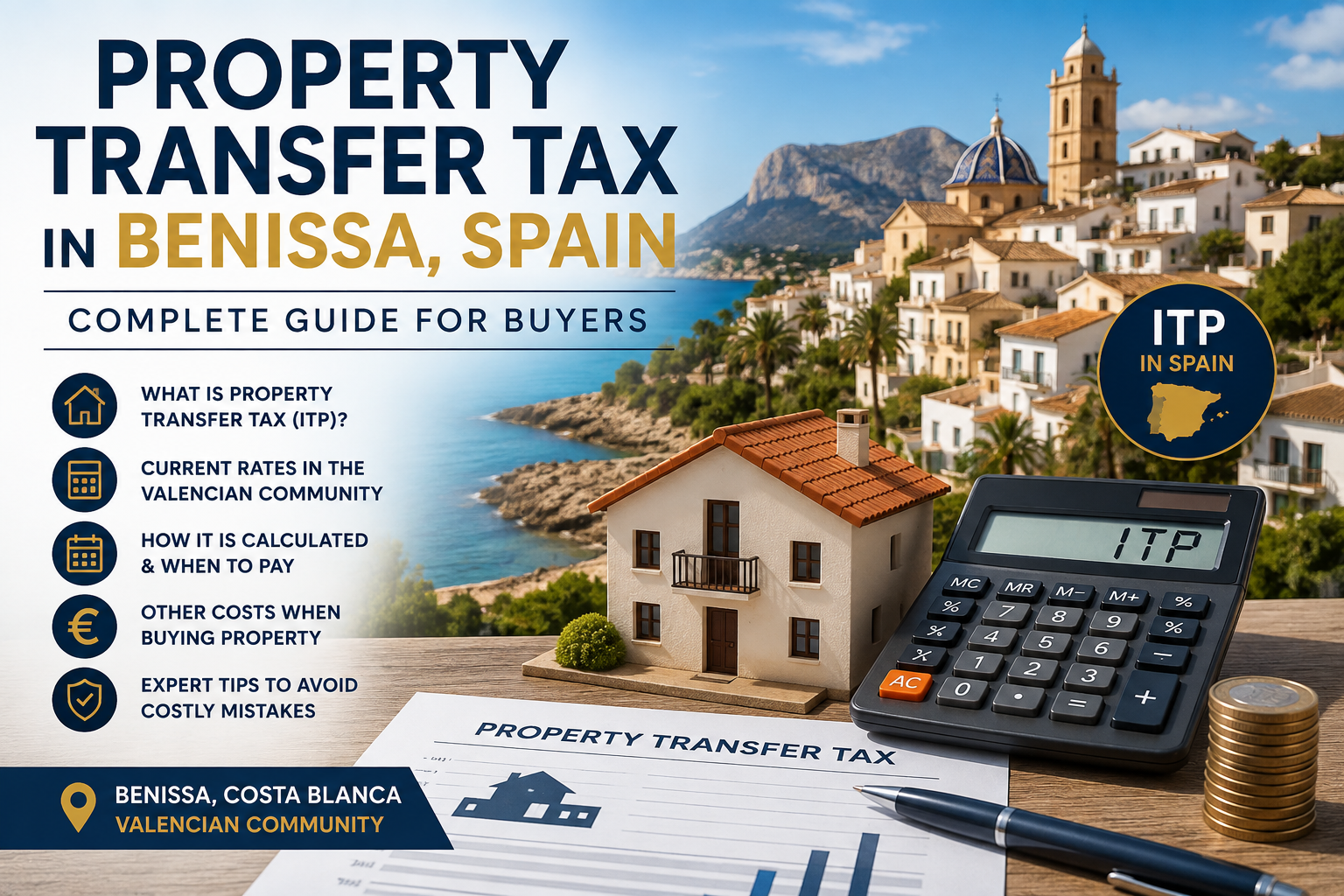
Property Transfer Tax in Benissa (Spain): Complete Guide for Buyers
Buying a property in Benissa is an exciting investment, whether you're searching for a holiday apartment overlooking the Mediterranean, a family villa in San Jaime, or a traditional finca surrounded by vineyards in Pedramala. However, alongside the agreed purchase price, you'll also need to budget for taxes and other acquisition costs.
For buyers of resale property, one of the most significant additional expenses is Property Transfer Tax, known in Spain as Impuesto sobre Transmisiones Patrimoniales (ITP). Understanding how this tax works before making an offer can help you avoid unexpected costs, prevent delays during the purchase process and ensure your budget reflects the true cost of buying property in Benissa.
This guide explains everything you need to know about Property Transfer Tax in Benissa, including:
- What ITP is
- When it applies
- Who pays it
- How it is calculated
- Current rules in the Valencian Community
- When payment is due
- How it differs from VAT (IVA)
- Other costs you should budget for when buying property
Although this guide focuses specifically on Benissa and the Valencian Community, tax legislation can change over time. Always seek advice from an independent lawyer or qualified tax adviser before completing a property purchase.
Key Takeaway
If you are buying a resale property in Benissa, you will normally pay Property Transfer Tax (ITP) rather than VAT. This tax forms a significant part of your acquisition costs and should always be included in your budget before making an offer. Your independent lawyer will calculate the amount due based on the legislation applicable at the time of purchase.
Last Reviewed
August 2026
Table of Contents
- What Is Property Transfer Tax (ITP) in Spain?
- Does Property Transfer Tax Apply in Benissa?
- Current Property Transfer Tax Rates in Benissa
- How Is Property Transfer Tax Calculated?
- When Must Property Transfer Tax Be Paid?
- Property Transfer Tax vs VAT (IVA)
- Other Costs When Buying Property in Benissa
- Practical Benissa Buying Examples
- Common Mistakes Buyers Make
- Frequently Asked Questions
- Final Thoughts
What Is Property Transfer Tax (ITP) in Spain?
Quick Answer
Property Transfer Tax (ITP) is a regional tax that is generally payable when purchasing a resale property in Spain from a private seller. In Benissa, it is administered under the rules of the Valencian Community and is one of the largest additional costs buyers need to budget for.
Buying a property in Spain involves more than simply paying the agreed purchase price. Depending on the type of property and who is selling it, different taxes may apply.
For most resale homes in Benissa, buyers pay Property Transfer Tax (ITP) instead of VAT.
Unlike annual taxes such as IBI, Property Transfer Tax is a one-off payment made when ownership changes from one owner to another.
Because it represents a substantial part of the total acquisition costs, understanding how it works should be one of the first steps when planning your purchase.
What Does ITP Stand For?
ITP stands for:
Impuesto sobre Transmisiones Patrimoniales
In English this is commonly translated as:
- Property Transfer Tax
- Property Transfer Duty
- Transfer Tax on Property Transactions
All three terms describe the same tax.
ITP should not be confused with:
- VAT (IVA)
- Stamp Duty (AJD)
- Capital Gains Tax
- Plusvalía Municipal
- Annual Property Tax (IBI)
Each applies under different circumstances.
Did You Know?
One of the most common misconceptions among overseas buyers is that every Spanish property purchase is subject to VAT. In reality, most villas, apartments and fincas sold in Benissa are resale properties, meaning Property Transfer Tax usually applies instead.
When Does Property Transfer Tax Apply?
Property Transfer Tax generally applies whenever a resale property is purchased from a private owner.
Typical examples include:
- Apartments
- Villas
- Townhouses
- Country fincas
- Commercial premises
- Many privately owned building plots
If you're purchasing a new-build property directly from a developer, VAT usually applies instead of ITP.
Understanding whether a property is considered a first transfer or a resale transaction is therefore essential before calculating your buying costs.
Property Types Usually Subject to ITP
| Property Type | Normally Subject to ITP |
|---|---|
| Resale apartment | Yes |
| Resale villa | Yes |
| Resale townhouse | Yes |
| Traditional finca | Yes |
| Commercial property | Yes |
| Building plot sold privately | Usually |
| New-build from developer | Usually VAT applies |
Important
The applicable tax depends on the legal nature of the transaction, not simply the type of property. Your lawyer will confirm which tax applies before completion.
Who Is Responsible for Paying the Tax?
The legal responsibility for paying Property Transfer Tax rests with the buyer.
Although your solicitor normally prepares the paperwork, calculates the tax and submits the declaration, the obligation to pay remains yours.
Most international buyers appoint an independent lawyer who will typically:
- Calculate the transfer tax due.
- Prepare the required documentation.
- Submit the tax declaration.
- Pay the tax on the buyer's behalf.
- Register the property after completion.
If you have granted Power of Attorney, these steps can often be completed without you remaining in Spain after signing the purchase deed.
Expert Tip
Ask your lawyer for a detailed completion statement before completion. This should clearly list the purchase price, estimated transfer tax, legal fees, notary fees, Land Registry fees and any other acquisition costs, allowing you to transfer the correct funds in advance.
Why Does Spain Charge Property Transfer Tax?
Like many countries, Spain taxes certain property transactions to generate revenue for public services.
Property Transfer Tax is a regional tax, meaning the revenue collected remains with the autonomous community where the property is located.
For Benissa buyers, this means the tax is administered by the Valencian Community rather than the local town hall.
From a buyer's perspective, the most important thing is understanding that:
- the tax is legally required,
- payment deadlines must be respected,
- late payment can result in interest and penalties,
- the tax should always be included in your acquisition budget before making an offer.
Does Property Transfer Tax Apply in Benissa?
Quick Answer
Yes.
If you purchase a qualifying resale property in Benissa, Property Transfer Tax generally applies under the legislation of the Valencian Community.
Whether you're buying:
- an apartment in La Fustera,
- a villa in San Jaime,
- a luxury home in Buenavista,
- a townhouse in the historic centre,
- or a countryside finca in Pedramala or Benimarco,
the applicable transfer tax rules are those of the Valencian Community.
Although Benissa has its own planning regulations, municipal taxes and local property market characteristics, Property Transfer Tax is not determined by the municipality.
Property Purchases in the Valencian Community
The Valencian Community comprises three provinces:
- Alicante
- Valencia
- Castellón
Benissa is located in the Province of Alicante.
As a result, buyers follow the same regional transfer tax legislation as purchasers in nearby towns such as:
- Moraira
- Calpe
- Jávea
- Dénia
- Altea
Why Benissa Follows Valencian Tax Regulations
Spain is divided into autonomous communities, each with powers to regulate certain taxes, including Property Transfer Tax.
This means that:
- transfer tax rates may vary between regions,
- reduced rates can differ,
- exemptions may not be identical,
- filing procedures may also vary.
For that reason, advice relating to another region of Spain should never be assumed to apply to Benissa.
Warning
Many online articles discuss Property Transfer Tax without specifying the autonomous community. Always ensure the information relates to the Valencian Community, as rates and reliefs elsewhere in Spain may be different.
Which Types of Property Are Subject to ITP?
Apartments
Most resale apartments in Benissa are purchased from private individuals and are therefore generally subject to Property Transfer Tax.
These remain particularly popular with holiday-home owners and investors seeking rental income.
Villas
Detached villas throughout Benissa Costa, including San Jaime, Fanadix, Buenavista and La Fustera, are commonly sold as resale properties.
ITP therefore applies in most cases.
Traditional Fincas
Country fincas around Pedramala, Benimarco and the rural areas surrounding Benissa are also generally subject to Property Transfer Tax when sold by private owners.
However, countryside properties often require additional legal checks relating to:
- land classification,
- access rights,
- water supply,
- septic systems,
- planning permissions,
- building legality,
- occupancy licences.
These investigations are separate from the tax itself but are an important part of buying rural property safely.
Local Insight
Benissa has one of the most diverse property markets on the Costa Blanca North. While the transfer tax rules are consistent across the Valencian Community, the legal due diligence required for a traditional finca can be considerably more extensive than for a modern apartment or villa. Buyers of rural properties should allow sufficient time for these additional checks before completion.
Townhouses
Townhouses in Benissa's historic centre are usually purchased as resale properties and are therefore generally subject to ITP.
Building Plots
Private sales of urban or rustic building plots may also be subject to Property Transfer Tax.
However, the tax treatment can vary depending on the seller and the nature of the transaction, making independent legal advice particularly important before committing to the purchase.
Commercial Property
Commercial premises such as offices, shops, restaurants and warehouses may also be subject to Property Transfer Tax where applicable.
Summary Table
| Property Type | Usually Subject to ITP? |
|---|---|
| Apartment | Yes |
| Villa | Yes |
| Townhouse | Yes |
| Traditional finca | Yes |
| Commercial property | Yes |
| Building plot | Usually, depending on the transaction |
| New-build purchased from a developer | Usually VAT instead |
Current Property Transfer Tax Rates in Benissa
One of the first questions buyers ask is:
"How much Property Transfer Tax will I pay when buying property in Benissa?"
The answer depends on the legislation in force in the Valencian Community at the time of purchase.
Because tax regulations and reduced-rate schemes can change, buyers should always verify the current rules with their solicitor shortly before completion.
Standard Transfer Tax Rate
For most resale property purchases in Benissa, the general Property Transfer Tax rate applicable in the Valencian Community is used.
The tax is applied to the property's taxable value under the legislation in force on the completion date.
Editorial Note
Tax rates are reviewed periodically and may change through regional legislation. Rather than relying on outdated information, always confirm the current applicable rate with your independent lawyer or qualified tax adviser before signing the title deed.
Reduced Tax Rates
The Valencian Community has introduced reduced Property Transfer Tax rates for certain qualifying buyers and transactions at various times.
Eligibility depends on the legislation in force and may relate to factors such as:
- the buyer's circumstances,
- the intended use of the property,
- family status,
- age,
- disability,
- or other statutory criteria.
Reduced rates are never automatic and should always be confirmed by your legal adviser.
Possible Exemptions and Special Situations
Some transactions may qualify for different tax treatment or specific reliefs under current legislation.
Examples can include:
- certain protected housing schemes,
- qualifying family situations,
- specific corporate transactions,
- other cases established by law.
Because these rules are technical and subject to change, professional legal advice is essential.
Do Property Transfer Tax Rates Change?
Yes.
Property Transfer Tax is governed by regional legislation and can change through future government reforms.
Before completing your purchase, make sure you:
- request an up-to-date completion statement,
- confirm the applicable tax rate,
- verify how your lawyer has calculated the tax,
- ensure sufficient funds are available before completion.
Common Mistake
Buyers sometimes budget using tax rates they found in articles published several years ago. As transfer tax legislation can change, always rely on current professional advice rather than outdated online information.
At a Glance
| Question | Answer |
|---|---|
| Does Property Transfer Tax apply in Benissa? | Yes, to most resale property purchases. |
| Who pays it? | The buyer. |
| Is it the same across Spain? | No. Each autonomous community has its own rules. |
| Is it included in the purchase price? | No. It is an additional acquisition cost. |
| Can the rates change? | Yes. Always verify the current legislation before completion. |
How Is Property Transfer Tax Calculated?
Quick Answer
For most resale property purchases in Benissa, Property Transfer Tax (ITP) is calculated by applying the applicable transfer tax rate in force in the Valencian Community to the property's taxable value under the legislation applicable on the completion date.
Although the calculation may appear simple, determining the correct taxable value can sometimes be more complex than buyers expect.
Buying a property is often the largest financial commitment you'll make, so understanding how your transfer tax is calculated is essential.
Many overseas buyers assume the tax is always based solely on the agreed purchase price. While the purchase price is important, Spanish tax legislation also considers the property's taxable value under the applicable regional rules.
Your solicitor will normally calculate the amount due and explain how it has been determined before completion.
Purchase Price vs Taxable Value
One of the most misunderstood aspects of Property Transfer Tax is the difference between the purchase price and the taxable value.
Purchase Price
The purchase price is the amount agreed between the buyer and seller in the purchase contract.
Taxable Value
The taxable value is the value used to determine the Property Transfer Tax payable under the applicable legislation.
Depending on the circumstances and the rules in force at the time of purchase, the tax authorities may review the declared value if they consider it does not reflect the appropriate taxable value.
This is why independent legal advice is so important.
Your lawyer will help ensure that:
- the purchase documentation is prepared correctly,
- the declared figures comply with current legislation,
- the tax is calculated using the appropriate legal basis,
- any supporting documentation is retained if required.
Warning
Declaring an incorrect purchase price or relying on outdated advice can result in additional tax assessments, statutory interest and possible penalties. Always declare the genuine purchase price and follow the advice of your independent solicitor.
Why the Taxable Value Matters
The taxable value exists to ensure Property Transfer Tax is calculated in accordance with Spanish tax legislation.
For buyers, the practical takeaway is simple:
- Do not assume the agreed purchase price automatically determines the tax.
- Ask your solicitor to explain how the taxable value has been calculated.
- Keep copies of all documentation relating to the transaction.
Understanding this before completion helps avoid surprises after becoming the legal owner.
Worked Calculation Examples
The following examples illustrate how buyers can estimate their acquisition costs.
They are provided for illustrative purposes only.
Because tax legislation and transfer tax rates may change, these examples should not be regarded as legal or tax advice.
Example 1 – Apartment in La Fustera
A British couple purchase a resale apartment overlooking the sea.
| Item | Amount |
|---|---|
| Purchase Price | €275,000 |
| Property Transfer Tax | Calculated using the applicable Valencian Community rate |
| Legal Fees | Additional |
| Notary Fees | Additional |
| Land Registry Fees | Additional |
| Total Budget Required | Purchase price plus acquisition costs |
Practical Considerations
Besides transfer tax, the buyers should also budget for:
- Community fees
- Building insurance
- Utility transfers
- Annual ownership costs
- Currency exchange costs
Example 2 – Villa in San Jaime
A family purchases a detached villa as a holiday home.
| Item | Amount |
|---|---|
| Purchase Price | €650,000 |
| Property Transfer Tax | Based on the applicable regional legislation |
| Legal Fees | Additional |
| Registry Fees | Additional |
| Notary Fees | Additional |
| Mortgage Costs | If applicable |
Practical Considerations
Before exchange, the buyers should also verify:
- planning documentation,
- swimming pool legality,
- occupancy licence,
- boundaries,
- community obligations (if any).
Example 3 – Luxury Property in Buenavista
An overseas buyer purchases a premium sea-view villa.
Although the Property Transfer Tax is calculated under the same legal principles, higher-value purchases often require additional planning.
Professional advice may also be required regarding:
- international fund transfers,
- ownership structures,
- succession planning,
- annual taxation,
- wealth planning,
- insurance.
Luxury purchases often involve a wider professional team than standard residential transactions.
Example 4 – Traditional Finca in Pedramala
An investor purchases a traditional finca with agricultural land.
Besides Property Transfer Tax, additional due diligence should include:
- land classification,
- agricultural restrictions,
- access rights,
- water supply,
- septic system,
- internet availability,
- planning compliance,
- swimming pool documentation,
- building legality.
These investigations are particularly important when buying rural property in Benissa.
Local Insight
Many countryside properties around Pedramala and Benimarco have evolved over several decades. Although this contributes to their character and appeal, buyers should ensure every building, extension and pool has been properly reviewed during legal due diligence before completion.
Example Completion Budget
Although every purchase is different, your completion statement will usually include something similar to the following.
| Cost | Included |
|---|---|
| Purchase Price | ✓ |
| Property Transfer Tax | ✓ |
| Legal Fees | ✓ |
| Notary Fees | ✓ |
| Registry Fees | ✓ |
| Mortgage Costs (if applicable) | ✓ |
| Property Valuation | If required |
| Currency Exchange Costs | If applicable |
This statement allows buyers to transfer the correct amount before completion.
Before You Make an Offer
Use this checklist to ensure you've considered the full financial picture.
- □ Calculate your maximum budget.
- □ Include Property Transfer Tax.
- □ Budget for legal fees.
- □ Budget for notary fees.
- □ Budget for registration costs.
- □ Allow for mortgage costs if financing.
- □ Consider currency exchange charges.
- □ Request a written completion statement.
When Must Property Transfer Tax Be Paid?
Understanding when Property Transfer Tax must be paid is just as important as understanding how it is calculated.
Fortunately, most international buyers appoint an independent lawyer who manages the entire process on their behalf.
Completion at the Notary
Property ownership officially transfers when the public title deed (Escritura Pública) is signed before a Spanish notary.
At completion:
- The balance of the purchase price is paid.
- Ownership transfers to the buyer.
- Keys are normally handed over.
- The notarial deed is signed.
- The post-completion legal process begins.
Although many buyers think the purchase finishes at the notary, several administrative steps still remain.
Payment Deadline
Property Transfer Tax is not normally paid during the appointment at the notary's office.
Instead, it must be declared and paid within the legal deadline established by the Valencian Community after completion.
Your lawyer will usually ensure this deadline is met, provided they have received sufficient funds beforehand.
Important
Before completion, your solicitor will normally request enough money to cover the estimated Property Transfer Tax together with all other acquisition costs.
How the Tax Is Submitted
Following completion, your solicitor will usually:
- prepare the required tax documentation,
- calculate the amount payable,
- submit the declaration,
- arrange payment,
- complete the registration process.
If you have granted Power of Attorney, this can often be completed without you returning to Spain.
Documents Usually Required
Although every purchase is different, your solicitor may require:
| Buyer Documents | Property Documents |
|---|---|
| Passport | Title Deed |
| NIE Number | Nota Simple |
| Proof of Funds | Energy Certificate (where applicable) |
| Mortgage Approval | Latest IBI Receipt |
| Power of Attorney (if applicable) | Occupancy Licence (where applicable) |
What Happens If Payment Is Late?
Late payment may lead to:
- financial surcharges,
- statutory interest,
- administrative penalties,
- delays in completing post-completion formalities.
If you believe a deadline has been missed, contact your lawyer immediately.
Common Mistake
Some buyers believe the notary automatically pays Property Transfer Tax. In reality, responsibility for payment remains with the buyer, even when a solicitor completes the process on their behalf.
Buying Timeline
| Stage | What Happens |
|---|---|
| Reservation Contract | Initial deposit paid |
| Legal Due Diligence | Property checks completed |
| Private Purchase Contract | Terms agreed |
| Mortgage Approval (if required) | Finance confirmed |
| Completion Before Notary | Ownership transfers |
| Property Transfer Tax Submitted | Within the applicable legal deadline |
| Registration | Buyer registered as owner |
| Utility Transfers | Services transferred into buyer's name |
Property Transfer Tax vs VAT (IVA)
One of the biggest sources of confusion for overseas buyers is the difference between Property Transfer Tax (ITP) and VAT (IVA).
Fortunately, the distinction is usually straightforward.
Buying a Resale Property
If you purchase an existing property from a private owner, the transaction is generally subject to:
✓ Property Transfer Tax (ITP)
Examples include:
- resale villas,
- resale apartments,
- resale townhouses,
- traditional fincas,
- many privately owned building plots.
This is the most common scenario for buyers in Benissa.
Buying a New-Build Property
If you buy a newly constructed property directly from a developer, the transaction is generally subject to:
✓ VAT (IVA)
Depending on the legislation applicable at the time, Stamp Duty (AJD) may also apply.
When Stamp Duty (AJD) Applies
AJD (Actos Jurídicos Documentados) is a separate tax that may apply to certain documented legal transactions.
It is most commonly associated with:
- purchases of newly built property,
- certain notarised legal documents,
- other transactions specified under current legislation.
Because the rules may change, your solicitor will explain whether AJD applies to your purchase.
ITP, VAT and AJD Compared
| Purchase Type | Main Tax Normally Payable |
|---|---|
| Resale Apartment | Property Transfer Tax (ITP) |
| Resale Villa | Property Transfer Tax (ITP) |
| Resale Finca | Property Transfer Tax (ITP) |
| Resale Townhouse | Property Transfer Tax (ITP) |
| Private Building Plot | Depends on the transaction |
| New-Build From Developer | VAT (IVA) and, where applicable, AJD |
Quick Comparison
| Question | ITP | VAT |
|---|---|---|
| Usually applies to resale property? | ✓ | X |
| Usually applies to new-build property? | X | ✓ |
| Paid by buyer? | ✓ | ✓ |
| Rules vary depending on the transaction? | ✓ | ✓ |
Expert Recommendation
Before paying any reservation deposit, ask your independent lawyer to confirm exactly which taxes apply to your purchase and provide a written estimate of your total acquisition costs. Understanding the complete financial picture from the outset is one of the best ways to avoid unexpected expenses later in the buying process.
Other Costs When Buying Property in Benissa
Quick Answer
Property Transfer Tax is only one part of the total cost of buying a property in Benissa. Buyers should also budget for notary fees, Land Registry fees, legal fees, mortgage-related expenses (if applicable), valuation costs and, for overseas buyers, currency exchange costs.
As a general guide, purchasers of resale property in the Valencian Community often budget approximately 11%–13% above the purchase price to cover taxes and acquisition costs, although the exact amount depends on the property, financing and individual circumstances.
Buying a home is about more than agreeing a purchase price.
Whether you're purchasing a modern apartment in La Fustera, a luxury villa in San Jaime, or a traditional finca in Pedramala, it's essential to understand every cost involved before signing a reservation contract.
A detailed budget allows you to:
- avoid unexpected expenses,
- transfer sufficient funds before completion,
- compare properties more accurately,
- purchase with confidence.
Notary Fees
Every property purchase in Spain must be completed before a Spanish notary.
The notary is an independent public official responsible for:
- verifying the identities of the parties,
- ensuring legal formalities are met,
- authorising the public title deed (Escritura Pública),
- recording the legal transfer of ownership.
Notary fees are regulated and generally depend on factors such as:
- the purchase price,
- the complexity of the transaction,
- the documentation being signed.
Although they represent a relatively small proportion of the total purchase cost, they are an essential part of every property transaction.
Land Registry Fees
Following completion, the title deed is submitted to the Spanish Land Registry.
Registration provides important legal protection because it:
- records you as the registered owner,
- protects your ownership rights,
- facilitates future sales,
- supports future mortgage applications.
Land Registry fees are separate from notary fees and are based on official fee scales.
Legal Fees
Independent legal advice is strongly recommended for every property purchase in Spain, particularly for international buyers.
A solicitor will usually assist with:
- legal due diligence,
- reviewing contracts,
- verifying ownership,
- checking debts and charges,
- confirming planning documentation,
- calculating acquisition taxes,
- submitting Property Transfer Tax,
- registering the property.
For rural properties in Benimarco, Pedramala and other countryside areas, additional investigations are often advisable, including:
- land classification,
- water rights,
- septic systems,
- swimming pool legality,
- access rights,
- occupancy licences,
- property boundaries.
Expert Tip
Choose a lawyer who acts exclusively for you rather than for the seller or developer. Independent legal advice is one of the best investments you can make during the buying process.
Mortgage Costs
If you're financing your purchase with a Spanish mortgage, additional expenses may apply.
These may include:
- bank valuation fees,
- mortgage administration,
- insurance requirements,
- banking charges.
Mortgage costs vary between lenders and products, so always request a personalised illustration before committing.
It is also important to remember that Spanish lenders do not normally finance the taxes and acquisition costs associated with a purchase. Buyers should therefore ensure they have sufficient funds available to cover these expenses separately.
Property Valuation Costs
Mortgage lenders generally require an independent valuation before approving finance.
The valuation helps determine:
- the property's market value,
- the bank's lending risk,
- the maximum loan amount.
Cash buyers sometimes commission their own valuation as an additional safeguard, particularly when purchasing high-value homes or countryside properties.
Currency Exchange Costs
Many overseas buyers transfer substantial sums from pounds, Swiss francs or other currencies into euros.
Even relatively small fluctuations in exchange rates can have a noticeable impact on the overall purchase cost.
Planning currency transfers well in advance can help reduce uncertainty when completion approaches.
Ongoing Ownership Costs
Buying costs should not be confused with the annual costs of owning a property.
After completion, owners may also need to budget for:
- IBI (municipal property tax),
- rubbish collection charges (where applicable),
- community fees,
- utilities,
- building insurance,
- maintenance,
- non-resident taxation (where applicable).
Understanding these ongoing commitments helps buyers make informed long-term decisions.
Typical Buying Cost Overview
| Cost | Usually Applicable? | When Paid |
|---|---|---|
| Purchase Price | ✓ | Completion |
| Property Transfer Tax | ✓ Resale Property | After completion within the legal deadline |
| VAT | ✓ New-build Property | Completion |
| Stamp Duty (AJD) | Certain purchases | Completion/Post-completion |
| Notary Fees | ✓ | Completion |
| Land Registry Fees | ✓ | After completion |
| Legal Fees | Strongly Recommended | Throughout the purchase |
| Mortgage Costs | If applicable | Before/at completion |
| Property Valuation | Often for mortgages | Before mortgage approval |
| Currency Exchange Costs | Overseas buyers | Before completion |
Important
Ask your solicitor to provide a written completion statement several days before signing. This should include every expected payment so that sufficient funds are available on completion day.
Practical Benissa Buying Examples
The following examples illustrate how different buyers might budget when purchasing property in Benissa.
These examples are for general guidance only.
British Couple Buying a €350,000 Villa
Location: San Jaime
The couple intend to use the property as a holiday home while spending several months each year on the Costa Blanca.
Budget Overview
| Item | Estimated Cost |
|---|---|
| Purchase Price | €350,000 |
| Property Transfer Tax | According to the applicable Valencian Community rate |
| Legal Fees | Additional |
| Notary Fees | Additional |
| Registry Fees | Additional |
| Currency Exchange | Depending on provider |
| Total Budget | Purchase price plus acquisition costs |
Additional considerations:
- arranging currency transfers,
- organising utilities,
- obtaining home insurance,
- budgeting for annual ownership costs.
Dutch Family Purchasing an Apartment
Location: La Fustera
The family plans to use the apartment during holidays while occasionally renting it out.
Besides acquisition costs, they should also budget for:
- community fees,
- insurance,
- maintenance,
- utility charges,
- annual taxation where applicable.
Before completion, their lawyer should review:
- community statutes,
- service charges,
- reserve funds,
- any approved extraordinary works.
German Retirees Buying a Sea-View Villa
Location: Buenavista
The buyers intend to relocate permanently to Spain after retirement.
Besides purchase costs, they should seek professional advice regarding:
- residency,
- succession planning,
- healthcare,
- annual Spanish tax obligations,
- estate planning.
Planning these matters before completion often makes the relocation process considerably easier.
Investor Purchasing a Traditional Finca
Location: Pedramala
The investor purchases a countryside property with agricultural land.
Additional due diligence should include:
- planning compliance,
- agricultural restrictions,
- access rights,
- water supply,
- septic systems,
- internet availability,
- swimming pool documentation,
- occupancy licence,
- building legality.
Local Insight
Two countryside properties with the same purchase price can require very different levels of legal investigation. Traditional fincas often involve more complex due diligence than modern apartments or recently built villas.
Before You Make an Offer
Use this checklist before signing a reservation agreement.
- □ Calculate your maximum purchase budget.
- □ Include Property Transfer Tax.
- □ Budget for all acquisition costs.
- □ Appoint an independent lawyer.
- □ Confirm mortgage approval (if required).
- □ Arrange currency transfers.
- □ Request a written completion statement.
- □ Understand annual ownership costs.
- □ Review all legal documentation.
Common Mistakes Buyers Make
Even experienced international buyers occasionally underestimate the complexity of purchasing property in Spain.
Avoiding the following mistakes can save both time and money.
Confusing VAT with Property Transfer Tax
Many buyers assume every property purchase is subject to VAT.
In reality:
- resale property is generally subject to Property Transfer Tax,
- new-build property is generally subject to VAT.
Always ask your lawyer which taxes apply to your transaction.
Budgeting Only for the Purchase Price
Focusing solely on the asking price is one of the most common budgeting mistakes.
Remember to include:
- Property Transfer Tax,
- legal fees,
- notary fees,
- Land Registry fees,
- mortgage costs,
- valuation fees,
- ongoing ownership costs.
Missing Payment Deadlines
Although your solicitor will normally manage the process, buyers should ensure:
- funds are transferred in good time,
- documents are signed promptly,
- instructions are returned without delay.
Missing statutory deadlines can result in additional costs.
Assuming Tax Rules Are the Same Across Spain
Property Transfer Tax is a regional tax.
Advice relating to Madrid, Andalusia or Catalonia may not apply to Benissa.
Always rely on information specific to the Valencian Community.
Buying Without Independent Legal Advice
This remains one of the most expensive mistakes a buyer can make.
A solicitor acting solely in your interests can identify issues relating to:
- planning permissions,
- debts,
- registry discrepancies,
- property boundaries,
- occupancy licences,
- illegal extensions,
- swimming pool legality,
- rural land restrictions.
These checks are particularly important for villas and countryside fincas.
Buyer Protection Checklist
Before signing any reservation contract, make sure you have:
- □ Appointed an independent lawyer.
- □ Confirmed which taxes apply.
- □ Requested a detailed acquisition cost estimate.
- □ Verified your financing.
- □ Reviewed Land Registry information.
- □ Checked planning documentation.
- □ Understood annual ownership costs.
- □ Allowed sufficient funds for completion.
- □ Considered currency exchange arrangements.
Expert Recommendation
The smoothest property purchases are usually those that are well prepared. Understanding your full budget, obtaining independent legal advice and completing thorough due diligence before signing contracts will significantly reduce the likelihood of unexpected problems later.
Related Guides
To understand the buying process in more detail, you may also find these guides helpful:
- Budget Planning for Buying Property in Benissa
- Mortgages for Property in Spain
- Reservation Contract Explained
- Private Purchase Contract
- Completion at the Notary
- Property Registration in Spain
- Utility Transfers After Completion
- Buying a Finca in Benissa
- Mortgages for Rustic Properties
Frequently Asked Questions
What is Property Transfer Tax (ITP)?
Property Transfer Tax (ITP) is a regional tax that generally applies when purchasing a resale property in Spain from a private seller. In Benissa, it is governed by the regulations of the Valencian Community and forms one of the largest additional costs associated with buying a property.
How much is Property Transfer Tax in Benissa?
The amount you pay depends on:
- the legislation in force in the Valencian Community at the time of purchase,
- the applicable transfer tax rate,
- the property's taxable value.
Because tax legislation can change, always ask your independent lawyer to confirm the current rate before completion.
Is Property Transfer Tax different in every Spanish region?
Yes.
Property Transfer Tax is a regional tax, meaning each autonomous community can establish its own rates, reliefs and administrative procedures within the legal framework established by Spain.
For this reason, information relating to Madrid, Andalusia or Catalonia may not apply to Benissa.
Do foreign buyers pay Property Transfer Tax?
Yes.
Whether you are buying from the UK, the Netherlands, Germany, Belgium, France, the United States or another country, the same Property Transfer Tax rules generally apply when purchasing a qualifying resale property in Benissa.
Nationality does not normally affect your obligation to pay ITP.
Can my lawyer pay the tax for me?
Yes.
Most international buyers appoint an independent solicitor who will:
- calculate the tax,
- prepare the necessary documentation,
- submit the declaration,
- arrange payment,
- register the property after completion.
If you have granted Power of Attorney, these steps can often be completed without you remaining in Spain.
When is Property Transfer Tax due?
Property Transfer Tax must be declared and paid within the legal deadline applicable in the Valencian Community after completion.
Your solicitor will normally organise this on your behalf, provided they have received sufficient funds before completion.
What is Modelo 600?
Modelo 600 is the official tax form generally used to declare and pay Property Transfer Tax in Spain.
Your solicitor will usually prepare and submit this form as part of the post-completion process.
Is Property Transfer Tax refundable?
In normal circumstances, no.
Once the purchase has completed and the tax has been correctly paid, it is generally not refundable.
If a transaction is cancelled or unusual circumstances arise, the outcome will depend on the applicable legislation and the facts of the case. Professional legal advice should always be sought.
What happens if I pay late?
Late payment may result in:
- surcharges,
- statutory interest,
- administrative penalties.
If you believe a deadline has been missed, contact your lawyer immediately to minimise any consequences.
Is Property Transfer Tax tax-deductible?
That depends on:
- why the property is being purchased,
- how it will be used,
- your personal tax circumstances,
- the legislation applicable at the time.
If you are buying an investment property or through a company, seek advice from a qualified tax adviser.
Does ITP apply to land purchases?
It can.
Whether Property Transfer Tax, VAT or another tax applies depends on factors such as:
- whether the land is urban or rustic,
- whether the seller is a private individual or a business,
- the nature of the transaction.
Land purchases should always be reviewed by an independent solicitor before contracts are signed.
Do I pay VAT and Property Transfer Tax together?
Usually not.
For most residential purchases:
| Property Type | Main Tax |
|---|---|
| Resale property | Property Transfer Tax (ITP) |
| New-build purchased from a developer | VAT (IVA), with Stamp Duty (AJD) potentially applicable depending on current legislation |
Can reduced Property Transfer Tax rates apply?
Possibly.
The Valencian Community has, at various times, introduced reduced rates for certain qualifying buyers or transactions.
Eligibility depends on the legislation in force at the time of purchase and should always be confirmed by your legal adviser.
What documents are usually required?
Although every purchase is different, your solicitor will normally require:
- Passport or national identity document
- NIE number
- Proof of funds
- Mortgage documentation (if applicable)
- Signed title deed
- Property documentation
- Supporting tax forms where required
Can the Tax Office review the declared value?
Yes.
Under Spanish tax legislation, the tax authorities may review the declared taxable value in certain circumstances.
Your solicitor will advise you on the correct declaration based on the legislation applicable to your purchase.
Can Property Transfer Tax be included in my mortgage?
In many cases, no.
Spanish mortgage lenders commonly finance a percentage of the property's value rather than the associated taxes and acquisition costs.
Buyers should therefore ensure they have sufficient funds available to cover these additional expenses.
Does Brexit affect Property Transfer Tax?
No.
Brexit does not change the obligation to pay Property Transfer Tax when purchasing a qualifying resale property in Benissa.
However, UK buyers should continue to obtain professional advice regarding residency, financing and taxation where appropriate.
Final Thoughts
Understanding Property Transfer Tax in Benissa is an essential part of planning a successful property purchase.
For most resale properties in the Valencian Community, ITP represents one of the largest additional costs you'll pay beyond the agreed purchase price. Knowing when it applies, who is responsible for paying it, how it is calculated and when it must be declared allows you to budget accurately and avoid unnecessary delays.
Whether you're purchasing:
- a holiday apartment in La Fustera,
- a family villa in San Jaime,
- a luxury home in Buenavista,
- or a traditional finca in Pedramala or Benimarco,
careful preparation and independent professional advice remain essential.
Every property transaction is unique. Rural homes may require additional legal investigations, financing arrangements differ from buyer to buyer, and tax legislation can change over time. Obtaining advice from an experienced independent lawyer before signing any contract is one of the best ways to protect your investment.
Ultimately, buying property in Benissa should be an exciting experience—not a stressful one. Understanding your full acquisition costs before making an offer will help ensure the process runs smoothly from reservation through to completion and registration.
Editorial Note
This guide has been prepared by Telio Homes, a real estate agency specialising in Benissa and the Costa Blanca North.
It is intended as general information for property buyers and reflects the procedures commonly followed when purchasing property in the Valencian Community.
It should not be considered legal or tax advice. Property legislation, tax rates and administrative procedures may change, and individual circumstances vary. Buyers should always seek advice from an independent lawyer or qualified tax adviser before completing a purchase.
Need Help Buying Property in Benissa?
Buying a property abroad can feel complex, especially if you're unfamiliar with the Spanish legal system or local market.
At Telio Homes, we help buyers understand every stage of the purchasing journey—from finding the right property and understanding acquisition costs to navigating the buying process with confidence.
Whether you're looking for a sea-view apartment, a luxury villa, a traditional finca or a building plot, we're happy to answer your questions and help you make informed decisions about buying property in Benissa.