Completion Day in Benissa: What Happens When You Buy Property in Spain?
Buying a property in Benissa is an exciting milestone, whether you're purchasing a holiday villa in La Fustera, a luxury home in San Jaime, a traditional finca in Benimarco, or an apartment close to the historic centre.
After weeks or even months of viewings, negotiations, legal checks and paperwork, everything leads to one important event: Completion Day.
Completion Day is when ownership of the property officially transfers from the seller to the buyer. In most Spanish property transactions, this takes place before a Spanish notary, where the purchase deed is signed, payment is completed and the keys are handed over.
For many international buyers, this stage can seem intimidating. Fortunately, when the transaction has been properly prepared by your lawyer, estate agent and any mortgage lender involved, Completion Day is usually straightforward and well organised.
Although this guide focuses on Completion Day in Benissa, the process described also applies to most residential property purchases throughout Spain.
In this guide you'll discover:
- What Completion Day is and why it matters
- What happens before the appointment
- Who attends the signing
- How payment is made
- Which documents you'll sign
- What happens after completion
- Common delays and how to avoid them
- Practical advice from experienced Benissa property professionals
Whether you're buying your first home in Spain, investing in a rental property or purchasing your dream villa on the Costa Blanca North, understanding the completion process will help you approach the day with confidence.
Table of Contents
- What Is Completion Day?
- What Happens Before Completion Day?
- Who Attends the Completion Appointment?
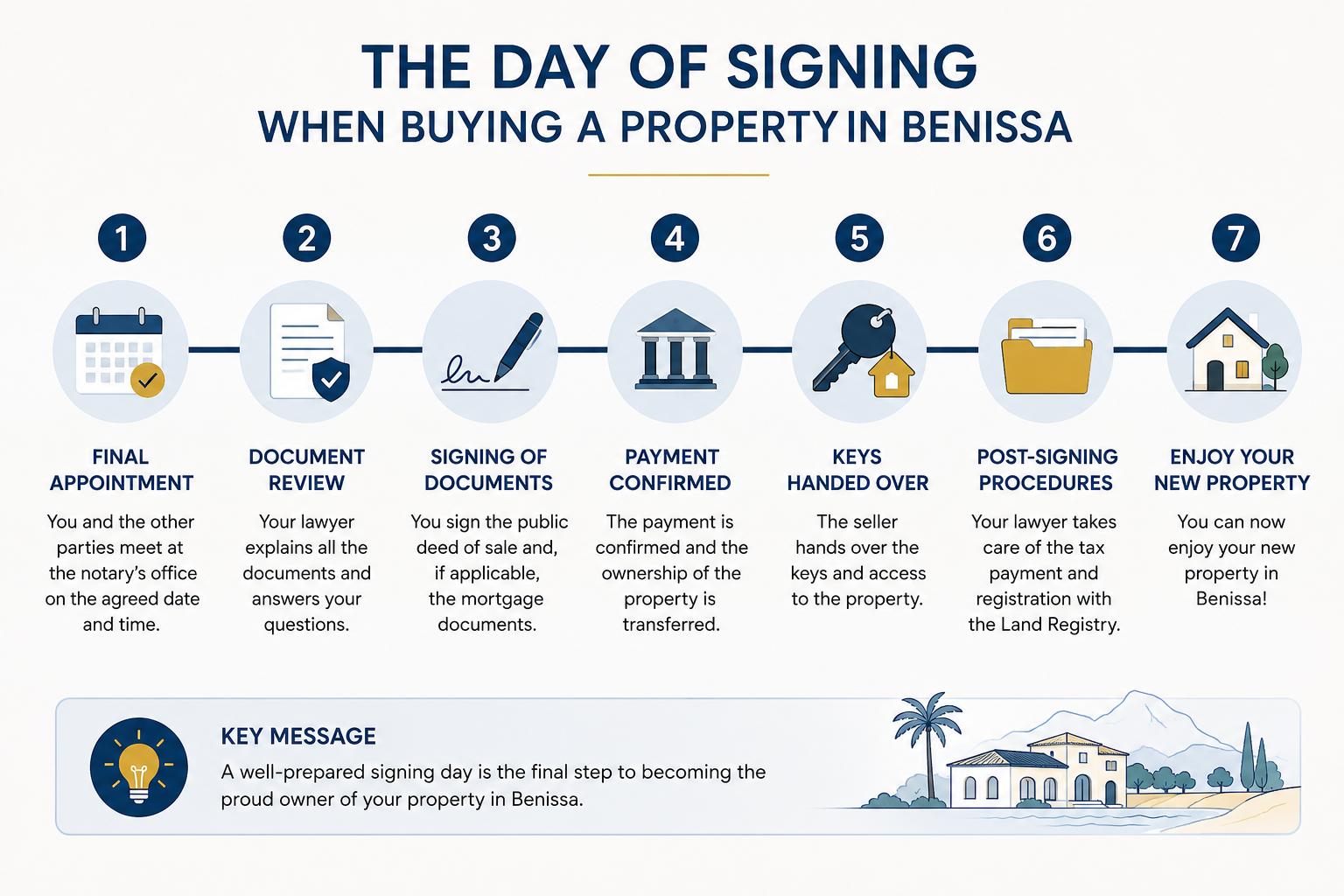
- Step-by-Step: What Happens on Completion Day?
- How Is the Purchase Price Paid?
- What Documents Will You Sign?
- What Happens Immediately After Completion?
- Can You Complete Without Travelling to Spain?
- Common Delays on Completion Day
- Completion Day Checklist
- Typical Completion Day Examples
- Frequently Asked Questions
- Expert Tips
- Why Buying with a Local Benissa Estate Agent Makes Completion Easier
- Conclusion
What Is Completion Day?
Definition of Completion Day
Completion Day is the day when ownership of a property legally transfers from the seller to the buyer.
In Spain, this normally takes place at a Notary's Office, where both parties sign the Escritura Pública de Compraventa (Public Deed of Sale).
Once the deed has been signed, payment has been completed and all agreed conditions have been satisfied, the buyer becomes the legal owner of the property.
Quick Answer
Completion Day in Spain is the legal transfer of property ownership. Buyer and seller (or their authorised representatives) meet before a Spanish notary, sign the public title deed, complete payment and hand over the keys.
Why It Is the Most Important Step in the Buying Process
Completion Day is much more than collecting the keys.
It represents the moment when:
- Ownership transfers.
- The remaining purchase price is paid.
- Mortgage funds are released (where applicable).
- The public deed is executed.
- Possession passes to the buyer.
- Responsibility for the property changes hands.
Everything that happens beforehand—from signing the reservation contract to legal due diligence—has been preparing for this moment.
When Completion Day Takes Place
There is no standard timeframe.
Completion usually takes place after:
- The legal due diligence has been completed.
- Both parties agree a completion date.
- The buyer's funds are available.
- Mortgage approval has been finalised (if required).
- The notary confirms the appointment.
For many purchases in Benissa, Completion Day takes place several weeks after signing the private purchase contract, although every transaction is different.
Important
The agreed completion date is normally stated in the private purchase contract. If either party cannot complete on that date, the consequences depend on the terms of the contract. Your independent lawyer should advise you if circumstances change.
What Happens Before Completion Day?
A successful Completion Day begins well before anyone arrives at the notary's office.
Proper preparation reduces the risk of delays and helps ensure everything proceeds smoothly.
Final Legal Checks
Before completion, your independent lawyer will normally verify:
- Ownership of the property
- Land Registry information
- Outstanding mortgages
- Embargoes or legal charges
- Planning matters
- Building legality
- Community fee status (where applicable)
- Local tax payments
For countryside properties around Pedramala, Benimarco and rural Benissa, additional checks may include:
- Property boundaries
- Rights of access
- Water supply
- Septic systems
- Agricultural regulations
- Legality of outbuildings
Expert Tip
Thorough legal due diligence is one of the best ways to prevent unexpected problems on Completion Day.
Reviewing the Completion Statement
Before Completion Day your lawyer will usually prepare a Completion Statement.
This document provides a clear breakdown of every payment involved in the transaction.
| Item | Included |
|---|---|
| Purchase price | ✓ |
| Reservation deposit already paid | ✓ |
| Remaining balance due | ✓ |
| Transfer Tax or VAT (where applicable) | ✓ |
| Notary fees | ✓ |
| Land Registry fees | ✓ |
| Legal fees | ✓ |
| Mortgage costs (if applicable) | ✓ |
Review this statement carefully before the appointment so you understand exactly what is payable.
Transferring the Purchase Funds
Ensure that purchase funds arrive in Spain well before Completion Day.
Large international transfers can occasionally be delayed because of:
- Banking cut-off times
- Fraud prevention checks
- Public holidays
- Currency transfers
Many overseas buyers also use specialist foreign exchange providers to reduce exchange-rate risk when transferring substantial amounts.
Warning
Sending funds at the last minute is one of the most common reasons for delayed completion.
Arranging a Mortgage (if applicable)
If you are buying with a Spanish mortgage, your lender will usually require:
- Final mortgage approval
- Property valuation
- Buildings insurance
- Confirmation of the completion appointment
- Completion of any remaining lending formalities
Your lawyer and lender will coordinate with the notary before Completion Day.
Final Property Inspection
Many buyers arrange one final inspection shortly before completion.
This is your opportunity to confirm that:
- The property remains in the agreed condition.
- Included furniture is still present.
- Appliances are functioning.
- Agreed repairs have been completed.
- The swimming pool equipment operates correctly.
- Air conditioning is working.
For villas in Fanadix, Buenavista and La Fustera, it is also sensible to check:
- Irrigation systems
- Outdoor lighting
- Electric gates
- Pool pumps
- Garden equipment
- Security systems
Confirming the Appointment with the Notary
A few days before completion, everyone involved should confirm:
- Appointment time
- Notary location
- Passport details
- NIE numbers
- Interpreter requirements
- Mortgage arrangements
- Payment method
- Final documentation
A knowledgeable local estate agent often coordinates communication between all parties, helping to prevent last-minute issues.
Who Attends the Completion Appointment?
Although every purchase differs, several professionals are usually involved.
The Buyer
The buyer signs the deed and becomes the legal owner.
Bring:
- Original passport or national identity card
- NIE certificate or card
- Mortgage documentation (if applicable)
- Any documents requested by your lawyer
The Seller
The seller signs the transfer deed and confirms the sale.
They will normally:
- Confirm receipt of payment
- Hand over the keys
- Provide any remaining documentation
- Transfer agreed manuals or warranties
The Spanish Notary
The notary is an independent public official.
Their role is to:
- Verify identities
- Confirm legal formalities
- Authenticate signatures
- Authorise the public deed
The notary is impartial and does not act for either buyer or seller.
Did You Know?
A Spanish notary ensures the legal validity of the public deed but does not replace your independent lawyer, whose role is to protect your interests throughout the transaction.
The Lawyers
Both buyer and seller are often represented by independent lawyers.
The buyer's lawyer typically:
- Explains the legal documentation
- Verifies the Completion Statement
- Confirms payment arrangements
- Coordinates registration after completion
- Handles tax filings where instructed
The Estate Agent
A professional local estate agent plays an important coordinating role.
They often assist by:
- Confirming appointments
- Liaising with lawyers
- Coordinating communication with the seller
- Helping resolve practical issues
- Organising key handover
- Assisting with utility readings
- Supporting buyers after completion
This practical coordination is particularly valuable for overseas buyers unfamiliar with the Spanish property buying process.
The Mortgage Bank Representative (if required)
If the purchase is financed through a Spanish mortgage, the lender may also be represented.
Their responsibilities may include:
- Releasing the mortgage funds
- Completing mortgage formalities
- Confirming loan documentation
When everyone has prepared properly, this stage is generally straightforward and forms part of a smooth completion process.
tep-by-Step: What Happens on Completion Day?
For many buyers, the reality of Completion Day is much simpler than they expect.
If the legal checks have been completed, the funds are available and everyone involved is prepared, the appointment is usually a straightforward final step.
Although every transaction is different, most property completions in Benissa follow a similar process.
Arriving at the Notary's Office
Completion appointments usually take place at a Spanish notary's office.
Depending on availability and the parties involved, the appointment may take place in Benissa, Calpe, Teulada, Dénia or another nearby town.
Before the signing begins, your lawyer will normally confirm that:
- All documentation is ready.
- Payment arrangements are in place.
- The buyer and seller details are correct.
- The final figures match the Completion Statement.
- Any mortgage requirements have been completed.
Expert Tip
Arrive 15–20 minutes early. This gives everyone time to complete final checks and avoids unnecessary pressure before signing.
Identity Verification
The notary must verify the identity of everyone signing the documents.
Buyers normally need:
- Original passport or national identity document
- NIE number
- Power of Attorney documentation (if someone signs on your behalf)
- Company documents (if buying through a company)
The seller must also prove their identity and confirm that they have the legal authority to transfer ownership.
Reading and Explaining the Title Deed
The main document signed on Completion Day is the Escritura Pública de Compraventa (Public Deed of Sale).
The deed confirms important information including:
- Buyer and seller details
- Property description
- Purchase price
- Payment arrangements
- Existing charges or mortgage information
- Special conditions agreed by the parties
The notary will review the document and explain the formal process.
If you do not speak Spanish fluently, your lawyer or an interpreter should explain the contents before you sign.
Important
Never sign a document you do not fully understand. Ask questions before signing, not afterwards.
Signing the Escritura Pública
Once everyone is satisfied that the documentation is correct:
- The buyer signs.
- The seller signs.
- The notary authorises the deed.
This is the key moment when the transfer of ownership is formalised.
The original deed becomes part of the official public record, and the buyer's lawyer will usually arrange the next administrative steps, including registration.
Paying the Purchase Price
The remaining purchase price is paid according to the agreed completion arrangements.
Payment methods may include:
- Banker's draft
- Electronic bank transfer
- Mortgage funds released by the lender
The exact process depends on the transaction and the instructions agreed between the parties.
Mortgage Signing (if applicable)
Buyers using finance may need to sign additional mortgage documentation.
This normally includes:
- Mortgage deed
- Loan conditions
- Bank documentation
Once the lender releases the mortgage funds, the purchase can be completed.
Mortgage buyers should ensure that:
- Insurance requirements are satisfied.
- The bank has all requested documents.
- Funds are ready before the appointment.
Receiving the Keys
For many buyers, this is the most memorable part of the day.
After payment has been confirmed, the seller normally hands over:
- Property keys
- Garage keys
- Storage keys
- Alarm controls
- Electric gate remotes
- Community access cards
- Mailbox keys
For villas and rural properties around Benissa, buyers should also request information about:
- Pool systems
- Irrigation controls
- Solar installations
- Water deposits
- Septic systems
- Maintenance schedules
Official Transfer of Ownership
After completion:
- The buyer takes possession.
- The seller leaves ownership behind.
- The property can normally be occupied.
- The registration process begins.
The new owner can usually start arranging:
- Utility transfers
- Insurance
- Renovation works (where legally permitted)
- Furniture deliveries
- Property maintenance
Important
Ownership registration at the Land Registry takes place after completion. Your lawyer normally handles this process and will provide confirmation once completed.
Completion Day Process Summary
| Step | What Happens |
|---|---|
| 1 | Buyer and seller arrive at the notary |
| 2 | Identities are verified |
| 3 | Escritura Pública is reviewed |
| 4 | Documents are signed |
| 5 | Purchase funds are confirmed |
| 6 | Mortgage documents are completed (if applicable) |
| 7 | Keys are handed over |
| 8 | Buyer takes possession |
How Is the Purchase Price Paid?
Understanding how money moves on Completion Day is important, especially for international buyers.
Large property purchases involve careful coordination between banks, lawyers, buyers and sellers.
Banker's Draft vs Electronic Transfer
Traditionally, many Spanish property purchases were completed using banker's drafts.
Today, electronic transfers are increasingly common, although the method depends on the circumstances of the transaction.
Banker's Draft
A banker's draft is a payment instrument issued by a bank confirming that funds are available.
Advantages
- Guaranteed payment
- Widely recognised in Spanish property transactions
- Immediate confirmation at completion
Considerations
- Must be arranged in advance
- Requires coordination with your bank
- May involve fees
Electronic Transfer
Electronic transfers are now widely used, particularly by international buyers.
Advantages
- No physical document required
- Easier record keeping
- Convenient for overseas buyers
Considerations
- International transfers may take time
- Banks may carry out security checks
- Transfer deadlines must be respected
Comparison Table
| Feature | Banker's Draft | Electronic Transfer |
|---|---|---|
| Payment confirmation | Immediate | Depends on bank confirmation |
| Physical document | Yes | No |
| Requires advance preparation | Yes | Yes |
| Suitable for international buyers | Sometimes | Often |
Mortgage Funds
If a buyer has arranged finance, the mortgage lender normally transfers the agreed loan amount as part of completion.
The buyer must still provide:
- Deposit already paid
- Remaining purchase balance
- Taxes
- Professional fees
- Other agreed costs
Completion Statement Explained
The Completion Statement provides a complete financial overview of the purchase.
A typical statement may include:
| Description | Example |
|---|---|
| Agreed purchase price | Total property price |
| Reservation payment | Amount already paid |
| Remaining balance | Amount still due |
| Property taxes | Depending on transaction type |
| Notary fees | Professional cost |
| Land Registry fees | Registration cost |
| Legal fees | Lawyer's charges |
| Mortgage-related costs | If applicable |
Your lawyer should explain each item before Completion Day.
Common Mistake
Many buyers budget only for the property price. Remember to include taxes, legal costs, registration fees and other purchase expenses when planning your funds.
Paying Taxes and Professional Fees
Buying a property in Spain involves additional costs beyond the purchase price.
Depending on the transaction, these may include:
- Property Transfer Tax
- VAT and Stamp Duty (for qualifying new-build purchases)
- Notary fees
- Land Registry fees
- Legal fees
- Mortgage-related costs
The exact amounts depend on the property type, location and current legislation.
Important
Spanish tax rules can change. Always obtain advice from your lawyer or tax adviser regarding your personal situation before completing a purchase.
What Documents Will You Sign?
Completion Day involves several important documents.
Your lawyer should explain each document before you sign.
Title Deed (Escritura Pública)
The Escritura Pública de Compraventa is the main document confirming the sale.
It records:
- The buyer
- The seller
- The property details
- The purchase price
- The transfer of ownership
It is signed before the notary and becomes the official public deed.
Mortgage Deed
If you purchase with a mortgage, you will also sign the mortgage deed.
This explains:
- Loan amount
- Repayment obligations
- Interest conditions
- Security provided to the bank
Take time to understand these obligations before signing.
Tax Documents
Following completion, the relevant purchase taxes must be filed and paid.
Depending on the transaction, this may include:
- Property Transfer Tax documentation
- VAT documentation
- Stamp Duty documentation
Your lawyer or tax adviser can normally assist with these obligations.
Utility Transfer Documents
After completion, utility accounts should be transferred into your name.
This may include:
- Electricity
- Water
- Internet
- Gas (where applicable)
For countryside homes in Benissa, additional practical matters may include:
- Water deposit management
- Septic tank servicing
- Solar system maintenance
Other Supporting Documentation
Depending on the property, you may also receive:
- Energy Performance Certificate
- Occupancy documentation where applicable
- Community information
- Appliance manuals
- Pool documentation
- Alarm instructions
- Keys inventory
- Building information
For rural properties around Benimarco and Pedramala, keeping documentation relating to water systems, access and installations is especially important.
Documents Summary
| Document | Purpose |
|---|---|
| Escritura Pública | Transfers legal ownership |
| Mortgage Deed | Creates mortgage obligations |
| Tax Documentation | Supports tax filing |
| Utility Forms | Transfers services |
| Property Certificates | Provides supporting information |
Did You Know?
Completion Day is not the end of the process. Your lawyer will normally continue working afterwards to complete registration, tax filings and administrative tasks so that your ownership records are properly updated.
What Happens Immediately After Completion?
Signing the Escritura Pública de Compraventa is the moment most buyers have been waiting for, but the process does not completely end when you leave the notary's office.
After Completion Day, there are still several important administrative steps to finalise your ownership and ensure your new property in Benissa is properly set up.
Some tasks are handled by your lawyer, while others require action from you as the new owner.
Collecting the Keys
For most buyers, receiving the keys is the highlight of Completion Day.
Once:
- The deed has been signed.
- Payment has been confirmed.
- Ownership has transferred.
the seller normally hands over the property keys.
You may receive:
- Main entrance keys
- Garage keys
- Storage room keys
- Mailbox keys
- Alarm controls
- Electric gate remotes
- Community access cards
For villas in areas such as La Fustera, San Jaime or Fanadix, it is also worth requesting:
- Pool equipment instructions
- Irrigation system information
- Air conditioning manuals
- Solar panel documentation
- Alarm details
- Spare keys
For countryside properties in Benimarco or Pedramala, make sure you also understand:
- Water deposit operation
- Septic tank maintenance requirements
- Agricultural systems
- Access arrangements
- Existing maintenance schedules
Expert Tip
Before leaving the property, photograph the electricity and water meter readings. This provides a clear record from the day you take possession.
Taking Possession of the Property
In most cases, the buyer can take possession immediately after completion unless another arrangement has been agreed in the purchase contract.
Your first visit as owner is a good opportunity to check:
✓ All rooms
✓ Appliances
✓ Outdoor areas
✓ Pool equipment
✓ Garden systems
✓ Security features
✓ Furniture included in the sale
Many buyers also choose to:
- Change external locks
- Update alarm codes
- Replace access passwords
- Photograph the condition of the property
These simple steps improve security and create a clear record from the beginning of ownership.
Registering the Property
After completion, the signed deed is submitted to the Registro de la Propiedad (Spanish Land Registry).
The purpose of registration is to officially record the change of ownership.
Your lawyer normally manages this process.
Registration provides important legal certainty by ensuring that:
- Your ownership is recorded publicly.
- The property details are updated.
- Future transactions are easier to complete.
The timeframe varies depending on the workload of the local registry and the complexity of the transaction.
Important
Although the buyer normally becomes owner when the deed is signed before the notary and completion takes place, completing Land Registry registration is still an essential final step.
Paying Purchase Taxes
After buying a property in Spain, the relevant purchase taxes must be declared and paid within the required deadlines.
The applicable taxes depend on the type of property and the nature of the transaction.
Examples include:
| Purchase Type | Possible Tax Treatment |
|---|---|
| Resale property | Usually Property Transfer Tax |
| New-build property | May involve VAT and Stamp Duty |
| Other transactions | Depends on circumstances |
Tax regulations can change, and the exact obligations depend on your personal situation.
Always obtain advice from your lawyer or tax adviser before and after completion.
Changing Utility Accounts
After becoming the owner, utilities should be transferred into your name.
Typical services include:
- Electricity
- Water
- Internet
- Gas (where available)
Your estate agent, lawyer or a local property management company may assist with this process.
For rural properties around Benissa, additional considerations may include:
Water Systems
Some countryside properties may use:
- Water deposits
- Private wells
- Alternative supply systems
Understanding how the system operates is essential before moving in.
Septic Systems
Properties outside urban areas may have septic systems requiring:
- Regular maintenance
- Servicing
- Documentation checks
Solar Installations
If the property includes solar panels, request:
- Installation information
- Warranty documentation
- Maintenance details
Community of Owners Notifications
If your property forms part of an apartment complex or urbanisation, the Community of Owners should be informed of the ownership change.
This ensures:
- Community fees are correctly charged.
- Voting rights transfer.
- Contact details are updated.
This is particularly relevant for apartments and properties within organised developments.
Setting Up Home Insurance
Arranging insurance should be a priority after completion.
Ideally, your property should be insured from the moment ownership transfers.
Insurance considerations for Costa Blanca properties may include:
- Building cover
- Contents insurance
- Theft protection
- Storm damage
- Water damage
- Public liability
- Swimming pool cover
- Garden and outdoor structures
- Holiday rental use (if applicable)
For villas in Benissa Costa, outdoor areas often represent a significant part of the property's value, so check that terraces, pools, walls and gardens are appropriately covered.
If purchasing with a mortgage, your lender may require buildings insurance as part of the loan conditions.
Post-Completion Checklist
Before Leaving the Property
✓ Collect all keys and remotes
✓ Photograph utility meters
✓ Check appliances
✓ Confirm furniture included in the sale
✓ Receive manuals and documentation
✓ Confirm alarm details
During the First Week
✓ Arrange insurance
✓ Transfer utilities
✓ Save copies of all legal documents
✓ Store the Escritura safely
✓ Update contact details
✓ Arrange maintenance if required
Can You Complete the Purchase Without Travelling to Spain?
Yes.
Many international buyers complete their Spanish property purchase without being physically present in Spain.
This is particularly common for buyers from:
- The United Kingdom
- The Netherlands
- Belgium
- Germany
- France
- Other European countries
The most common solution is using a Power of Attorney.
Using a Power of Attorney
A Power of Attorney allows another person—often your lawyer—to act on your behalf.
Depending on the authority granted, your representative may be able to:
- Attend the notary appointment
- Sign the purchase deed
- Complete mortgage documentation
- Pay taxes
- Register the property
- Transfer utilities
- Collect keys
Before granting Power of Attorney, buyers should receive independent legal advice and understand exactly what authority they are giving.
Remote Completion Process
A typical remote completion follows these steps:
- Buyer grants Power of Attorney.
- Lawyer prepares completion documentation.
- Buyer transfers funds.
- Lawyer attends the notary.
- Purchase deed is signed.
- Ownership transfers.
- Registration and tax procedures begin.
- Keys are collected and delivered or stored.
Many overseas buyers then visit Benissa afterwards and enjoy their new property without needing to attend the legal completion in person.
Advantages and Considerations of Remote Completion
| Advantages | Considerations |
|---|---|
| No need to travel to Spain | Choose your representative carefully |
| Useful if travel dates change | Documentation must be correctly prepared |
| Convenient for overseas buyers | Funds must arrive before completion |
| Saves time and travel costs | Communication is essential |
Did You Know?
Remote completion has become increasingly common among international buyers purchasing second homes on the Costa Blanca.
Common Delays on Completion Day
Most Completion Days happen smoothly, but delays can occasionally occur.
Understanding the common causes helps buyers prepare.
Missing Documentation
A missing document can prevent completion from taking place.
Examples include:
- Expired passport
- Missing NIE documentation
- Incorrect Power of Attorney
- Missing mortgage paperwork
- Company documentation issues
The easiest way to avoid this is to confirm requirements with your lawyer well before completion.
Delays with Bank Transfers
Banking delays are among the most common practical problems.
Possible causes include:
- International transfer delays
- Banking security checks
- Incorrect account information
- Transfer limits
- Public holidays
Always transfer funds early and confirm receipt before the appointment.
Mortgage Issues
Mortgage-related delays may occur if:
- Final approval is incomplete.
- The bank requires additional documents.
- Insurance arrangements are missing.
- Mortgage funds are not ready.
Regular communication with your lender and lawyer helps prevent these issues.
Registry or Legal Problems
Occasionally, legal issues may appear before completion.
Examples include:
- Outstanding charges
- Registry discrepancies
- Mortgage cancellation issues
- Ownership questions
- Inheritance matters
Good legal due diligence should identify most problems before Completion Day.
How Delays Are Usually Resolved
Most delays are administrative rather than serious problems.
Solutions may include:
- Correcting documents
- Waiting for bank confirmation
- Rescheduling the notary appointment
- Agreeing a new completion date
- Obtaining additional information
A coordinated team of buyer, seller, lawyer, bank and estate agent can usually resolve issues efficiently.
Warning
Do not feel pressured to complete if important legal questions remain unresolved. Solving problems before signing is usually much easier than correcting them afterwards.
Completion Day Checklist
Before Leaving for the Notary
✓ Passport
✓ NIE number
✓ Lawyer contact details
✓ Mortgage documentation (if applicable)
✓ Proof of funds if requested
✓ Mobile phone charged
Documents to Bring
| Document | Required |
|---|---|
| Passport or ID | Yes |
| NIE number | Usually |
| Mortgage documents | If applicable |
| Power of Attorney | If applicable |
| Company documents | If purchasing through a company |
Questions to Ask Before Signing
Before signing, make sure you understand:
- Is the property description correct?
- Is the purchase price correct?
- Are all agreed conditions included?
- Have all payments been accounted for?
- When will registration be completed?
- Who will handle utility transfers?
- When does insurance begin?
After Receiving the Keys
✓ Photograph the property condition
✓ Record meter readings
✓ Change security codes
✓ Store legal documents safely
✓ Arrange insurance
✓ Begin enjoying your new home in Benissa
Example: A Typical Completion Day in Benissa
Every property purchase is different. However, the following examples show how Completion Day often works for different types of buyers purchasing property in Benissa.
These examples are based on common situations experienced by international buyers purchasing villas, fincas and apartments on the Costa Blanca North.
Cash Buyer Example
Buying a Villa in La Fustera
A British couple purchases a detached villa in La Fustera as a holiday home.
Before Completion Day:
- Their lawyer completes legal checks.
- The purchase funds are transferred several days in advance.
- The Completion Statement is reviewed.
- Buildings insurance is arranged.
On the day of completion:
- They meet their lawyer at the notary.
- Their passports and NIE numbers are checked.
- The Escritura Pública is reviewed.
- The purchase deed is signed.
- Payment is confirmed.
- The seller hands over the keys.
- They visit the property to record meter readings.
Because everything was prepared in advance, the appointment takes less than an hour.
That afternoon, they open the doors to their new Benissa home for the first time as owners.
Mortgage Buyer Example
Buying an Apartment Near Benissa Town
A German buyer purchases an apartment and finances part of the purchase with a Spanish mortgage.
Before completion:
- The bank approves the mortgage.
- The property valuation is completed.
- Insurance arrangements are confirmed.
- The lawyer checks all documentation.
On Completion Day:
- Mortgage documents are signed.
- The lender releases the mortgage funds.
- The purchase deed is signed.
- The remaining balance is paid.
- Ownership transfers.
- The keys are handed over.
The process involves more paperwork than a cash purchase, but with good preparation it follows a similar structure.
Completion Using a Power of Attorney
Overseas Buyer Unable to Travel
A Dutch buyer agrees to purchase a countryside property near Pedramala, but cannot travel to Spain on the agreed completion date.
Before completion:
- The buyer grants Power of Attorney to their lawyer.
- The lawyer explains exactly what authority is being granted.
- Funds are transferred.
- All documents are checked.
On Completion Day:
The lawyer:
- Attends the notary.
- Signs the purchase deed.
- Completes the transaction.
- Arranges registration and tax procedures.
- Collects the keys.
The buyer later travels to Benissa and takes possession of the property without needing to attend the legal completion personally.
Common Completion Day Mistakes to Avoid
Even well-prepared buyers can make mistakes.
The following are some of the most common issues:
| Mistake | Why It Causes Problems | How to Avoid It |
|---|---|---|
| Sending funds too late | Bank transfers may not arrive in time | Transfer funds several days before completion |
| Forgetting identification | Notary cannot complete identity checks | Prepare passports and NIE documents early |
| Not reviewing costs | Unexpected expenses appear | Study the Completion Statement carefully |
| Assuming everything transfers automatically | Utilities may remain in the seller's name | Arrange transfers after completion |
| Not inspecting the property | Missing items may be discovered later | Carry out a final inspection |
| Signing without understanding documents | Creates unnecessary risk | Ask your lawyer before signing |
Frequently Asked Questions
What time does completion usually take place?
Completion appointments are normally arranged during working hours, often in the morning or early afternoon.
The exact time depends on:
- Notary availability
- Buyer and seller schedules
- Lawyer availability
- Mortgage arrangements
Your lawyer or estate agent should confirm the appointment details beforehand.
How long does the appointment last?
A straightforward cash purchase usually takes around 30–60 minutes.
Transactions involving:
- Mortgages
- Multiple buyers
- Companies
- Additional documentation
may take longer.
When do I officially own the property?
In normal circumstances, ownership transfers when:
- The public deed has been signed before the notary.
- The agreed payment has been completed.
The property is then registered in your name at the Land Registry.
When do I receive the keys?
Usually immediately after:
- The deed is signed.
- Payment is confirmed.
The exact handover arrangements should be agreed before completion.
Can I move into the property immediately?
Usually yes.
However, buyers should check whether the purchase contract contains any special arrangements regarding possession.
For example:
- Seller remaining temporarily after completion.
- Agreed furniture removal.
- Delayed handover arrangements.
What happens if completion is delayed?
If completion cannot happen on the planned date, the parties normally work together to resolve the issue.
Common solutions include:
- Correcting missing documents.
- Waiting for bank confirmation.
- Agreeing a new completion date.
The consequences depend on the terms of the purchase contract and the reason for the delay.
Can someone sign on my behalf?
Yes.
A buyer can often complete using a properly prepared Power of Attorney.
This is especially common for:
- Overseas buyers.
- Holiday-home owners.
- Buyers unable to travel.
Always obtain independent legal advice before granting authority to another person.
Do I need to speak Spanish?
No.
Many international buyers complete property purchases without speaking Spanish.
Your lawyer should explain the documents, and an interpreter can assist if required.
You should never sign legal documents you do not understand.
What happens after signing?
After completion, your lawyer will normally continue with:
- Tax procedures.
- Land Registry registration.
- Administrative paperwork.
- Utility arrangements (if instructed).
Your estate agent may also assist with practical matters after you receive the keys.
How long does Land Registry registration take?
The timeframe varies depending on:
- The local registry workload.
- The complexity of the transaction.
- Whether additional corrections are required.
Your lawyer will normally inform you when registration has been completed.
What documents will I receive?
You should keep copies of important documents including:
- Escritura Pública
- Completion Statement
- Proof of payments
- Tax documents
- Mortgage documentation (if applicable)
The registered title information will usually be available once the Land Registry process is complete.
What costs are paid on Completion Day?
Costs depend on the type of purchase, but may include:
- Remaining purchase price
- Property Transfer Tax or applicable taxes
- Notary fees
- Registry fees
- Legal fees
- Mortgage-related costs
Always confirm the final amounts with your lawyer before completion.
Can I buy a property in Benissa remotely?
Yes.
Many overseas buyers complete remotely using Power of Attorney.
This can be a practical solution when:
- Travel is difficult.
- Buyers live abroad.
- Completion dates cannot be changed.
What happens if I discover a problem after completion?
If you discover an issue after buying, the first step is usually to contact your lawyer.
The appropriate action depends on:
- The nature of the problem.
- The documentation available.
- The terms of the purchase agreement.
- Spanish legal requirements.
This is why thorough checks before completion are so important.
Expert Tips for a Smooth Completion Day
Prepare Your Funds Early
Large international transfers should never be left until the last minute.
Good preparation includes:
- Confirming your bank details.
- Checking transfer times.
- Allowing extra time for security checks.
- Confirming receipt with your lawyer.
Double-Check All Documentation
Before Completion Day, confirm that you have:
✓ Passport
✓ NIE number
✓ Mortgage paperwork if applicable
✓ Power of Attorney if applicable
✓ Bank confirmation if requested
Carry Identification
Spanish notaries require valid identification.
Bring original documents rather than relying only on digital copies.
Arrange Insurance Before Completion
Insurance should ideally begin from the day you become responsible for the property.
For Benissa villas, consider cover for:
- Buildings
- Contents
- Swimming pools
- Gardens
- Outdoor areas
- Holiday rental use (if applicable)
Understand the Property You Are Buying
Local knowledge matters.
Different property types have different considerations.
For example:
Coastal Villas
Properties in:
- La Fustera
- San Jaime
- Fanadix
may require attention to:
- Salt exposure
- Pool maintenance
- Outdoor areas
Countryside Properties
Properties in:
- Pedramala
- Benimarco
may require understanding of:
- Water systems
- Septic tanks
- Access roads
- Rural maintenance
Why Buying with a Local Benissa Estate Agent Makes Completion Easier
Buying a property abroad involves many moving parts.
A specialist local estate agent helps coordinate the practical side of the transaction and provides support beyond finding the property.
Coordinating with Lawyers and the Notary
Completion involves communication between:
- Buyer
- Seller
- Lawyers
- Notary
- Banks
- Estate agent
A local agent can help ensure everyone works towards the same completion date.
This is particularly useful when buyers and sellers are located in different countries.
Helping with Utility Transfers
After completion, many buyers need help understanding local procedures.
A local estate agent can assist with:
- Electricity transfers
- Water accounts
- Internet providers
- Local services
For rural properties, practical guidance can be especially valuable.
Assisting After Completion
A good relationship does not end when the keys are handed over.
Many buyers need help with:
- Finding reliable tradespeople
- Property maintenance
- Renovation contacts
- Local recommendations
- Understanding the area
For international owners, having someone local they can contact provides additional reassurance.
Local Knowledge That Prevents Delays
Every property has its own history.
A local Benissa specialist understands common issues affecting properties in the area, including:
- Differences between urban and rural properties.
- Typical documentation requirements.
- Characteristics of local urbanisations.
- Practical considerations of owning a Costa Blanca home.
While legal advice should always come from an independent lawyer, local experience can help buyers prepare better and avoid unnecessary problems.
Conclusion
Completion Day in Benissa property purchases represents the final and most exciting stage of buying a home in Spain.
After the legal checks, negotiations and paperwork are complete, this is the moment when ownership transfers, payment is finalised and the keys become yours.
Although the process may seem complicated at first, a well-prepared Completion Day is usually straightforward.
The key steps are:
- Complete legal checks early.
- Prepare funds in advance.
- Understand the documents before signing.
- Arrange insurance and utilities promptly.
- Work with experienced professionals who understand the local market.
Whether you are buying a beachfront apartment, a villa in San Jaime, a property near La Fustera, or a countryside finca around Benimarco or Pedramala, local guidance can make the journey much easier.
At Telio Homes, we specialise in helping buyers navigate the Benissa property market from the first viewing through to Completion Day and beyond.
We work with trusted local professionals and provide practical support throughout the purchase process, helping international buyers feel confident at every stage.
If you are considering buying property in Benissa, contact Telio Homes for guidance, local knowledge and support with finding your ideal Costa Blanca home.
Important: Property laws, taxes and administrative procedures can change. Always obtain independent legal and tax advice based on your personal circumstances before completing a property purchase in Spain.