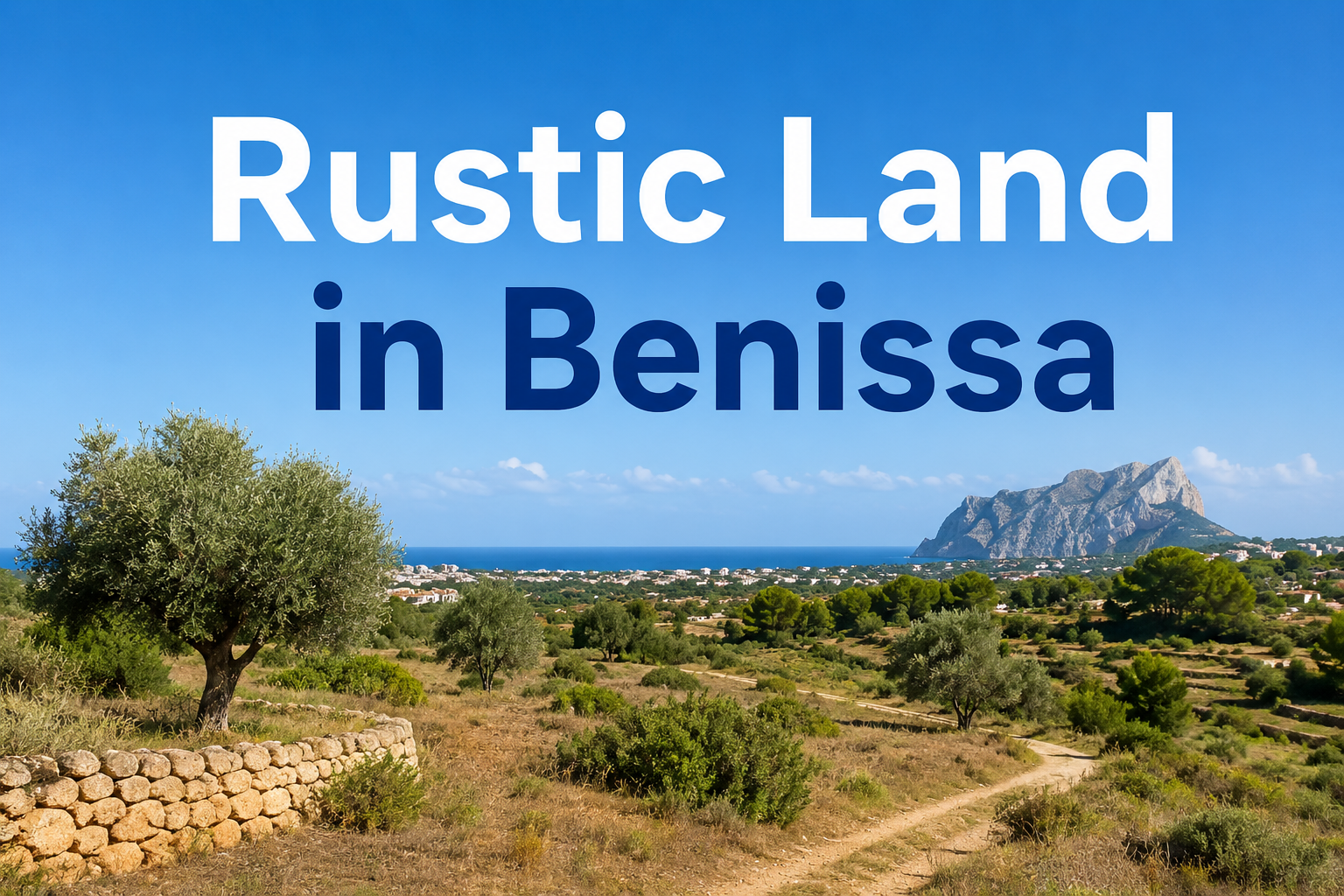
Rustic Land in Benissa: Complete Guide to Buying, Building and Owning Rural Land
Introduction
Rustic land in Benissa can offer something that conventional residential property cannot: space, privacy, mature trees, open countryside, traditional agricultural landscapes and, in some locations, spectacular views towards the Mediterranean.
It is one of the reasons rural areas such as Benimarco, Pedramala, Buenavista and parts of Benissa's countryside continue to attract buyers looking for a finca, a future home or a more private lifestyle on the Costa Blanca North.
But rustic land is also one of the property types where buyers need to be especially careful.
The most important rule is simple:
Rustic land does not automatically mean buildable land.
A property advertisement may describe a parcel as terreno rústico, suelo rústico, suelo no urbanizable or even "buildable rustic land". None of those descriptions, on their own, establishes exactly what you can legally construct.
The answer depends on the planning classification of the specific parcel, its size and configuration, applicable planning regulations, permitted uses, protected status, access, existing buildings, infrastructure and other restrictions.
There is also an important current planning development in Benissa. The municipality approved the start of public exposure of the initial version of its new Plan General Estructural (PGE) in July 2026. This is significant for anyone buying rural land because planning documentation can evolve. However, a proposed or publicly exhibited planning document should not be treated as an existing development right. Buyers should assess a property according to the planning position that legally applies to it at the time of purchase.
This guide explains how to assess rustic land properly, including:
-
what suelo rústico and suelo no urbanizable mean;
-
whether you can build a house;
-
what the 10,000 m² rule actually means;
-
how to assess an existing finca;
-
how to check Catastro and the Registro de la Propiedad;
-
how to investigate water, electricity and sewage;
-
how rustic land is valued;
-
how financing works;
-
the risks of buying land advertised as "buildable";
-
and how to carry out a proper rural-property due-diligence process.
Important: Planning, building, environmental, tax and legal regulations can change. Information in this guide is general and should not replace independent legal, architectural or planning advice for a specific property.
Table of Contents
What Is Rustic Land in Benissa?
What Does “Suelo Rústico” Mean?
Suelo rústico is the Spanish expression commonly used for rural or countryside land.
In property advertising, you may also encounter:
-
terreno rústico;
-
parcela rústica;
-
finca rústica;
-
suelo rústico;
-
suelo no urbanizable;
-
suelo no urbanizable común;
-
suelo no urbanizable protegido.
These expressions do not necessarily describe exactly the same planning situation.
For a buyer, the important question is therefore not simply:
"Is this land rustic?"
It is:
"What exact planning classification applies to this parcel, and what rights and restrictions come with it?"
That distinction can have a major effect on value.
What Does “Suelo No Urbanizable” Mean?
Suelo no urbanizable refers broadly to land that is not classified as conventional urban development land.
It can encompass rural land subject to different planning purposes and restrictions.
Depending on the specific classification, land may be affected by:
-
agricultural requirements;
-
landscape protection;
-
environmental protection;
-
infrastructure restrictions;
-
road-related restrictions;
-
water-related constraints;
-
heritage considerations;
-
other planning limitations.
Consequently, two neighbouring parcels can have different development potential.
This is why a rural property should always be assessed by its specific cadastral parcel and planning classification, rather than by its estate-agent description.
Rustic Land vs Urban Land in Benissa
The broad distinction can be summarised as follows:
| Rustic / non-urbanisable land | Urban land | |
|---|---|---|
| General character | Rural | Urban |
| Development | More restricted and planning-dependent | Generally greater, subject to planning |
| New dwelling | Not automatically permitted | Depends on urban planning and conditions |
| Infrastructure | May be limited or private | Generally more developed |
| Planning restrictions | Can be substantial | Usually different and often less restrictive |
| Due diligence | Particularly important | Important |
| Typical buyer | Rural lifestyle, agriculture, finca or specific development opportunity | Residential or development buyer |
Rustic land is not necessarily "worse" than urban land.
It is a different type of property.
For someone looking for a traditional finca surrounded by land, privacy and countryside, rustic property may be exactly what they want.
Different Types of Rustic Land
Planning classification matters because not every rural parcel has the same permitted uses.
Potential situations include:
-
common non-urbanisable land;
-
specially protected non-urbanisable land;
-
agricultural land;
-
landscape-sensitive land;
-
land affected by infrastructure;
-
land affected by roads or easements;
-
land containing existing buildings;
-
land with previous licences or planning history.
The applicable Benissa planning documentation must therefore be identified for the individual parcel.
The Telio Homes Rural Land Test
Before treating a rustic plot as a development opportunity, ask ten questions:
-
What is the exact planning classification?
-
Does the parcel meet the applicable minimum requirements?
-
Is the intended use permitted?
-
Is residential use possible?
-
What building parameters apply?
-
Is access legally established?
-
What restrictions affect the land?
-
Are existing buildings legal?
-
Can water, electricity and sewage be provided?
-
Has the position been independently confirmed?
If several of these questions remain unanswered, the land should not yet be valued as a straightforward building plot.
Can You Build on Rustic Land in Benissa?
Is Rustic Land Automatically Buildable?
No.
This is the most important answer for anyone searching for rustic land in Benissa.
A rustic parcel may have:
-
potential for a particular type of development;
-
potential for a dwelling subject to conditions;
-
agricultural potential but no residential potential;
-
an existing legal building but limited scope for further construction;
-
additional environmental or planning restrictions;
-
no realistic development potential.
The word "rustic" does not establish which of these applies.
Neither does plot size by itself.
What Does 10,000 m² Actually Mean?
The figure of 10,000 m² is extremely important in discussions about rural housing in the Valencian Community and Benissa.
Under the relevant planning framework for isolated housing on non-urbanisable land, a one-hectare minimum is an important reference. Benissa's planning documentation also contains a 10,000 m² reference in relation to rural housing and parcelation.
But this does not mean:
"If the plot is 10,000 m², I can automatically build a house."
That is one of the most dangerous oversimplifications in rural-property marketing.
10,000 m²: Myth vs Reality
| What a buyer may think | What it actually means |
|---|---|
| "The plot is 10,000 m², so I can build." | Size is only one part of the planning assessment. |
| "It is 12,000 m², so it must be buildable." | Other planning requirements still apply. |
| "My neighbour has a villa, so I can build too." | A neighbouring property does not establish your planning rights. |
| "It has electricity, therefore I can build." | Utilities do not create planning permission. |
| "It is registered in Catastro, therefore it is legal to build." | Cadastral registration does not by itself establish planning permission. |
| "It has been agricultural land for years, so I can construct a house." | Agricultural status does not automatically create residential rights. |
| "The listing says buildable." | The claim needs supporting planning evidence. |
The correct conclusion is:
10,000 m² can be an important eligibility threshold in the relevant rural-housing regime, but it is not a standalone buildability certificate.
How Building Rights Are Determined
For a specific parcel, the investigation should establish:
-
Planning classification.
-
Applicable subcategory or zoning.
-
Permitted uses.
-
Minimum parcel requirements.
-
Whether the parcel qualifies for the intended use.
-
Maximum occupation.
-
Buildable floor area.
-
Setbacks.
-
Height.
-
Number of floors.
-
Access requirements.
-
Infrastructure requirements.
-
Protected or restricted areas.
-
Conditions affecting existing buildings.
-
Any additional authorisations required.
This is why an architect, urban-planning professional or other suitably qualified adviser can be essential when the main purpose of the purchase is construction.
Minimum Plot Requirements
A one-hectare or 10,000 m² reference is important for isolated family housing under the relevant Valencian framework, but the exact legal analysis must be carried out against the current legislation and Benissa planning documentation applicable to the parcel.
There may also be requirements concerning:
-
how the land is used;
-
whether the parcel can be segregated;
-
existing residential buildings;
-
planning classification;
-
access;
-
building parameters;
-
protected status;
-
environmental considerations.
The municipality or a qualified planning professional should therefore confirm the position of the specific parcel.
Expert Tip: If a property is being marketed specifically because it is "over 10,000 m²", ask for the planning evidence that explains what that size actually allows.
Building Size and Edificability
Even where residential use is possible in principle, the permitted house may be subject to strict parameters.
These can govern:
-
maximum occupation of the plot;
-
maximum floor area;
-
building envelope;
-
height;
-
number of floors;
-
location;
-
setbacks;
-
auxiliary buildings;
-
landscaping;
-
access.
A buyer should therefore ask:
What exactly can I build?
rather than:
Can I build?
The difference is important.
Setbacks and Building Position
A parcel may be large enough in total area but still have a difficult building envelope.
Setbacks can apply from:
-
roads;
-
boundaries;
-
neighbouring properties;
-
protected features;
-
infrastructure;
-
watercourses;
-
other regulated elements.
Plot shape matters too.
A long, narrow or irregularly shaped parcel may have significantly less practical building potential than a more compact parcel of the same area.
Height and Number of Floors
Planning rules may control:
-
maximum height;
-
number of floors;
-
roof design;
-
location of upper floors;
-
auxiliary structures;
-
other aspects of the building envelope.
Never assume that a neighbouring two-storey finca establishes the same right on your parcel.
Protected Land and Additional Restrictions
Additional restrictions can arise from:
-
environmental protection;
-
landscape;
-
forestry;
-
coastal planning;
-
roads;
-
watercourses;
-
heritage;
-
archaeological considerations;
-
wildfire risk;
-
infrastructure corridors;
-
easements.
This is particularly important in the more attractive parts of Benissa, where landscape and views are part of the property's appeal.
Common Mistake: Seeing a spectacular plot in Pedramala, Benimarco or another rural area and assuming that the views mean a villa can be built there.
Views are a property feature.
They are not planning permission.
Benissa's New General Structural Plan: Why Buyers Should Pay Attention
Benissa is currently progressing a new Plan General Estructural (PGE).
In July 2026, the Ayuntamiento de Benissa announced the public-exposure process for the initial version of the PGE, describing it as a key document for defining the municipality's future urban and territorial model. The process includes public participation and a period for submitting observations and allegations.
This matters to buyers of rustic land because planning documents can change the future framework of a municipality.
However, there is a crucial distinction:
A proposed or publicly exhibited planning document is not the same as an adopted right to build.
If you are buying rustic land because of what a future plan might allow, obtain professional advice on the actual status of the planning process.
Do not pay today's price for a future planning right that has not yet been legally established.
Important: Benissa's planning position should be checked again whenever this article is reviewed. The applicable planning documentation for a particular purchase must always be confirmed at the time of the transaction.
What Can You Build on Rustic Land in Benissa?
There is no universal list of structures that every rustic parcel can accommodate.
The table below should therefore be treated as a due-diligence guide rather than a list of automatic permissions.
| Proposed use | Automatically permitted? | What must be checked? |
|---|---|---|
| New house | No | Planning classification, residential use, parcel requirements and building parameters |
| Renovation of existing finca | No | Legal status, existing footprint, licences and scope of works |
| Agricultural building | No | Agricultural use, dimensions, location and licence requirements |
| Swimming pool | No | Planning rules, location, existing building status and licence |
| Garage | No | Auxiliary-building rules and applicable limits |
| Storage building | No | Permitted use and construction requirements |
| Walls or fencing | No | Height, location, materials and applicable regulations |
| Solar panels | No | Type of installation and planning/technical requirements |
| Commercial activity | No | Permitted use and any additional authorisations |
Building a New House
A new dwelling is usually the highest-value question for a rustic-land buyer.
Where a house may be possible, establish:
-
whether residential use is permitted;
-
minimum parcel requirements;
-
whether the specific parcel qualifies;
-
maximum occupation;
-
buildable floor area;
-
setbacks;
-
height;
-
number of floors;
-
access;
-
infrastructure;
-
environmental restrictions;
-
technical and planning documentation;
-
required licences.
A statement such as "house possible" is not enough.
The buyer should understand the development envelope.
Renovating an Existing Finca
An existing finca can be a very different proposition from an empty plot.
It may already have:
-
an established building;
-
access;
-
electricity;
-
water;
-
gardens;
-
terraces;
-
a pool;
-
agricultural infrastructure.
But first establish the legal status of everything that exists.
There is a major difference between:
-
repairing an existing building;
-
refurbishing internally;
-
changing its structure;
-
extending the footprint;
-
changing use;
-
reconstructing;
-
demolishing and rebuilding.
A building's age does not automatically make every proposed future alteration lawful.
Agricultural Buildings
Agricultural structures can be treated differently from residential buildings.
A genuine agricultural use does not automatically create a right to construct a house.
Likewise, an agricultural store should not be viewed as a shortcut to residential accommodation.
Before purchasing land for agricultural construction, establish:
-
whether the intended agricultural use is permitted;
-
whether the proposed structure qualifies;
-
applicable dimensions;
-
location;
-
access;
-
required documentation;
-
whether a municipal or other authorisation is necessary.
Swimming Pools
A swimming pool may be possible in some circumstances, but it should be checked separately.
Questions include:
-
Is the pool permitted on the parcel?
-
Where can it be located?
-
What setbacks apply?
-
Is a licence required?
-
Does the existing house have a legal status that affects the application?
-
Is the land affected by additional restrictions?
Do not assume that a pool is permitted simply because another property nearby has one.
Garages and Storage Buildings
Garages, storage rooms and auxiliary structures can also be regulated.
Check:
-
permitted use;
-
dimensions;
-
location;
-
relationship with the main dwelling;
-
whether the structure requires a licence;
-
whether an existing building is already included in the property's legal documentation.
A garage shown in an estate-agent photograph is not proof of legal authorisation.
Walls and Fencing
Boundary treatments are often overlooked.
Potential requirements can concern:
-
height;
-
materials;
-
visual impact;
-
road frontage;
-
boundaries;
-
gates;
-
retaining walls.
On sloping land, retaining walls can also become a significant construction issue.
Solar Panels and Renewable Energy
Solar energy can be particularly attractive for a rural property.
A finca may have:
-
mains electricity;
-
solar panels;
-
battery storage;
-
a private electrical system;
-
a combination of systems.
However, installing solar equipment is still a technical and potentially regulated matter.
Before installation, establish the applicable planning, technical and electrical requirements.
Other Structures and Installations
Other items that may need checking include:
-
pergolas;
-
terraces;
-
retaining walls;
-
agricultural structures;
-
outdoor kitchens;
-
driveways;
-
gates;
-
sports facilities;
-
irrigation installations;
-
telecommunications equipment.
The right question is always:
Is this structure permitted on this specific parcel, and does it require prior authorisation?
What You May Not Be Able to Build on Rustic Land
Additional Houses
A large parcel does not automatically mean several houses.
Planning rules can restrict:
-
number of dwellings;
-
residential density;
-
parcel division;
-
creation of new residential concentrations.
A 50,000 m² parcel should therefore never automatically be treated as five future building plots.
Mobile Homes
A mobile home, caravan or similar structure is not automatically exempt from planning controls because it can be moved.
If it is being used as accommodation or placed on land in a way that constitutes a regulated use or installation, planning issues may arise.
Do not assume that wheels create a legal loophole.
Shipping Containers and Prefabricated Buildings
A shipping container is not automatically exempt from planning requirements.
The same applies to:
-
prefabricated houses;
-
modular accommodation;
-
cabins;
-
container homes;
-
temporary structures.
Before installing substantial structures, obtain professional confirmation of the applicable requirements.
Unauthorised Extensions
Rural properties can accumulate alterations over many years.
Examples include:
-
enclosed terraces;
-
extra bedrooms;
-
converted garages;
-
enlarged kitchens;
-
additional bathrooms;
-
covered porches;
-
pool structures;
-
storage rooms.
The fact that an extension has existed for a long time does not automatically answer its legal status.
Tourist Accommodation
A rural house does not automatically have permission to operate as tourist accommodation.
Tourist use can involve separate planning, registration and sector-specific requirements.
If your investment plan depends on holiday rentals, establish the legal position before buying.
Do not build the investment case around rental income that has not been legally confirmed.
Commercial Uses
Commercial activity on rustic land can require a different planning route from residential use.
Potential examples include:
-
restaurants;
-
event venues;
-
equestrian businesses;
-
tourism facilities;
-
warehouses;
-
workshops;
-
other commercial activities.
Some activities can require specific planning authorisation, potentially including a Declaración de Interés Comunitario, depending on the use and applicable framework.
Never assume that purchasing rural land gives you the right to operate a business from it.
Buying Rustic Land With an Existing Finca or House
Why Existing Buildings Change the Due-Diligence Process
An empty plot mainly raises one question:
Can I build what I want?
A rustic property with an existing house raises many more:
-
Was the house authorised?
-
What was originally permitted?
-
Is the current footprint legal?
-
Are later extensions authorised?
-
Does the building match Catastro?
-
Does it match the Registro?
-
Does the Escritura describe it correctly?
-
Is the current use lawful?
-
Can it be renovated?
-
Can it be extended?
-
Are there unresolved planning issues?
Buying a finca therefore means buying not just land and a building, but also its documentary and planning history.
Is the House Legally Registered?
Compare:
-
Escritura;
-
Registro de la Propiedad;
-
Catastro;
-
planning information;
-
licences;
-
technical documentation;
-
physical measurements.
Ideally, these should tell a consistent story.
For example, if the documents describe 120 m² but the physical building appears to contain 220 m², the difference needs to be investigated.
A discrepancy does not automatically mean the property is illegal. It does mean you need an explanation.
Catastro vs Registro de la Propiedad
The Catastro and Registro de la Propiedad perform different functions.
The Registro is concerned with registered ownership and rights affecting the property.
Catastro is an administrative property and mapping system containing cadastral information about parcels and buildings.
The systems can be coordinated, but they should not be treated as interchangeable.
The fact that a building appears in Catastro does not by itself prove that every part of it has planning permission.
Likewise, a difference between Catastro and Registro does not automatically mean that a property is unlawful.
The important point is to understand why the records differ and whether the discrepancy affects the purchase.
What If the House Appears in Catastro but Not Registro?
This situation requires investigation.
Possible explanations can include:
-
historical documentation;
-
registration issues;
-
later alterations;
-
incomplete updating;
-
differences in how the building has been described.
The correct response is not automatically "illegal".
The correct response is:
Find out why the discrepancy exists and whether it matters legally.
Depending on the circumstances, a lawyer, architect, surveyor or other professional may need to establish:
-
when the building was constructed;
-
what licences exist;
-
whether it can be registered;
-
whether planning infringements exist;
-
whether further documentation is required.
What If Parts of the House Were Built Without Permission?
This is one of the most important rural-property risks.
A finca might contain:
-
an original authorised dwelling;
-
an enclosed terrace;
-
an unlicensed extension;
-
an additional bedroom;
-
a larger pool terrace;
-
an agricultural building converted into accommodation.
Each element can have a different legal history.
Do not focus only on whether the "main house" is legal.
Investigate the entire built footprint.
Can an Existing Finca Be Renovated?
Potentially, but the answer depends on the building's legal status and the proposed works.
There is a significant difference between:
-
maintenance;
-
refurbishment;
-
structural alterations;
-
extensions;
-
changes of use;
-
reconstruction;
-
demolition and replacement.
Before buying, establish what work is realistically possible.
Can an Existing Property Be Legalised?
Potentially, but legalisation is not automatic.
The answer depends on factors such as:
-
what was constructed;
-
when it was constructed;
-
applicable planning rules;
-
current planning classification;
-
whether an infringement remains actionable;
-
environmental or other restrictions;
-
the documentation available.
Never buy a property on the assumption:
"The architect will legalise everything afterwards."
Legalisation should be investigated before the purchase price is agreed on that basis.
What About Older Rural Buildings?
Older buildings deserve careful investigation.
Age can be relevant to the legal analysis, but:
Old does not automatically mean legal.
Similarly, a building existing for decades does not automatically mean that every future alteration is permitted.
For an older finca, establish its documentary and planning history before assuming that renovation or reconstruction will be straightforward.
Water, Electricity and Sewage on Rustic Land
Mains Electricity
Some rustic properties around Benissa have mains electricity. Others rely on alternative systems.
Check:
-
whether a connection physically exists;
-
whether it is active;
-
where the meter is located;
-
who supplies the property;
-
whether the installation serves the entire property;
-
whether the existing connection is appropriately documented;
-
whether additional capacity or a new connection would be required.
"Electricity nearby" is not the same as "electricity connected".
Mains Water
The same principle applies to water.
A listing might say:
-
"water available";
-
"water nearby";
-
"possibility of connection";
-
"own water";
-
"water deposit".
These phrases can describe very different realities.
Establish:
-
source;
-
connection;
-
legal arrangement;
-
reliability;
-
capacity;
-
ownership or usage rights;
-
future connection possibilities.
Wells, Deposits and Private Water Supplies
Rural properties can use:
-
water deposits;
-
wells;
-
private supplies;
-
irrigation water;
-
mains water;
-
combinations of systems.
The buyer should establish the source, capacity, relevant rights and any applicable authorisations.
An existing water deposit does not automatically mean that the property has an unlimited domestic water supply.
Septic Tanks
Sewage is particularly important for rural property.
Where mains sewerage is unavailable, a private wastewater system may be used, subject to the circumstances and applicable requirements.
Check:
-
what system exists;
-
whether it is authorised;
-
whether it is suitable for the property;
-
whether it meets applicable requirements;
-
whether it needs replacement or upgrading;
-
whether additional permissions are required.
An old septic tank should never be treated as an automatic guarantee of compliance.
Connecting to Public Infrastructure
A utility located close to the property is not necessarily a connection waiting to happen.
Ask for evidence of:
-
availability;
-
connection conditions;
-
distance;
-
technical requirements;
-
estimated costs;
-
required permissions.
The cost and practicality of infrastructure should form part of the purchase assessment.
Why Utilities Should Be Verified Before Buying
For rural property, infrastructure can materially affect usability and value.
| Infrastructure | Questions to ask |
|---|---|
| Electricity | Is it connected and legally supplied? |
| Water | Mains, well, deposit or other source? |
| Sewage | Mains or private wastewater system? |
| Internet | What service is realistically available? |
| Road access | Public, private or easement? |
| Mobile signal | Is reliable coverage available? |
Rural Property Reality Check
A property with:
-
confirmed water;
-
established electricity;
-
legal access;
-
appropriate sewage arrangements;
can be a very different proposition from a similar-looking plot where all four remain unresolved.
How to Check if Rustic Land in Benissa Is Buildable
This is the Telio Homes Rural Land Due-Diligence Framework.
The aim is to turn a vague statement such as "buildable plot" into a documented answer.
Step 1 — Identify the Cadastral Reference
Obtain the referencia catastral.
Use it to identify:
-
the exact parcel;
-
cadastral area;
-
boundaries;
-
buildings shown in Catastro;
-
cadastral mapping;
-
available property information.
The official Sede Electrónica del Catastro provides cadastral information and mapping services.
Step 2 — Check the Land Registry
Obtain a current Nota Simple.
Check:
-
registered owner;
-
registered area;
-
property description;
-
mortgages;
-
charges;
-
easements;
-
usufructs;
-
restrictions;
-
ownership structure;
-
correspondence with the seller's information.
The Colegio de Registradores explains that the Nota Simple is informative and identifies the registered property, rights, holders and limitations. Where formal proof is required, the appropriate Registry certification should be considered.
Step 3 — Check the Catastro
Compare Catastro with:
-
Registro;
-
Escritura;
-
physical property.
Look for differences in:
-
land area;
-
boundaries;
-
buildings;
-
use;
-
parcel identification.
The Catastro is also useful for checking the cadastral representation of the parcel.
Step 4 — Confirm the Planning Classification
Do not ask merely:
"Is it rustic?"
Ask:
"What exact planning classification and subcategory applies to this cadastral parcel?"
This is one of the most important questions in the entire purchase.
Step 5 — Check Applicable Benissa Planning Regulations
Identify the planning documentation that applies to the parcel.
Depending on the property's location and planning history, this may involve:
-
the applicable PGOU documentation;
-
subsequent modifications;
-
specific planning instruments;
-
current municipal planning information;
-
the evolving PGE process.
Check:
-
permitted uses;
-
parcel requirements;
-
building parameters;
-
protected status;
-
access;
-
restrictions;
-
other conditions.
Benissa's Urban Planning department is the appropriate municipal reference point for planning and licensing matters.
Step 6 — Verify Building Potential
If construction is the reason you are buying the land, obtain a professional assessment.
Establish:
-
whether residential use is permitted;
-
whether the parcel qualifies;
-
maximum building envelope;
-
occupation;
-
buildable area;
-
height;
-
floors;
-
setbacks;
-
access;
-
infrastructure;
-
additional restrictions.
Where appropriate, obtain written planning information or a formal urban-planning report.
Step 7 — Check Existing Buildings and Licences
If anything exists on the land, investigate it.
Check:
-
house;
-
garage;
-
agricultural buildings;
-
pool;
-
terraces;
-
walls;
-
extensions;
-
water infrastructure;
-
septic system.
Do not concentrate only on the main house.
Step 8 — Check Access and Servitudes
Establish whether access is:
-
directly from a public road;
-
via a private road;
-
through another property;
-
based on a registered right of way;
-
subject to other easements.
Physical Access vs Legal Access
A road leading to a property during a viewing does not automatically mean the buyer has legally secure access.
Ask:
Who owns the road or access route, and what legal right does the property have to use it?
This distinction can become critical in rural areas.
Step 9 — Check Water, Electricity and Sewage
Confirm the actual infrastructure situation.
Do not rely on:
-
"available";
-
"nearby";
-
"possibility";
-
"easy connection".
Obtain evidence.
Step 10 — Check Natural and Environmental Constraints
Where relevant, investigate:
-
flood risk;
-
wildfire risk;
-
protected areas;
-
landscape restrictions;
-
watercourses;
-
coastal restrictions;
-
geological or topographical issues;
-
infrastructure corridors.
For sloping rural land, consider the practical implications of:
-
foundations;
-
retaining walls;
-
drainage;
-
driveway construction;
-
excavation;
-
landscaping.
Step 11 — Assess the Physical Shape of the Parcel
Plot area is only one part of the equation.
Check:
-
frontage;
-
width;
-
depth;
-
slope;
-
irregular boundaries;
-
usable area;
-
building envelope.
A 10,000 m² parcel with difficult topography and an awkward shape may be less useful than a smaller but better-configured site.
Step 12 — Obtain Professional Confirmation Before Purchase
Depending on the property, consider independent advice from:
-
a property lawyer;
-
architect;
-
technical architect;
-
surveyor;
-
urban-planning professional;
-
other appropriate specialists.
If your purchase depends on being able to build a particular house, verify that before becoming financially committed.
Documents to Check Before Buying Rustic Land
| Document | What it helps establish | Why it matters |
|---|---|---|
| Nota Simple | Ownership and registered rights | Establishes the registered legal position |
| Escritura | Deed and property description | Helps compare the legal description with reality |
| Cadastral information | Parcel and building data | Identifies the cadastral property |
| Cadastral plan | Parcel representation | Helps compare boundaries and land area |
| Planning documentation | Planning classification | Central to development potential |
| Building licences | Authorised construction | Important for existing structures |
| Technical projects | Construction details | Useful for existing or proposed works |
| Utility documents | Water/electricity/sewage | Confirms infrastructure |
| Easement documentation | Rights of access and use | Important for isolated properties |
| Previous reports | Earlier professional findings | Can reveal unresolved issues |
Document Checklist
-
Nota Simple obtained
-
Ownership confirmed
-
Escritura reviewed
-
Cadastral reference confirmed
-
Cadastral plan reviewed
-
Land area compared across documents
-
Existing buildings checked
-
Planning classification confirmed
-
Building potential independently verified
-
Licences checked
-
Access confirmed
-
Easements checked
-
Water verified
-
Electricity verified
-
Sewage verified
-
Natural and environmental restrictions considered
-
Legal review completed where appropriate
-
Technical review completed where appropriate
How Much Does Rustic Land in Benissa Cost?
There is no single average €/m² figure that meaningfully represents all rustic land in Benissa.
That would combine very different properties into one number.
For example:
-
a large agricultural parcel with no realistic residential potential;
-
a smaller parcel with attractive views;
-
a plot with verified building potential;
-
a finca with a legal house;
-
a property with serious documentary discrepancies;
are not comparable simply because they are all "rustic".
Why Rustic Land Prices Vary So Much
Important value factors include:
-
planning potential;
-
legal status;
-
plot size;
-
plot shape;
-
location;
-
access;
-
views;
-
orientation;
-
topography;
-
existing buildings;
-
water;
-
electricity;
-
sewage;
-
agricultural value;
-
privacy;
-
protected status;
-
market demand.
Does Plot Size Determine Value?
Size matters, but not in isolation.
Additional land can provide:
-
privacy;
-
agricultural use;
-
separation from neighbours;
-
landscaping;
-
views;
-
lifestyle value.
But additional land does not automatically create additional residential development rights.
A 20,000 m² plot is not necessarily worth twice as much as a 10,000 m² plot.
Why Building Potential Matters More Than Price per m²
For many buyers, the crucial question is:
What can I legally do with the land?
Consider two hypothetical parcels:
Plot A: 15,000 m² with beautiful views but no confirmed residential potential.
Plot B: 11,000 m² with verified residential potential, good access and established utilities.
Plot A is larger.
Plot B may nevertheless be considerably more valuable to a buyer whose objective is to build a home.
Location and Accessibility
Location within the Benissa area matters.
Rural property in Pedramala can appeal to buyers looking for views and countryside, while Benimarco offers a different rural environment and relationship with Benissa and neighbouring areas.
Properties closer to the coast, including parts of Fanadix, Buenavista and Benissa Costa, can command stronger lifestyle appeal, but proximity to the coast can also introduce additional planning considerations.
Always assess:
-
distance to Benissa town;
-
access to Calpe;
-
access to Moraira;
-
nearest shops;
-
road quality;
-
journey time;
-
public/private access;
-
local services.
Sea Views and Orientation
Sea views can have a strong effect on buyer appeal.
Orientation can also matter for:
-
sunlight;
-
outdoor living;
-
energy use;
-
garden design;
-
swimming pool positioning.
But views and orientation should never be confused with development rights.
A spectacular plot can still have very limited construction potential.
Topography
Topography deserves particular attention in rural Benissa.
A steep plot may require:
-
retaining walls;
-
engineered foundations;
-
additional excavation;
-
drainage solutions;
-
more complex access;
-
more landscaping work.
These costs can materially affect the economics of a project.
Existing Houses and Buildings
A legally established house can fundamentally change the value proposition.
Compare:
Empty rustic land
with:
Rustic land with a legally established finca
and:
Rustic land with a house whose legal status is uncertain.
These are three different products.
Water and Electricity
Established infrastructure can increase practical value because it can reduce uncertainty and potentially avoid significant connection work.
However, each utility should be independently verified.
Legal Status
Legal certainty is itself a value factor.
A buyer may accept a discount for a property requiring substantial legal work, but only if the cost, risk and outcome are understood.
Protected or Restricted Land
Restrictions can reduce the range of uses available to a buyer.
This does not necessarily make land worthless.
Agricultural, environmental, landscape and lifestyle value can remain significant.
But the property should be valued according to its actual confirmed use, not an imagined future use.
Factors Affecting Rustic Land Value
| Factor | Potential importance |
|---|---|
| Verified building potential | Very high for development buyers |
| Existing legal house | Potentially very significant |
| Location | High |
| Sea or mountain views | Potentially significant |
| Access | High |
| Utilities | High |
| Plot size | Important but not decisive |
| Plot shape | Can materially affect usability |
| Topography | Can materially affect construction costs |
| Legal status | High |
| Protected status | Can materially restrict use |
| Existing unauthorised works | Potentially negative |
| Agricultural value | Relevant for rural use |
| Privacy | Important for lifestyle buyers |
| Market demand | Important |
Important: Asking prices are not the same as achieved transaction prices. A proper valuation should consider relevant comparable properties and, crucially, the planning and legal characteristics of the specific land.
Rustic Land vs Buying a Finca in Benissa
Buying Empty Rustic Land
Potential advantages:
-
design a bespoke home if construction is permitted;
-
no need to inherit an unsuitable building;
-
ability to orient the new house to the site;
-
potentially lower initial purchase price.
Potential disadvantages:
-
planning uncertainty;
-
construction costs;
-
professional fees;
-
infrastructure costs;
-
longer project;
-
financing challenges;
-
construction risk.
Buying Rustic Land With an Existing House
Potential advantages:
-
existing accommodation;
-
established access;
-
existing utilities;
-
mature landscaping;
-
potentially faster use;
-
renovation opportunity.
Potential disadvantages:
-
legal discrepancies;
-
illegal extensions;
-
old construction;
-
maintenance;
-
unsuitable layout;
-
septic issues;
-
refurbishment costs.
Advantages of Buying Land
Land may suit a buyer who:
-
wants a bespoke home;
-
has a clear construction plan;
-
has sufficient capital;
-
understands planning;
-
is comfortable with a longer project;
-
has verified development potential.
Advantages of Buying an Existing Finca
An existing finca may suit a buyer who:
-
wants to use the property sooner;
-
values mature gardens;
-
prefers renovation to new construction;
-
wants existing infrastructure;
-
wants to reduce some of the uncertainty associated with starting from an empty parcel.
Which Option Is Better for Different Buyers?
| Buyer objective | Potentially better option |
|---|---|
| Bespoke new home | Rustic land with verified development potential |
| Move in quickly | Existing legal finca |
| Avoid construction from scratch | Existing property |
| Modern architectural design | Suitable building plot |
| Mature gardens | Existing finca |
| Lower planning uncertainty | Existing legally established property |
| Long-term development project | Only land with thoroughly verified potential |
| Rural lifestyle | Either, depending on the legal and physical condition |
Financing Rustic Land in Benissa
Can You Get a Mortgage on Rustic Land?
Potentially, but financing can be more difficult than for a conventional urban home.
Banks may consider:
-
property type;
-
valuation;
-
planning status;
-
legal status;
-
security;
-
borrower's finances;
-
intended use.
Some lenders may be less comfortable with vacant rustic land or properties with irregular buildings.
Why Financing Can Be More Difficult
A bank needs to understand the asset it is financing.
Potential concerns include:
-
uncertain building potential;
-
irregular construction;
-
lack of utilities;
-
access issues;
-
limited comparable sales;
-
planning restrictions;
-
discrepancies between documentation;
-
valuation difficulties.
This can affect whether financing is offered and on what terms.
Financing Rustic Land With an Existing House
An existing residential building may make the property easier for a lender to understand, particularly where:
-
the building is legally established;
-
documentation is consistent;
-
the property can be valued normally;
-
utilities exist;
-
residential use is clear.
But a house on rustic land is not automatically an easy mortgage.
Legal status still matters.
What Banks May Need to See
Depending on the lender and transaction, the bank may request:
-
property documentation;
-
valuation;
-
identification;
-
income evidence;
-
tax information;
-
existing mortgage information;
-
planning or legal documentation.
If finance is essential to the purchase, speak with the lender before making an unconditional commitment.
Why Legal Status Matters for Financing
A buyer may be willing to accept a legal or planning uncertainty.
A lender may not.
An unregistered extension, unclear house status or uncertain building potential can affect the lender's risk assessment.
This is another reason to complete due diligence early.
The Biggest Risks When Buying Rustic Land
Assuming Rustic Means Buildable
This is the most common conceptual mistake.
Rustic does not automatically mean buildable.
Trusting “Possibility to Build” in a Listing
Ask:
-
Based on which planning document?
-
What exact use is permitted?
-
What minimum requirements apply?
-
What can actually be built?
-
What occupation is permitted?
-
What setbacks apply?
-
Has the municipality confirmed the position?
-
Has an architect or planning professional reviewed it?
Unregistered Buildings
A house can look perfectly normal while its documentary position remains unclear.
Always compare the physical property with the paperwork.
Illegal Extensions
A converted terrace or enlarged garage can add apparent floor area while creating a legal issue.
Problems With Water
"Water available" should be translated into a specific answer:
-
Where does it come from?
-
Is the connection legal?
-
Is it reliable?
-
What capacity exists?
-
Who controls the supply?
-
What would a new connection cost?
Problems With Access
Ask whether access is legally secured.
Physical access and legal access are not the same thing.
Planning Restrictions
Protected areas, infrastructure corridors, roads, watercourses and other restrictions can materially affect development.
Buying Based on Future Rezoning
Never base today's purchase price on the assumption that rustic land will become urban.
Planning processes can take years and can produce outcomes that differ from a buyer's expectations.
Incomplete Due Diligence
The biggest risk is often not one individual issue.
It is buying before all the issues have been assessed together.
BEFORE YOU BUY
Do not buy rustic land in Benissa solely because:
-
the advertisement says "buildable";
-
the plot exceeds 10,000 m²;
-
a neighbour has a villa;
-
electricity is nearby;
-
water is nearby;
-
the property appears in Catastro;
-
the building is old;
-
someone says legalisation should be possible;
-
the seller says the planning position is straightforward;
-
the land may eventually be rezoned.
First verify the planning, legal, technical and infrastructure position of the specific property.
Real-Life Rustic Land Examples in Benissa
The following examples are anonymised scenarios reflecting the types of situations that can arise in the Benissa rural-property market. They are illustrative rather than descriptions of specific current listings.
Example 1 — Large Rustic Plot With Potential to Build
What the buyer sees
A rural parcel of more than one hectare with good access and open views.
The seller says a detached house can be built.
What must be checked
-
planning classification;
-
parcel status;
-
minimum area;
-
residential use;
-
occupation;
-
buildable area;
-
setbacks;
-
access;
-
utilities;
-
protected status.
Potential risk
The buyer assumes that exceeding 10,000 m² automatically means the desired villa can be constructed.
Correct approach
Confirm the complete development envelope before signing an unconditional purchase contract.
Example 2 — Smaller Plot With Attractive Sea Views
What the buyer sees
A rural parcel on the coastal side of Benissa with attractive Mediterranean views.
What must be checked
-
planning category;
-
residential potential;
-
historic parcel status;
-
environmental restrictions;
-
coastal considerations;
-
access;
-
neighbouring development;
-
utilities.
Potential risk
The buyer pays a premium for the view without confirming whether the intended building is permitted.
Correct approach
Value the land according to its confirmed planning rights, not the villa shown in a marketing visualisation.
Example 3 — Rustic Plot With an Existing Finca
What the buyer sees
A traditional finca surrounded by mature trees and agricultural land.
The house appears substantially larger than the cadastral description.
What must be checked
-
Escritura;
-
Registro;
-
Catastro;
-
licences;
-
physical measurements;
-
extensions;
-
pool;
-
terraces;
-
current use;
-
renovation potential.
Potential risk
The buyer assumes the whole existing structure can simply be refurbished.
Correct approach
Establish which parts are legally established before agreeing the purchase price.
Example 4 — Large Agricultural Plot With Restrictions
What the buyer sees
A large parcel with olive or almond trees and plenty of land.
What must be checked
-
agricultural classification;
-
protected status;
-
permitted agricultural structures;
-
residential possibilities;
-
water arrangements;
-
access;
-
environmental restrictions.
Potential risk
The buyer sees the size and assumes there are multiple development opportunities.
Correct approach
Assess the property according to its confirmed agricultural and planning use.
Example 5 — Property Advertised as “Buildable”
What the buyer sees
An online listing describes the land as "buildable".
What must be checked
Ask for the evidence behind the statement.
Is there:
-
planning documentation?
-
a municipal report?
-
an architect's assessment?
-
an existing licence?
-
an approved project?
-
a clearly identified planning provision?
Potential risk
"Buildable" means only that someone believes construction may be possible.
Correct approach
Turn the marketing statement into documented planning evidence.
Example 6 — A 4,000 m² Plot That Looks More Attractive Than Its Size Suggests
What the buyer sees
A smaller parcel with a good location, attractive views and neighbouring houses.
What must be checked
-
exact planning classification;
-
historic parcel status;
-
whether a dwelling is permitted;
-
existing development;
-
access;
-
protected restrictions;
-
potential for any permitted use.
Potential risk
The buyer assumes that neighbouring villas prove that a new house can be built.
Correct approach
Treat the neighbouring properties as context, not evidence of the parcel's own development rights.
Example 7 — Large Plot With a Traditional Building
What the buyer sees
A substantial rural parcel with an old agricultural building and attractive land.
What must be checked
-
original purpose of the building;
-
licence history;
-
current legal status;
-
whether residential use exists;
-
cadastral description;
-
Registry description;
-
possibility of renovation or change of use.
Potential risk
The buyer assumes that an old building can be converted into a home simply because it has existed for decades.
Correct approach
Establish the legal route for the proposed use before valuing the property on that basis.
Is Rustic Land in Benissa a Good Investment?
When Rustic Land Can Make Sense
Rustic land can make sense for buyers who:
-
understand the planning restrictions;
-
want rural privacy;
-
value land itself;
-
have a suitable lifestyle objective;
-
have verified development potential where required;
-
have a long-term investment horizon;
-
understand the costs of rural ownership.
When Rustic Land May Not Be Suitable
It may not be suitable if you:
-
need immediate occupation;
-
require conventional mortgage financing;
-
need certainty about construction;
-
have a limited project budget;
-
are relying on future rezoning;
-
want several houses;
-
do not want planning risk.
Buying for Lifestyle vs Development
This distinction should be made before looking at properties.
A buyer thinking:
"I want olive trees, privacy and somewhere peaceful for weekends"
may be perfectly satisfied with land that has limited development potential.
A buyer thinking:
"I want to build a substantial villa"
needs much greater certainty.
The intended use should therefore determine the due-diligence strategy.
Why Planning Rights Affect Investment Value
Two parcels with similar areas can have completely different values because their planning potential differs.
The value of rustic land is therefore not simply:
land area × €/m²
It is a combination of:
location + planning + legal status + infrastructure + physical characteristics + market demand + intended use
Why You Should Not Buy Based on Speculation About Rezoning
Future planning changes are uncertain.
Benissa's new PGE makes the planning environment particularly relevant, but the existence of a planning process should not be confused with a guaranteed future development right.
A proposed classification is not the same as an adopted classification.
Buy according to what can be legally established today.
Treat any future planning possibility as uncertainty rather than guaranteed value.
Buying Rustic Land in Benissa Step by Step
1. Define What You Want to Use the Land For
Decide whether your objective is:
-
a new home;
-
a finca;
-
agriculture;
-
recreation;
-
investment;
-
holiday use;
-
another permitted activity.
The intended use determines what needs to be investigated.
2. Find Suitable Plots
Search according to:
-
location;
-
size;
-
budget;
-
views;
-
access;
-
existing buildings;
-
planning characteristics;
-
utilities.
Do not assume that every rustic plot can satisfy the same objective.
3. Check Planning Classification
Identify the exact planning classification before treating a property as a development opportunity.
4. Verify Ownership and Legal Status
Check:
-
registered owner;
-
title;
-
charges;
-
boundaries;
-
cadastral information;
-
buildings;
-
easements.
5. Confirm Building Potential
If construction matters, establish the development envelope before purchasing.
6. Check Infrastructure and Access
Confirm:
-
electricity;
-
water;
-
sewage;
-
road access;
-
internet;
-
easements.
7. Complete Legal and Technical Due Diligence
Use appropriate independent professionals.
8. Negotiate the Purchase
The price should reflect what has actually been verified.
If there is unresolved planning or legal uncertainty, discuss how that should affect the price and contractual protection.
9. Sign the Appropriate Contract
Before signing a reservation agreement or private purchase contract, make sure any critical conditions are properly documented.
If the transaction depends on planning confirmation, finance or another material condition, discuss the appropriate contractual protection with your lawyer.
10. Complete the Purchase
Completion normally involves the appropriate notarial and registration procedures, followed by utility transfers and other ownership-related matters where applicable.
Rustic Land Buyer Checklist
Planning
-
Planning classification checked
-
Exact subcategory identified
-
Building potential verified
-
Intended use confirmed as permitted
-
Minimum requirements confirmed
-
Maximum building parameters checked
-
Setbacks checked
-
Height and floors checked
-
Protected status checked
-
Environmental restrictions considered
-
Future planning changes not treated as guaranteed rights
Legal
-
Nota Simple checked
-
Ownership confirmed
-
Escritura checked
-
Catastro checked
-
Boundaries confirmed
-
Existing buildings verified
-
Existing licences checked
-
Easements checked
-
Legal review completed
Infrastructure
-
Access confirmed
-
Legal access rights checked
-
Electricity checked
-
Water checked
-
Sewage/septic system checked
-
Internet availability checked
-
Utility connection costs considered
-
Road condition assessed
Physical Property
-
Plot shape checked
-
Frontage checked
-
Slope assessed
-
Building envelope considered
-
Retaining-wall requirements considered
-
Drainage considered
-
Flood/fire/environmental risks considered
Purchase
-
Independent legal review
-
Technical review where appropriate
-
Planning review where appropriate
-
Purchase costs calculated
-
Finance confirmed if required
-
Contract reviewed
-
Planning conditions documented where necessary
-
No assumptions about future development
Frequently Asked Questions About Rustic Land in Benissa
What is rustic land in Benissa?
Rustic land is generally rural land outside conventional urban development areas. In Benissa, the precise planning classification is more important than the general description "rustic", because different categories of suelo no urbanizable can have different permitted uses and restrictions.
Can you build a house on rustic land in Benissa?
Potentially, but not automatically. The answer depends on the specific parcel, planning classification, applicable minimum requirements, permitted residential use, building parameters, access, infrastructure and other restrictions. The individual parcel should be checked before purchase.
What is the minimum plot size for building on rustic land?
A 10,000 m² or one-hectare threshold is an important reference for isolated family housing under the relevant Valencian planning framework, and Benissa planning documentation also contains a 10,000 m² reference. However, 10,000 m² alone does not guarantee that a house can be built. The complete planning position of the parcel must be established.
Does a 10,000 m² plot guarantee permission to build?
No.
It may satisfy one important size-related requirement, but other conditions can still apply, including planning classification, permitted use, parcel characteristics, access, restrictions, building parameters and the legal status of existing structures.
Can you build two houses on a rustic plot?
Do not assume so.
The fact that a plot is large does not automatically create a right to build multiple dwellings. Residential density, parcel division, existing buildings and applicable planning rules all need to be checked.
Can you divide rustic land in Benissa into smaller plots?
Not automatically.
Segregation and subdivision of rustic land are regulated and can be subject to minimum parcel sizes, planning classification and other requirements. A large parcel should never be valued as several future plots without professional confirmation that subdivision is legally possible.
Can you renovate a house on rustic land?
Potentially. The answer depends on the legal and planning status of the existing building and the scope of the proposed works. Refurbishing an established building is different from extending, reconstructing or changing its use.
Can you build a swimming pool on rustic land in Benissa?
A swimming pool may be possible in certain circumstances, but it is not automatically permitted on every rustic plot. Planning classification, the existing building's legal status, pool position, setbacks and the relevant licence requirements should be checked.
Can you put a mobile home on rustic land?
Do not assume that a mobile home is exempt from planning controls. Its placement and use as accommodation can raise planning and land-use issues. Obtain confirmation before installing one.
Can you put a caravan on rustic land in Benissa?
The answer depends on how and where it is being used. A caravan should not be treated as an automatic way around planning restrictions. If it is effectively being used as accommodation or permanently placed on the land, the relevant planning requirements need to be checked.
Can you convert an agricultural building into a house?
Not automatically.
An agricultural building and a residential dwelling are different uses. A change from one use to another may require planning permission or other authorisation and may not be possible on every parcel.
Can you live permanently on rustic land?
Permanent residential occupation depends on the legal status of the dwelling and whether residential use is permitted. An agricultural structure or rural building should not automatically be treated as a legally established home.
Can rustic land have electricity and water?
Yes.
Some rural properties have mains electricity and/or mains water, while others use private or alternative systems. The actual connection, supply arrangements and legal position should be verified.
Does having electricity make rustic land buildable?
No.
Electricity is an infrastructure issue, not a planning permission.
A plot can have an electricity connection and still have no right to construct a new dwelling.
Does having water make rustic land buildable?
No.
Water availability does not create residential development rights.
It is one of several practical factors that should be checked after establishing the planning position.
Can you install a septic tank on rustic land?
A private wastewater system may be possible where public sewerage is unavailable, but the applicable technical, environmental and planning requirements must be checked. Existing systems should also be investigated.
Can you get a mortgage for rustic land?
Potentially, although financing can be more difficult than for conventional urban residential property. Banks may be more cautious where planning status, existing buildings, valuation or infrastructure are unclear.
What happens if the cadastral size is different from the registered size?
The discrepancy should be investigated.
It does not automatically mean the property is illegal, but the buyer should understand why the records differ and whether the difference affects ownership, boundaries, development potential or the transaction.
Can I build on rustic land if my neighbour has a house?
Not necessarily.
A neighbouring property demonstrates that a building exists nearby. It does not establish that your parcel has the same planning rights.
The specific planning classification and legal history of your parcel must be checked.
How do I check whether a plot is buildable?
Start with the cadastral reference, then check the Registro, Catastro and applicable Benissa planning documentation. If building a house is central to the purchase, obtain professional confirmation of the permitted use and development parameters before committing to the purchase.
What documents should I check before buying?
At minimum:
-
Nota Simple;
-
Escritura;
-
cadastral information;
-
cadastral plan;
-
planning documentation.
If buildings exist, investigate licences and technical documentation. Water, electricity, sewage, access and easements should also be verified.
Is rustic land cheaper than urban land?
Not necessarily in a meaningful €/m² comparison.
Some rustic land may have limited development potential and therefore lower value, while land with verified residential potential, strong views, excellent access and infrastructure can be highly sought after.
Is rustic land a good investment?
It can be, particularly for buyers with a clear long-term objective and a thorough understanding of the permitted use.
It is much less suitable as a speculative investment based solely on hoped-for rezoning.
Can rustic land be reclassified?
Planning classifications can change through the appropriate planning process, but there is no guarantee that a particular parcel will be reclassified.
A buyer should value the property according to its current confirmed planning position rather than an assumed future change.
Does Benissa's new PGE change the rules for rustic land?
The new PGE is part of Benissa's ongoing planning process and is intended to define the municipality's future urban and territorial model.
However, a planning document under preparation or public exposure should not automatically be treated as an adopted development right.
For a specific purchase, check the planning status applicable to the parcel at the time of the transaction.
Can I build a guest house on rustic land?
Do not assume that a separate guest house is permitted.
Whether an additional residential structure can be built depends on the planning framework and the legal status of the main dwelling and parcel.
Can I build a pool before building the house?
Do not assume that the pool can simply be constructed independently.
The planning status of the parcel, permitted uses, location of the proposed pool and applicable authorisation requirements should be checked before starting work.
Final Advice for Buying Rustic Land in Benissa
Do not buy rustic land based solely on its size, location, views or an advertisement saying that it is buildable. First verify the planning classification, development potential, legal status, infrastructure, access, physical characteristics and any restrictions affecting the specific parcel.
This is particularly important in Benissa because rural properties can differ enormously from one another.
A plot in Pedramala with panoramic views can have a very different planning and valuation profile from agricultural land in Benimarco. A finca around Buenavista may present completely different legal and infrastructure questions from an undeveloped parcel elsewhere in the municipality. The same principle applies around Fanadix, La Fustera, San Jaime and the wider Benissa Costa area.
The best rural-property purchase is not necessarily the property with:
-
the largest plot;
-
the best views;
-
the lowest asking price;
-
or the most impressive advertisement.
It is the property where you understand exactly what you are buying.
The Five Questions Every Rustic Land Buyer Should Answer
Before committing to a purchase, you should be able to answer:
-
What is the exact planning classification?
-
What can I legally do with this parcel?
-
Are the existing buildings and structures legally established?
-
Does the property have secure access and workable infrastructure?
-
Has an independent professional confirmed the information that matters to my purchase?
If you cannot answer those questions, the due-diligence process is not finished.
Looking for Rustic Land or a Finca in Benissa?
If you are looking for rustic land in Benissa, an existing finca or countryside property with development or renovation potential, Telio Homes can help you assess the property from a local-market perspective.
For buyers, the most useful information is often not simply the asking price.
It is understanding:
-
where the property is;
-
what the land actually is;
-
what exists on it;
-
what can legally be done;
-
what infrastructure is available;
-
what risks need investigating;
-
and whether the asking price reflects those characteristics.
If you already own rustic land in Benissa and are considering selling, the same principles apply. A rural-property valuation should take account of planning characteristics, existing buildings, access, infrastructure, views, condition and legal status—not simply the number of square metres.
Telio Homes specialises in Benissa and the surrounding Costa Blanca North market, including rural property and fincas. The objective is straightforward: help buyers understand the property before they commit, and help owners understand what their property is genuinely worth in the current market.
Rustic land should be bought for what it legally and practically is—not for what an advertisement suggests it might become.
Authoritative sources to consult
For a specific property, the most relevant sources include:
-
Ajuntament de Benissa – Urban Planning: current municipal planning information, licences and planning documentation.
-
Ajuntament de Benissa – Plan General Estructural: current information regarding the municipality's evolving PGE process.
-
Generalitat Valenciana: current regional planning legislation and guidance.
-
DOGV / BOE: official published legislation and planning instruments.
-
Sede Electrónica del Catastro: cadastral references, maps and property information.
-
Colegio de Registradores / Registro de la Propiedad: Nota Simple and registered property information.
Always check the current version of the relevant legislation and planning documentation before making a purchase or construction decision.
Publication and review
Last reviewed: August 2026
Planning and legal information should be reviewed regularly because municipal planning documents, regional legislation and administrative procedures can change.
For an individual parcel, independent professional advice should always take precedence over general information published online.