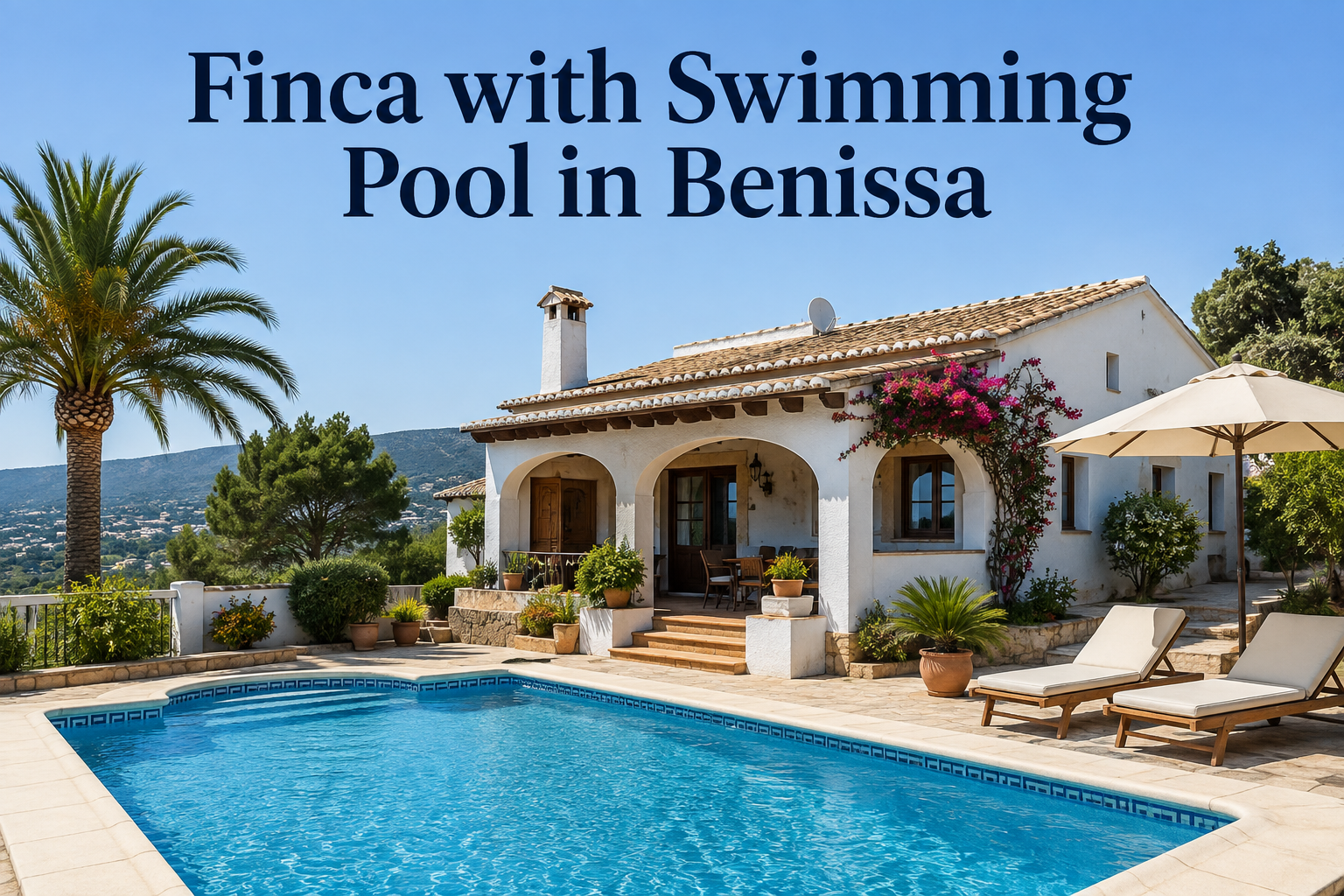
Finca with Swimming Pool in Benissa: Can You Build a Pool on Rustic Land?
A swimming pool in a finca in Benissa is one of the features many buyers actively look for. With the Mediterranean climate, outdoor lifestyle and countryside setting of the Costa Blanca North, a private pool can make a finca considerably more attractive as a permanent home, second home or holiday property.
But there is an important distinction between having a swimming pool and having a swimming pool that has been properly authorised and documented.
The same applies if you want to build one. Owning rustic land, even a relatively large plot, does not automatically mean that a new swimming pool can be constructed wherever you choose.
This matters particularly in Benissa because countryside properties can have very different planning circumstances. A finca in Benimarco may have a different planning situation from one in Pedramala, while a property closer to the coast can be affected by additional planning or environmental considerations. Even neighbouring properties are not necessarily subject to exactly the same rules.
Benissa's current municipal planning information is particularly important to check because the Ayuntamiento publishes the applicable planning instruments and modifications, while a new Plan General Estructural is also progressing through the planning process. In July 2026, the municipality announced the public exhibition of the initial version of that plan. This makes property-specific and up-to-date planning verification especially important rather than relying on an old map, estate-agent description or general rule of thumb.
At Telio Homes, we specialise in Benissa and the Costa Blanca North. From a property-buying perspective, one of the most important lessons with fincas is simple:
Never investigate the swimming pool in isolation from the rest of the property.
The house, pool, terraces, retaining walls, garages, summer kitchens, pergolas, plant rooms and other structures all form part of the due-diligence picture.
Key Takeaway
Buying a finca with a swimming pool in Benissa? Don't assume the pool is legal simply because it exists or appears in Catastro. Check the property's planning classification, municipal documentation and the relationship between the physical property and its official records before committing to the purchase.
Important: Planning legislation, municipal planning instruments and administrative procedures can change. This guide is intended as practical property information, not legal or architectural advice. For a specific finca or proposed pool, obtain current information from the Ayuntamiento de Benissa and, where appropriate, independent advice from a qualified architect, technical professional and property lawyer.
Table of Contents
-
Swimming Pools on Fincas in Benissa: What You Need to Know
-
Can You Build a Swimming Pool on Rustic Land in Benissa?
-
Does a Swimming Pool Need Planning Permission in Benissa?
-
Does the Size of the Finca Matter?
-
How to Check If a Swimming Pool on a Finca Is Legal
-
Catastro, Registro and Planning: What Is the Difference?
-
What If the Swimming Pool Was Built Without Permission?
-
Swimming Pool Setbacks and Other Planning Considerations
-
Buying a Finca With a Swimming Pool in Benissa
-
Finca Swimming Pool Buyer Due-Diligence Checklist
-
Real-Life Finca Swimming Pool Examples in Benissa
-
Does a Swimming Pool Increase the Value of a Finca in Benissa?
-
Costs to Consider When Owning a Finca With a Swimming Pool
-
Frequently Asked Questions About Finca Swimming Pools in Benissa
-
Final Thoughts: Buying a Finca With a Swimming Pool in Benissa
Swimming Pools on Fincas in Benissa: What You Need to Know
Can a Finca in Benissa Have a Swimming Pool?
Yes, a finca in Benissa can have a private swimming pool, but the important question is whether the particular property and pool comply with the planning regime applicable to that property.
For an existing pool, you need to establish how it was authorised, documented and recorded.
For a new pool, you need to establish whether the proposed project is compatible with the planning rules applying to the land and what municipal procedure and technical documentation are required.
An architect reviewing a proposed pool may need to consider:
-
the precise planning classification of the land;
-
the legal and planning status of the existing dwelling;
-
the location of the proposed pool;
-
applicable setbacks;
-
land occupation and other planning parameters;
-
protected or restricted areas;
-
roads and access;
-
watercourses and other infrastructure;
-
retaining walls and changes in ground levels;
-
terraces and associated structures;
-
the technical characteristics of the pool; and
-
the municipal procedure applicable to the works.
The important point is that “Can I build a pool?” is not answered simply by looking at the size of the plot.
What Does “Rustic Land” Mean in Benissa?
Property advertisements commonly use the term rustic land. In planning terminology, countryside land may fall within suelo no urbanizable, or non-developable land, but that does not mean all non-developable land is subject to exactly the same restrictions.
Benissa's planning information includes different planning instruments, modifications and categories affecting land throughout the municipality. The current municipal planning portal lists the existing planning framework and documents in progress, so the classification of an individual parcel should always be checked against the current official information.
This distinction is particularly relevant to properties in areas such as:
-
Benimarco;
-
Pedramala;
-
Fanadix;
-
Buenavista;
-
La Fustera;
-
San Jaime; and
-
other rural and residential parts of the municipality.
The fact that a property is described as a finca does not, by itself, tell you what can legally be built on the land.
Why the Planning Classification of the Property Matters
Planning classification determines the framework within which land can be used and developed.
The Valencian Texto Refundido de la Ley de Ordenación del Territorio, Urbanismo y Paisaje (TRLOTUP) establishes the regional planning framework, including provisions concerning suelo no urbanizable. The applicable municipal planning instruments then need to be considered alongside the regional framework.
The question is therefore not simply:
“Is this a 10,000 m² finca?”
It is:
“What is this particular parcel classified as, what planning rules apply to it, what existing development is legally established, and what do those rules permit at the proposed pool location?”
That is a much more useful question.
Why There Is No Single Rule for Every Finca
One of the most common mistakes buyers make is using a neighbouring property as proof of what they can do.
For example:
“The finca next door has a swimming pool, so ours can have one too.”
Not necessarily.
The neighbouring property may:
-
have a different planning classification;
-
have been developed under an earlier planning regime;
-
have a different planning history;
-
have a different parcel configuration;
-
be affected by different restrictions;
-
have an existing authorised building;
-
have an older pool with a different documentary history; or
-
itself contain undocumented works.
The existence of a pool next door is therefore useful as background information, but it is not evidence that your own proposed pool will be authorised.
Telio Homes Tip
When assessing a finca, treat the property as an individual planning case. Neighbouring properties can provide useful context, but they should never replace a property-specific planning investigation.
Can You Build a Swimming Pool on Rustic Land in Benissa?
Quick answer: A swimming pool may be possible on rustic land in Benissa, but there is no blanket rule allowing every finca to have one. The answer depends on the property's planning classification, the status of the existing dwelling, the proposed location and design of the pool, applicable planning parameters and any additional restrictions affecting the land.
Building a New Swimming Pool
If a finca does not currently have a pool, the first step should not be contacting pool companies for construction quotations.
The first step should be determining whether the project is planning-feasible.
A sensible process is:
-
Identify the exact cadastral parcel.
-
Establish the current planning classification.
-
Confirm the planning and documentary status of the existing house.
-
Check applicable municipal planning provisions and restrictions.
-
Identify any sectoral constraints affecting the proposed location.
-
Have an architect assess the proposed pool and associated works.
-
Establish the municipal procedure and technical documentation required.
-
Obtain the necessary authorisation before construction begins.
This sequence is particularly important on rustic land because the pool may involve more than the pool basin itself.
Excavation, retaining walls, changes in levels, terraces, drainage, plant rooms and access for construction machinery can all become relevant.
Existing Finca With a Swimming Pool
An existing pool creates a different question:
Under what authorisation was the pool built, and does the pool that exists today correspond with that authorisation?
A buyer should ideally establish:
-
when the pool was constructed;
-
whether it formed part of an approved project;
-
whether a separate authorisation was required;
-
whether its dimensions match the plans;
-
whether its position matches the approved documentation;
-
whether it has subsequently been enlarged or altered; and
-
whether associated structures were added later.
An older pool is not automatically illegal because paperwork is missing.
Equally, an old pool is not automatically legal because it has been there for many years.
The correct answer requires investigation of its individual history and current planning position.
Replacing or Renovating an Existing Pool
Replacing equipment is different from reconstructing or substantially altering the pool.
Routine maintenance may include:
-
replacing pumps;
-
replacing filters;
-
repairing equipment;
-
renewing finishes; or
-
maintaining existing installations.
More substantial works can involve:
-
changing the pool's footprint;
-
rebuilding the shell;
-
moving the pool;
-
changing surrounding levels;
-
constructing new retaining walls;
-
enlarging terraces; or
-
adding new structures.
Before major works begin, establish whether the proposed work requires municipal authorisation and whether the existing pool itself has a satisfactory planning history.
Enlarging an Existing Swimming Pool
An enlargement is particularly important because the physical footprint changes.
Suppose a finca has an existing 8 × 4 metre pool and the owner wants to make it 10 × 5 metres.
The question is not simply:
“Can the pool be made bigger?”
The project may need to consider:
-
the additional land occupied;
-
boundary setbacks;
-
ground levels;
-
excavation;
-
retaining structures;
-
terraces;
-
drainage;
-
protected areas;
-
access; and
-
the planning status of the existing pool.
An architect should assess the complete proposal before work starts.
Why You Should Check the Property Before Starting Any Work
The cheapest time to identify a planning problem is before construction.
Once concrete has been poured and associated structures built, the owner may be dealing with a retrospective planning problem rather than a straightforward construction project.
This can become especially complicated where the pool is only one part of a larger set of undocumented alterations.
Key Takeaway
Never assume that because a neighbouring finca has a swimming pool, the same pool can automatically be built on your property.
Does a Swimming Pool Need Planning Permission in Benissa?
Planning Permission and Municipal Requirements
A permanent swimming pool should be treated as a construction project, not simply as garden equipment.
The exact municipal procedure depends on the nature and location of the works and the planning regime applying to the property.
Benissa's Urban Planning Department is responsible for, among other functions, the management of licences and planning control. The municipality currently directs planning enquiries through its Urban Planning Department.
For a specific pool project, the correct procedure should therefore be confirmed with the Ayuntamiento rather than assumed from another property or from a general rule found online.
Why the Type of Land Matters
The planning position can be substantially different depending on whether the property is in an urbanised area, residential development or non-developable countryside.
For rustic properties, additional considerations can include:
-
agricultural land;
-
protected land;
-
landscape considerations;
-
forestry restrictions;
-
watercourses;
-
roads;
-
coastal restrictions;
-
infrastructure;
-
easements; and
-
other sectoral controls.
The Valencian planning framework specifically regulates development and uses on suelo no urbanizable, meaning that a rural property needs to be assessed within that framework rather than treated like an ordinary urban villa plot.
When a Technical Project May Be Required
The need for technical documentation depends on the works proposed and the applicable rules.
A pool project can involve:
-
excavation;
-
structural concrete;
-
retaining walls;
-
drainage;
-
electrical systems;
-
filtration;
-
technical rooms;
-
terraces;
-
changes to natural ground levels.
That is why a professional should assess the project before construction.
Do not assume that the label “small pool” or “renovation” determines the municipal procedure.
Why Requirements Can Differ Between Properties
Two properties with similar plot sizes may have very different planning circumstances.
For example:
Finca A
-
established residential use;
-
straightforward planning classification;
-
suitable pool location;
-
no obvious sectoral constraints.
Finca B
-
similar plot size;
-
different planning classification;
-
road restriction;
-
sloping terrain;
-
potential protected-area issue.
The two properties cannot safely be treated as identical.
Why Verbal Confirmation Is Not Enough
Statements such as:
“The builder says it is allowed.”
or:
“The previous owner had a pool.”
are not substitutes for formal planning due diligence.
If the ability to build a pool is important to the purchase, make the question part of your pre-purchase investigation.
Ask the appropriate professional to establish:
-
what the planning classification is;
-
what rules apply;
-
whether the proposed pool appears compatible;
-
what documentation is needed; and
-
what municipal procedure should be followed.
Important
If you would not buy the finca without being able to build a pool, investigate the pool before becoming unconditionally committed to the purchase, rather than assuming you can deal with it after completion.
Does the Size of the Finca Matter?
Plot Size and Residential Construction
Plot size can be important, particularly when considering residential development on non-developable land.
The Valencian planning framework contains specific requirements for isolated family dwellings on non-developable land, including a minimum plot reference of one hectare in the relevant provisions.
This is one reason the 10,000 m² figure appears so frequently in discussions about rustic property in the Costa Blanca.
But it is essential to understand what the figure does — and does not — mean.
Why Plot Size Does Not Automatically Answer the Pool Question
A 10,000 m² plot does not automatically mean:
-
you can build a new house;
-
you can build a swimming pool;
-
you can position a pool wherever you want;
-
all existing structures are legal;
-
the property is free from protected-land restrictions; or
-
no additional planning investigation is required.
Plot size is only one part of the planning analysis.
The Importance of the Property's Planning Classification
Before asking how many square metres the property has, ask:
What planning classification applies to the parcel?
Then establish:
What does the applicable planning framework allow on that land?
Only then should the precise pool design and location be considered.
This is particularly important because Benissa's planning framework is evolving. The municipality currently publishes existing planning instruments and modifications while a new Plan General Estructural is progressing through the planning process.
Why Buyers Should Not Rely on the “10,000 m² Rule” Alone
The phrase “10,000 m² rule” is often used as though it were a universal answer to every countryside property question.
It is not.
The relevant question is always:
10,000 m² of what planning classification, with what existing development, subject to what restrictions and for what proposed use?
Common Mistake — “The plot is over 10,000 m², so everything is fine.”
A large plot may be an important advantage, but it does not automatically establish the right to build a house, swimming pool or other structures.
How to Check If a Swimming Pool on a Finca Is Legal
There is rarely one document that answers every question.
Good due diligence means comparing several sources.
A useful framework is:
Documents → planning → Catastro → Registro → physical reality
Check the Escritura
The escritura can provide important information about the property and buildings included in the transaction.
Look for:
-
property description;
-
plot area;
-
buildings;
-
declarations of new construction;
-
later alterations;
-
references to ancillary structures.
However, the absence of a pool from a particular deed is not, by itself, proof that the pool is illegal.
It is one piece of the investigation.
Check the Nota Simple
Obtain an up-to-date Nota Simple from the Registro de la Propiedad.
Review:
-
registered owner;
-
registered property description;
-
registered buildings;
-
plot information;
-
charges and encumbrances;
-
annotations;
-
relevant planning references.
Spanish land legislation also provides for certain planning acts and urban-discipline matters to be reflected in the Property Registry.
The Registro is therefore an important part of due diligence, but it is not a replacement for checking municipal planning records.
Check Catastro
The Catastro can be extremely useful for countryside property.
Depending on the property, cadastral information can help you understand:
-
the cadastral parcel;
-
boundaries;
-
buildings;
-
construction areas;
-
physical features;
-
pool information;
-
cadastral references.
The official Catastro explains that its coordination with the Registro is intended to provide greater certainty concerning the location, boundaries and surface area of registered properties. It also provides tools for obtaining cadastral information about buildings and, in certain circumstances, swimming pools.
But this distinction is crucial:
A pool appearing in Catastro does not automatically prove that the pool has full planning authorisation.
Check Existing Planning Documentation
Request whatever documentation exists for the property, which may include:
-
building licences;
-
approved projects;
-
technical plans;
-
completion documentation;
-
declarations of new construction;
-
pool documentation;
-
later alteration licences;
-
legalisation documentation;
-
technical certificates.
Then compare the documentation with the property.
Check Municipal Records
The Ayuntamiento is central to investigating the planning history of the property.
Benissa's Urban Planning Department manages licences and planning control, and the municipality publishes its planning instruments and modifications through its planning portal.
Where the documentation is unclear, your lawyer or architect may need to investigate the relevant municipal file.
The purpose is to establish whether the pool:
-
formed part of an approved project;
-
was authorised separately;
-
was later modified;
-
was subject to legalisation;
-
or simply does not appear in the available planning history.
Check the Current Planning Classification
Do not rely solely on the planning classification shown in an old estate-agent document.
Check the current municipal planning information applicable to the parcel.
This is particularly important while Benissa's planning framework is being updated.
The municipality's current planning portal identifies the existing PGOU framework and modifications as well as planning documents in progress, including the new Plan General Estructural.
Compare the Documents With the Physical Property
This is one of the most important steps.
Walk around the property and compare:
What exists → what is on the plans → what is in Catastro → what is registered → what the municipal file shows.
Look at:
-
house dimensions;
-
pool dimensions;
-
pool location;
-
terraces;
-
retaining walls;
-
garages;
-
storage buildings;
-
summer kitchens;
-
pergolas;
-
plant rooms;
-
external bathrooms;
-
other extensions.
A property can have a perfectly documented swimming pool but undocumented structures elsewhere.
Get Professional Confirmation Where Necessary
If there is a material discrepancy, do not guess what it means.
An architect or other appropriately qualified technical professional can investigate the physical and planning aspects.
A property lawyer can assess the legal and contractual implications.
These professionals perform different roles and should not be treated as interchangeable.
Telio Homes Tip
In our experience with countryside property, the pool is often only the first question. Once documentation is compared with the physical property, buyers may also discover discrepancies involving terraces, retaining walls, garages, summer kitchens or extensions. Review the whole property rather than trying to solve one structure in isolation.
Catastro, Registro and Planning: What Is the Difference?
International buyers sometimes assume that if a swimming pool appears in an official database, it must therefore be legal.
That is not how the different systems work.
| Source | What It Can Tell You | What It Does Not Automatically Prove |
|---|---|---|
| Catastro | Cadastral parcel, mapping and physical/economic information, including information about constructions | Full planning legality |
| Registro de la Propiedad | Registered ownership, rights, charges and registered property description | Complete planning compliance of everything physically present |
| Ayuntamiento | Municipal planning information, licences and planning files | Ownership by itself |
| Physical inspection | What actually exists on the land | Whether construction was authorised |
What Catastro Shows
Catastro is an administrative property database with an important cadastral and fiscal role.
Its information is particularly useful when comparing the official parcel with the physical property.
The official Catastro also provides tools for cadastral building information and explains how Catastro and Registro can be coordinated.
However:
“The pool is in Catastro, therefore it is legal” is not a sufficient planning conclusion.
What the Registro de la Propiedad Shows
The Registro deals primarily with registered property rights and the registered description of the finca.
It can provide important information about:
-
ownership;
-
mortgages;
-
easements;
-
registered buildings;
-
charges;
-
planning-related annotations and other matters affecting the registered property.
Spanish land legislation also establishes mechanisms for registering certain urban-planning acts and planning-discipline matters.
But registration should not be confused with municipal planning authorisation.
What Municipal Planning Records Show
The municipal planning file can answer questions that Catastro and Registro cannot.
For example:
-
Was a project approved?
-
Was a licence issued?
-
Was a later alteration authorised?
-
Is there a planning or enforcement file?
-
What planning conditions apply?
This is why the Ayuntamiento is so important when investigating a pool.
Why One Database Does Not Prove Everything Is Legal
Think of the systems as answering different questions:
Catastro: What is recorded cadastrally?
Registro: What property rights and descriptions are registered?
Ayuntamiento: What planning framework and municipal authorisations apply?
Physical inspection: What is actually there?
The strongest due diligence compares all four.
Quick Answer
A swimming pool appearing in Catastro or the Registro does not, by itself, prove complete planning legality. A proper investigation compares cadastral and registered information with municipal planning records, available licences and plans, and the physical property.
What If the Swimming Pool Was Built Without Permission?
Undocumented Does Not Always Mean the Same Thing as Illegal
This distinction is important.
The following statements do not necessarily mean the same thing:
-
“The pool isn't mentioned in the Nota Simple.”
-
“The pool isn't shown in the documents supplied by the seller.”
-
“The pool isn't shown in Catastro.”
-
“We cannot find the original licence.”
-
“The pool was built without the required authorisation.”
Each situation requires investigation.
For some older constructions, the relevant legal position can depend on the date of construction, the applicable planning regime, municipal records, whether enforcement action exists and whether the law permits particular forms of registration or regularisation.
The Spanish Land and Urban Rehabilitation Act contains specific rules concerning declarations of completed works where enforcement measures leading to demolition are no longer available because applicable limitation periods have expired. However, this is not the same as saying that an undocumented construction automatically becomes fully legal.
How Unauthorised Pools Can Become a Problem
An unresolved pool can create difficulties when:
-
buying;
-
selling;
-
obtaining finance;
-
updating the property's documentation;
-
carrying out additional works;
-
dealing with municipal planning;
-
insuring the property; or
-
negotiating with a future buyer.
The problem may remain invisible for years and only become obvious when the property enters a transaction.
Can an Existing Pool Be Legalised?
Sometimes a legalisation or regularisation route may be available.
Sometimes it may not.
The answer depends on the particular property and the applicable law.
A professional investigation may need to establish:
-
what was built;
-
when it was built;
-
what documentation exists;
-
what planning rules applied at the relevant time;
-
what rules apply today;
-
whether enforcement action exists;
-
whether the present construction is compatible with planning requirements; and
-
what procedure, if any, is available.
Never assume that paying an administrative fee automatically makes an unauthorised pool legal.
Why Buyers Should Investigate Before Signing
If a pool is important to your purchase, establish its status as early as possible.
Depending on the circumstances, unresolved discrepancies can affect:
-
the purchase price;
-
the offer;
-
contractual conditions;
-
financing;
-
completion timing;
-
future resale; and
-
whether you decide to proceed.
Your independent lawyer should advise on how any identified issue should be dealt with contractually.
Potential Problems When Selling the Property Later
A pool that is ignored today can become a buyer's objection tomorrow.
This is why sellers should consider reviewing documentation before marketing the property, particularly where the finca has been altered over many years.
Warning
Do not wait until a buyer's lawyer discovers a pool or building discrepancy shortly before completion. If you are selling a finca, identifying documentation issues early gives you more time to investigate and resolve them where possible.
Swimming Pool Setbacks and Other Planning Considerations
Distance From Property Boundaries
Setbacks can be an important consideration when planning a pool on rustic land.
However, the correct setback should be established from the currently applicable planning rules for the specific property, not from a generic Costa Blanca rule.
Historical Benissa planning documentation contains specific provisions concerning swimming-pool positioning, but the municipality's current planning framework and modifications must be checked before relying on any historical numerical parameter. Benissa is also progressing a new Plan General Estructural, making current verification particularly important.
For that reason, this article deliberately does not present an old numerical setback as a universal current rule.
Distance From Roads and Other Infrastructure
A rural finca may adjoin:
-
a public road;
-
a rural road;
-
a track;
-
utility infrastructure;
-
a watercourse;
-
protected land; or
-
another restricted corridor.
These can introduce additional constraints.
A pool that appears to fit comfortably within the property boundary may still be affected by restrictions related to the road or infrastructure beside it.
Protected Land and Other Restrictions
Particular care is required where land is affected by:
-
environmental protection;
-
forestry restrictions;
-
landscape protection;
-
coastal planning;
-
watercourses;
-
hydraulic restrictions;
-
infrastructure;
-
easements;
-
other sectoral planning controls.
Benissa's planning information includes different planning instruments and protected areas, while regional planning law also establishes restrictions and controls for non-developable land.
The relevant question is therefore not:
“Is there protected land somewhere in Benissa?”
It is:
“Is this particular parcel, or the proposed pool location, affected by a relevant restriction?”
Pool Terraces
The pool basin is only one part of the project.
A pool terrace can involve:
-
paving;
-
excavation;
-
filling;
-
changes to natural ground levels;
-
retaining walls;
-
drainage;
-
access.
On a sloping finca, these works can become particularly significant.
A project that looks simple in a photograph may involve substantial earthworks once construction begins.
Pool Houses and Technical Rooms
A plant room or technical building should not be treated as an invisible part of the pool.
It is a physical structure and needs to be considered as part of the overall project.
The same applies to:
-
storage rooms;
-
outdoor bathrooms;
-
covered structures;
-
pool bars;
-
summer kitchens;
-
substantial pergolas.
Outdoor Kitchens and Other Pool Structures
A pool area can gradually evolve into:
Pool + terrace + shower + pergola + barbecue + summer kitchen + bathroom + storage + retaining walls.
Each additional element may have its own planning implications.
This is why an architect should assess the complete proposed pool area, not just the swimming pool dimensions.
Sloping Ground and Retaining Walls
Benissa's countryside includes properties with significant changes in elevation.
A pool on a hillside may require:
-
excavation;
-
retaining walls;
-
reinforced structures;
-
changes in finished levels;
-
drainage;
-
additional access works.
These can have planning implications beyond the pool itself.
Access for Construction Machinery
A practical issue that is easy to overlook is construction access.
Some fincas have:
-
narrow rural roads;
-
steep access;
-
tight gates;
-
stone walls;
-
neighbouring boundaries;
-
limited turning areas.
A pool may be technically feasible but considerably more difficult or expensive to construct if excavators, concrete lorries or other machinery cannot reach the proposed location easily.
This should be considered before a project budget is finalised.
Telio Homes Tip
When viewing a finca, look beyond the water. Ask how the pool was built, where the equipment is housed, how the terrace was created, where drainage goes and whether retaining walls or other structures form part of the installation.
Buying a Finca With a Swimming Pool in Benissa
What Should You Check Before Making an Offer?
Before making an unconditional commitment, establish at least:
-
the exact property and cadastral parcel;
-
planning classification;
-
https://www.teliohomes.com/en/blog/benissa-property-guide-is-my-property-legal-in-spain/legal status of the house;
-
registered property description;
-
cadastral information;
-
pool documentation;
-
physical dimensions and position of the pool;
-
documentation for terraces and other structures;
-
any known planning discrepancies;
-
water supply;
-
access and topography.
If the ability to build a new pool is essential to your decision, investigate that before assuming the project is possible.
What Documents Should You Request?
Useful documents can include:
| Document | Why It Matters |
|---|---|
| Escritura | Helps establish the documentary history and description of the property |
| Current Nota Simple | Shows current registered information |
| Cadastral information | Helps compare cadastral data with the physical property |
| Building licence | Evidence concerning authorised construction |
| Approved plans | Allows comparison with the current property |
| Pool documentation | Helps establish the pool's planning history |
| Completion documentation | Helps establish how authorised works were completed |
| Legalisation documentation | Relevant where previous discrepancies were regularised |
| Municipal planning information | Helps establish the applicable planning context |
| Technical report | Useful where the physical property does not clearly match the documents |
Not every finca will have every document.
Older rural properties can have complicated documentary histories. The absence of one document should therefore trigger investigation rather than an automatic conclusion.
Questions to Ask the Seller
Ask:
When was the pool built?
Was it included in the original house project?
Do you have the pool licence or approved plans?
Has the pool ever been enlarged or reconstructed?
Have the terrace, plant room or surrounding structures been added later?
Has an architect reviewed the property?
Are you aware of any planning discrepancies?
A seller who cannot immediately answer every question is not necessarily hiding something. Older properties often have incomplete records.
The important point is that unanswered questions should be investigated before the purchase becomes difficult to unwind.
Questions to Ask the Estate Agent
Ask whether the agency has:
-
reviewed the property's cadastral reference;
-
compared advertised areas with available documentation;
-
seen pool documentation;
-
identified known discrepancies;
-
requested supporting documentation from the seller;
-
identified later extensions or structures.
An estate agent should not replace your lawyer or architect.
However, a specialist local agent should recognise when a property requires additional investigation and help ensure the appropriate questions are raised early.
When Should You Involve an Architect?
Consider involving an architect early if:
-
the pool documentation is missing;
-
plans do not match reality;
-
you want to build a new pool;
-
you want to enlarge an existing pool;
-
retaining walls are involved;
-
the property is on steep ground;
-
additional structures are undocumented;
-
the land is rustic;
-
planning classification is unclear; or
-
the proposed pool is fundamental to your purchase decision.
When Should You Involve a Lawyer?
Your independent property lawyer should review the legal documentation and advise you on the transaction.
The lawyer and architect have different roles.
Architect / technical professional:
What physically exists? What was authorised? What appears technically and planning-wise possible?
Property lawyer:
What are you legally buying? What risks exist? What contractual protection may be appropriate?
Using both can be particularly valuable with rustic properties.
What About Water Supply?
Water deserves specific attention when buying a finca with a swimming pool.
Ask:
-
Is the property connected to mains water?
-
Does it use a water deposit?
-
Is there another private supply arrangement?
-
How is the pool normally filled?
-
Are there any known restrictions or practical limitations?
-
Is the water infrastructure documented?
The answer can materially affect the practical cost and maintenance of the property.
Do not assume that because a pool is already full on viewing day, its water supply is straightforward.
What About Drainage and Emptying the Pool?
Ask where water goes when the pool is:
-
emptied;
-
partially drained;
-
backwashed;
-
repaired; or
-
maintained.
On rural property, drainage arrangements deserve particular attention.
A buyer should not assume that water can simply be discharged anywhere on the land.
Telio Homes Tip
The most useful question is often not “Does the finca have a pool?” but “Can I demonstrate how the pool, house and surrounding structures came to exist and whether today's property corresponds with the documentation?”
Finca Swimming Pool Buyer Due-Diligence Checklist
Before buying a Benissa finca with a swimming pool:
-
Confirm the exact cadastral parcel.
-
Confirm the current planning classification.
-
Confirm the legal and planning status of the house.
-
Obtain an up-to-date Nota Simple.
-
Review the escritura.
-
Check Catastro.
-
Request available pool licences and approved plans.
-
Check municipal planning information.
-
Compare the pool dimensions with the documentation.
-
Compare the pool's physical location with the plans.
-
Check boundary and road relationships.
-
Investigate protected or restricted areas where relevant.
-
Check terraces and retaining walls.
-
Check pool plant rooms and technical structures.
-
Check outdoor kitchens, pergolas, bathrooms and storage buildings.
-
Investigate any discrepancy between documents and physical reality.
-
Check how the property receives water.
-
Ask how the pool is filled and maintained.
-
Consider drainage and pool-emptying arrangements.
-
Assess construction access if you intend to build or enlarge the pool.
-
Obtain technical advice where necessary.
-
Obtain independent legal advice before committing to the purchase.
Real-Life Finca Swimming Pool Examples in Benissa
The following examples are anonymised scenarios illustrating the types of questions that can arise with Benissa countryside property. They are not descriptions of individual transactions or legal precedents.
Example 1: Finca With a Fully Documented Pool
A buyer finds a countryside finca in Benissa with:
-
an established house;
-
private pool;
-
terrace;
-
garden;
-
supporting structures.
The seller supplies the relevant title documentation, current Nota Simple, cadastral information and available planning documentation.
The architect compares the plans with the physical property and finds that the pool and principal structures correspond with the documentation.
This is the straightforward scenario.
The buyer's lawyer can then continue with the normal legal due-diligence process.
Lesson
Good documentation reduces uncertainty.
It does not eliminate the need for legal due diligence, but it makes the property much easier to understand.
Example 2: Finca With an Existing but Undocumented Pool
A buyer views a finca in the Benimarco area.
The pool is clearly established and appears well maintained.
The seller says:
“It has been here for years.”
But no pool documentation is immediately available.
The correct response is neither:
“It's old, so it must be fine.”
nor:
“It's illegal.”
Instead, the buyer's professionals investigate:
-
the age of the pool;
-
municipal records;
-
available planning documentation;
-
Catastro;
-
Registro;
-
physical dimensions;
-
current planning circumstances.
Lesson
An undocumented pool is a question to investigate, not an automatic legal conclusion.
Example 3: Buyer Wants to Build a New Pool on a Large Finca
A buyer finds a large countryside property near Pedramala.
The plot is substantial and there is already a house.
The buyer wants to build a pool immediately after completion.
The temptation is to assume:
“The plot is large enough.”
Instead, the architect checks:
-
current planning classification;
-
legal status of the house;
-
proposed pool position;
-
setbacks;
-
topography;
-
access;
-
retaining-wall requirements;
-
drainage;
-
associated structures;
-
other restrictions affecting the land.
Lesson
A large plot can improve the possibilities, but it does not answer the planning question by itself.
Example 4: Pool Appears in Catastro but Documentation Is Unclear
A buyer notices that the swimming pool appears in cadastral information.
The seller therefore says:
“It is legal because it is in Catastro.”
The buyer continues investigating.
This is the correct approach.
Catastro and Registro have an important coordination system, but that does not make the cadastral database a substitute for municipal planning authorisation.
Lesson
Cadastral presence is evidence of cadastral information, not a universal planning certificate.
Example 5: Finca With Pool, Terrace and Additional Structures
A finca contains:
-
main house;
-
swimming pool;
-
large terrace;
-
barbecue;
-
summer kitchen;
-
storage building;
-
pergola;
-
retaining walls.
The pool itself corresponds with an old project.
Several surrounding structures do not clearly correspond.
Lesson
The pool may not be the problem. The wider property may be.
This is why a proper inspection should cover the entire built environment.
Example 6: Sloping Finca With a Proposed Pool
A buyer finds a countryside property with excellent views and wants an infinity-style pool.
The proposed position sits below the house on a significant slope.
The project may require:
-
excavation;
-
retaining walls;
-
structural works;
-
drainage;
-
substantial earth movement;
-
machinery access.
Lesson
A visually simple pool can become a technically complex construction project when the land is steep.
Example 7: Existing Pool to Be Enlarged
A finca has a 8 × 4 metre pool.
The buyer wants a 10 × 5 metre pool with a larger terrace.
The additional works change:
-
the pool footprint;
-
the amount of excavation;
-
the surrounding terrace;
-
potentially the relationship with boundaries;
-
the project's construction requirements.
Lesson
Enlarging an existing pool should be treated as a new planning and technical question, not merely a cosmetic alteration.
Does a Swimming Pool Increase the Value of a Finca in Benissa?
Why Buyers Value Private Pools
A private swimming pool is an important lifestyle feature for many buyers looking at Benissa property.
This is particularly relevant for:
-
second homes;
-
holiday properties;
-
family homes;
-
countryside fincas;
-
properties marketed to international buyers.
A pool can strengthen a property's market appeal because it supports the outdoor lifestyle associated with the Costa Blanca.
Pool Condition and Property Value
Not every pool contributes equally to the property's appeal.
Buyers will notice:
-
cracked finishes;
-
leaking structures;
-
outdated equipment;
-
poor filtration;
-
damaged coping;
-
unattractive terraces;
-
poor access;
-
excessive shade;
-
neglected surroundings.
A well-positioned and maintained pool can be a strong selling feature.
A neglected pool can instead become a negotiating point.
Legal Documentation and Buyer Confidence
Documentation also matters.
A buyer is in a much stronger position when the seller can clearly demonstrate:
-
what was built;
-
when it was built;
-
what was authorised;
-
what appears in the relevant records;
-
that the physical property corresponds with the documentation.
The pool itself may look identical from the garden.
The transaction can feel completely different when the paperwork is clear.
Swimming Pools and Holiday-Home Appeal
Benissa attracts international buyers looking for second homes and holiday properties.
For these buyers, the outdoor environment can be as important as the interior.
Fincas in areas such as Benimarco and Pedramala can offer privacy, gardens, open countryside and views, making the pool area an important part of the overall property proposition.
Properties in areas such as La Fustera, San Jaime, Fanadix and Buenavista have different planning and urbanisation contexts, but a private pool is similarly important to many villa buyers.
Does Every Pool Add the Same Value?
No.
There is no responsible universal percentage that can be applied to every Benissa property.
The pool's contribution depends on:
-
location;
-
property type;
-
price range;
-
condition;
-
privacy;
-
views;
-
orientation;
-
pool design;
-
terrace quality;
-
garden;
-
documentation;
-
buyer demand.
A pool should therefore be assessed as part of the whole property, not valued using a generic percentage uplift.
If you are considering selling, a professional property valuation should take the complete property, location and current market into account.
Costs to Consider When Owning a Finca With a Swimming Pool
A swimming pool is an asset, but it also creates ongoing costs.
Pool Maintenance
Regular maintenance can include:
-
cleaning;
-
water testing;
-
chemical treatment;
-
filtration;
-
equipment inspection;
-
seasonal preparation.
The frequency depends on usage, pool design and equipment.
Electricity
Electricity may be required for:
-
pumps;
-
filtration;
-
lighting;
-
heating;
-
automatic cleaning systems;
-
other equipment.
Consumption depends heavily on the equipment and operating schedule.
Water
Water is required for:
-
initial filling;
-
topping up;
-
maintenance;
-
cleaning.
For a finca, the property's water supply deserves particular attention.
A buyer should understand whether the property has:
-
mains water;
-
a deposit;
-
another private supply;
-
a combination of systems.
Cleaning and Equipment
Regular expenditure may include:
-
pool cleaning;
-
chemicals;
-
filters;
-
pumps;
-
automatic cleaners;
-
replacement components.
Repairs and Renovation
Older pools may eventually require:
-
resurfacing;
-
waterproofing;
-
new coping;
-
filtration replacement;
-
pump replacement;
-
pipe repairs;
-
structural repairs;
-
terrace renovation.
Potential Professional and Administrative Costs
If you build, enlarge, substantially alter or investigate the legal status of a pool, additional professional or administrative costs may arise.
Depending on the project, these can include:
-
architect or technical professional;
-
surveys;
-
technical documentation;
-
municipal procedures;
-
legal advice;
-
specialist reports.
Because project requirements vary, current quotations should be obtained for the specific property rather than relying on generic online figures.
| Cost | What It Covers | Frequency |
|---|---|---|
| Cleaning | Routine pool maintenance | Regular |
| Water treatment | Maintaining water quality | Regular |
| Electricity | Pumps, filtration and equipment | Ongoing |
| Water | Filling and topping up | As required |
| Equipment servicing | Pumps, filters and associated systems | Periodic |
| Repairs | Equipment or structural problems | As required |
| Renovation | Major refurbishment | Occasional |
| Professional/administrative costs | Technical advice, projects and procedures | When required |
5 Red Flags When Viewing a Finca With a Swimming Pool
1. Pool documentation cannot be produced
Missing paperwork does not automatically prove illegality, but it means the pool's history needs to be investigated.
2. The pool appears considerably newer than the house
Ask when it was constructed and whether it formed part of an approved project.
3. Pool dimensions do not match the plans
This may indicate an enlargement or later alteration.
4. Additional structures are undocumented
Check:
-
terraces;
-
retaining walls;
-
summer kitchens;
-
pergolas;
-
plant rooms;
-
storage buildings;
-
outdoor bathrooms.
5. The seller says, “It's legal because it's in Catastro”
Catastro is useful evidence, but cadastral information should not be treated as a universal planning authorisation.
Frequently Asked Questions About Finca Swimming Pools in Benissa
Can you build a swimming pool on rustic land in Benissa?
Potentially, yes. The answer depends on the property's precise planning classification, the status of the existing dwelling, the proposed location and characteristics of the pool and any other restrictions affecting the land. Current planning information and, where necessary, professional technical advice should be obtained before proceeding.
Do I need permission to build a pool on a finca?
A permanent in-ground swimming pool should be treated as a construction project requiring the appropriate municipal procedure. The exact authorisation and technical documentation depend on the project and property and should be confirmed with the Ayuntamiento de Benissa and your architect.
Does a 10,000 m² plot automatically allow a swimming pool?
No.
The one-hectare figure is relevant to certain aspects of residential development on non-developable land, but plot size alone does not create an automatic right to construct a house or swimming pool. The planning classification, existing development and other applicable restrictions must also be considered.
Can I build a pool if the finca already has a legal house?
The existence of a legally established house can be an important part of the planning analysis, but it does not automatically answer whether a new pool can be constructed. The proposed pool still needs to be assessed against the applicable planning framework and its specific location and design.
Can I build a pool if the house itself is not fully documented?
This requires particular caution.
The legal and planning status of the house should be established before assuming that a new pool can be added. A technical and legal review should determine whether unresolved issues with the existing dwelling affect the proposed project.
Can I build a pool on protected rustic land?
Do not assume that all rustic land has the same rules.
If a parcel is affected by protected land, coastal, environmental, forestry, hydraulic or other restrictions, additional controls may apply. The precise parcel and proposed location need to be checked against the applicable planning and sectoral regulations.
Can I build a pool next to a rural road in Benissa?
Possibly, but the relevant road and planning restrictions need to be checked.
The distance from the pool to a road may be subject to rules that are separate from ordinary property-boundary setbacks.
Can I build a pool on a sloping finca?
Potentially, but the technical and planning implications can be considerably greater.
Excavation, retaining walls, changes in ground levels, drainage and access for construction machinery can all become relevant.
Can I buy a finca with an existing swimming pool?
Yes. Many Benissa properties have existing private pools.
The important point is to investigate the pool's planning and documentary status before completing the purchase.
How can I check if a swimming pool is legal?
Compare:
-
the escritura;
-
the Nota Simple;
-
Catastro;
-
available licences and approved plans;
-
municipal planning records;
-
the current planning classification; and
-
the physical property.
Where there is a discrepancy, obtain appropriate professional advice.
Does the pool need to appear in Catastro?
Material differences between cadastral information and the physical property should be investigated.
However, cadastral information and planning authorisation are different matters. Catastro itself explains that its coordination with the Registro concerns matters such as geographical location, boundaries and surface area.
Does the pool need to appear in the Registro de la Propiedad?
Whether and how a pool or associated construction should be reflected in the registered property description depends on the circumstances and documentation.
Your lawyer should advise on the particular property.
The absence of a pool from a Nota Simple should not be treated as the only test of legality, just as its appearance there should not be treated as the only test of planning compliance.
What happens if the pool was built without permission?
The consequences depend on the pool's history, age, applicable planning rules, municipal records and whether enforcement or other proceedings exist.
Some existing constructions may have routes for particular forms of registration or regularisation, but an undocumented pool should not automatically be assumed to be legalisable.
Can an existing pool be legalised?
Potentially, in some circumstances.
The possibility depends on the applicable planning and legal regime, the date and nature of the works, the current planning position and other factors.
Professional advice is essential before assuming a legalisation route exists.
Can I enlarge an existing pool?
Possibly, but enlarging a pool changes the physical development.
The proposed footprint, setbacks, excavation, retaining walls, terraces and other associated works should be checked before construction.
Are there minimum distances from boundaries?
Planning rules can establish setbacks, but the applicable current requirement should be confirmed for the specific Benissa property.
Do not rely on a generic Spain-wide figure or an old planning document without checking the current rules.
Can I fill a finca swimming pool from a water deposit?
The practical answer depends on the property's water system.
Before buying, establish how the property obtains water, what storage facilities exist and how the pool is normally filled and maintained.
Where can I empty a finca swimming pool?
Do not assume that pool water can simply be discharged onto the land.
The appropriate drainage arrangement should be established for the property and the proposed work, particularly where the finca has rural drainage, slopes, watercourses or other environmental constraints.
How much does a swimming pool cost in Benissa?
There is no useful single figure.
Costs vary according to:
-
pool size;
-
excavation;
-
ground conditions;
-
access;
-
retaining walls;
-
finishes;
-
filtration;
-
equipment;
-
terraces;
-
drainage;
-
professional services.
A current quotation based on a defined project is much more reliable than a generic online estimate.
Does a swimming pool increase the value of a finca?
A good private pool can improve market appeal, particularly for holiday homes and second homes, but there is no universal percentage increase.
Condition, design, location, views, privacy, outdoor space, documentation and buyer demand all influence the pool's contribution to value.
Can a bank finance a finca with an undocumented swimming pool?
An undocumented pool does not automatically mean that a bank will refuse finance, but discrepancies can create additional questions during valuation, legal due diligence or mortgage processing.
If financing is important, identify documentation issues early and discuss them with your lawyer, mortgage adviser and lender where appropriate.
Should I investigate the pool before signing a reservation contract?
If the pool is material to your decision, it is sensible to raise the issue before becoming contractually committed.
Your lawyer should advise on the appropriate level of due diligence and whether contractual protection is required.
What should I check before buying a finca with a pool?
At minimum, check:
-
planning classification;
-
house legality;
-
pool documentation;
-
municipal planning information;
-
Catastro;
-
Registro;
-
physical dimensions;
-
pool location;
-
terraces;
-
retaining walls;
-
ancillary structures;
-
water supply;
-
drainage;
-
any discrepancies between documents and reality.
Final Thoughts: Buying a Finca With a Swimming Pool in Benissa
A swimming pool in a finca in Benissa can be one of the property's greatest attractions.
For many buyers, it represents exactly what they are looking for in the Costa Blanca North: outdoor living, privacy, summer entertaining and a place to enjoy the Mediterranean climate.
But the pool should never be considered simply as a lifestyle feature.
For a buyer, it is also part of the property's planning, legal and technical due diligence.
The five principles worth remembering are:
1. Existence is not proof of authorisation
A pool can exist physically without the available documentation clearly establishing how it was authorised.
2. Catastro is not the same as planning permission
Cadastral information is valuable, but it should be considered alongside municipal planning records and the physical property.
3. The 10,000 m² figure is not a universal pool rule
Plot size matters, but classification, existing development and other planning restrictions matter too.
4. The whole property needs to be reviewed
The pool, house, terraces, retaining walls, garages, summer kitchens, pergolas and other structures should be considered together.
5. Investigate before you commit
If the pool is an important reason for buying the finca, establish its status — or the feasibility of constructing one — before the transaction reaches a point where changing your mind becomes difficult.
Benissa's planning framework is also not static. The municipality currently publishes its existing planning instruments and modifications while a new Plan General Estructural is progressing through the planning process. This makes current, parcel-specific verification particularly important.
Buying or Selling a Finca With a Swimming Pool?
At Telio Homes, we specialise in Benissa and the Costa Blanca North.
If you are buying a finca, our role is not to replace your independent lawyer or architect. It is to help you understand the property, identify the questions that need to be answered and make sure important issues are raised early in the transaction.
If you are selling a finca, reviewing documentation before marketing can also be valuable. A pool, extension or terrace discrepancy discovered before the property goes to market gives the seller considerably more time to investigate than a problem discovered immediately before completion.
If you are considering buying or selling a finca with a swimming pool in Benissa, you can contact Telio Homes in Benissa to discuss the property and the practical questions that should be considered.
This article is intended as general property information and should not be treated as legal, tax, planning or architectural advice. Planning legislation, municipal planning instruments and administrative procedures may change. For a specific property or proposed swimming-pool project, obtain current advice from the relevant authority and appropriately qualified independent professionals.
Authoritative Sources
Ajuntament de Benissa — Urban Planning
Benissa's Urban Planning Department is responsible for planning control and the management of licences and activities. The municipality's planning portal also publishes planning instruments, modifications and documents currently in progress.
Ajuntament de Benissa — Urban Planning
Valencian Planning Legislation — TRLOTUP
The Decreto Legislativo 1/2021, approving the consolidated text of the Valencian law on territorial planning, urbanism and landscape, provides the regional planning framework relevant to non-developable land.
BOE — Decreto Legislativo 1/2021
Dirección General del Catastro
The official Catastro explains the coordination system between Catastro and the Registro de la Propiedad and provides tools for cadastral and building information.
Dirección General del Catastro — Catastro/Registro Coordination
Spanish Land and Urban Rehabilitation Act
The Real Decreto Legislativo 7/2015 contains provisions concerning declarations of new construction and the registration of certain planning and urban-discipline matters.