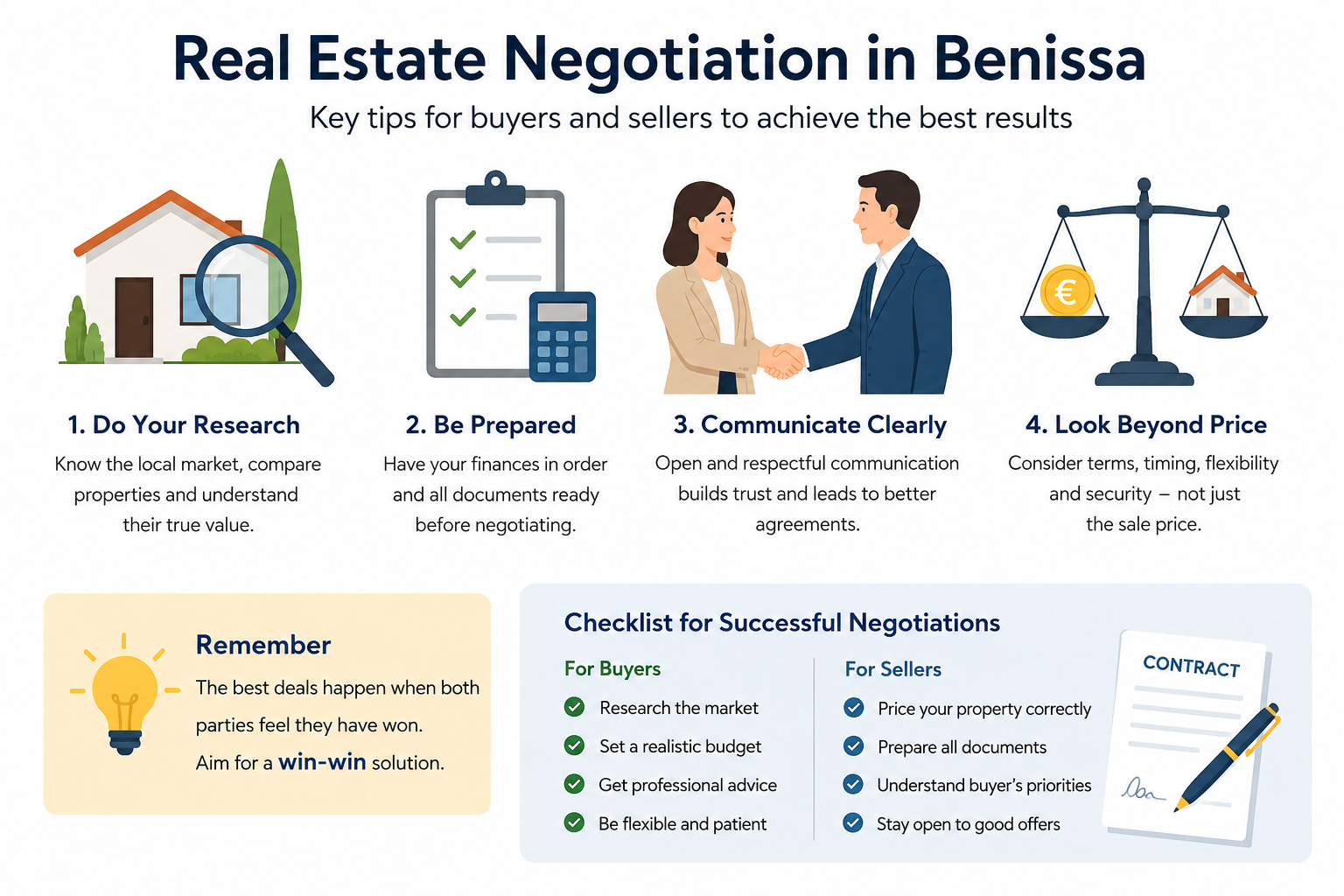
Negotiating Property Offers in Benissa: A Complete Guide for Buyers and Sellers
Buying or selling a property is one of the most significant financial decisions most people will ever make. Yet, many transactions are won or lost during a single stage: the negotiation.
Negotiating property offers in Benissa isn't simply about agreeing on a price. It's about understanding market conditions, recognising the motivations of both buyer and seller, evaluating the overall strength of an offer and reaching an agreement that works for everyone involved.
Whether you're selling a modern villa in San Jaime, buying a traditional finca in Benimarco, investing in an apartment near La Fustera, or considering a building plot in Pedramala, every negotiation is unique. Local market knowledge, preparation and realistic expectations often make the difference between a smooth transaction and a missed opportunity.
Unlike many larger cities, the property market in Benissa is highly varied. Two seemingly similar homes can command very different prices depending on their location, sea views, legal documentation, orientation, condition, privacy and demand. Understanding these local factors gives both buyers and sellers a significant advantage during negotiations.
This guide explains how negotiations work in the Benissa property market, what influences negotiating power, common mistakes to avoid, practical strategies for buyers and sellers, and what happens once an offer has been accepted. It also includes real-world examples, expert advice and practical checklists to help you negotiate with confidence.
Table of Contents
- Understanding How Property Negotiations Work in Benissa
- Preparing Before You Negotiate
- Negotiation Strategies for Buyers
- Negotiation Strategies for Sellers
- What Influences Negotiating Power?
- Common Negotiation Scenarios in Benissa
- Negotiation Tactics That Actually Work
- Real-Life Negotiation Examples
- What Happens After an Offer Is Accepted?
- Mistakes That Cost Buyers and Sellers Money
- Expert Tips from Telio Homes
- Frequently Asked Questions
- Conclusion
Understanding How Property Negotiations Work in Benissa
Quick Answer
Negotiating property offers in Benissa is the process of reaching mutually acceptable terms between a buyer and seller. While price is central to most discussions, successful negotiations often include completion dates, legal conditions, included furnishings, repairs and other practical considerations.
The objective is not to "win" the negotiation but to reach an agreement that allows both parties to move forward with confidence.
What Is a Property Negotiation?
Property negotiations begin when a buyer expresses an interest in purchasing a property and submits an offer through the estate agent or, less commonly, directly to the seller.
The seller then has three options:
- Accept the offer.
- Reject the offer.
- Make a counter-offer.
This exchange may continue through several rounds until an agreement is reached or one party decides to withdraw.
Although price receives most attention, negotiations frequently include:
- Completion dates.
- Reservation periods.
- Included furniture.
- White goods.
- Repairs.
- Survey findings.
- Mortgage conditions.
- Legal documentation.
- Access arrangements.
- Handover dates.
Many successful transactions are achieved by negotiating these elements rather than focusing solely on the purchase price.
How Negotiations Typically Unfold
The following table summarises the typical process.
| Stage | What Happens |
|---|---|
| Property viewing | Buyer views the property |
| Market research | Buyer assesses comparable homes |
| Initial offer | Submitted through the estate agent |
| Seller response | Accept, reject or counter |
| Further discussions | Price and conditions negotiated |
| Agreement reached | Both parties agree terms |
| Reservation agreement | Property removed from the market |
| Legal due diligence | Lawyers begin investigations |
| Completion | Transfer of ownership before the notary |
Every transaction progresses at its own pace. Straightforward purchases may reach agreement quickly, while more complex negotiations can take several weeks.
The Role of the Estate Agent
A professional estate agent is more than a messenger passing offers between buyer and seller.
An experienced negotiator helps:
- Explain each party's position.
- Manage expectations.
- Provide objective market advice.
- Keep negotiations constructive.
- Prevent emotional decisions.
- Resolve misunderstandings.
- Coordinate with lawyers and mortgage advisers.
Good estate agents also recognise that international buyers often have different expectations depending on their home country. Understanding these cultural differences helps avoid confusion and keeps negotiations moving.
Expert Tip
Buyers and sellers often focus exclusively on price, but experienced negotiators know that flexibility over timing, conditions and included items can create solutions that benefit both parties.
Why Local Market Knowledge Matters
Property values vary considerably across Benissa.
A renovated sea-view villa in La Fustera may attract multiple offers shortly after being listed, while a traditional countryside finca in Pedramala may appeal to a smaller group of buyers seeking privacy and larger plots.
Similarly:
- San Jaime attracts buyers looking for golf, sea views and proximity to Moraira.
- Buenavista combines residential tranquillity with coastal convenience.
- Fanadix offers quieter neighbourhoods popular with second-home owners.
- Benimarco appeals to buyers looking for authentic countryside living.
- Benissa Costa attracts a strong international market due to its beaches and coastal lifestyle.
Understanding these differences helps determine whether an asking price is realistic and how much room there may be for negotiation.
Factors That Influence Every Negotiation
Before any offer is made, several factors already influence negotiating strength.
These include:
- Current market conditions.
- Property location.
- Asking price accuracy.
- Property condition.
- Time on the market.
- Buyer demand.
- Financing arrangements.
- Seller motivation.
- Legal documentation.
Successful negotiators consider all of these factors rather than relying on general rules such as "always offer 10% below asking price."
Preparing Before You Negotiate
The strongest negotiations begin long before the first offer is submitted.
Preparation reduces uncertainty, improves decision-making and helps both buyers and sellers negotiate with confidence.
Research the Local Property Market
Understanding the local market is one of the most important steps before negotiating.
Compare properties based on:
- Location.
- Built area.
- Plot size.
- Sea views.
- Swimming pool.
- Orientation.
- Renovation requirements.
- Privacy.
- Walking distance to amenities.
- Energy efficiency.
Remember that two villas with similar floor areas can differ significantly in value depending on these characteristics.
Buyer's Research Checklist
Before making an offer, make sure you have:
- □ Compared similar properties.
- □ Researched the surrounding area.
- □ Estimated renovation costs.
- □ Calculated total purchase costs.
- □ Spoken to an independent lawyer.
- □ Reviewed your mortgage options.
- □ Established your maximum budget.
Understand Current Market Conditions
Negotiation strategies should reflect the current market rather than assumptions.
Ask yourself:
- Is buyer demand currently strong?
- How long are similar properties remaining on the market?
- Have asking prices recently been reduced?
- Are there many competing properties available?
- Is the property newly listed?
A buyer's strategy during a competitive market differs significantly from one during a slower market.
Market Conditions and Negotiation Strategy
| Market Type | Buyer Position | Seller Position |
|---|---|---|
| Seller's Market | Less negotiating power | Strong position |
| Balanced Market | Moderate flexibility | Moderate flexibility |
| Buyer's Market | Greater negotiating opportunities | More pressure to negotiate |
Know Your Priorities
Not every negotiation revolves around achieving the lowest or highest price.
Buyers may prioritise:
- Securing the property quickly.
- Completing before relocating.
- Including furniture.
- Minimising renovation work.
Sellers may prioritise:
- Certainty of completion.
- A specific moving date.
- Achieving a minimum acceptable price.
- Selling before purchasing another property.
Clearly defining your priorities before negotiations begin helps avoid impulsive decisions later.
Determine Your Negotiation Limits
One of the biggest mistakes buyers and sellers make is entering negotiations without clear limits.
Before discussions begin, establish:
Buyers
- Maximum purchase price.
- Maximum monthly mortgage.
- Available renovation budget.
- Preferred completion date.
- Non-negotiable legal requirements.
Sellers
- Minimum acceptable sale price.
- Preferred completion timeframe.
- Furniture included or excluded.
- Conditions you are unwilling to change.
Knowing these limits allows you to negotiate calmly and confidently.
Prepare Your Documentation
Preparation also involves ensuring that the necessary documentation is ready.
Buyers
- Passport or identification.
- Proof of funds.
- Mortgage approval (if applicable).
- Lawyer instructed.
- Reservation deposit available.
Sellers
- Property documentation.
- Identification.
- Energy certificate (where required).
- Details of community fees (if applicable).
- Existing planning documentation.
- Contact details for your lawyer.
Having paperwork prepared reduces delays once negotiations begin.
Important
Property laws, planning regulations and taxation in Spain may change over time. Buyers and sellers should always seek advice from qualified legal and tax professionals before making significant financial decisions.
Common Preparation Mistakes
Preparation mistakes often weaken negotiating positions before discussions have even started.
Avoid:
- Negotiating emotionally.
- Ignoring comparable properties.
- Making assumptions about market value.
- Failing to arrange financing.
- Waiting too long to appoint a lawyer.
- Underestimating renovation costs.
- Assuming every asking price is negotiable.
Key Takeaways
- Preparation creates confidence.
- Local market knowledge strengthens negotiations.
- Evidence is more persuasive than emotion.
- Price is only one part of a successful agreement.
- Knowing your limits prevents costly mistakes.
Did You Know?
Some of the strongest negotiations in Benissa are achieved without significant price changes. Instead, buyers and sellers often agree on practical compromises such as completion dates, included furniture or repair responsibilities, allowing both parties to achieve their objectives.
Negotiation Strategies for Buyers
Buying a property in Benissa is about much more than negotiating the lowest possible price. The most successful buyers understand the local market, present themselves as credible purchasers and focus on securing the right property on the best overall terms.
A negotiation should never feel like a battle. Instead, it should be a structured discussion that helps both buyer and seller reach a fair agreement.
Quick Answer
The best way to negotiate property offers in Benissa is to base your offer on local market evidence, understand the seller's priorities, have your finances ready and remain flexible on terms such as completion dates or included items—not simply focus on achieving the biggest discount.
How Much Below the Asking Price Should You Offer?
This is one of the most common questions buyers ask.
The honest answer is:
There is no standard percentage.
Anyone suggesting that you should always offer 10% or 15% below the asking price is oversimplifying how the Benissa property market works.
A realistic offer depends on several factors.
Consider:
- How accurately the property has been priced.
- Whether it has recently come onto the market.
- The property's condition.
- Comparable homes currently available.
- Renovation costs.
- Whether multiple buyers are interested.
- The seller's circumstances.
For example, a beautifully presented villa in La Fustera that has just been listed and is attracting significant interest may receive offers very close to the asking price.
By contrast, an older finca requiring modernisation in Pedramala may naturally allow more room for negotiation because buyers must budget for future improvements.
Typical Negotiation Potential
| Property Situation | Typical Flexibility |
|---|---|
| Newly listed and realistically priced | Low |
| Highly desirable location with strong demand | Low |
| Property needs modernisation | Moderate |
| Significant renovation required | Higher |
| Long time on the market | May increase |
| Seller requires a quick sale | May increase |
These are general observations rather than fixed rules. Every property should be assessed individually.
When to Make a Strong Opening Offer
Sometimes the strongest negotiating strategy is making a competitive first offer.
This can be appropriate when:
- The property is realistically priced.
- Comparable homes are selling quickly.
- It is difficult to find similar properties.
- Several buyers are interested.
- You have found exactly what you have been looking for.
Waiting in the hope of negotiating a small discount can occasionally result in losing an exceptional property to another buyer.
Expert Tip
A well-supported offer submitted promptly often carries more weight than an aggressive low offer made after lengthy delays.
What Strengthens Your Negotiating Position?
Sellers assess much more than the purchase price.
They also evaluate how likely the transaction is to complete smoothly.
Characteristics of a Strong Buyer
- Proof of funds available.
- Mortgage agreed in principle (where applicable).
- Independent lawyer already instructed.
- Flexible completion dates.
- Clear communication.
- Realistic expectations.
- Ability to make decisions promptly.
A slightly lower offer from a well-prepared buyer can sometimes be more attractive than a higher offer that depends on uncertain financing.
Strong Buyer Checklist
Before making an offer, ask yourself:
- □ Have I researched comparable properties?
- □ Is my financing organised?
- □ Have I appointed an independent lawyer?
- □ Do I understand all purchasing costs?
- □ Have I decided on my maximum budget?
- □ Am I prepared to move quickly if my offer is accepted?
Negotiating Beyond the Purchase Price
One of the biggest misconceptions is that negotiations are only about money.
Many successful agreements involve other valuable terms.
These may include:
- Furniture.
- White goods.
- Garden equipment.
- Swimming pool accessories.
- Completion dates.
- Minor repairs.
- Storage areas.
- Parking spaces.
- Flexible handover arrangements.
For example, a buyer may happily pay the asking price if expensive outdoor furniture and pool equipment are included.
Similarly, a seller may accept a slightly lower offer if the buyer can complete within their preferred timeframe.
Thinking creatively often produces better outcomes than concentrating exclusively on price.
Negotiating After a Survey or Legal Discovery
Negotiations do not always end when an offer is accepted.
Sometimes new information comes to light during legal due diligence or technical inspections.
Examples include:
- Roof repairs.
- Damp problems.
- Pool documentation.
- Boundary discrepancies.
- Missing planning documents.
- Occupancy licence issues.
- Structural concerns.
When genuine issues are identified, it may be reasonable to discuss:
- A revised purchase price.
- The seller carrying out repairs.
- Financial retention until the issue is resolved.
- Alternative contractual arrangements.
Any changes should always be documented and reviewed by the respective legal advisers.
Important
Renegotiation should always be based on newly discovered facts rather than an attempt to reduce the agreed price without justification.
Common Buyer Mistakes to Avoid
Many buyers unintentionally weaken their own negotiating position.
Avoid these mistakes
X Making offers without researching the market.
X Assuming every seller is desperate to sell.
X Falling in love with the property before negotiating.
X Revealing your maximum budget too early.
X Delaying responses.
X Ignoring legal advice.
X Negotiating purely on emotion.
X Focusing only on price instead of overall value.
Warning
An unrealistically low offer can sometimes discourage further discussions. While every seller responds differently, offers that appear unsupported by market evidence are less likely to lead to productive negotiations.
Buyer's Key Takeaways
✓ Research comparable properties.
✓ Understand current market conditions.
✓ Be financially prepared.
✓ Keep negotiations professional.
✓ Focus on overall value, not just purchase price.
✓ Stay flexible where possible.
Negotiation Strategies for Sellers
For sellers, negotiation is about balancing price, certainty and timing.
The highest offer is not always the best offer.
Understanding how buyers think allows sellers to evaluate offers more effectively and avoid unnecessary delays.
Should You Accept the First Offer?
One of the biggest myths in property sales is that the first offer should always be rejected.
In reality, the quality of an offer matters far more than its position in the negotiation process.
Consider:
- Is the offer close to market value?
- Has the property only recently been listed?
- Are there likely to be more buyers?
- How strong is the buyer financially?
- How quickly can they complete?
- Are there any conditions attached?
Sometimes the first buyer is simply the right buyer.
When to Make a Counter-Offer
Counter-offers keep negotiations moving while signalling that you remain interested.
Rather than rejecting an offer outright, consider negotiating:
- Purchase price.
- Completion date.
- Included furniture.
- Repair responsibilities.
- Reservation period.
- Deposit arrangements.
Professional counter-offers often create momentum towards an agreement.
Counter-Offer Decision Matrix
| Situation | Recommended Response |
|---|---|
| Offer meets expectations | Accept |
| Offer slightly below expectations | Counter-offer |
| Offer significantly below realistic value | Reject or explain your reasoning |
| Buyer requests unrealistic conditions | Negotiate alternatives |
How to Reject an Offer Professionally
Not every offer will be suitable.
If declining an offer:
- Respond promptly.
- Thank the buyer.
- Explain that the offer has been considered carefully.
- Leave the door open for further discussions where appropriate.
Maintaining a professional tone encourages future dialogue if circumstances change.
Recognising Serious Buyers
Price alone should never determine your decision.
A serious buyer usually demonstrates:
- Financial readiness.
- Mortgage approval where required.
- Independent legal representation.
- Good communication.
- Flexibility.
- Realistic expectations.
These factors often reduce the likelihood of delays or failed transactions.
Avoiding Emotional Decision-Making
Many owners have a strong emotional attachment to their property.
This is understandable.
However, buyers assess a property based on its value to them rather than its sentimental importance.
Successful sellers:
- Listen to market feedback.
- Consider comparable properties.
- Stay objective.
- Focus on achieving their goals rather than proving a point.
Negotiating in Different Market Conditions
Negotiation strategies should reflect current market conditions.
Seller's Market
Where demand exceeds supply:
- Sellers generally negotiate from a stronger position.
- Buyers may need to submit competitive offers quickly.
- Flexibility on price is often limited.
Balanced Market
Where supply and demand are broadly equal:
- Both parties usually have reasonable negotiating opportunities.
- Practical compromises become increasingly important.
Buyer's Market
Where there are many properties available:
- Buyers may negotiate more confidently.
- Sellers often need to remain flexible.
- Correct pricing becomes even more important.
Understanding the wider market helps prevent unrealistic expectations.
Common Mistake
Holding out for a price that the market is unlikely to support can result in a longer selling period and ultimately a lower final sale price.
Seller's Preparation Checklist
Before responding to an offer:
- □ Know your minimum acceptable price.
- □ Decide which conditions are negotiable.
- □ Prepare your documentation.
- □ Understand your preferred completion date.
- □ Listen carefully to professional advice.
- □ Keep discussions objective.
Seller's Key Takeaways
✓ Evaluate the overall strength of every offer.
✓ Price your property realistically.
✓ Stay flexible where appropriate.
✓ Focus on certainty as well as price.
✓ Keep negotiations professional.
What Influences Negotiating Power?
Not every buyer or seller enters negotiations with the same level of influence.
Negotiating strength changes depending on the property, the market and the circumstances surrounding the transaction.
Understanding these factors helps both parties negotiate more effectively.
Current Market Conditions
Supply and demand remain one of the biggest influences.
When desirable properties are scarce and buyer demand is strong, sellers usually have greater negotiating power.
When there are many similar homes available, buyers often have more choice and therefore greater leverage.
Monitoring current market conditions before entering negotiations provides valuable context.
Property Condition
The condition of a property significantly affects negotiations.
Properties that are:
- Well maintained.
- Recently renovated.
- Legally compliant.
- Energy efficient.
typically justify stronger asking prices.
Conversely, buyers may reasonably negotiate where substantial improvements are required.
Asking Price Accuracy
Realistic pricing is one of the strongest negotiating tools available to sellers.
Correct pricing tends to:
- Generate more enquiries.
- Encourage stronger offers.
- Reduce time on the market.
- Increase buyer confidence.
Overpricing often has the opposite effect.
Time on the Market
Buyers frequently consider how long a property has been available.
| Time on Market | Possible Impact |
|---|---|
| Newly listed | Seller often negotiates less |
| Several months | Buyers may expect greater flexibility |
| Recent price reduction | Depends on buyer demand |
| Relisted property | Buyers may investigate previous pricing |
Time alone should never determine an offer, but it can provide useful context.
Cash Buyers vs Mortgage Buyers
Cash buyers often present fewer financing risks and may complete more quickly.
However, buyers with mortgage approval already in place can also be extremely attractive.
Ultimately, sellers usually evaluate:
- Price.
- Certainty.
- Timescale.
- Conditions.
- Financial readiness.
Seller Motivation
Every seller has different priorities.
Examples include:
- Downsizing.
- Relocating abroad.
- Selling an inherited property.
- Releasing capital.
- Selling a holiday home.
Understanding these priorities—without making assumptions—can help shape constructive negotiations.
Buyer Flexibility
Sometimes flexibility is more valuable than a higher offer.
Buyers willing to adjust completion dates or accommodate the seller's plans often strengthen their negotiating position without increasing their budget.
Factors Influencing Negotiating Power
| Factor | Benefits Buyer | Benefits Seller |
|---|---|---|
| Cash purchase | ✓ | |
| Mortgage approved | ✓ | |
| High buyer demand | ✓ | |
| Accurate asking price | ✓ | |
| Flexible completion | ✓ | ✓ |
| Legal documentation ready | ✓ | ✓ |
| Property in excellent condition | ✓ |
Did You Know?
Some of the smoothest property transactions in Benissa occur because both parties remain flexible on timing and practical arrangements, rather than negotiating every aspect of the purchase price.
Common Negotiation Scenarios in Benissa
Every property transaction is different, but certain negotiation patterns appear regularly in the Benissa property market. Understanding these scenarios helps buyers and sellers approach discussions with realistic expectations and greater confidence.
Negotiating on a Villa
Modern villas are among the most sought-after properties in Benissa, particularly in San Jaime, La Fustera, Buenavista and along Benissa Costa.
Buyers are typically attracted by features such as:
- Sea views
- South-facing orientation
- Walking distance to the coast
- Modern kitchens and bathrooms
- Private swimming pools
- Low-maintenance gardens
- Energy-efficient improvements
Where a villa has been priced accurately and presented well, sellers often have relatively little need to negotiate heavily.
However, negotiations frequently focus on:
- Completion dates
- Included furniture
- Outdoor furniture
- Pool equipment
- Garden machinery
- Minor repairs
- Air conditioning servicing
Example
A contemporary villa in San Jaime is listed at a realistic market price.
Within ten days, two buyers submit offers.
Buyer A offers slightly more but requires a lengthy mortgage process.
Buyer B offers marginally less but has proof of funds and can complete within six weeks.
The seller chooses Buyer B because certainty and speed outweigh the small difference in price.
Lesson: The strongest offer is not always the highest offer.
Negotiating on a Finca
Traditional fincas often involve more detailed negotiations because buyers are purchasing not only a house but also land and rural infrastructure.
Issues commonly discussed include:
- Water supply
- Water deposits
- Septic tank systems
- Internet availability
- Solar installations
- Agricultural land
- Access roads
- Building documentation
- Future renovation costs
Older countryside properties may also require modernisation, which naturally becomes part of the negotiation.
Example
A finca in Benimarco requires:
- Roof repairs
- New kitchen
- Updated electrics
- Improved insulation
Rather than submitting an aggressive offer, the buyer provides realistic quotations for the renovation work and explains how these costs influence their budget.
The seller recognises the evidence and both parties reach a fair agreement.
Lesson: Evidence-based negotiations are usually more productive than unsupported price reductions.
Negotiating on an Apartment
Apartments generally involve more straightforward negotiations because buyers can compare similar properties more easily.
Common discussion points include:
- Community fees
- Parking
- Storage rooms
- Furniture
- Rental licences (where applicable)
- Lift access
- Energy efficiency
Where several comparable apartments are available, buyers often have greater negotiating leverage.
Negotiating on a Building Plot
Building plots require a different approach because buyers are evaluating future development potential rather than an existing home.
Negotiations often focus on:
- Planning restrictions
- Buildability
- Utilities
- Topography
- Orientation
- Views
- Construction costs
- Access
A plot with exceptional sea views but challenging terrain may require expensive retaining walls, which naturally influences negotiations.
Negotiating Rustic Properties
Rustic properties deserve special consideration because they frequently involve additional practical and legal considerations.
Negotiations may include discussions around:
- Agricultural land classification
- Existing buildings
- Water rights
- Septic tanks
- Electricity supply
- Solar installations
- Access roads
- Boundary definitions
Buyers should understand these matters before negotiating, as unexpected discoveries later may affect both value and timescales.
Multiple Buyers Competing for One Property
Desirable homes occasionally attract multiple interested buyers.
When this happens, sellers often compare offers based on far more than price alone.
What Sellers Usually Consider
| Factor | Why It Matters |
|---|---|
| Purchase price | Financial outcome |
| Proof of funds | Confidence in completion |
| Mortgage approved | Lower financing risk |
| Flexible completion | Easier planning |
| Few conditions | Simpler transaction |
| Good communication | Reduces delays |
Trying to negotiate aggressively in a competitive situation may increase the risk of losing the property altogether.
Negotiation Tactics That Actually Work
Successful negotiations rely on preparation, communication and mutual respect—not confrontation.
The following strategies consistently produce better outcomes.
Create a Win-Win Outcome
The objective should never be to "beat" the other party.
Instead, aim to understand:
- What matters most to the buyer.
- What matters most to the seller.
- Which compromises create value for both.
Examples include:
- Accepting a slightly lower offer in exchange for a quicker completion.
- Paying the asking price because valuable furniture is included.
- Agreeing a completion date that suits both parties.
These practical compromises often produce smoother transactions than prolonged arguments over relatively small differences in price.
Use Comparable Properties Effectively
Comparable properties are one of the strongest negotiation tools available.
However, comparisons should genuinely reflect similar homes.
Good comparisons consider:
- Location
- Plot size
- Built area
- Age
- Condition
- Renovation level
- Views
- Swimming pool
- Orientation
Comparing a fully renovated villa overlooking the sea with an older inland property rarely provides meaningful guidance.
Comparable Property Checklist
Before relying on comparable homes, check:
- □ Same neighbourhood?
- □ Similar plot size?
- □ Similar built area?
- □ Similar condition?
- □ Similar views?
- □ Similar age?
- □ Similar facilities?
The closer the comparison, the stronger your negotiating position.
Know When to Walk Away
One of the most valuable negotiation skills is recognising when a transaction no longer makes sense.
Buyers should consider walking away if:
- Serious legal issues remain unresolved.
- The asking price is clearly unrealistic.
- Significant structural defects are discovered.
- Financing becomes impossible.
- Trust breaks down completely.
Similarly, sellers should not feel pressured into accepting offers that fail to reflect realistic market value.
Walking away can sometimes be the best commercial decision.
Keep Negotiations Moving
Momentum matters.
Long periods without communication create uncertainty and increase the likelihood that buyers or sellers begin considering alternative options.
Good practice includes:
- Responding promptly.
- Confirming agreements in writing.
- Keeping lawyers informed.
- Clarifying conditions early.
- Remaining transparent.
Professional communication builds confidence throughout the transaction.
Avoid Common Psychological Traps
Property decisions are naturally emotional.
Recognising common behavioural biases helps both parties make better decisions.
Common Psychological Traps
| Trap | Better Approach |
|---|---|
| Emotional attachment | Focus on market evidence |
| Chasing tiny price differences | Consider the overall transaction |
| Negotiating simply to "win" | Aim for mutual benefit |
| Making assumptions | Ask questions and verify facts |
| Rushing decisions | Take professional advice |
Warning
Negotiations based purely on emotion often lead to poorer decisions than those based on objective market evidence.
Decision Tree: Should You Counter-Offer?
For Sellers
Offer received
↓
Is it close to your expectations?
- Yes → Consider accepting.
- No → Continue.
↓
Is the buyer financially strong?
- Yes → Consider a reasonable counter-offer.
- No → Assess the risk before negotiating further.
↓
Can both parties compromise?
- Yes → Continue negotiations.
- No → Decline politely and remain open to future discussions.
Real-Life Negotiation Examples
The following examples are illustrative scenarios based on situations commonly encountered in the Benissa property market.
Example 1: A Villa in San Jaime
A villa is marketed at a realistic asking price.
Within two weeks:
- Three viewings are arranged.
- Two offers are received.
Buyer A offers slightly more but needs additional time to secure financing.
Buyer B offers slightly less but has funds available immediately.
The seller accepts Buyer B because certainty is more valuable than the small increase in price.
Key Lesson
Certainty often has financial value.
Example 2: Renovating a Finca in Pedramala
A countryside finca requires:
- Roof repairs.
- Updated plumbing.
- New septic system.
- Modern heating.
The buyer obtains realistic quotations before negotiating.
Instead of making a speculative low offer, they explain how the renovation costs affect the property's value.
The seller agrees to a revised price supported by evidence.
Key Lesson
Preparation creates credibility.
Example 3: Holiday Apartment in La Fustera
A retired couple wish to buy an apartment before the summer season.
Rather than negotiating aggressively on price, they ask whether the seller would include:
- Furniture.
- Kitchen appliances.
- Window coverings.
The seller agrees because it simplifies the move.
Key Lesson
Negotiating beyond price can create value for both parties.
Example 4: Building Plot Near Benissa Costa
A buyer discovers that developing the plot will require additional retaining walls due to the slope.
Professional estimates indicate significantly higher construction costs than originally expected.
After discussing these findings, buyer and seller agree a revised purchase price.
Key Lesson
New information can legitimately change negotiations.
Example 5: Selling from Abroad
An overseas owner decides to sell a holiday home remotely.
The buyer requests a flexible completion date to coordinate their relocation.
Rather than changing the agreed price, both parties agree revised completion arrangements that suit everyone.
Key Lesson
Flexibility is often more valuable than small financial concessions.
Lessons Learned
Although every property transaction is different, successful negotiations usually have several characteristics in common.
They are based on:
- Preparation.
- Evidence.
- Good communication.
- Professional advice.
- Realistic expectations.
- Flexibility.
The strongest negotiators understand that creating certainty and solving problems often produces better outcomes than focusing exclusively on price.
Negotiation Success Checklist
Buyers
- □ Research comparable properties.
- □ Arrange financing.
- □ Appoint an independent lawyer.
- □ Understand renovation costs.
- □ Know your maximum budget.
- □ Stay objective.
Sellers
- □ Price realistically.
- □ Prepare documentation.
- □ Understand buyer priorities.
- □ Know your minimum acceptable price.
- □ Remain flexible where appropriate.
- □ Listen to professional advice.
Expert Tip
The most successful negotiations are rarely dramatic. They are usually the result of realistic pricing, careful preparation, open communication and a willingness to find practical solutions that work for both buyer and seller.
What Happens After an Offer Is Accepted?
Reaching an agreement on price is a significant milestone, but it is only the beginning of the legal and administrative process. A well-managed transaction after an accepted offer helps reduce delays, minimise misunderstandings and keep both parties confident that the sale will complete successfully.
Although every transaction is different, property sales in Benissa generally follow the same sequence.
Quick Answer
After an offer is accepted, the buyer and seller normally sign a reservation agreement, the buyer pays a reservation deposit, legal due diligence begins, financing is finalised (if required), and the transaction concludes with the signing of the title deed before a Spanish notary.
Reservation Agreement
The first formal step is usually the reservation agreement.
Its purpose is to:
- Confirm the agreed purchase price.
- Identify the buyer and seller.
- Record the reservation deposit.
- Establish a timetable for the next stages.
- Remove the property from the market while legal checks are carried out.
The exact wording and conditions vary between transactions, so both parties should have the document reviewed by their own independent lawyer before signing.
Important
A reservation agreement is an important legal document. Never sign it without understanding its terms and the financial implications if either party fails to meet their obligations.
Reservation Deposit
Following the reservation agreement, the buyer normally pays a reservation deposit.
The deposit demonstrates commitment to the purchase and allows the legal process to begin.
The agreement should clearly explain:
- The amount of the deposit.
- Where the money will be held.
- The circumstances in which it may be refunded or retained.
- The next contractual milestones.
Legal Due Diligence
One of the most important stages begins after the offer has been accepted.
The buyer's lawyer will investigate matters such as:
- Ownership.
- Property Registry information.
- Cadastral information.
- Existing mortgages or charges.
- Planning permissions.
- Building legality.
- Occupancy licence (where applicable).
- Community obligations.
- Property boundaries.
If legal issues are identified, further negotiations may sometimes become necessary.
Examples include:
- Missing documentation.
- Boundary discrepancies.
- Outstanding mortgage cancellation.
- Unregistered alterations.
- Pool documentation.
- Planning issues.
This is why buyers should never assume that acceptance of an offer guarantees completion.
Legal Due Diligence Checklist
✓ Ownership verified
✓ Registry information checked
✓ Property boundaries reviewed
✓ Outstanding debts investigated
✓ Planning documentation examined
✓ Occupancy documentation confirmed (where applicable)
✓ Community fees verified (if relevant)
✓ Utility arrangements reviewed
Warning
If significant legal issues are discovered during due diligence, seek legal advice before agreeing to amend the purchase price or contractual terms.
Mortgage Approval (Where Applicable)
Where financing is required, the lender continues processing the mortgage application.
This stage may involve:
- Property valuation.
- Verification of income.
- Review of legal documentation.
- Final lending approval.
Buyers should avoid making significant financial changes during this period, as doing so could affect their mortgage approval.
Final Contract Negotiations
Although many buyers believe negotiations end once an offer has been accepted, this is not always the case.
Occasionally, new information discovered during legal investigations or inspections may justify further discussion.
Examples include:
- Previously undisclosed structural issues.
- Legal documentation requiring correction.
- Unexpected repair requirements.
- Completion timetable changes.
- Retentions agreed until outstanding matters are resolved.
These discussions should remain constructive and be supported by professional advice.
Signing Before the Notary
Once all conditions have been satisfied, the parties meet before a Spanish notary.
During completion:
- The title deed is signed.
- Purchase funds are transferred.
- Ownership changes hands.
- Keys are handed to the buyer.
The notary ensures the deed is executed correctly but does not replace the role of the buyer's or seller's independent lawyer.
Completion and Key Handover
Following completion, several administrative tasks remain.
These typically include:
- Registration of the new ownership.
- Payment of applicable taxes and fees.
- Utility transfers.
- Updating official records where necessary.
A good lawyer will normally coordinate these formalities on behalf of the buyer.
Typical Timeline After an Accepted Offer
| Stage | Typical Order |
|---|---|
| Offer accepted | ✓ |
| Reservation agreement | ✓ |
| Reservation deposit | ✓ |
| Legal due diligence | ✓ |
| Mortgage approval (if applicable) | ✓ |
| Final contract preparations | ✓ |
| Completion before the notary | ✓ |
| Registration and utility transfers | ✓ |
Every transaction is different, so the exact timescale depends on the property's circumstances, financing requirements and the readiness of both parties.
Mistakes That Cost Buyers and Sellers Money
Even experienced buyers and sellers occasionally make mistakes that weaken their negotiating position or delay completion.
Recognising these pitfalls can save considerable time, stress and expense.
Overpricing a Property
For sellers, unrealistic pricing is one of the most common causes of prolonged negotiations.
An overpriced property may:
- Attract fewer enquiries.
- Remain on the market for longer.
- Encourage buyers to negotiate more aggressively.
- Eventually require price reductions.
Correct pricing from the outset usually attracts stronger interest and more credible offers.
Making Unrealistic Offers
Buyers sometimes assume every property has significant room for negotiation.
An offer far below market value may:
- Discourage the seller.
- Damage trust.
- Delay negotiations.
- Encourage the seller to focus on other buyers.
Offers supported by comparable market evidence are generally more persuasive.
Letting Emotions Control Decisions
Buying or selling a home is naturally emotional.
However, negotiations based purely on emotion rather than evidence often lead to poorer outcomes.
Successful negotiators remain focused on:
- Market value.
- Practical priorities.
- Long-term objectives.
- Professional advice.
Ignoring Professional Advice
Estate agents, lawyers, mortgage advisers and tax specialists all contribute valuable expertise.
Attempting to resolve legal or financial issues without appropriate advice may increase risk.
Important
Spanish property law, planning regulations and taxation can change over time. Always obtain advice from appropriately qualified professionals before making significant legal or financial decisions.
Delaying Decisions
Momentum is valuable during negotiations.
Long delays can create uncertainty and increase the possibility of a transaction failing.
Prompt communication and timely decision-making help maintain confidence on both sides.
Assuming Price Is Everything
Price is important, but it is rarely the only consideration.
Many successful negotiations are influenced by:
- Completion dates.
- Financial certainty.
- Legal readiness.
- Included furniture.
- Flexibility.
- Practical solutions.
Looking beyond the purchase price often creates better outcomes.
Common Negotiation Mistakes
| Mistake | Potential Consequence | Better Approach |
|---|---|---|
| Overpricing | Longer selling period | Price realistically |
| Unrealistic offer | Negotiations stall | Use comparable evidence |
| Emotional decisions | Missed opportunities | Focus on facts |
| Poor preparation | Weak negotiating position | Prepare thoroughly |
| Delayed communication | Loss of buyer confidence | Respond promptly |
| Ignoring legal advice | Increased risk | Seek professional guidance |
Expert Tips from Telio Homes
After years of negotiating property transactions across Benissa and the Costa Blanca North, certain principles consistently produce successful outcomes.
How Experienced Negotiators Maximise Value
Experienced negotiators understand that value is measured by more than price alone.
They consider:
- Market evidence.
- Buyer strength.
- Seller priorities.
- Timing.
- Certainty.
- Legal readiness.
- Practical flexibility.
Balancing these factors often produces stronger overall results than concentrating exclusively on the headline figure.
Why Local Knowledge Matters
Every part of Benissa attracts different buyers.
For example:
- Buyers looking in La Fustera often prioritise beach access and holiday-home potential.
- San Jaime appeals to buyers seeking golf, sea views and proximity to Moraira.
- Buenavista attracts those wanting peaceful coastal living.
- Pedramala and Benimarco appeal to buyers looking for larger plots, privacy and traditional fincas.
- Fanadix offers a quieter residential environment with good access to the coast.
Understanding these local market dynamics helps buyers make informed offers and helps sellers set realistic expectations.
When Professional Guidance Can Save Money
Professional advice becomes particularly valuable when:
- Buying or selling a rustic property.
- Negotiating after legal issues are discovered.
- Selling from abroad.
- Purchasing with mortgage finance.
- Dealing with inherited property.
- Negotiating completion dates or contractual conditions.
Experienced guidance often prevents expensive mistakes and unnecessary delays.
Final Advice Before Making or Accepting an Offer
Buyers
✓ Research the local market thoroughly.
✓ Understand your total buying costs.
✓ Arrange financing before negotiating.
✓ Appoint an independent lawyer.
✓ Focus on overall value, not simply the asking price.
Sellers
✓ Price realistically.
✓ Prepare documentation early.
✓ Understand your priorities.
✔ Consider the strength of the buyer as well as the offer.
✔ Remain open to sensible compromises.
Expert Tip
The best negotiations are rarely remembered because they were dramatic. They are remembered because both buyer and seller completed the transaction feeling that the agreement was fair.
Frequently Asked Questions
Can you negotiate property prices in Benissa?
Yes. Many transactions involve negotiation, although the scope depends on market conditions, property type, location and the motivations of both parties.
How much below the asking price should I offer?
There is no fixed percentage. Your offer should be based on comparable properties, the condition of the home and current market demand.
Should sellers accept the first offer?
Not necessarily. Every offer should be assessed on its overall strength, including price, financing, conditions and likelihood of completion.
Is the asking price always negotiable?
Often, yes. However, realistically priced properties in high-demand areas may achieve offers very close to the asking price.
How long do negotiations usually take?
Some negotiations conclude within a day, while more complex transactions may take several weeks.
Can negotiations continue after an offer has been accepted?
Yes. If legal investigations or inspections reveal previously unknown issues, the parties may agree revised terms.
What happens after the reservation agreement?
Legal due diligence, financing (if required) and preparation for completion normally follow.
Can an accepted offer fall through?
Yes. Financing problems, unresolved legal issues or one party withdrawing may prevent completion.
Are cash buyers in a stronger negotiating position?
Often they are, because they remove one source of uncertainty. However, every offer is assessed individually.
Should I negotiate after a survey or legal investigation?
If genuine issues are discovered that affect value or future costs, further discussions may be appropriate.
What if there are several interested buyers?
The seller will usually consider price, financial strength, conditions and certainty of completion before making a decision.
When should I walk away from a negotiation?
If significant legal concerns remain unresolved, the asking price is unrealistic or the transaction no longer meets your objectives, it may be sensible to withdraw.
Conclusion
Negotiating property offers in Benissa is about much more than agreeing a purchase price. The strongest negotiations are built on preparation, local market knowledge, realistic expectations and clear communication.
For buyers, understanding the market, arranging finances early and remaining flexible can significantly strengthen your negotiating position. For sellers, realistic pricing, complete documentation and evaluating the overall quality of each offer—not just the headline figure—often lead to smoother transactions and better results.
Whether you are buying a sea-view villa in San Jaime, selling a finca in Benimarco, investing in an apartment near La Fustera or purchasing land in Pedramala, every negotiation should be approached with patience, evidence and professional advice.
A successful negotiation is one where both parties move forward with confidence.
Need Expert Guidance?
Negotiating property offers can be one of the most challenging stages of buying or selling a home, particularly if you are unfamiliar with the Spanish property market.
At Telio Homes, we combine local knowledge of Benissa and the Costa Blanca North with practical negotiation experience to help buyers and sellers make informed decisions at every stage of the process.
Whether you are preparing to sell your property, considering an offer or searching for your ideal home, professional guidance can help you negotiate with confidence and achieve the best possible outcome.