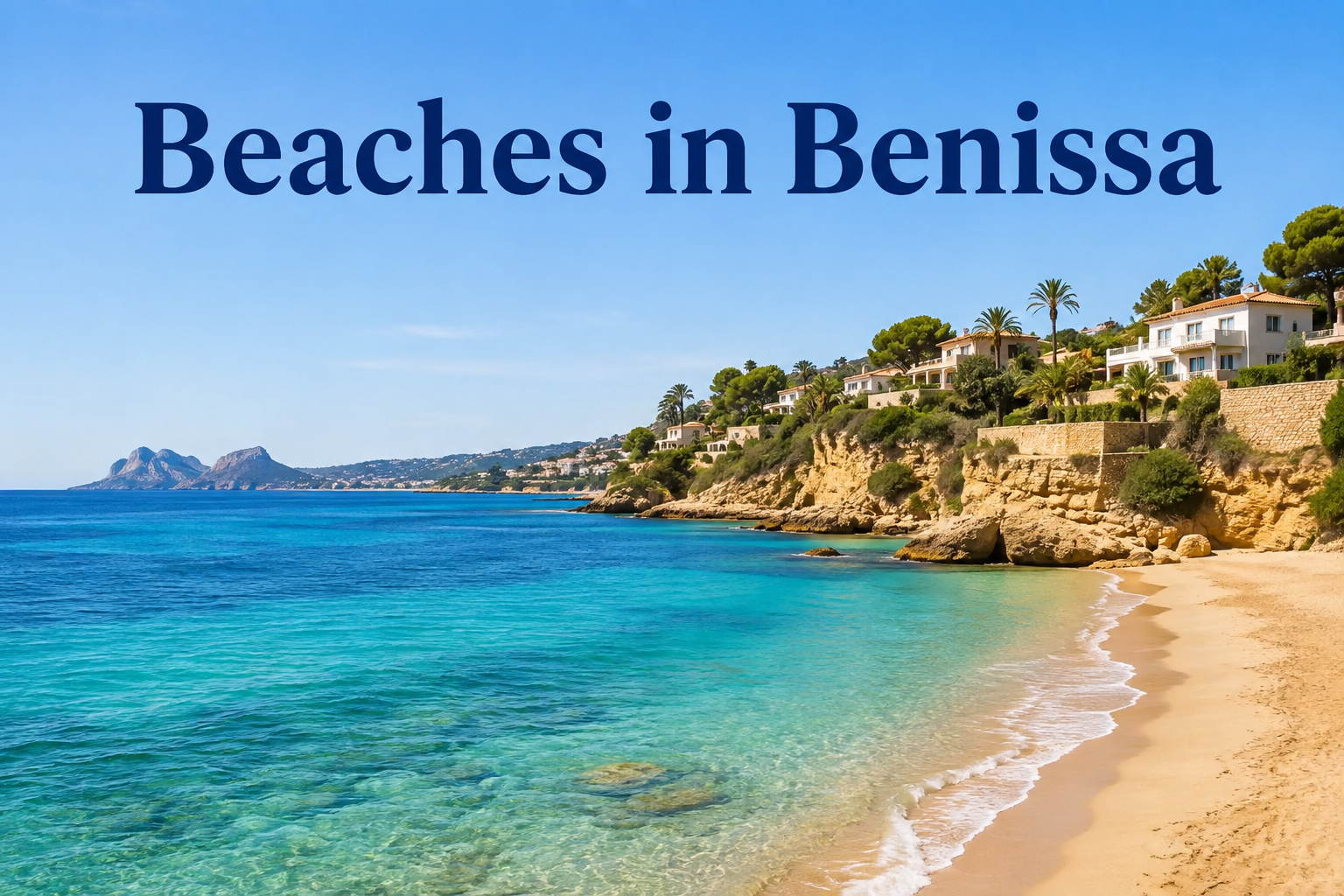
Beaches in Benissa: Complete Guide to Benissa Costa Beaches and Coves
Introduction
The beaches in Benissa are different from the broad, urban sandy beaches found elsewhere on the Costa Blanca. Benissa's coastline is characterised by small coves, rocky shorelines, clear Mediterranean water, pebble beaches and one principal sandy beach: La Fustera.
The municipality has around four kilometres of coastline, stretching between Calpe and the Moraira area. The six principal coastal locations highlighted by Benissa's official tourism service are Les Bassetes, La Fustera, Cala Pinets, Cala Llobella, Platgeta de l'Advocat and Cala Baladrar.
That does not mean every part of the coast looks or feels like a conventional beach. Some locations are better understood as coves or rocky swimming areas. For a family with young children, that distinction matters. So does the difference between a beach that is easy to reach by car and a secluded cove reached by steps or a longer walk.
This guide covers the practical differences between the Benissa Costa beaches and coves, including:
-
Which beach is best for families.
-
Where to find sand.
-
The best places for swimming and snorkelling.
-
Where to find restaurants and facilities.
-
Parking and accessibility.
-
Beaches near Calpe and Moraira.
-
What it is actually like to live near the coast.
-
What buyers should consider when purchasing property close to a Benissa beach.
Expert Tip: If you are viewing a property advertised as "walking distance to the beach", do the journey yourself. In Benissa, 500 metres on a map can mean a very different experience depending on gradients, steps, roads and the final access to the water.
Table of Contents
The Best Beaches and Coves in Benissa at a Glance
If you only have time to visit one Benissa beach, La Fustera is the easiest all-round recommendation. It combines sand, swimming, facilities, parking, restaurants and relatively straightforward access.
If you prefer something more natural, the smaller coves are more interesting. Cala Llobella is particularly peaceful and natural, while Cala Pinets, Cala Advocat and Cala Baladrar are well suited to swimming and exploring the rocky coastline.
For watersports, Les Bassetes stands apart because of its yacht club and range of nautical activities.
Benissa Beaches Quick Comparison
| Beach / cove | Main character | Surface | Best for | Parking | Food nearby | Snorkelling | Family suitability | Accessibility |
|---|---|---|---|---|---|---|---|---|
| La Fustera | Main sandy beach | Sand | Families, swimming, facilities | Yes, seasonal demand | Yes | Excellent | Excellent | Best overall |
| Les Bassetes | Coastal marina area | Rock / coast | Watersports, walking | Yes, availability varies | Yes | Excellent | Good | Mixed |
| Cala Pinets | Small cove | Sand / rock | Swimming, snorkelling | Nearby, limited | Limited | Excellent | Good | Moderate |
| Cala Llobella | Natural cove | Pebbles / rock | Nature, peace, snorkelling | Yes, limited | No immediate beach services | Excellent | Moderate | More difficult |
| Cala Advocat | Small protected cove | Sand / rock | Swimming, snorkelling | Yes, seasonal | Seasonal/local | Excellent | Good | Moderate |
| Cala Baladrar | Natural rocky cove | Pebbles / rock | Swimming, views, nature | Nearby | Seasonal/local | Excellent | Moderate | Steps / uneven access |
Services are seasonal and can change. Always check current municipal information before travelling, particularly during July and August.
Benissa's official tourism portal currently provides live information on beach conditions and water quality alongside its beach information.
The six principal coastal locations
The official Benissa tourism service currently highlights:
-
Les Bassetes
-
La Fustera
-
Cala Pinets
-
Cala Llobella
-
Platgeta de l'Advocat
-
Cala Baladrar
The six locations are not interchangeable. Choosing the right one depends on whether your priority is sand, children, snorkelling, watersports, restaurants, nature, accessibility or proximity to a particular residential area.
La Fustera Beach
What Is La Fustera Beach Like?
For most visitors, La Fustera is the main beach in Benissa.
It is a compact sandy beach surrounded by rocky Mediterranean coastline and vegetation. The current official Benissa tourism information gives the beach a length of 110 metres and a width of 40 metres.
Unlike some of the smaller Benissa coves, La Fustera has a substantial range of services. The official information currently lists toilets, a restaurant, picnic area, parking, foot-washing facilities, lifeguard service, snorkelling, diving, kayaking, sailing and other beach facilities.
It is also the location of the Tourist Info Benissa Playa and Aula del Mar, making it an important starting point for learning about the coastline.
For someone visiting Benissa for the first time, La Fustera is probably the best place to start.
Who Is La Fustera Best For?
La Fustera is particularly suitable for:
-
Families with young children.
-
Visitors who prefer sand rather than pebbles.
-
People who want toilets and other facilities nearby.
-
Swimmers.
-
Holiday-home owners who want convenient beach access.
-
Visitors interested in snorkelling.
-
People wanting to combine a beach day with the ecological coastal walk.
It is also one of the most practical locations to consider if you are looking for property near a beach in Benissa.
Facilities, Parking and Accessibility
La Fustera has the strongest overall accessibility provision among the main Benissa beaches.
The current municipal information lists:
-
Accessible parking.
-
Accessible toilets.
-
Adapted access.
-
Adapted walkways.
-
An amphibious chair.
-
Lifeguard service.
-
Foot-washing facilities.
-
Tourist information.
-
Parking.
-
Picnic facilities.
-
Bicycle parking.
The municipal information currently states that adapted bathing equipment, including an amphibious chair and crutches, is available during the summer season, with dates and times published by the municipality. Lifeguard provision is also seasonal.
That makes La Fustera the clearest option if accessibility is an important consideration.
Parking
Parking exists close to the beach, but availability is not the same as guaranteed availability.
During the busiest summer weeks, arriving earlier is usually much easier than arriving around lunchtime.
If you are considering buying nearby, this is worth experiencing for yourself. A property that is easy to reach in February can feel very different in August.
Swimming and Snorkelling at La Fustera
La Fustera is excellent for swimming and is also more interesting underwater than its sandy surface might suggest.
Benissa's official snorkelling route describes a seabed that changes from sand to exposed rock, algae-covered stones and Posidonia oceanica meadows. The route reaches a maximum depth of approximately 4–5 metres, making it suitable for relatively shallow-water exploration when conditions are appropriate.
Marine life described by the municipal snorkelling guide includes salps, needlefish, sea bream and other Mediterranean species.
Expert Tip: La Fustera is not simply the "family beach". It can also be a good base for snorkelling, especially if you explore beyond the central sandy area towards the rocky sections.
Les Bassetes
What Is Les Bassetes Like?
Les Bassetes is different from the traditional idea of a beach.
At the northern end of the Benissa coastline, close to Calpe, it is better understood as a coastal recreation and marina area.
The yacht club is a major feature. The current Benissa tourism information states that Club Náutico Les Bassetes has 80 moorings and offers activities including catamaran and kayak excursions and diving.
This makes Les Bassetes particularly relevant to people who want to combine the sea with an active lifestyle.
Water Sports and Activities
Depending on the season and operator availability, the area is suitable for:
-
Kayaking.
-
Paddleboarding.
-
Sailing.
-
Diving.
-
Snorkelling.
-
Coastal walking.
-
Boat-based activities.
The ecological coastal route between Tourist Info Benissa Playa and Les Bassetes passes an old quarry where tosca stone, a local form of aeolianite, was historically extracted. The route also passes an environmental micro-reserve. At Les Bassetes, the official route information identifies two restaurants, a sailing school and a diving school.
That combination of natural heritage, restaurants and watersports gives Les Bassetes a different character from the quieter coves farther south.
Facilities, Restaurants and Parking
Les Bassetes benefits from the marina and surrounding services.
The practical advantage is that you can combine several activities without moving the car:
walk → swim → snorkel → eat → continue along the coast.
Parking demand increases in summer, so the same rule applies as elsewhere on Benissa Costa: do not assume that being able to park near the beach in winter means finding a space easily in August.
Who Is Les Bassetes Best For?
Les Bassetes is particularly suitable for:
-
Watersports enthusiasts.
-
Active families.
-
Kayakers.
-
Paddleboarders.
-
Divers.
-
People who enjoy coastal walking.
-
Visitors staying in northern Benissa Costa.
-
People who want easy access to Calpe as well as Benissa.
For property buyers, the northern position also matters. Homes around Les Bassetes and nearby parts of Benissa Costa can offer a useful compromise between Benissa's residential coastline and Calpe's larger range of services.
Cala Pinets
What Is Cala Pinets Like?
Cala Pinets is a small coastal cove where sand, rock and Mediterranean vegetation meet.
It is much smaller and more intimate than La Fustera and is better suited to people who want a cove experience rather than a conventional beach day.
Its position also makes it an interesting stop when exploring the ecological coastal route.
The area around Pinets contains an unusual local feature known as Mar Morta i Roques Negres, a rocky coastal landscape associated with the ecological and geological character of this section of Benissa's shoreline.
Swimming and Snorkelling
Cala Pinets is particularly attractive to people who enjoy entering the water from a rocky or mixed shoreline.
The rocks create a more varied environment for marine life than an entirely sandy beach.
If you are snorkelling:
-
Use suitable footwear.
-
Enter the water carefully.
-
Avoid stepping on marine vegetation.
-
Check visibility before swimming away from shore.
-
Do not enter if conditions are unsuitable.
Warning: Wet Mediterranean rocks can be extremely slippery. A beautiful photograph is not a reason to climb exposed rocks close to the waterline.
Access and Facilities
Cala Pinets has fewer facilities than La Fustera.
This is part of its appeal, but it also means visitors should arrive prepared.
Take:
-
Water.
-
Sun protection.
-
Appropriate footwear.
-
Towels or beach mats.
-
Snorkelling equipment if required.
-
Everything you need for children.
Do not expect the same level of infrastructure as La Fustera.
Who Is Cala Pinets Best For?
Cala Pinets is a good choice for:
-
Snorkellers.
-
Swimmers.
-
Couples.
-
Older children who enjoy exploring.
-
Visitors following the coastal path.
-
People who prefer small coves to busy sandy beaches.
It is less suitable for someone looking for a large, flat beach with extensive services.
Cala Llobella
What Is Cala Llobella Like?
Cala Llobella is one of the most natural-feeling coves on the Benissa coastline.
The official Benissa tourism service describes it as a particularly natural and peaceful cove, with pebble and rounded-stone shoreline, rocky surroundings and clear water. The current official information gives the cove a length of 100 metres and width of 30 metres.
The natural setting is one of its main attractions.
Pines and Mediterranean vegetation reach towards the coast, while the lack of extensive beach infrastructure gives the cove a noticeably quieter character.
Swimming and Snorkelling
Cala Llobella is particularly strong for snorkelling.
The municipality has published a dedicated snorkelling route here. It starts from the northern part of the cove, where a shallow rocky platform leads towards Posidonia meadows. The seabed then alternates between Posidonia, rock and sandy clearings, with the route reaching a maximum depth of around 6 metres.
This is a good example of why Benissa is more interesting for snorkelling than its sandy beaches alone might suggest.
Access and Facilities
Llobella is deliberately less developed than La Fustera.
The current official listing identifies parking, hiking access, snorkelling, diving and other water activities, but does not offer the same comprehensive service package as La Fustera.
The approach can also be more demanding.
If you have limited mobility, are carrying a lot of equipment or are travelling with very young children, this may not be your easiest option.
Who Is Cala Llobella Best For?
Choose Cala Llobella if you value:
-
Nature.
-
Peace and quiet.
-
Snorkelling.
-
Diving.
-
Rocky Mediterranean scenery.
-
A less urbanised coastline.
It is one of the strongest choices in Benissa for someone who wants to feel that they have escaped the more developed parts of the coast.
Cala Advocat
What Is Cala Advocat Like?
Platgeta de l'Advocat is a small coastal bathing area with a sheltered, intimate character.
The current Benissa tourism service lists the beach at approximately 45 metres long and 8 metres wide, with sand, rocks and a small breakwater. It also lists parking, toilets, foot-washing facilities, a chiringuito, snorkelling, diving and other activities.
The breakwater is important because it gives this little cove a different character from some of the more exposed rocky sections of the coastline.
Swimming and Snorkelling
Cala Advocat is attractive for swimming and exploring the water around the rocks and breakwater.
The official ecological-walk information describes the area as having a small breakwater that provides protection from waves, as well as an interesting underwater environment.
For snorkellers, the combination of shallow water, rocks and marine vegetation can make this a rewarding location when visibility and sea conditions are good.
Facilities, Parking and Access
Cala Advocat has more facilities than some of Benissa's smaller natural coves.
The current official information includes:
-
Accessible parking.
-
Accessible WC.
-
Restaurant/chiringuito.
-
Foot-washing facilities.
-
Parking.
-
Picnic area.
-
Snorkelling.
-
Diving.
-
Kayaking and other nautical activities.
Services can be seasonal, so check before travelling.
Who Is Cala Advocat Best For?
Cala Advocat is particularly suitable for:
-
Swimmers.
-
Snorkellers.
-
Couples.
-
Visitors staying nearby.
-
People who prefer a small cove to a large beach.
-
Visitors exploring the ecological route.
It can also be a useful compromise for families who want a smaller cove but still value some facilities.
Cala Baladrar
What Is Cala Baladrar Like?
Cala Baladrar is one of the most recognisable natural coves on the Benissa coastline.
It is characterised by pebbles, rock and Mediterranean vegetation rather than a broad expanse of sand.
The cove is surrounded by rocky slopes and vegetation and has a particularly scenic appearance.
It is also close to the southern end of the main ecological coastal route, but an important practical point is often missed: the current official route information states that there is currently no pedestrian connection along the ecological route to Baladrar.
That means you should not assume that every Benissa beach can be reached by simply following one continuous seaside path.
Swimming and Snorkelling
Baladrar is a strong choice for swimming and snorkelling.
The rocky environment provides more underwater variety than a purely sandy beach, while the natural setting makes the cove particularly attractive for people who enjoy Mediterranean scenery.
Sea conditions still determine whether it is a good day to enter the water. Never judge safety solely from a photograph or from conditions on a previous visit.
Facilities, Parking and Access
Cala Baladrar is less accessible than La Fustera.
Expect a more natural environment, uneven surfaces and steps rather than a fully adapted sandy beach experience.
This is one reason it is important to distinguish beautiful from easy to access.
The cove can be excellent for a couple looking for a scenic swim while being considerably less convenient for someone pushing a pram.
Who Is Cala Baladrar Best For?
Baladrar is particularly attractive to:
-
Swimmers.
-
Snorkellers.
-
Couples.
-
Adults seeking a scenic cove.
-
Visitors who value nature.
-
People staying in nearby coastal villas.
If your priority is sand, easy access and extensive facilities, La Fustera is the better choice.
Which Is the Best Beach in Benissa?
There is no single best beach for everyone.
The right choice depends on what you want to do.
| Your priority | Best choice | Why |
|---|---|---|
| Families with young children | La Fustera | Sand, facilities and easier access |
| Swimming | La Fustera | Conventional beach and generally practical access |
| Snorkelling | La Fustera, Pinets, Llobella, Advocat or Baladrar | Rocky seabeds and Posidonia |
| Sandy beach | La Fustera | Principal sandy beach |
| Accessibility | La Fustera | Strongest adapted facilities |
| Nature and peace | Cala Llobella | Natural, quieter setting |
| Watersports | Les Bassetes | Yacht club and nautical activities |
| Beach facilities | La Fustera | Broadest service range |
| Coastal walking | La Fustera / Les Bassetes / Pinets / Llobella / Advocat | Connected sections of the ecological route |
| Quiet swimming cove | Cala Advocat | Small protected bathing area |
| Scenery and natural atmosphere | Cala Baladrar | Rocky coastline and vegetation |
Best Beach in Benissa for Families
La Fustera is the strongest all-round choice.
It combines sand, facilities, relatively straightforward access and a range of services.
Best Beach for Swimming
La Fustera is the easiest conventional recommendation.
Cala Advocat, Cala Pinets and Cala Baladrar are alternatives for people who prefer smaller coves.
Best Beach for Snorkelling
There is no single winner.
Cala Llobella is particularly strong for experienced snorkellers because of its rocky seabed and Posidonia environment. La Fustera is also unusually accessible for beginners because Benissa provides a dedicated snorkelling route with shallow water.
Best Sandy Beach
La Fustera.
If soft sand is essential, start here.
Best Beach for Accessibility
La Fustera.
Its current official facilities include accessible parking, accessible WC, adapted walkways and an amphibious chair.
Best Beach for Peace and Nature
Cala Llobella.
Its natural surroundings and limited infrastructure make it one of the strongest choices for escaping the more developed coastal areas.
Best Beach for Restaurants and Facilities
La Fustera and Les Bassetes.
La Fustera is the better traditional beach; Les Bassetes is stronger if you want to combine food with marina and watersports activities.
Best Area for Coastal Walking
The section around Les Bassetes, La Fustera, Pinets, Llobella and Cala Advocat provides some of the best opportunities to combine beaches with walking.
Do not assume that the ecological route currently provides a continuous pedestrian connection to every Benissa cove. In particular, the official information states that Baladrar is not currently connected by foot along this route.
Benissa Beaches Compared
| Feature | La Fustera | Les Bassetes | Cala Pinets | Cala Llobella | Cala Advocat | Cala Baladrar |
|---|---|---|---|---|---|---|
| Primary character | Sandy beach | Marina/coast | Small cove | Natural cove | Small protected cove | Natural cove |
| Surface | Sand | Rock/coast | Sand/rock | Pebbles/rock | Sand/rock | Pebbles/rock |
| Swimming | Excellent | Good | Very good | Very good | Very good | Very good |
| Snorkelling | Excellent | Excellent | Excellent | Excellent | Excellent | Excellent |
| Restaurants/food | Yes | Yes | Limited | Limited | Seasonal/local | Seasonal/local |
| Toilets | Yes | Nearby facilities | Limited | Limited | Yes | Limited |
| Parking | Yes | Yes | Nearby | Yes, limited | Yes | Nearby |
| Accessibility | Best | Mixed | Moderate | More difficult | Good facilities | More difficult |
| Family suitability | Excellent | Good | Good | Moderate | Good | Moderate |
| Natural character | High | Moderate | High | Very high | High | Very high |
| Watersports | Excellent | Excellent | Good | Good | Good | Good |
| Coastal walking | Excellent | Excellent | Excellent | Excellent | Excellent | Limited connection |
| Best for | Families and all-round use | Watersports | Snorkelling | Nature | Swimming/snorkelling | Scenic swimming |
Important: Beach services are not static. Toilets, restaurants, chiringuitos, lifeguards, adapted bathing services and watersports can be seasonal. Use the current Benissa tourism information when planning a visit.
Beaches in Benissa for Families
What Makes a Beach Family-Friendly?
A family-friendly beach is not simply somewhere with calm water.
Parents should consider the complete experience:
-
Is there sand?
-
How far is the car from the water?
-
Are there toilets?
-
Is food available?
-
Is there somewhere to rinse feet?
-
Is access suitable for a pushchair?
-
Are there rocks immediately below the surface?
-
Is there lifeguard cover?
-
Is shade available?
-
How easy is it to return to the car?
On those criteria, La Fustera is the strongest choice in Benissa.
Best Benissa Beaches for Children
1. La Fustera
The easiest family option because of sand, services and access.
2. Cala Pinets
Good for older children who enjoy exploring rocks and snorkelling.
3. Cala Advocat
A smaller swimming cove with useful facilities and a more intimate atmosphere.
4. Cala Baladrar
Beautiful but less convenient because of the pebble/rock surface and more demanding access.
5. Cala Llobella
Excellent for families who enjoy nature and are comfortable with a less developed beach environment.
Facilities Parents Should Consider
Before leaving your accommodation, check:
-
Water for everyone
-
Sun protection
-
Hat
-
Beach shoes
-
Towels
-
Food/snacks if required
-
Swimming equipment
-
Current sea conditions
-
Current lifeguard information
-
Parking arrangements
Common Mistake: Choosing a beach because it looks spectacular online without considering the route from the car to the water. In Benissa, the most scenic cove is not necessarily the easiest beach for a family carrying a pushchair, umbrella, towels and children's equipment.
Best Beaches in Benissa for Snorkelling and Diving
Why Benissa Is Good for Snorkelling
Benissa's coastline is particularly well suited to snorkelling because it contains far more than sandy seabed.
The combination of:
-
rocks,
-
Posidonia meadows,
-
shallow water,
-
small coves,
-
underwater ledges,
-
sandy clearings
creates a more varied marine environment.
The municipality has developed dedicated snorkelling routes at several coastal locations, including La Fustera and Llobella.
Best Coves for Exploring Underwater
La Fustera
Excellent for beginners and intermediate snorkellers. The official route reaches approximately 4–5 metres and starts directly from the beach.
Cala Llobella
Particularly interesting for experienced snorkellers. The official route reaches around six metres and passes Posidonia, rocks and sandy clearings.
Cala Pinets
A good choice if you want a small cove and rocky coastline.
Cala Advocat
The breakwater and surrounding rocky seabed create an interesting underwater environment.
Cala Baladrar
A natural rocky setting that can be rewarding for snorkelling when sea conditions are suitable.
Les Bassetes
Best for combining snorkelling with other nautical activities and diving.
Posidonia and the Marine Environment
Posidonia oceanica, often called Neptune grass, is a Mediterranean seagrass species rather than ordinary seaweed.
Its underwater meadows are an important part of the Mediterranean marine ecosystem.
The Benissa coastal route passes areas where Posidonia can be seen underwater, and the municipality highlights its importance as part of the coastal environment.
When snorkelling:
-
Do not stand on Posidonia.
-
Do not pull or collect marine vegetation.
-
Avoid disturbing marine animals.
-
Do not anchor on protected seagrass areas.
-
Take rubbish home with you.
Protecting the marine environment is particularly important in small coves where visitor pressure can be concentrated.
Snorkelling Safety Tips
-
Check sea conditions before entering.
-
Never swim beyond your ability.
-
Avoid snorkelling alone.
-
Use suitable footwear around rocks.
-
Stay alert for boats and watersports.
-
Do not enter the water during unsuitable conditions.
-
Keep children within close reach.
-
Do not touch marine animals.
-
Consider a visible flotation aid if swimming away from shore.
-
Exit the water if conditions deteriorate.
The Benissa Ecological Coastal Walk
What Is the Benissa Ecological Coastal Path?
The Benissa Ecological Coastal Walk, or Paseo Ecológico de Benissa, is one of the best ways to understand the coastline.
Rather than treating each beach as a separate destination, the route connects the coastal landscape, coves, cliffs, vegetation, geological features and viewpoints.
The current official tourism information lists the ecological walk at 3.5 kilometres, with a typical duration of approximately 45 minutes to one hour, classified as an easy route, with around 93 metres of positive elevation.
It can be walked as a complete route or explored in sections.
Which Beaches and Coves Can You Visit?
The route is divided into sections.
The official information describes, among others:
-
Tourist Info Benissa Playa to Les Bassetes — approximately 0.6 km.
-
Tourist Info Benissa Playa towards Cala Advocat — approximately 2.9 km.
Along the way, you can encounter:
-
La Fustera.
-
Cala Pinets.
-
Cala Llobella.
-
Cala Advocat.
-
Les Bassetes.
-
Cliffs and viewpoints.
-
Environmental micro-reserves.
-
Posidonia meadows.
-
Geological features.
-
Historic evidence of local stone extraction.
The route is therefore much more than a seaside promenade.
A particularly local detail
Near Les Bassetes, the route passes an old quarry where tosca stone was extracted. This local aeolianite was historically used in construction, including important buildings in the area.
This is the kind of detail that makes the coastal route worth experiencing rather than simply using it to get from one beach to another.
How Difficult Is the Walk?
The complete route is officially classified as easy, but "easy" does not mean flat.
The route has elevation changes, steps and uneven coastal sections.
For most reasonably active walkers, it is manageable, but people with limited mobility should assess the specific section they intend to walk rather than assuming the entire route has the same accessibility.
The route is also not a continuous promenade connecting every cove.
In particular, the current official information states that there is no pedestrian connection along the ecological route to Cala Baladrar.
What to Take With You?
Coastal Walk Checklist
-
Comfortable walking shoes
-
Water
-
Sun protection
-
Hat
-
Mobile phone
-
Fully charged phone for navigation
-
Small first-aid kit
-
Snacks
-
Swimming clothes in summer
-
Beach shoes
-
Lightweight backpack
Benissa's official hiking guidance recommends carrying water, staying on the paths, respecting flora and fauna and walking with appropriate care.
Expert Tip: If you are considering buying a villa in Benissa Costa, walk the coastal route around the area you are considering. It provides a much better understanding of the topography, neighbouring urbanisations, access roads and relationship between individual beaches than a property listing can provide.
Practical Guide to Visiting Benissa Beaches
Parking
Parking is one of the biggest practical differences between the Benissa beaches.
La Fustera has established parking and accessible parking, while other coves have more limited arrangements.
During July and August, demand increases substantially.
A sensible summer strategy
-
Arrive early.
-
Park legally.
-
Never block private entrances or access routes.
-
Avoid assuming that a space will be available at lunchtime.
-
If staying nearby, consider walking rather than moving the car.
What if you do not have a car?
Benissa's current tourism information states that the Benibus provides a free service connecting the town centre with the coves, while other local bus services connect Benissa Costa with Calpe and Teulada-Moraira.
For visitors staying directly on Benissa Costa, however, the practicality of public transport depends heavily on the exact accommodation and beach.
Toilets and Showers
Facilities vary considerably.
La Fustera has toilets, accessible toilets and foot-washing facilities.
Cala Advocat also currently lists toilets and foot-washing facilities.
Smaller natural coves offer considerably less infrastructure.
Always check current information before relying on a particular service.
Restaurants and Chiringuitos
Food availability is another major difference.
La Fustera has restaurant and chiringuito facilities, while Les Bassetes has restaurants around the yacht club.
Cala Advocat also has a chiringuito/restaurant service listed by the municipality.
For quieter coves such as Llobella, it is sensible to arrive with water and food if you intend to stay for several hours.
Opening hours and seasonal operations can change.
Lifeguards
Lifeguard services are seasonal.
The current La Fustera information states that lifeguard provision operates during the summer season, with dates and times specified by the municipality.
Never assume that a lifeguard is present simply because a beach has had lifeguard cover in previous years.
Check:
-
Current beach information.
-
Beach flags.
-
Lifeguard posts.
-
Local warnings.
-
Weather and sea conditions.
Accessibility
Accessibility varies considerably.
La Fustera is the strongest option because the municipality currently lists:
-
Accessible parking.
-
Accessible WC.
-
Adapted walkways.
-
Accessible beach access.
-
Amphibious chair.
Cala Advocat also currently lists accessible parking and accessible WC.
The smaller coves should not automatically be assumed to be suitable for wheelchairs or people with limited mobility.
If accessibility is essential, confirm the current facilities directly with the local tourist information service before travelling.
Dogs and Beach Restrictions
Dog access can be subject to local rules and seasonal restrictions.
The current official pages for La Fustera, Cala Llobella and Cala Advocat explicitly list dogs as prohibited.
Rules can change, so always check current municipal information and beach signage before bringing a dog.
Do not assume that a general Costa Blanca dog-beach article reflects the current rules in Benissa.
Water Safety
Mediterranean water can look calm while conditions around rocks, breakwaters and exposed sections are more challenging.
Always respect:
-
Beach flags.
-
Lifeguard instructions.
-
Temporary closures.
-
Weather warnings.
-
Strong swell.
-
Boat traffic.
-
Your own swimming ability.
Benissa's tourism service provides current beach-condition information, while the Generalitat Valenciana operates regional bathing-water monitoring.
Visiting During Summer
July and August are the busiest months.
Expect:
-
Higher parking demand.
-
More people on the beaches.
-
More demand for restaurants.
-
Busy roads.
-
Greater demand for watersports.
-
Higher daytime temperatures.
Early morning is often the most comfortable time for walking and snorkelling, although actual sea conditions always take priority over a general timetable.
Late afternoon can also be attractive if your priority is a quieter beach atmosphere.
Visiting Outside the Summer Season
Benissa Costa is not only a summer destination.
Spring and autumn can be particularly enjoyable for:
-
Coastal walking.
-
Photography.
-
Cycling.
-
Lunch by the sea.
-
Exploring the coves.
-
Swimming on suitable days.
-
Viewing properties.
-
Understanding what the area feels like outside peak tourism.
For prospective property buyers, this is particularly valuable.
A location that looks perfect during an August holiday may feel very different in January, when some seasonal businesses are closed and the roads are quieter.
Beaches Near Benissa
Benissa is particularly well positioned because its coastline sits between two very different coastal environments: Calpe to the north and Moraira to the south.
Beaches Near Calpe
Calpe offers a more urban beach experience.
Its larger sandy beaches, promenade, restaurants, apartments and wider range of services contrast with the smaller coves of Benissa Costa.
This is useful for residents.
You do not necessarily need every facility to be within your own neighbourhood if Calpe is only a short drive away.
For buyers considering northern Benissa Costa, proximity to Calpe can therefore be an important part of the location equation.
Beaches Near Moraira
To the south, Moraira provides another very different coastal experience.
The town has sandy beaches and sheltered coves, together with restaurants, shops, marina facilities and a walkable centre.
El Portet is particularly well known for its sheltered bay, while L'Ampolla provides a more conventional beach close to Moraira town.
This makes Moraira attractive to buyers who want a beach and town-centre lifestyle rather than a primarily residential coastal environment.
Beaches Near Teulada
Teulada itself is inland.
When people search for "beaches near Teulada", they are generally referring to the coast belonging to the municipality of Teulada-Moraira.
This distinction matters when comparing properties.
A house marketed as being near Teulada may still be several kilometres from the sea, whereas a property in Moraira is inherently a coastal location.
When to Consider Beaches Outside Benissa
Look beyond Benissa if your priority is:
-
A very large sandy beach.
-
A broad promenade.
-
Extensive urban services.
-
Nightlife.
-
A high concentration of apartments.
-
Large resort-style facilities.
Choose Benissa if you prefer:
-
Smaller coves.
-
Rocky Mediterranean coastline.
-
Snorkelling.
-
Coastal walking.
-
Sea views.
-
Residential villas.
-
A less urban coastal environment.
The two styles can also complement one another. Living in Benissa does not mean being restricted to Benissa beaches.
Living Near the Beaches of Benissa
What Is Benissa Costa Like?
Benissa Costa is a residential coastal area rather than a single beach resort.
That distinction is fundamental when buying property.
The coastline includes established villas, urbanisations, holiday homes, detached houses and pockets of more natural surroundings.
Locations such as La Fustera, San Jaime, Fanadix, Buenavista, Benimarco and Pedramala can feel very different even though they are all associated with the wider Benissa area.
For property buyers, the exact micro-location often matters more than the broad label "Benissa Costa".
Which Areas Are Closest to the Beaches?
Beach-oriented locations include areas around:
-
La Fustera.
-
San Jaime.
-
Les Bassetes.
-
Pinets.
-
Llobella.
-
Advocat.
-
Baladrar.
-
Parts of Fanadix.
But Benissa Costa does not automatically mean walking distance to the beach.
A property may have a Benissa Costa address and still require a car.
The walking-distance test
If a property is advertised as:
"500 metres from the beach"
check:
-
The actual starting point at the property.
-
The actual beach entrance.
-
Whether the route has pavements.
-
Whether there are steps.
-
The gradient.
-
Whether the route is comfortable in summer heat.
-
Whether the journey is practical with children.
This is particularly important in Benissa because coastal terrain is not uniformly flat.
Benefits of Living Near the Coast
Living close to the beaches can provide:
-
Easy access to swimming.
-
Coastal walking.
-
Sea views.
-
Outdoor living.
-
A Mediterranean lifestyle.
-
Strong appeal for holiday use.
-
Convenient access to Calpe and Moraira.
-
Potential appeal to holiday renters, subject to current regulations.
For many second-home buyers, genuine walking access to the sea can be more valuable than simply having a distant sea view.
Things to Consider Before Buying Near the Sea
Coastal property has its advantages, but it also requires careful inspection.
Consider:
-
Salt-air exposure.
-
Exterior paint and render.
-
Metalwork.
-
Windows and doors.
-
Roof condition.
-
Drainage.
-
Pool equipment.
-
Access roads.
-
Parking.
-
Internet.
-
Water supply.
-
Electricity.
-
Insurance.
-
Building legality.
-
Planning restrictions.
-
Holiday-rental rules where relevant.
-
Year-round services.
A villa that looks immaculate in a summer photograph can require more maintenance than expected.
Beaches and Property Buying in Benissa
Does Being Near the Beach Affect Property Prices?
Proximity to the Mediterranean can influence buyer demand, but there is no reliable fixed premium based solely on the number of metres from a beach.
Two villas at the same distance from La Fustera can have very different values.
Factors include:
-
Sea views.
-
Orientation.
-
Plot size.
-
Privacy.
-
Property condition.
-
Swimming pool.
-
Parking.
-
Outdoor space.
-
Access.
-
Construction quality.
-
Renovation requirements.
-
Rental potential.
-
Exact micro-location.
This is why a professional property valuation in Benissa should use appropriate comparable properties and consider the entire property, not simply apply a distance-to-beach formula.
Sea Views vs Walking Distance to the Beach
This is one of the most important decisions for buyers.
Property with sea views
Advantages
-
Strong visual appeal.
-
Attractive outdoor living.
-
Potential premium depending on the quality and permanence of the view.
-
The property can feel connected to the Mediterranean even when it is not close enough to walk to the beach.
Disadvantages
-
The property may be significantly further from the water.
-
Steep terrain can make walking impractical.
-
Views can sometimes be affected by surrounding development.
Property within walking distance
Advantages
-
Genuine lifestyle convenience.
-
Excellent for families.
-
Useful for holiday-home owners.
-
Less dependence on the car.
-
Easy access to morning swims and coastal walks.
Disadvantages
-
"Walking distance" may involve steep roads or steps.
-
Summer traffic and parking can be busier.
-
Properties very close to the coast may experience greater exposure to salt air.
Expert Tip: When buying near the coast, test the journey in both directions. Walking downhill to the beach can feel easy; walking back uphill carrying beach equipment in August tells you much more about whether the location is genuinely practical.
Coastal Villas vs Inland Benissa Properties
The choice is not simply coast versus countryside.
A property around Pedramala or Benimarco, for example, may offer larger plots, privacy and countryside surroundings while remaining within a reasonable drive of Benissa Costa.
A villa around La Fustera or San Jaime may prioritise convenience, sea views and coastal lifestyle.
Neither is inherently better.
It depends on how you intend to use the property.
| Priority | Coastal property | Inland property |
|---|---|---|
| Walk to the sea | Strong advantage | Usually weaker |
| Sea views | Potentially excellent | Can be excellent from elevated locations |
| Privacy | Varies | Often stronger |
| Plot size | Varies | Can be larger |
| Beach access | Excellent in selected areas | Usually car-dependent |
| Rural atmosphere | Lower | Stronger |
| Holiday appeal | Strong | Depends on property |
| Coastal exposure | Potentially higher | Usually lower |
| Access to Calpe/Moraira | Generally convenient | Depends on location |
What Buyers Should Consider When Buying Near the Coast
Coastal Property Buying Checklist
-
Check the actual walking route to the beach.
-
Visit at different times of year if possible.
-
Check parking arrangements.
-
Inspect exterior walls and metalwork for coastal exposure.
-
Check pool equipment.
-
Review water and electricity arrangements.
-
Check internet availability.
-
Confirm the legal status of buildings and extensions.
-
Check access to the property.
-
Review insurance requirements.
-
Understand whether any intended holiday-rental use is legally possible.
-
Obtain independent legal advice before committing to the purchase.
Property, planning, tax and holiday-rental regulations can change. Buyers should obtain current professional advice for their individual circumstances.
Frequently Asked Questions About Beaches in Benissa
What are the best beaches in Benissa?
The six principal coastal locations highlighted by Benissa's official tourism service are Les Bassetes, La Fustera, Cala Pinets, Cala Llobella, Platgeta de l'Advocat and Cala Baladrar. La Fustera is the strongest all-round choice for families and facilities, while the smaller coves are particularly attractive for swimming, snorkelling and nature.
How many beaches are there in Benissa?
Benissa has approximately four kilometres of coastline containing a series of beaches, coves and rocky coastal areas. The municipality's official tourism service currently highlights six principal locations: Les Bassetes, La Fustera, Cala Pinets, Cala Llobella, Platgeta de l'Advocat and Cala Baladrar.
The exact number can vary depending on whether smaller rocky bathing areas are counted separately as beaches or coves.
Which is the best sandy beach in Benissa?
La Fustera is the main sandy beach in Benissa and the best choice if sand is your priority. The municipality currently lists it at 110 metres long and 40 metres wide.
Which Benissa beach is best for families?
La Fustera is generally the most practical family beach because it combines sand, facilities, relatively easy access, toilets, picnic facilities, a children's area and seasonal lifeguard services.
Which beaches are best for snorkelling?
La Fustera, Cala Llobella, Cala Pinets, Cala Advocat and Cala Baladrar are all worth considering.
La Fustera and Llobella have particularly useful official snorkelling information, including mapped routes and details of their underwater environments.
Is La Fustera suitable for children?
Yes. La Fustera is the most straightforward family choice in Benissa because of its sandy beach, facilities and relatively accessible layout. The current municipal information also lists accessible parking, adapted access, toilets and an amphibious chair.
Children should still be supervised continuously in and around the sea.
Is Cala Baladrar good for swimming?
Yes. Cala Baladrar is a popular swimming and snorkelling cove, but its pebble and rocky surface makes it a different experience from La Fustera. It is better suited to visitors who value scenery and natural surroundings than those looking for a large sandy beach.
Which Benissa beach has the easiest access?
La Fustera generally has the easiest overall access and the strongest accessibility infrastructure.
Cala Advocat also has accessible parking and an accessible WC according to the current municipal listing.
Which Benissa beach has the best facilities?
La Fustera has the most comprehensive range of facilities, including toilets, accessible facilities, parking, restaurant/chiringuito, lifeguard service, foot-washing facilities, tourist information, picnic areas and watersports.
Which Benissa beaches have restaurants?
La Fustera has restaurant and chiringuito facilities, Les Bassetes has restaurants around the yacht club, and Cala Advocat currently lists a chiringuito/restaurant.
Smaller coves have fewer food options, so bring supplies if you intend to spend several hours there.
Can you snorkel directly from La Fustera?
Yes. Benissa publishes a dedicated snorkelling route from La Fustera. The route begins from the beach and moves from sandy seabed to rocky areas and Posidonia meadows, with a maximum depth of approximately 4–5 metres.
What is Mar Morta i Roques Negres?
Mar Morta i Roques Negres refers to a distinctive rocky coastal area around the Pinets section of Benissa's coastline. It is one of the local natural features worth looking for when exploring the coast and ecological route.
How long is the Benissa Ecological Walk?
The current official tourism information lists the ecological walk at 3.5 kilometres, with a typical duration of approximately 45 minutes to one hour, classified as an easy route with around 93 metres of positive elevation.
Individual sections can be walked independently.
Is the Benissa coastal walk suitable for children?
Much of the ecological walk is manageable for active families, but it is not a flat promenade. Some sections involve uneven ground, steps and changes in elevation.
Parents should choose the section according to the age and ability of their children and bring sufficient water.
Are Benissa beaches accessible?
Accessibility varies.
La Fustera has the strongest accessible infrastructure, including accessible parking, WC, adapted walkways and an amphibious chair.
Cala Advocat also has accessible parking and WC listed by the municipality.
The more natural coves are less suitable for visitors with significant mobility limitations.
Which Benissa beaches have parking?
Parking is available around the main coastal locations, although the amount and convenience varies.
La Fustera has designated parking, including accessible parking. Other coves have more limited arrangements, and summer demand can be high.
Parking availability should always be treated as seasonal, not guaranteed.
Are dogs allowed on Benissa beaches?
Rules vary by location and can change.
The current official listings for La Fustera, Cala Llobella and Cala Advocat state that dogs are prohibited.
Always check current local signage before taking a dog to any Benissa beach.
Can you walk between the beaches in Benissa?
You can walk between several of the main coastal locations using sections of the Benissa Ecological Coastal Walk.
However, it is not one completely continuous flat promenade, and Baladrar is currently not connected by foot along the ecological route according to the municipality.
Which Benissa beach is closest to Calpe?
Les Bassetes and the northern section around La Fustera are closest to Calpe.
This is particularly relevant for property buyers who want the residential character of Benissa Costa while remaining close to Calpe's larger range of shops, restaurants and urban services.
Which Benissa beach is closest to Moraira?
The southern coves, including Cala Baladrar and Cala Advocat, are among the coastal locations closest to Moraira.
Exact journey times depend on the starting point and traffic.
Which beaches are best if you do not have a car?
La Fustera and the coastal areas connected by local public transport can be practical, depending on where you are staying.
Benissa currently operates the Benibus, a free service connecting the town centre with the coves, while other bus services connect Benissa Costa with Calpe and Teulada-Moraira.
For a holiday without a car, choose your accommodation based on the actual transport route rather than simply the name "Benissa Costa".
What beaches are near Benissa?
The nearest alternatives are the larger beaches of Calpe to the north and the beaches and coves around Moraira to the south.
Calpe is generally better for large urban sandy beaches and extensive services, while Moraira combines beaches with a walkable coastal town.
Is Benissa a good place to live near the beach?
Yes, particularly if you prefer a residential Mediterranean environment with access to smaller coves, coastal walking, sea views and nearby towns.
The key is choosing the right micro-location.
Some properties genuinely allow walking to the sea; others require a car despite being marketed as coastal properties.
Which areas of Benissa are closest to the beaches?
Coastal areas around La Fustera, San Jaime, Les Bassetes, Pinets, Llobella, Advocat and Baladrar offer some of the closest access to the beaches.
Other locations such as Fanadix and Buenavista can also provide convenient coastal access depending on the exact property.
Further inland, areas such as Pedramala and Benimarco may offer more space and privacy while remaining within a practical driving distance of the coast.
Find a Property Near the Beaches of Benissa
For property buyers, "near the beach" can mean very different things.
You may want:
-
A villa within genuine walking distance of La Fustera.
-
A sea-view property in San Jaime.
-
A home near Les Bassetes and the marina.
-
A coastal villa around Fanadix or Buenavista.
-
A quieter property close to Cala Baladrar.
-
A larger plot around Pedramala or Benimarco with the beaches a short drive away.
These are very different property searches.
The right choice depends on whether you prioritise walking access, sea views, privacy, plot size, proximity to restaurants, access to Calpe or Moraira, holiday use or year-round living.
At Telio Homes, our focus is specifically on Benissa and the surrounding Costa Blanca North market. That local focus allows us to look beyond a property's headline distance from the sea and consider the practical characteristics of its location.
If you already own a property in Benissa Costa, beach proximity can also form part of the property's market appeal. But it should be considered alongside views, orientation, condition, access, outdoor space, parking, legal status and comparable sales.
If you are considering buying or selling property near the beaches of Benissa, contact Telio Homes for a local conversation about the area, the property and the current market.
Conclusion
The beaches in Benissa are defined less by one large expanse of sand and more by the variety of the coastline.
La Fustera is the best all-round option for families, sand, facilities and accessibility. Les Bassetes is the natural choice for watersports and marina activities. Cala Pinets offers a smaller cove and excellent access to the coastal landscape. Cala Llobella is particularly attractive for nature and snorkelling. Cala Advocat combines a compact swimming area with useful facilities, while Cala Baladrar offers a scenic, more natural cove for swimming and exploring.
The coastline becomes even more interesting when you look beneath the surface. Benissa's Posidonia meadows, rocky seabeds and shallow snorkelling routes give the coast an ecological dimension that is easy to miss if you only visit for a day on the sand.
For visitors, the best approach is to choose beaches according to what you actually want from the day.
For families, that may mean La Fustera.
For snorkelling, it may mean Llobella or Pinets.
For watersports, Les Bassetes.
For peace and nature, Llobella.
For a scenic swim, Baladrar.
For property buyers, the question is more nuanced.
A villa "near the beach" is not automatically better than one further inland. What matters is how the property connects with the coast: the real walking route, the gradient, the views, privacy, parking, maintenance requirements, access to services and the character of the surrounding neighbourhood.
That is why understanding Benissa as a collection of distinct coastal micro-locations is so important.
If you are considering buying or selling in Benissa, take the time to experience the coastline at different times of year. Walk the streets around the property, visit the nearest cove, check the route to the beach and consider how the location works beyond a summer holiday.
The best beach in Benissa is ultimately the one that fits your lifestyle. The best property location is the one that continues to work when the holiday ends.
Editorial and Information Note
Beach facilities, lifeguard services, parking arrangements, restaurants, access restrictions, dog rules, water-sports operations and adapted bathing services can change between seasons.
For the most current information, check Benissa's official tourism service and current beach information before travelling. The municipality provides current information on its principal beaches, bathing conditions and water quality.
Property, planning, building, taxation, coastal and holiday-rental regulations can also change. Information in this guide is general and should not be treated as legal, tax, planning or financial advice. Buyers and sellers should obtain professional advice appropriate to their individual circumstances.