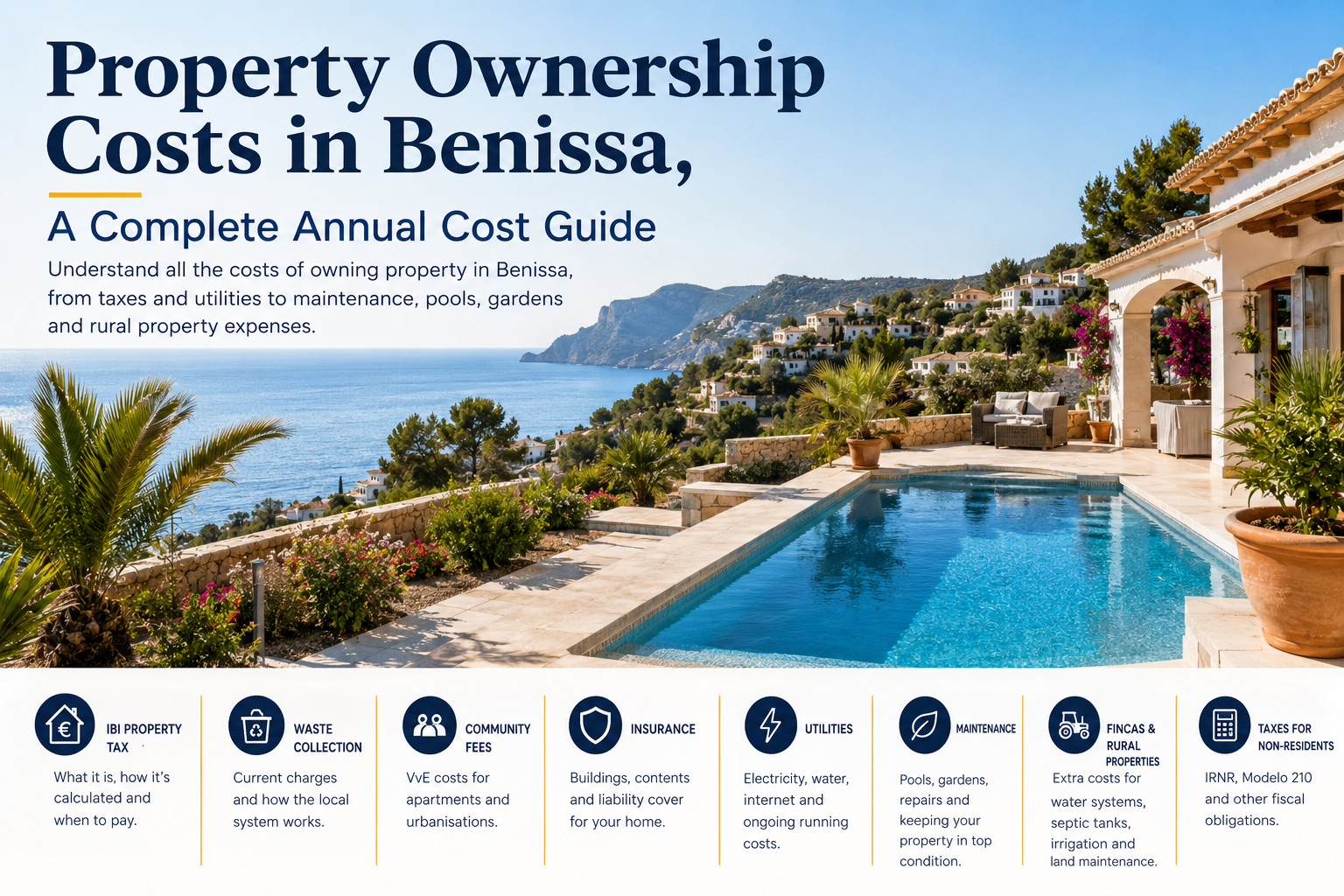
Property Ownership Costs in Benissa, Spain: Complete Annual Cost Guide
Introduction
Understanding property ownership costs in Spain is just as important as understanding the purchase price.
Buying a property in Benissa can be an excellent long-term decision, whether you are purchasing an apartment near the coast, a townhouse in the town, a villa in an established urbanisation or a finca with land inland. But the purchase price is only the beginning. Every property has ongoing costs, and those costs can vary considerably depending on what you buy.
A two-bedroom apartment and a large finca in the Benissa countryside may both be described simply as "property", but their annual running costs can be completely different.
For an owner in Benissa, the recurring budget may include:
-
Waste collection charges
-
Community fees
-
Buildings and contents insurance
-
Electricity
-
Water
-
Swimming pool maintenance
-
Garden maintenance
-
Repairs and general maintenance
-
Security and property inspections
-
Rural infrastructure
-
Tax obligations for non-resident owners
For overseas buyers, there can also be tax obligations that are easy to overlook, particularly if the property is used as a second home or left empty for part of the year.
This guide explains the cost of owning a property in Spain from the perspective of owning property in Benissa and the Costa Blanca North. It also explains why a finca, villa and apartment can have very different annual budgets, and gives worked examples to help buyers assess the true cost before purchasing.
Quick answer: There is no reliable single percentage or fixed annual figure for owning property in Spain. A small apartment may have relatively modest running costs, while a detached villa with a pool and garden can cost several thousand euros more each year. A finca can require a still larger reserve because of land, water systems, wastewater, access and other rural infrastructure.
Important: Tax rules, municipal charges and regulations can change. The tax information in this guide reflects the rules and official guidance available at the time of publication and should be checked again before making a purchase or filing a tax return.
Table of Contents
-
Additional Costs of Owning a Finca or Rural Property in Benissa
-
Property Ownership Costs in Benissa — Annual Budget Checklist
-
Frequently Asked Questions About Property Ownership Costs in Benissa
How Much Does It Cost to Own a Property in Benissa?
There is no single annual figure that applies to every Benissa property.
The most useful way to budget is to separate ownership costs into four groups:
-
Fixed costs — expenses such as IBI, insurance and community fees.
-
Usage costs — electricity, water and other services affected by occupancy.
-
Maintenance costs — pools, gardens, repairs and servicing.
-
Contingency and major expenditure — larger repairs and replacement of ageing equipment.
Typical annual property ownership costs
The following is a budgeting framework rather than a price list. Actual costs should be established from the specific property's bills, quotations and physical condition.
| Cost category | Apartment | Townhouse | Detached villa | Finca |
|---|---|---|---|---|
| IBI | ✓ | ✓ | ✓ | ✓ |
| Waste charges | ✓ | ✓ | ✓ | ✓ |
| Community fees | Often | Sometimes | Sometimes | Usually not |
| Insurance | ✓ | ✓ | ✓ | ✓ |
| Electricity | ✓ | ✓ | ✓ | ✓ |
| Water | ✓ | ✓ | ✓ | ✓ |
| Internet | Common | Common | Common | Location dependent |
| Pool | Usually communal | Sometimes | Often private | Often private |
| Garden | Low/communal | Low–moderate | Moderate–high | Potentially high |
| General maintenance | Low–moderate | Moderate | Moderate–high | High |
| Rural infrastructure | No | No | Occasionally | Often |
| Property management | Optional | Optional | Useful for second homes | Particularly useful |
| Overall complexity | Low | Low–moderate | Moderate | High |
The purchase price is therefore a poor predictor of annual running costs.
A €500,000 apartment and a €500,000 finca could have completely different ownership budgets.
Why ownership costs vary between properties
The most important factors are:
-
Property type: apartment, townhouse, villa or finca
-
Property size: larger properties generally require more energy and maintenance
-
Plot size: maintaining 1,000 m² is very different from maintaining several thousand square metres
-
Location: coastal properties can face greater exposure to wind and salt-laden air
-
Swimming pool: private pools create recurring cleaning, chemical and equipment costs
-
Garden: mature gardens, trees, lawns and hedges require ongoing work
-
Community: apartments and some urbanisations have communal fees
-
Rural infrastructure: fincas may use water deposits, private wastewater systems, pumps or alternative energy
-
Occupancy: a permanently occupied home normally uses more utilities than a holiday home
-
Tax status: non-resident owners can have Spanish tax obligations even where a property produces no rental income
Fixed, variable and unexpected costs
A useful way to think about the cost of owning a property in Spain is to divide expenses into three principal groups, plus a separate reserve for major expenditure.
Fixed costs
These are relatively predictable:
-
IBI
-
Waste charges
-
Community fees
-
Insurance
-
Internet
-
Property management, where contracted
Variable costs
These depend on usage or maintenance requirements:
-
Electricity
-
Water
-
Pool chemicals and servicing
-
Garden maintenance
-
Cleaning
-
Repairs
Unexpected costs
These are the expenses that can disrupt an otherwise sensible budget:
-
Broken pool pumps
-
Air-conditioning failure
-
Roof repairs
-
Plumbing leaks
-
Electrical faults
-
Storm damage
-
Irrigation failures
-
Water-system repairs
-
Septic-system problems
-
Wall or gate repairs
Major replacement and capital expenditure
Routine maintenance is not the same as replacing a major system.
Eventually, a property may require:
-
New air-conditioning equipment
-
A replacement pool pump or filtration system
-
New windows
-
Roof work
-
Exterior repainting
-
New solar equipment or batteries
-
Driveway repairs
-
Major landscaping
These costs should ideally be planned through a separate long-term reserve.
Expert Tip: When comparing properties in Benissa, ask for the previous 12 months of utility bills, the latest IBI receipt, waste charges, community accounts and available maintenance invoices. Actual historical costs are far more useful than a generic online estimate.
Main Annual Costs of Owning Property in Benissa
IBI Property Tax
IBI stands for Impuesto sobre Bienes Inmuebles, the Spanish local property tax.
It applies to qualifying urban and rural property. The tax calculation is based on cadastral information and the applicable local tax rate rather than simply on what the property is worth on the open market. Spanish legislation establishes the framework for the tax, including the relationship between the taxable base and the municipal rate.
This distinction is important.
A property might have a market value of €600,000 while its cadastral value is considerably lower. These figures serve different purposes and should never be assumed to be interchangeable.
The IBI calculation broadly involves:
-
The property's cadastral information.
-
The applicable taxable base.
-
The municipal tax rate.
-
Any applicable reductions or exemptions.
The exact annual bill therefore needs to be checked for the individual property.
Who pays IBI?
The person liable for IBI depends on the ownership and legal circumstances established by the applicable legislation. For a normal property purchase, buyers should make sure they obtain the latest IBI receipt and confirm that there are no outstanding amounts.
When is IBI paid?
The collection arrangements are established locally. Owners should check the current payment period and their specific bill rather than relying on a generic Spanish calendar.
How can you check your IBI?
Before buying a property, ask to see:
-
The latest IBI receipt
-
The cadastral reference
-
Relevant cadastral information
-
Evidence that previous IBI payments are up to date
The cadastral reference is also relevant when completing certain Spanish tax declarations, including Modelo 210 for non-residents.
Common Mistake: Assuming that the purchase price tells you what the IBI will be. It does not. The safest approach is to inspect the actual IBI bill for the property you are considering.
Waste Collection and Rubbish Charges
Waste collection is another recurring ownership cost.
Municipal waste charges are separate from the property's purchase price. The applicable charge and collection arrangements can change, so an old property listing or previous owner's estimate should not be treated as a current tariff.
When buying, ask for:
-
The latest waste bill or receipt
-
Confirmation of who administers the charge
-
The current payment arrangements
-
Confirmation that there are no outstanding amounts
This article deliberately does not publish an invented "standard Benissa rubbish fee". Where a municipal charge can change, the latest official bill is the more reliable source.
Expert Tip: Treat municipal charges in the same way as IBI during due diligence: obtain the actual property-specific documentation rather than relying on an estimate from a listing, agent or previous owner.
Community Fees
Community fees are particularly relevant to apartments and properties within managed urbanisations.
Depending on the development, community fees may contribute towards:
-
Communal swimming pools
-
Gardens
-
Roads or common areas
-
Lighting
-
Cleaning
-
Building maintenance
-
Lifts
-
Communal insurance
-
Administration
-
Other shared facilities
A property in an apartment complex may have a straightforward community budget.
A villa can be different. Even if it has a private pool and garden, the owner may still contribute towards communal roads, security, landscaping or other shared infrastructure.
What should buyers check?
Do not ask only:
"How much are the community fees?"
Also ask:
-
What exactly is included?
-
Have the fees increased recently?
-
Are there outstanding community debts?
-
Is there a reserve fund?
-
Have extraordinary payments been approved?
-
Are major works planned?
-
Does the property have any outstanding community balance?
Warning: A low community fee is not automatically a good thing. A poorly funded community can eventually require substantial extraordinary payments for essential works.
Home Insurance
Insurance is a core annual ownership cost.
Depending on the policy, cover can include:
-
Buildings
-
Contents
-
Third-party liability
-
Water damage
-
Fire
-
Storm-related damage
-
Theft
-
Glass
-
Other risks specified in the policy
The appropriate cover depends on the property.
A holiday home occupied for several weeks a year may have different insurance conditions from a permanently occupied residence. Rural properties can also require careful consideration because they may include large plots, detached structures, swimming pools, outbuildings, private water systems or solar equipment.
For a second home, check the policy's conditions concerning periods when the property is unoccupied.
Do not compare insurance policies on price alone. Check exclusions, liability limits, security requirements and unoccupied-property conditions.
Electricity
Electricity is one of the most variable ownership costs.
Two villas of similar size can have very different annual electricity bills.
The main influences include:
-
Property size
-
Number of occupants
-
Air conditioning
-
Heating
-
Hot water
-
Pool pump
-
Pool heating
-
Appliances
-
Home-office equipment
-
Frequency of occupancy
-
Electricity tariff
In Benissa, air conditioning can become a significant summer expense, particularly in larger detached properties.
Heating should not be overlooked either. Winters are mild compared with northern Europe, but detached properties can still require heating during cooler periods.
Expert Tip: When buying a second home, ask for 12 months of electricity bills rather than looking only at a summer bill. A holiday home's annual consumption can be highly seasonal.
Water
Water costs depend on consumption and the property's infrastructure.
A conventional property connected to the mains water network can be easier to budget for than a rural property with additional systems.
Factors include:
-
Number of occupants
-
Frequency of use
-
Garden irrigation
-
Pool filling and topping-up
-
Water leaks
-
Property size
-
Water source
-
Storage tanks or deposits
-
Irrigation systems
For a rural property, do not simply ask:
"Does the property have water?"
Ask:
"Where does the water come from, where is it stored, how is it distributed and what equipment is required to keep the system operating?"
That distinction can materially affect the annual ownership budget.
Internet and Telecommunications
Internet is straightforward for many properties, but rural connectivity requires more investigation.
A second home may continue to incur an internet subscription even when nobody is living there.
Connectivity can also support:
-
Security systems
-
Cameras
-
Smart heating
-
Remote monitoring
-
Alarm systems
-
Working remotely
Before buying a finca, check the actual services available at the property. Fibre availability in Benissa town does not automatically mean that the same service is available at a rural address.
For rural properties, alternatives may include mobile broadband or other technologies depending on the location.
Taxes for Non-Resident Property Owners in Spain
Owning a property in Spain while living abroad creates an additional layer of administration.
The key tax to understand is Impuesto sobre la Renta de No Residentes (IRNR), or Spanish Non-Resident Income Tax.
The tax treatment depends on how the property is used. The Spanish Tax Agency identifies, among other categories, imputed income from urban property, rental income and gains from the sale of Spanish property as relevant areas for non-resident taxation.
What is non-resident income tax?
IRNR is the Spanish tax system applying to certain income obtained in Spain by people who are not Spanish tax residents.
For a private individual who owns Spanish property, the tax position depends on factors including:
-
Whether the property is rented
-
Whether it is used personally
-
Whether it is vacant
-
The owner's tax residence
-
Ownership percentage
-
The period of ownership
-
The nature of the income
It is therefore important not to treat every non-resident property owner as having exactly the same tax calculation.
What is Modelo 210?
Modelo 210 is a Spanish tax return used for various categories of IRNR for taxpayers without a permanent establishment.
For property owners, it can be relevant to:
-
Imputed income from an urban property
-
Rental income
-
Certain property-related gains
The Agencia Tributaria specifically identifies imputed income from urban property as a category declared through Modelo 210.
2026 update: Modelo 210 deadlines
There has been an important recent change.
Order HAC/623/2026 introduced changes to Modelo 210 filing deadlines for certain imputed property income and rental-income declarations. The Spanish Tax Agency confirms that the changes apply to relevant 2026 tax-year declarations, while the treatment of earlier accruals remains subject to the previous timetable.
For imputed income relating to the 2026 tax year, the new timetable is relevant to filings made in 2027.
This is a good example of why owners should not rely indefinitely on old articles about Spanish property taxation.
Does a non-resident pay tax on an empty holiday home?
Potentially, yes.
A non-resident individual can have an IRNR liability on an urban property that is used personally or left vacant because Spanish tax rules can impose imputed income even when no rent has actually been received.
The calculation is based on the property's cadastral value and the applicable statutory percentage.
The current Agencia Tributaria guidance provides for a 1.1% percentage in specified circumstances, including where the cadastral value has been reviewed, modified or determined through a general collective valuation procedure in the relevant period or within the preceding ten tax periods. Other circumstances can result in a 2% percentage.
The resulting taxable amount is then subject to the applicable IRNR rate.
For eligible individual taxpayers, the general rate is currently 19% for residents of the EU, Iceland, Norway and Liechtenstein, and 24% for other taxpayers, subject to the taxpayer's precise circumstances and current legislation.
A simplified illustration
Suppose:
-
Cadastral value: €100,000
-
Applicable imputation percentage: 1.1%
-
Applicable IRNR rate: 19%
The simplified calculation would be:
€100,000 × 1.1% = €1,100 imputed income
Then:
€1,100 × 19% = €209 tax
This is only an illustration. It is not a tax calculation for a particular property.
The actual result can depend on the cadastral position, ownership percentage, dates, tax residence, applicable rate and current legislation.
What changes if the property is rented?
Rental income is treated differently from a property that is personally used or left vacant.
The Agencia Tributaria confirms that income from renting Spanish property can be subject to IRNR. For individuals without a permanent establishment, the general rate is currently 19% for qualifying residents of the EU, Iceland, Norway and Liechtenstein and 24% for other taxpayers, with the treatment of deductible expenses depending on the taxpayer's circumstances.
If a property is rented for only part of the year, rental income may apply to the rental period while imputed income may apply to the relevant remaining period.
This is one area where professional tax advice is particularly worthwhile.
For a detailed explanation, see the dedicated Rental Income Tax guide in the Telio Homes Property Guide.
Other taxes that may apply
Property ownership can also interact with other Spanish taxes depending on the owner's circumstances.
These can include:
-
Temporary Solidarity Tax on Large Fortunes
-
Capital Gains Tax when selling
-
Plusvalía when selling certain urban property
-
Tax relating to rental income
These should not all be treated as universal annual ownership costs.
Their relevance depends on factors such as:
-
Tax residence
-
Value of assets
-
Ownership structure
-
Whether the property is rented
-
Whether the property is sold
-
Estate-planning circumstances
-
Applicable regional rules
-
International tax treaties
Important — tax advice: Tax legislation can change. This article provides general information and should not be used as a substitute for advice from a qualified Spanish tax professional. Check the latest Agencia Tributaria guidance before filing any return.
Property Maintenance Costs in Benissa
Maintenance is where the difference between an apartment and a detached Mediterranean property becomes particularly obvious.
A property can look perfect when you buy it and still require regular expenditure to remain in good condition.
General repairs and maintenance
A sensible annual budget should allow for routine repairs such as:
-
Plumbing
-
Electrical work
-
Appliance repairs
-
Door and window adjustments
-
Locks
-
Damp-related repairs
-
Exterior maintenance
-
Small building repairs
Not every year will produce the same expenditure.
That is why a maintenance reserve is more useful than assuming maintenance will cost exactly the same every year.
For an older property, the reserve should be more conservative because several systems may reach the end of their useful lives at roughly the same time.
Swimming pool maintenance
A private swimming pool creates several recurring costs.
These can include:
-
Regular cleaning
-
Chemicals
-
Water testing
-
Filter maintenance
-
Pump maintenance
-
Equipment repairs
-
Replacement of consumable components
-
Occasional major repairs
The cost depends on pool size, filtration system, frequency of professional servicing and whether the owner handles some work personally.
A professionally maintained pool throughout the year will generally cost more than one maintained largely by the owner.
However, the bigger financial risk is not routine cleaning. It is replacement or repair of equipment.
A pump, filter, heating system or pool structure can produce a much larger one-off expense.
Garden maintenance
Garden costs vary dramatically in Benissa.
A small apartment garden is not comparable with a mature Mediterranean garden surrounding a detached villa.
Costs may include:
-
Regular gardening
-
Tree pruning
-
Hedge cutting
-
Irrigation maintenance
-
Weed control
-
Lawn care
-
Green waste
-
Pest control
-
Replacement planting
A property in La Fustera, San Jaime or Fanadix with a landscaped garden can have very different requirements from a rural property around Benimarco or Pedramala.
The size of the plot is only one consideration. Vegetation type matters too.
A relatively large plot with low-maintenance Mediterranean planting may be easier to manage than a smaller property with extensive lawns, hedges and ornamental planting.
Air conditioning and heating
Air-conditioning systems require periodic servicing.
Owners should budget for:
-
Routine servicing
-
Filter cleaning
-
Repairs
-
Refrigeration-system issues
-
Eventual replacement
Heating systems also require attention, particularly in larger detached properties.
When viewing a property, buyers should establish the age and condition of the main heating and cooling equipment.
A property with several older units may look inexpensive to run until multiple systems begin requiring replacement.
Painting and exterior maintenance
The Mediterranean climate is attractive, but exposed properties still require maintenance.
Sun, wind, rain and coastal conditions can affect:
-
External paint
-
Render
-
Metalwork
-
Wooden elements
-
Shutters
-
Pergolas
-
Balustrades
Properties closer to the coast can experience greater exposure to salt-laden air.
Exterior maintenance should therefore be treated as a recurring long-term cost rather than an occasional surprise.
Roof maintenance
Roofs should not be ignored simply because there is no visible leak.
Periodic inspection can identify:
-
Damaged tiles
-
Failed waterproofing
-
Cracked elements
-
Blocked drainage
-
Water ingress
-
Deteriorating flashing
For older fincas and traditional properties, roof condition can become a major financial consideration.
Plumbing and electrical repairs
Older properties can contain systems that have been modified repeatedly over the years.
A renovated interior does not necessarily mean that every underlying installation has been modernised.
Potential costs include:
-
Replacing old pipework
-
Repairing leaks
-
Upgrading electrical components
-
Replacing pumps
-
Replacing water heaters
-
Correcting poorly executed previous work
This is why technical checks before purchase are particularly important for older villas and fincas.
Pest control
Mediterranean properties can occasionally require professional pest treatment.
The need varies according to:
-
Property location
-
Garden
-
Trees
-
Outbuildings
-
Rural surroundings
-
Property condition
Rural properties may require more attention simply because they have greater contact with surrounding vegetation and land.
Security and alarm systems
Second-home owners often choose:
-
Alarm systems
-
Cameras
-
Smart locks
-
External lighting
-
Remote monitoring
These can involve both installation and recurring subscription costs.
For overseas owners, the value is not simply security. Remote monitoring can also provide early warning of water leaks, power failures and other problems.
Property inspections when you are abroad
For overseas owners, regular property inspections can be one of the most useful recurring services.
A property manager or trusted professional can identify problems such as:
-
Water leaks
-
Electrical faults
-
Storm damage
-
Pool equipment failure
-
Alarm problems
-
Garden deterioration
-
Damp
-
Broken shutters
A small inspection cost can be insignificant compared with the cost of discovering a leak several months after it began.
Expert Tip: If you own a second home that remains empty for long periods, budget for preventive inspections. The purpose is not simply to check that the house is still there; it is to identify small problems before they become expensive ones.
Additional Costs of Owning a Finca or Rural Property in Benissa
This is one of the biggest differences between owning a finca in Benissa and owning an apartment.
A rural property can provide privacy, land, views and character, but the land and infrastructure become part of the owner's responsibility.
Private water systems and water deposits
Some rural properties have water arrangements that differ from conventional urban properties.
Depending on the property, this can involve:
-
Water deposits
-
Pumps
-
Pressure systems
-
Filtration
-
Private water arrangements
-
Irrigation systems
The important question is not simply whether water is available.
A buyer should understand:
Where does the water come from? Where is it stored? How is it distributed? What equipment is involved? Who maintains that equipment?
Those answers can materially affect both annual running costs and the property's long-term maintenance requirements.
Septic tanks and wastewater systems
A rural property may not have the same wastewater infrastructure as a conventional urban property.
Where a septic or other private wastewater system is used, owners should understand:
-
What system is installed
-
Its maintenance requirements
-
Pumping requirements
-
Its condition
-
Its legal and technical status
-
Whether upgrades are required
A septic system should never be treated as an afterthought when buying a finca.
Large gardens and plots
Land is an asset, but it is also a maintenance obligation.
A 1,000 m² garden and a much larger rural plot are completely different propositions.
Costs can include:
-
Vegetation management
-
Tree pruning
-
Clearing
-
Irrigation
-
Access maintenance
-
Pest control
-
Green waste
-
Boundary maintenance
The owner should establish how much of the land is actually landscaped and how much is natural or agricultural.
Irrigation systems
Large gardens can contain irrigation networks involving:
-
Pumps
-
Timers
-
Pipes
-
Drippers
-
Sprinklers
-
Filters
-
Water storage
Leaks or pump failures can increase water consumption and repair costs.
Irrigation should therefore be inspected as part of the property rather than treated as a minor garden feature.
Walls, gates and fencing
Rural properties often have considerably more boundary infrastructure than apartments.
Maintenance can include:
-
Stone walls
-
Fencing
-
Gates
-
Gate motors
-
Posts
-
Access-control systems
Older masonry boundaries may require specialist repairs.
Automatic gates also contain electrical and mechanical components that eventually need servicing or replacement.
Rural access and exterior maintenance
The house itself is only part of a finca.
Owners should also consider:
-
Private driveways
-
Gates
-
Drainage
-
Access surfaces
-
Retaining structures
-
Vegetation
-
Stormwater management
Heavy rainfall can expose weaknesses in drainage and access arrangements.
A buyer should therefore look beyond the building when estimating the annual cost of owning a rural property.
Solar panels and alternative energy systems
Solar panels can reduce reliance on grid electricity, but they are not maintenance-free.
Depending on the system, owners may need to consider:
-
Inverter servicing
-
Battery replacement
-
Panel cleaning
-
Electrical components
-
Monitoring equipment
-
Eventual replacement
The buyer should establish exactly what equipment is installed, its approximate age and what forms part of the sale.
Why a finca can cost more to maintain than an apartment
The difference is simple:
An apartment owner mainly maintains a home and contributes towards communal infrastructure. A finca owner may be responsible for a home, pool, garden, land, water system, wastewater system, access, boundaries and multiple pieces of equipment.
That does not make a finca a bad purchase.
It simply means that the annual ownership budget needs to reflect the property as a whole.
Expert Tip: When comparing a finca with an apartment at a similar purchase price, compare the infrastructure rather than the asking price. The annual cost difference can come from the pool, land, water, septic system, access and maintenance—not from the house itself.
Property Ownership Costs by Property Type
The table below is a practical budgeting framework rather than a published price list.
| Cost category | Apartment | Townhouse | Detached villa | Finca | Large villa with pool & garden |
|---|---|---|---|---|---|
| IBI | ✓ | ✓ | ✓ | ✓ | ✓ |
| Waste | ✓ | ✓ | ✓ | ✓ | ✓ |
| Community | Often | Sometimes | Sometimes | Usually no | Sometimes |
| Insurance | Low–moderate | Moderate | Moderate | Moderate–high | High |
| Electricity | Low–moderate | Moderate | Moderate–high | Moderate–high | High |
| Water | Low–moderate | Moderate | Moderate | Variable | Moderate–high |
| Pool | Usually communal | Sometimes | Often | Often | Often |
| Garden | Low | Low–moderate | Moderate–high | High | High |
| Rural systems | No | No | Sometimes | Often | Occasionally |
| Maintenance | Low–moderate | Moderate | Moderate–high | High | High |
| Property management | Optional | Optional | Common for second homes | Particularly useful | Common for second homes |
| Overall complexity | Low | Low–moderate | Moderate | High | High |
The same purchase price can produce very different annual costs
Consider three properties, each costing approximately €500,000:
| Property | Likely ownership profile |
|---|---|
| Apartment | Community fees, utilities, insurance, IBI and relatively limited private maintenance |
| Detached villa | Utilities, private pool, garden, insurance, IBI and a larger maintenance reserve |
| Finca | All of the above, potentially plus land, water systems, septic infrastructure, gates, walls, irrigation and rural access |
This is why percentage rules such as "budget 1% of the property value" should be treated only as a rough starting point, not as a substitute for property-specific analysis.
A €500,000 property is not automatically a €5,000-per-year property to own.
Realistic Examples of Annual Property Costs in Benissa
The following examples answer the question many buyers actually ask:
"How much should I budget each year?"
These are illustrative budgeting ranges, not quotations from Benissa suppliers or official municipal statistics.
The examples assume:
-
Private ownership
-
Moderate occupancy
-
Normal household consumption
-
Standard insurance
-
Routine rather than major refurbishment
-
No mortgage costs
-
No major one-off construction project
-
No extraordinary tax liability
-
No rental operation unless specifically stated
Actual costs can be substantially different.
Example 1 — €300,000 Benissa apartment
Assume:
-
Two-bedroom apartment
-
Communal pool
-
Communal areas
-
Moderate community fees
-
Used mainly as a second home
| Cost | Illustrative annual range |
|---|---|
| IBI | €450–€900 |
| Waste charges | €150–€250 |
| Community fees | €600–€1,500 |
| Insurance | €200–€350 |
| Electricity | €800–€1,500 |
| Water | €200–€400 |
| Internet | €300–€500 |
| Routine maintenance reserve | €300–€600 |
| Non-resident tax* | €200–€600 |
| Illustrative total | €3,200–€6,600 |
*Only where applicable, and shown as a broad budgeting allowance rather than a tax calculation.
The biggest variables are likely to be community fees and utilities.
Before buying, obtain the community accounts and actual utility bills rather than relying on the range above.
Example 2 — €400,000 coastal apartment in Benissa Costa
Assume:
-
Two- or three-bedroom apartment
-
Benissa Costa location
-
Communal pool
-
Communal gardens
-
Holiday-home use
-
No major private garden
| Cost | Illustrative annual range |
|---|---|
| IBI | €500–€1,000 |
| Waste charges | €150–€250 |
| Community fees | €800–€1,800 |
| Insurance | €250–€400 |
| Electricity | €900–€1,700 |
| Water | €250–€450 |
| Internet | €300–€500 |
| Maintenance reserve | €400–€700 |
| Property inspections/management | €300–€900 |
| Non-resident tax* | €200–€700 |
| Illustrative total | €4,050–€8,400 |
This illustrates an important point: a coastal apartment can have meaningful annual costs even without a private pool or large garden.
Community fees and property management can become particularly relevant for overseas owners.
Example 3 — €500,000 Benissa villa
Assume:
-
Detached villa
-
Private swimming pool
-
Medium-sized garden
-
Air conditioning
-
Second-home use
-
No major structural problems
| Cost | Illustrative annual range |
|---|---|
| IBI | €800–€1,600 |
| Waste charges | €150–€250 |
| Insurance | €350–€600 |
| Electricity | €1,500–€2,800 |
| Water | €300–€600 |
| Internet | €300–€500 |
| Pool | €900–€1,500 |
| Garden | €1,000–€2,500 |
| General maintenance reserve | €1,000–€2,500 |
| Property inspections/management | €300–€1,000 |
| Non-resident tax* | €300–€800 |
| Illustrative total | €6,600–€14,150 |
The largest variables are electricity, gardening, pool maintenance and repairs.
A villa occupied for several months a year can have significantly higher utility consumption than one visited for only a few weeks.
Example 4 — €600,000 villa in San Jaime or nearby Benissa Costa
Assume:
-
Detached villa
-
Private pool
-
Established garden
-
Air conditioning
-
Terraces
-
Security system
-
Second-home use
| Cost | Illustrative annual range |
|---|---|
| IBI | €900–€1,800 |
| Waste charges | €150–€250 |
| Insurance | €400–€700 |
| Electricity | €1,600–€3,000 |
| Water | €350–€700 |
| Internet/security | €400–€800 |
| Pool | €900–€1,600 |
| Garden | €1,200–€2,800 |
| General maintenance reserve | €1,200–€3,000 |
| Property management/inspections | €400–€1,200 |
| Non-resident tax* | €300–€900 |
| Illustrative total | €7,800–€16,750 |
The purpose of this example is not to suggest that every San Jaime property costs this much.
It demonstrates how a coastal villa's annual budget can increase when it combines a private pool, garden, security systems and regular professional maintenance.
Example 5 — €700,000 Benissa finca
Assume:
-
Detached finca
-
Large plot
-
Private swimming pool
-
Garden
-
Water deposit or private water arrangement
-
Private wastewater system
-
Rural location
-
Irrigation
-
Gates and boundary infrastructure
| Cost | Illustrative annual range |
|---|---|
| IBI | €900–€1,800 |
| Waste charges | €150–€250 |
| Insurance | €400–€700 |
| Electricity | €1,500–€3,000 |
| Water / water infrastructure | €400–€1,300 |
| Internet | €300–€600 |
| Pool | €900–€1,600 |
| Garden / land | €1,500–€4,000 |
| Septic / wastewater | €200–€500 |
| General maintenance | €1,500–€3,500 |
| Walls, gates, access and exterior reserve | €500–€1,500 |
| Property inspections/management | €400–€1,200 |
| Non-resident tax* | €300–€900 |
| Illustrative total | €9,050–€20,850 |
This is why rural-property buyers should never compare fincas with apartments simply on purchase price.
The land and infrastructure can create an entirely different maintenance profile.
Example 6 — €1 million+ villa
A large villa may include:
-
Extensive gardens
-
Large swimming pool
-
Multiple air-conditioning units
-
Several bathrooms
-
Outdoor kitchens
-
Terraces
-
Automatic gates
-
Security systems
-
High-value contents
-
More complex technical equipment
A reasonable planning range might be €12,000–€25,000+ per year, before mortgage costs, major renovation projects or unusual repairs.
This is deliberately broad.
A modern, energy-efficient property with solar power and a simple garden could cost considerably less to operate than an older villa with extensive landscaped grounds and several ageing technical systems.
Important: These examples are budgeting models, not official statistics. Before buying, replace every estimate with the property's actual IBI receipt, waste bill, community accounts, utility bills, insurance quotation and realistic maintenance requirements.
What should you ask the seller before buying?
One of the best ways to estimate the cost of owning a property in Spain is to replace assumptions with evidence.
| Information to request | Why it matters |
|---|---|
| Latest IBI receipt | Establishes the actual property tax |
| Latest waste bill | Establishes the current municipal charge |
| 12 months of electricity bills | Shows real consumption |
| 12 months of water bills | Shows consumption and possible anomalies |
| Community accounts | Shows fees, reserves and planned expenditure |
| Community debt certificate | Identifies outstanding community obligations |
| Insurance details | Shows current cover and risk profile |
| Pool maintenance invoices | Establishes actual annual pool costs |
| Garden maintenance invoices | Establishes actual gardening costs |
| Air-conditioning/heating information | Identifies ageing equipment |
| Water-system information | Important for rural properties |
| Septic-system information | Establishes rural wastewater requirements |
| Solar-system information | Establishes equipment and maintenance needs |
| Property management agreement | Establishes second-home management costs |
This information can transform a generic ownership-cost estimate into a much more realistic financial model.
How Much Does It Cost to Own a Holiday Home in Benissa?
A holiday home is not necessarily an inexpensive home simply because you are not there all year.
Costs when you use the property yourself
When occupied, costs can increase because of:
-
Air conditioning
-
Water consumption
-
Electricity
-
Pool use
-
Hot water
-
Internet
-
Cleaning
-
Gardening
The summer period can be particularly important for electricity consumption.
Costs when the property is empty
Even an empty property can continue generating:
-
IBI
-
Waste charges
-
Insurance
-
Community fees
-
Internet
-
Security costs
-
Maintenance
-
Garden costs
-
Pool costs
-
Tax obligations for non-residents, where applicable
This is why "we only use it for six weeks a year" does not mean the annual ownership cost is six weeks' worth of expenses.
Security and property management
For owners living in the UK, Netherlands, Belgium, Germany, France or elsewhere, property management can be particularly valuable.
Services can include:
-
Regular inspections
-
Keyholding
-
Emergency response
-
Cleaning
-
Pool management
-
Garden maintenance
-
Contractor access
-
Pre-arrival preparation
-
Storm checks
The cost of management should be considered part of the holiday-home budget rather than treated as an unexpected expense.
Maintenance between visits
A vacant property needs attention.
A small leak can become a major problem if nobody notices it.
Similarly:
-
A failed pool pump can damage equipment.
-
An irrigation leak can waste substantial water.
-
A storm can damage external elements.
-
An alarm fault can go unnoticed.
-
Vegetation can quickly become difficult to control.
Why vacant does not mean cost-free
The annual cost of owning a second home is largely determined by the property itself, not by the number of nights you sleep there.
A property with a pool, garden and extensive equipment still needs to be maintained whether you visit for two weeks or six months.
What If You Rent Out Your Benissa Property?
Rental income changes the financial calculation.
Once a property is rented, owners need to consider additional operating costs, including:
-
Property management
-
Guest communication
-
Cleaning
-
Linen
-
Changeovers
-
Maintenance
-
Consumables
-
Booking-related costs
-
Insurance
-
Rental-related tax
-
Applicable licences and regulatory requirements
The tax treatment depends on the owner's circumstances and the nature of the rental.
The Agencia Tributaria confirms that rental income from Spanish property can be subject to the relevant non-resident tax rules where IRNR applies.
Local and regional rules relating to tourist accommodation can also change, so owners should verify the current requirements before advertising a property for short-term tourist rental.
For a detailed explanation of taxation, see the Telio Homes guide to Rental Income Tax in Spain.
How to Budget for Property Ownership in Benissa
A practical annual budget should be created before you make an offer.
Calculate your fixed annual costs
Start with:
-
IBI
-
Waste charges
-
Community fees
-
Insurance
-
Internet
-
Known property-management costs
Use actual bills wherever possible.
Estimate your monthly running costs
Add:
-
Electricity
-
Water
-
Pool
-
Garden
-
Cleaning
-
Property management
For a second home, use historical bills if available.
Create a maintenance reserve
Do not budget only for predictable maintenance.
Set aside a separate annual reserve for:
-
Appliances
-
Air conditioning
-
Pool equipment
-
Plumbing
-
Electrical work
-
Exterior repairs
-
Painting
-
Roof work
Create a major-replacement reserve
Routine maintenance and major replacement are not the same.
Consider the eventual replacement of:
-
Air-conditioning systems
-
Pool pumps
-
Water heaters
-
Solar inverters
-
Solar batteries
-
Appliances
-
Windows
-
Roof components
A property with older equipment may need a larger reserve than a newly refurbished property.
Budget for unexpected repairs
A roof, pool pump, air-conditioning system or electrical installation can produce a substantial one-off bill.
A property owner with no financial reserve can find these repairs particularly difficult.
Budget differently for rural properties
For a finca, add a separate rural-property reserve covering:
-
Water infrastructure
-
Septic system
-
Irrigation
-
Gates
-
Walls
-
Fencing
-
Access
-
Trees
-
Land maintenance
-
Solar equipment
A simple ownership-cost formula
Annual ownership budget = fixed costs + variable costs + maintenance reserve + major-replacement reserve + contingency
This is a better approach than simply saying:
"I have €X for the property, so I can afford it."
The purchase budget and ownership budget should be calculated separately.
Property Ownership Costs in Benissa — Annual Budget Checklist
Use this checklist when calculating the real cost of a property.
Property taxes and municipal charges
-
IBI checked
-
Latest IBI receipt obtained
-
Cadastral reference confirmed
-
Waste charges checked
-
Outstanding municipal charges checked
Community
-
Current community fee confirmed
-
Community accounts reviewed
-
Extraordinary payments checked
-
Planned major works identified
-
Communal facilities understood
-
Community reserve fund checked
-
Community debts checked
Insurance
-
Buildings insurance
-
Contents insurance
-
Liability cover
-
Holiday-home conditions checked
-
Rural-property requirements checked where applicable
-
Unoccupied-property conditions checked
Utilities
-
Electricity bills reviewed
-
Water bills reviewed
-
Internet availability confirmed
-
Heating system checked
-
Air conditioning checked
-
Solar system understood where applicable
-
Equipment age checked
Pool and garden
-
Pool maintenance cost estimated
-
Pool equipment condition checked
-
Garden maintenance cost estimated
-
Irrigation system checked
-
Tree maintenance considered
-
Green-waste requirements considered
Maintenance
-
Roof condition assessed
-
Plumbing checked
-
Electrical installation reviewed
-
Windows and shutters checked
-
Exterior paint/render assessed
-
Gates and fencing checked
-
Drainage considered
-
Major equipment age assessed
Rural property
-
Water source confirmed
-
Water deposit checked
-
Pumps checked
-
Septic system checked
-
Rural access assessed
-
Walls and boundaries inspected
-
Land maintenance estimated
-
Solar equipment checked
-
Irrigation equipment checked
Non-resident owners
-
IRNR position established
-
Modelo 210 requirements checked
-
Ownership percentages confirmed
-
Tax residence confirmed
-
Rental activity considered
-
Professional tax advice obtained where necessary
Before making an offer
-
Actual annual costs calculated
-
Maintenance reserve estimated
-
Major replacement risks identified
-
Property-management costs considered
-
Emergency contingency considered
-
Total annual budget compared with personal finances
Frequently Asked Questions About Property Ownership Costs in Benissa
1. How much does it cost to own a property in Benissa?
There is no universal figure. An apartment may have relatively modest annual costs, while a detached villa with a pool and garden can cost several thousand euros more. A large finca can require an even larger maintenance budget because of land, water, wastewater, access and rural infrastructure.
2. What are the annual costs of owning a property in Spain?
The main costs can include IBI, waste charges, community fees, insurance, electricity, water, internet, maintenance, pool and garden care and, for some non-resident owners, IRNR. Rental properties can have additional operating and tax costs.
3. Is 1% of the property value enough to cover annual costs in Spain?
Not necessarily. Percentage rules can be useful as an initial budgeting exercise, but they can be misleading because two properties with the same market value can have very different ownership profiles. A villa with a pool and large garden can cost more to maintain than an apartment with the same purchase price.
4. How much is IBI in Benissa?
The amount varies by property because IBI is calculated using cadastral information and the applicable municipal tax rate. The safest way to establish the cost for a property is to obtain its latest IBI receipt rather than estimate it from the property's market value.
5. Do non-residents pay IBI in Spain?
IBI is a local property tax and is not limited to Spanish residents. Ownership of qualifying property creates the relevant liability under the applicable rules. Residency is a separate issue from the local property tax.
6. What is Modelo 210?
Modelo 210 is a Spanish tax return used for several categories of IRNR for taxpayers without a permanent establishment, including certain property-related income.
7. Do I pay tax on an empty holiday home in Spain?
A non-resident individual can have an IRNR liability on an urban property that is used personally or left vacant because Spanish tax rules can impose imputed income even when no rent has actually been received.
8. Do I have property costs if I only visit Spain for a few weeks?
Yes. Many ownership costs continue regardless of occupancy. IBI, waste charges, insurance, community fees, internet, maintenance and certain tax obligations can continue even when the property is empty.
9. How much does it cost to maintain a villa in Benissa?
It depends heavily on the villa. A property with a pool, mature garden, air conditioning and several terraces can require substantially more annual expenditure than a smaller, simpler home. A sensible budget should include both routine expenses and a maintenance reserve.
10. How much does swimming pool maintenance cost in Spain?
There is no single reliable national figure. Cost depends on pool size, equipment, cleaning frequency, chemical use, servicing arrangements and whether the owner performs some maintenance themselves. The best estimate comes from obtaining a local maintenance quotation for the specific pool.
11. How much does garden maintenance cost in Benissa?
Garden maintenance can range from relatively modest costs for a simple garden to several thousand euros annually for a large landscaped property or finca. The size of the plot, vegetation, trees, irrigation and frequency of maintenance are major factors.
12. How much are community fees in Benissa?
Community fees vary significantly between developments. An apartment with a communal pool, gardens, lift and other facilities can have substantially different fees from a small development with limited communal infrastructure. Always inspect the latest community accounts and ask whether extraordinary payments are planned.
13. Is owning a finca in Benissa expensive?
It can be more expensive to maintain than an apartment because the owner may also be responsible for land, water deposits, irrigation, septic systems, gates, walls, access and other rural infrastructure.
14. What are the hidden costs of owning property in Spain?
The most commonly overlooked costs are often practical rather than mysterious taxes. They include maintenance, pool equipment, garden care, property inspections, insurance, rural infrastructure, major equipment replacement and non-resident tax obligations.
15. What does it cost to maintain a second home in Spain?
The answer depends on the property. A small apartment may be relatively straightforward, while a villa with a pool and garden can have significantly higher annual costs. Even when vacant, owners may continue paying fixed costs and may have tax obligations.
16. How much should I budget for annual property maintenance?
There is no universal percentage that works for every Benissa property. A better approach is to assess the age and condition of the building, pool, garden, installations and equipment, then establish a separate reserve for major repairs and replacement.
17. Are property ownership costs higher for rural properties?
They can be. Rural properties often have more infrastructure and land to maintain. Water systems, septic tanks, irrigation, access, walls, fencing and vegetation can all create additional costs compared with a conventional apartment.
18. What costs should I ask the seller for before buying?
Ask for the latest IBI receipt, waste bill, community accounts, community debt information, utility bills, insurance details and, where relevant, pool, garden, water, septic and solar-system information. This provides a much more reliable ownership-cost estimate than a generic percentage.
19. What is the cheapest type of property to maintain in Benissa?
There is no universal answer, but apartments and smaller townhouses often have lower private maintenance responsibilities because some external infrastructure is shared. Community fees need to be included in the comparison.
20. What is usually the most expensive type of property to maintain?
Large detached villas and fincas can require the greatest budgets because they may combine private pools, gardens, extensive equipment, larger buildings and, in the case of rural properties, additional infrastructure.
21. Does a swimming pool significantly increase annual property costs?
It can. A private pool creates recurring costs for cleaning, chemicals, water, electricity, servicing and eventual equipment replacement. The annual difference depends on the size and type of pool and how it is maintained.
22. What are the annual costs of a second home in Spain for a UK resident?
A UK resident owning property in Spain can have many of the same property running costs as any other owner, including IBI, insurance, utilities and maintenance. Non-resident Spanish tax obligations can also apply. The precise tax treatment should be checked against current Spanish rules and the owner's individual circumstances.
Final Thoughts on Property Ownership Costs in Benissa
The purchase price is only one part of the financial commitment involved in owning property.
The real property ownership costs in Spain depend on what you buy, where it is located, how it is built and how much infrastructure you are responsible for maintaining.
An apartment in Benissa may be relatively straightforward to budget for. A detached villa in San Jaime or La Fustera can require a larger annual reserve. A finca around Benimarco or Pedramala can require a completely different approach because of its land, water, wastewater, access and maintenance requirements.
For non-resident owners, Spanish tax obligations also need to be included in the calculation rather than treated as an afterthought.
The best time to calculate these costs is before buying, not after completion.
The most reliable approach is to build a property-specific budget from the actual IBI bill, waste charges, community accounts, utility bills, insurance quotation and expected maintenance requirements.
If you are comparing two properties at similar prices, do not assume they will cost the same to own.
Look at the whole property:
house + land + pool + garden + utilities + infrastructure + tax + maintenance + contingency.
That is the real cost of ownership.
Thinking about buying property in Benissa?
At Telio Homes, we specialise in Benissa and the Costa Blanca North. Our role is not simply to help buyers find a property; it is to help them understand the practical realities of owning it.
When assessing a property, it is worth looking beyond the asking price and asking:
What will this property actually cost me each year?
If you are considering buying in Benissa, Telio Homes can help you assess the property, understand its characteristics and identify the practical ownership considerations that should form part of your decision.
Authoritative Sources
For tax and legal information, owners should always check the latest official guidance.
Agencia Tributaria
The Spanish Tax Agency provides the current official information on IRNR and Modelo 210, including filing procedures and changes to filing deadlines.
Agencia Tributaria — Modelo 210 and Non-Resident Income Tax
Agencia Tributaria — Modelo 210 instructions
BOE — Spanish Official Gazette
The BOE provides the official consolidated legislation governing local taxation, including IBI. The current consolidated version of the Ley Reguladora de las Haciendas Locales was updated on 3 June 2026.
BOE — Ley Reguladora de las Haciendas Locales
Spanish Cadastre
The official Cadastre should be used when checking cadastral references and cadastral information relevant to a property.