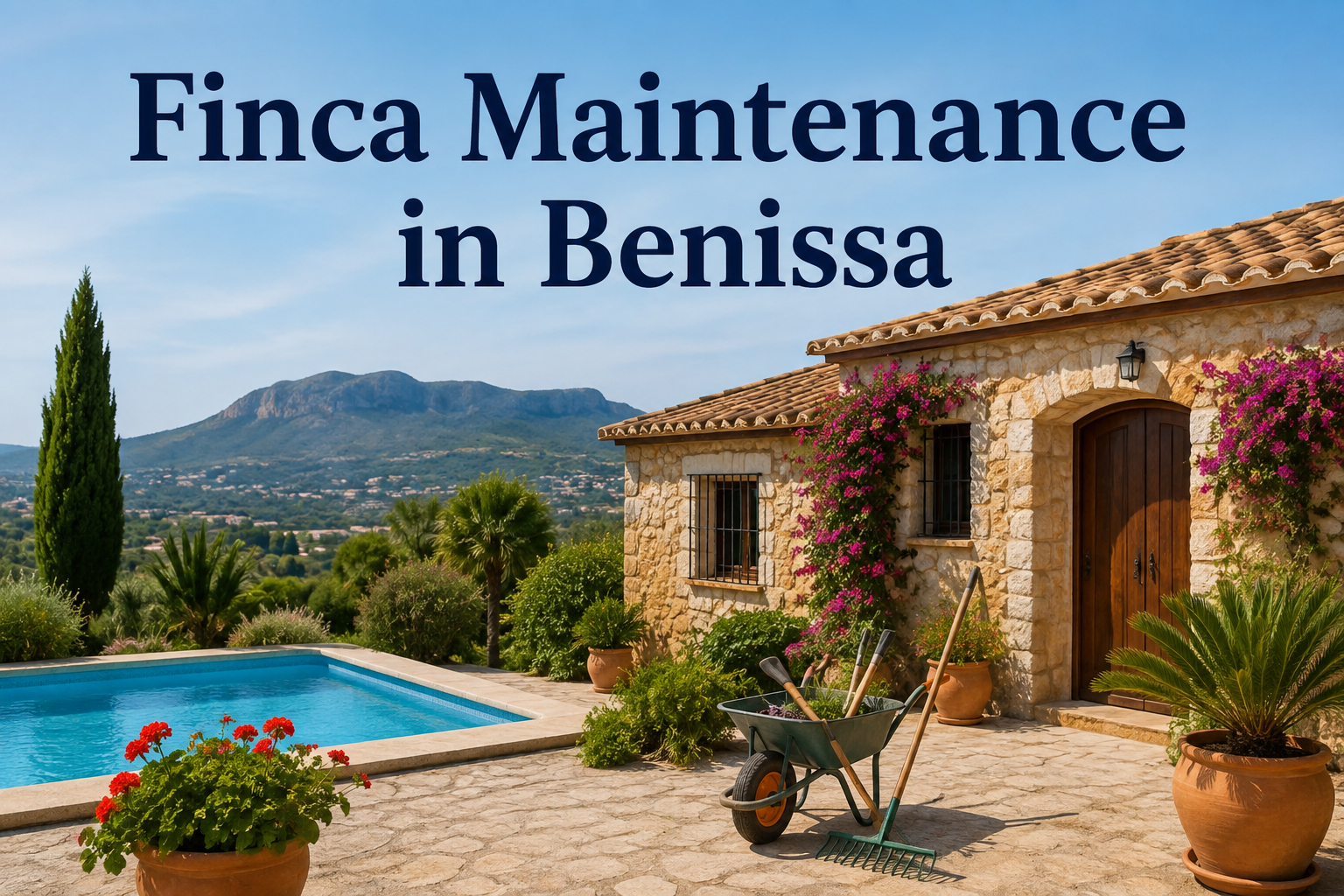
Finca Maintenance in Benissa, Spain: Complete Country House Maintenance Guide
Owning a finca in Benissa offers something that a conventional villa or apartment often cannot: more land, greater privacy, mature gardens, traditional architecture and a closer connection with the Mediterranean countryside. But finca maintenance in Spain is also more involved because you are usually maintaining much more than the house itself.
A rural property may include a swimming pool, garden, agricultural land, trees, irrigation, water deposits, pumps, a septic system, solar panels, boundary walls, gates, terraces and private access. Each additional system creates another potential maintenance requirement.
Benissa's Mediterranean climate adds another layer. Long, hot and dry summers place pressure on gardens, irrigation and pools, while periods of intense rainfall can expose weaknesses in roofs, terraces, drainage and retaining structures. Coastal properties may also experience greater exposure to salt-laden air.
For owners who live abroad, there is an additional risk: problems can develop while nobody is at the property.
The most effective approach is therefore preventative maintenance rather than emergency maintenance.
Quick answer: A finca in Benissa needs maintenance of the building, land, pool, water supply, wastewater system, drainage, access and security. For an empty property, a monthly inspection is a sensible practical baseline, with additional checks after significant storms or other events that could cause damage.
This guide explains what country house maintenance in Spain involves, how to maintain a finca throughout the year, what systems require professional attention, what owners living abroad should arrange, what maintenance can cost, and what buyers should investigate before purchasing a rural property in Benissa.
Why Finca Maintenance in Spain Is Different
A finca is more than a house
A conventional apartment may require little more than internal repairs, utility management and communal maintenance.
A finca can involve an entire network of independent systems and outdoor areas.
Depending on the property, maintenance may include:
-
The main house
-
Roofs and terraces
-
Exterior walls and render
-
Traditional stonework
-
Windows, doors and shutters
-
Swimming pool
-
Pool pump and filtration
-
Garden and landscaping
-
Fruit trees
-
Irrigation
-
Water deposits
-
Pumps and pressure systems
-
Wells or private water supplies
-
Batteries
-
Air conditioning
-
Heating
-
Fireplaces
-
Boundary walls
-
Fences and gates
-
Rural access roads
-
Retaining walls
-
Agricultural areas
-
Storage buildings
-
Security systems
This is why two fincas with similarly sized houses can have completely different ownership costs.
A relatively simple 180 m² finca on a manageable plot may be straightforward to maintain. A 180 m² house on several thousand square metres of sloping land with mature trees, a pool, private water supply and septic system is a very different proposition.
The maintenance profile matters as much as the house
When assessing a finca, think in terms of its maintenance profile rather than simply its floor area.
| Property characteristic | Likely maintenance impact |
|---|---|
| No swimming pool | Lower |
| Swimming pool | Higher |
| Small garden | Lower |
| Large landscaped garden | Higher |
| Mains water | Generally simpler |
| Water deposit and pump | More equipment to maintain |
| Septic/wastewater system | Additional maintenance |
| Large plot | More land to inspect |
| Mature trees | More pruning and storm-related work |
| Solar and battery system | Additional equipment |
| Long private access | More inspection and upkeep |
| Property occupied permanently | Problems usually noticed quickly |
| Property empty for months | Greater need for inspections |
How Benissa's climate affects your property
Benissa has a Mediterranean climate, with hot, dry periods during summer and generally mild winters.
For property owners, the important issue is not simply temperature. It is the combination of:
-
Strong sunlight
-
UV exposure
-
Long dry periods
-
Summer heat
-
Occasional intense rainfall
-
Wind
-
Coastal exposure
-
Rapid changes between dry and wet conditions
Over time, these conditions can affect exterior paint, render, sealants, timber, metalwork, irrigation equipment and outdoor furniture.
Properties nearer the coast, including areas of Benissa Costa and La Fustera, can also experience greater exposure to salt air than properties further inland.
Why rural properties need regular inspections
A rural property can be less forgiving when something goes wrong.
A leaking pipe inside an occupied home may be discovered immediately. A leaking pipe at an empty finca may continue for weeks.
Similarly:
-
A failed irrigation system can damage plants during summer.
-
A pool pump can stop working while nobody notices.
-
A roof leak can worsen during repeated rainfall.
-
A broken gate can leave the property unsecured.
-
Overgrown vegetation can increase fire exposure.
-
A blocked drainage channel can redirect water towards the building.
For an unoccupied finca, inspection is itself a form of maintenance.
The additional maintenance of land, pools and private infrastructure
The larger the plot and the more independent infrastructure it contains, the more important it becomes to understand the entire property.
When viewing a finca, do not stop at the kitchen, bedrooms and pool.
Walk the boundaries and ask:
-
Where does the water come from?
-
Where does wastewater go?
-
Where is the main water shut-off?
-
Where is the pump?
-
Where is the electrical panel?
-
How does irrigation work?
-
Where are the septic system and access points?
-
How is rainwater drained?
-
Who maintains the access?
-
What happens if the pool equipment fails?
Common Mistake: Buying a finca based almost entirely on the condition of the house. A well-presented property can still have significant maintenance requirements in its land, water, wastewater, drainage or infrastructure.
What Does Finca Maintenance Include?
House and building maintenance
Routine building maintenance includes:
-
Checking walls and ceilings for damp
-
Inspecting windows and doors
-
Checking shutters
-
Inspecting exterior paint and render
-
Checking external sealants
-
Inspecting terraces
-
Checking plumbing
-
Checking electrical installations
-
Servicing air conditioning
-
Inspecting heating systems
-
Checking fireplaces where applicable
The objective is to identify deterioration before it becomes expensive.
Roofs, terraces and exterior walls
Roofs deserve particular attention in rural properties.
Look for:
-
Broken or displaced roof tiles
-
Cracked mortar
-
Failed flashing
-
Blocked drainage points
-
Water stains internally
-
Damaged waterproofing
-
Vegetation
-
Problems around chimneys and other roof penetrations
After significant rainfall, a roof inspection can be particularly useful.
Garden and surrounding land
Land maintenance can include:
-
Weed control
-
Pruning
-
Tree management
-
Hedge cutting
-
Removal of dead vegetation
-
Irrigation maintenance
-
Fruit tree care
-
Clearing paths
-
Maintaining driveways
-
Checking walls
-
Removing fallen branches
The workload depends heavily on whether the land is ornamental, agricultural, natural or largely undeveloped.
Swimming pool
A private pool normally requires regular attention to:
-
Water level
-
Water chemistry
-
Surface debris
-
Pool walls
-
Skimmers
-
Filters
-
Pump
-
Valves
-
Automatic dosing equipment
-
Salt chlorinator, if installed
-
Pool cover
-
Lighting
-
Surrounding paving
The correct maintenance regime depends on the type of pool, equipment, frequency of use and local conditions.
Water supply and storage
A finca may have:
-
Mains water
-
A water deposit
-
A private well
-
A combination of systems
-
Separate irrigation water
-
Pressure pumps
The first step is understanding exactly how the property is supplied.
If a pump fails, for example, the problem may not be the water source itself but the equipment delivering water to the house.
Septic tank and wastewater
Where there is no conventional mains sewer connection, wastewater may be handled through an individual system.
Maintenance can include:
-
Checking the tank
-
Monitoring levels
-
Emptying when required
-
Inspecting pipes
-
Checking for odours
-
Looking for unusually wet areas
-
Ensuring inappropriate materials are not flushed
The exact maintenance requirements depend on the type of wastewater installation.
Electricity and solar systems
A finca may have:
-
Conventional grid electricity
-
Solar photovoltaic panels
-
Batteries
-
Backup systems
-
Generators
-
Separate circuits for pumps and pool equipment
Solar photovoltaic systems generally require limited routine maintenance, but the equipment should still be monitored and checked appropriately.
Air conditioning and heating
Before summer, service air-conditioning systems rather than waiting until the first major heatwave.
Check:
-
Filters
-
Drainage
-
Cooling performance
-
Outdoor units
-
Unusual noises
-
Condensation
-
Remote controls
For heating systems, inspect boilers, heat pumps, radiators and fireplaces before they are needed.
Walls, fences, gates and access
Rural properties often have more boundary infrastructure than urban homes.
Inspect:
-
Boundary walls
-
Fences
-
Gates
-
Automatic gate motors
-
Hinges
-
Locks
-
Access roads
-
Drainage channels
-
Retaining walls
A gate that becomes difficult to open is not merely a cosmetic issue if contractors, owners or emergency services need access.
Security and property inspections
A proper inspection should involve more than walking through the house.
A useful inspection covers:
-
Exterior
-
Roof and visible drainage
-
Water supply
-
Pool
-
Garden
-
Electricity
-
Security
-
Internal rooms
-
Damp and water ingress
-
Previous maintenance issues
Finca Maintenance Calendar: What to Do Throughout the Year
Monthly maintenance
For an empty finca, a monthly inspection is a sensible practical baseline.
Check:
-
Exterior condition
-
Interior condition
-
Visible leaks
-
Water supply
-
Pool equipment
-
Irrigation
-
Doors and gates
-
Security
-
Damp
-
Garden condition
-
Storm damage
-
Pest activity
Photograph anything requiring attention.
Quarterly maintenance
Every few months, carry out a deeper inspection covering:
-
Roof
-
Gutters
-
Drainage
-
Garden
-
Trees
-
Pool equipment
-
Water deposit
-
Pumps
-
Septic system
-
Air conditioning
-
Electrical systems
-
Boundary walls
-
Access road
-
Security
Annual maintenance
Annual work may include:
-
Air-conditioning servicing
-
Roof inspection
-
Major pruning
-
Irrigation servicing
-
Pool equipment servicing
-
Solar system inspection
-
Septic maintenance
-
Exterior painting or repairs
-
Gate servicing
-
Review of insurance and property documentation
Not every task needs to happen every year. The appropriate interval depends on the property and equipment.
Maintenance after heavy rain or storms
After significant rainfall or a storm, inspect:
-
Roofs
-
Terraces
-
Gutters
-
Drainage channels
-
Retaining walls
-
Lower-ground areas
-
Pool equipment
-
Trees
-
Boundary walls
-
Access roads
-
Water deposits
-
Electrical equipment exposed to water
This is particularly important on sloping rural plots.
Maintenance before and after long periods of absence
Before leaving:
-
Check for leaks
-
Secure the property
-
Confirm pool maintenance
-
Confirm garden maintenance
-
Test alarms
-
Check gates
-
Confirm inspection arrangements
-
Leave emergency access instructions
On return:
-
Check for water damage
-
Run taps
-
Check toilets
-
Inspect the pool
-
Check electricity
-
Test air conditioning
-
Inspect the garden
-
Look for pests
-
Review reports from the period of absence
Annual finca maintenance calendar
| Season | Main priorities |
|---|---|
| Spring | Garden, irrigation, pool, AC and winter damage |
| Summer | Pool, irrigation, vegetation, water, security and fire-risk management |
| Autumn | Drainage, gutters, roof, trees and storm preparation |
| Winter | Damp, water ingress, security, heating and storm inspections |
Spring Finca Maintenance in Benissa
Preparing the garden and land
Spring is a useful time to assess what happened during winter.
Look for:
-
Fallen branches
-
Dead plants
-
Damaged irrigation
-
Weeds
-
Erosion
-
Damaged paths
-
Problems with retaining walls
A garden that is manageable in March can become considerably more difficult once temperatures rise.
Checking irrigation systems
Test every irrigation zone rather than assuming the system is working.
Look for:
-
Broken emitters
-
Blocked drippers
-
Leaking pipes
-
Failed valves
-
Broken controllers
-
Poor pressure
A small leak can waste water while leaving other parts of the garden dry.
Preparing the swimming pool
Before regular summer use:
-
Clean the pool.
-
Inspect filtration.
-
Check the pump.
-
Check dosing equipment.
-
Test the water.
-
Inspect skimmers.
-
Check surrounding paving.
Inspecting the roof and exterior
Spring is a useful time to look for winter damage.
Pay particular attention to:
-
Roof tiles
-
Terrace waterproofing
-
External cracks
-
Sealants
-
Gutters
-
Downpipes
Checking air conditioning before summer
Do not wait for the first 35°C day.
Servicing the system before peak summer can identify drainage, filter or performance problems before demand for technicians increases.
Looking for winter damage
Walk around the property and compare it with photographs from the previous year.
For non-resident owners, dated photographs are particularly useful because they create a visual maintenance history.
Summer Finca Maintenance
Swimming pool and filtration
Summer is normally the busiest period for a private pool.
Check:
-
Water level
-
Filtration
-
Pump
-
Chemical balance
-
Skimmers
-
Pool cover
-
Surrounding paving
The exact maintenance regime depends on the pool equipment, size, weather and usage.
Garden irrigation
During hot periods, irrigation failures can become serious quickly.
Automated systems should be checked rather than simply programmed and forgotten.
Trees and vegetation
Dry vegetation around buildings should not be allowed to become unmanaged.
For rural properties, vegetation management should be considered both from a maintenance perspective and in relation to wildfire exposure.
Air conditioning
Clean filters and monitor performance.
An air-conditioning system that runs continuously but struggles to cool the property may require professional attention rather than simply a lower thermostat setting.
Water consumption and supply
For fincas using deposits, pumps or private systems, summer is when weaknesses often become most apparent.
Monitor:
-
Deposit levels
-
Pump operation
-
Pressure
-
Irrigation consumption
-
Pool top-ups
-
Unexpected consumption
Security during the summer
Check:
-
Gates
-
Locks
-
Cameras
-
Alarms
-
External lighting
-
Access controls
Reducing wildfire risk around the property
Vegetation management is an important part of responsible rural property ownership.
However, do not assume that every finca has identical legal obligations. Requirements can depend on the property's location, land classification and relationship with forest land.
Before clearing, cutting or carrying out significant work on vegetation in or near forest land, check the applicable Valencian and local requirements.
Important: General wildfire-prevention advice should not be treated as confirmation that particular works are legally permitted on a specific property.
Autumn Finca Maintenance
Preparing for heavy rainfall
Autumn deserves particular attention in the Marina Alta because intense rainfall can expose drainage weaknesses quickly.
Check:
-
Gutters
-
Downpipes
-
Roof drains
-
Terrace drains
-
Driveway drainage
-
Channels
-
Culverts
-
Retaining structures
Cleaning drainage and gutters
Remove leaves, soil and vegetation before the main rainfall period.
A blocked drain can turn otherwise manageable rainwater into a building problem.
Inspecting roofs and terraces
Look for:
-
Cracks
-
Loose tiles
-
Failed waterproofing
-
Standing water
-
Damaged flashing
-
Blocked outlets
Checking trees and branches
Large branches should be assessed before severe weather.
Pay particular attention to trees:
-
Close to the house
-
Near power lines
-
Overhanging roofs
-
Beside access roads
-
Near walls
Inspecting boundary walls
Heavy rain can expose weaknesses in old masonry, especially where water pressure builds behind a wall.
Look for:
-
Bulging
-
Cracks
-
Displaced stones
-
Erosion at the base
-
Drainage problems
Preparing the property for winter
Before leaving a property for a long period:
-
Check plumbing
-
Check security
-
Clean gutters
-
Inspect the roof
-
Test the alarm
-
Confirm inspection arrangements
-
Confirm emergency contacts
Winter Finca Maintenance
Protecting an empty finca
An empty finca should never be treated as a property that requires no attention.
Arrange regular inspections and make sure somebody local can respond quickly to a leak, storm or security issue.
Checking for damp and water ingress
Look for:
-
Ceiling stains
-
Peeling paint
-
Musty smells
-
Mould
-
Damp corners
-
Cracks
-
Water around windows
The key question is not simply whether damp exists, but where the water is coming from.
Heating and ventilation
Even in a mild Mediterranean climate, a closed property can develop humidity.
Periodic ventilation can help, while heating systems should be maintained according to the manufacturer's requirements.
Water systems
Whether particular sections of the plumbing should be isolated while the property is empty depends on the property's installation.
Do not adopt a generic procedure without understanding the house's plumbing, heating, pool and water-supply configuration.
Security inspections
Check:
-
Doors
-
Windows
-
Shutters
-
Gates
-
Alarms
-
Cameras
-
External lighting
Checking the property after storms
Do not wait until your next holiday.
Arrange an inspection after significant storms where there is a reasonable possibility of damage.
Maintaining the Finca Building
Roof maintenance
The roof is one of the most important elements of a rural property.
An inspection should identify:
-
Broken tiles
-
Movement
-
Cracked mortar
-
Flashing defects
-
Chimney problems
-
Blocked gutters
-
Damaged waterproofing
-
Vegetation
Traditional tiled roofs and modern flat roofs require different approaches, so maintenance should be appropriate to the construction.
Exterior walls and render
Look for:
-
Cracks
-
Blown render
-
Peeling paint
-
Damp staining
-
Salt deposits
-
Biological growth
Not every crack indicates structural damage. However, a crack that is widening, significant, associated with movement or accompanied by water ingress deserves professional assessment.
Traditional stone walls
Traditional stone walls are an important feature of many rural properties around Benissa.
Maintenance may involve:
-
Repointing
-
Replacing loose stones
-
Managing vegetation
-
Improving drainage
-
Addressing water penetration
Avoid using inappropriate repair materials simply because they appear quicker or cheaper. Traditional masonry may require techniques compatible with the original construction.
Windows, doors and shutters
Inspect:
-
Timber
-
Hinges
-
Locks
-
Frames
-
Seals
-
Shutters
-
Exterior paint
Coastal exposure can accelerate corrosion of exposed metal components.
Terraces and patios
Check:
-
Tiles
-
Grout
-
Drainage
-
Waterproofing
-
Expansion joints
-
Cracks
-
Slopes
Standing water is a warning sign rather than something to ignore.
Damp and water ingress
Possible sources include:
-
Roof
-
Terrace
-
Plumbing
-
Groundwater
-
Poor drainage
-
Failed sealant
-
Condensation
The correct repair depends on identifying the source.
Drainage around the property
Where possible, rainwater should be directed away from buildings.
Check whether:
-
Gutters discharge correctly
-
Drainage channels are clear
-
Terrace outlets work
-
Water collects beside walls
-
Driveways channel water towards the house
Building inspection checklist
-
Inspect roof tiles and waterproofing
-
Check gutters and downpipes
-
Look for internal damp
-
Inspect exterior render
-
Check stone walls
-
Inspect windows and shutters
-
Check terrace drainage
-
Look for significant cracks
-
Inspect doors and gates
-
Check drainage around the house
Garden and Land Maintenance at a Finca
Trees and pruning
Trees can be one of the greatest assets of a finca, but they also create maintenance responsibilities.
Large trees can affect:
-
Roofs
-
Pools
-
Driveways
-
Walls
-
Power lines
-
Drainage
-
Access
Large or potentially dangerous trees should be assessed by an appropriately qualified professional.
Weeds and dry vegetation
Unmanaged dry vegetation can increase fire exposure and make the property look neglected.
Management should be planned rather than left until vegetation becomes difficult to control.
Irrigation systems
A good irrigation system should be inspected regularly.
Check:
-
Timers
-
Valves
-
Drippers
-
Sprinklers
-
Filters
-
Pressure
-
Underground leaks
Fruit trees and agricultural areas
If a property includes citrus, olives, almonds or other trees, maintenance may include:
-
Pruning
-
Irrigation
-
Pest monitoring
-
Ground management
-
Harvesting
-
Removing fallen fruit
Where land has genuine agricultural use, applicable requirements may differ from those for a purely residential garden.
Boundary vegetation
Vegetation crossing boundaries can create disputes and maintenance problems.
Where boundaries are unclear, do not rely solely on what appears to be the physical boundary. Legal property boundaries should be checked through the appropriate documentation where necessary.
Driveways and access roads
Rural access can deteriorate through:
-
Heavy rainfall
-
Erosion
-
Vehicle use
-
Vegetation
-
Poor drainage
The correct repair depends on the surface, gradient and ownership arrangements.
Retaining walls and rural structures
On sloping land, retaining structures deserve particular attention.
Warning signs include:
-
New cracks
-
Bulging
-
Movement
-
Water pressure
-
Soil erosion
-
Displaced stones
Wildfire prevention and vegetation management
For rural properties, vegetation management should form part of the annual maintenance plan.
Pay particular attention to:
-
Dry vegetation close to buildings
-
Access routes
-
Trees overhanging structures
-
Accumulated garden waste
-
Dense vegetation around walls
-
Areas that could make property access more difficult
Local and regional requirements can vary according to the property's location and classification.
Finca garden and land maintenance checklist
-
Inspect trees
-
Remove dangerous dead branches
-
Control dry vegetation
-
Test irrigation
-
Check boundary vegetation
-
Inspect walls
-
Check driveway drainage
-
Inspect retaining structures
-
Clear access routes
-
Remove storm debris
-
Review wildfire-risk areas
Swimming Pool Maintenance at a Finca
Regular pool cleaning
Regular maintenance normally includes:
-
Surface cleaning
-
Skimmer cleaning
-
Pool-floor cleaning
-
Brushing
-
Filter maintenance
-
Water testing
-
Chemical adjustment
-
Pump checks
The correct programme depends on the pool size, equipment, exposure and use.
Water chemistry
The objective is to maintain water that is safe and comfortable while protecting the pool and its equipment.
Poorly controlled water can contribute to:
-
Algae
-
Cloudiness
-
Scaling
-
Corrosion
-
Equipment problems
Pumps and filtration
A pool pump should not simply be assumed to be working because the water looks clean.
Check:
-
Pump noise
-
Pressure
-
Filter pressure
-
Leaks
-
Valves
-
Timer
-
Electrical supply
Pool equipment
Inspect:
-
Salt chlorinator
-
Dosing equipment
-
Heat pump
-
Pool cover
-
Robot cleaner
-
Lights
-
Valves
Preparing the pool for summer
Before heavy use:
-
Clean the pool.
-
Check filtration.
-
Check the pump.
-
Test the water.
-
Inspect dosing equipment.
-
Check surrounding paving.
-
Confirm relevant safety equipment is in place.
Maintaining the pool when the property is empty
An empty pool should not simply be forgotten.
Depending on the system, owners may choose ongoing professional maintenance or a properly managed closed/low-use arrangement.
The correct approach depends on the equipment and local conditions.
What happens when pool maintenance is neglected?
Common consequences include:
-
Green water
-
Algae
-
Scaling
-
Blocked filters
-
Pump damage
-
Damaged surfaces
-
More expensive recovery work
Pool maintenance schedule
| Task | Typical frequency |
|---|---|
| Surface cleaning | Weekly or more often |
| Water testing | Regularly during use |
| Skimmer cleaning | Weekly |
| Pump inspection | Regularly |
| Filter maintenance | According to equipment |
| Chemical adjustment | According to test results |
| Professional servicing | Periodically |
| Equipment inspection | Annually or as required |
Water Systems at a Finca
Water is one of the most important systems to understand before buying a rural property.
A finca with a simple mains connection can have a very different maintenance profile from one dependent on a deposit, pump and private supply.
Mains water
A property connected to mains water is generally simpler, but you should still understand:
-
Meter location
-
Main stopcock
-
Internal distribution
-
Pressure
-
Any storage tank
-
Irrigation connection
Water deposits
Many rural properties use storage deposits.
A deposit can provide useful resilience but introduces additional equipment.
Check:
-
Tank condition
-
Float valve
-
Pump
-
Inlet
-
Outlet
-
Level sensor
-
Leaks
-
Cleanliness
Wells and private water supplies
A private water supply is a major point to investigate when buying a finca.
Do not simply ask whether the property "has water".
Ask:
-
What is the source?
-
Is it private or shared?
-
What documentation exists?
-
Is the supply reliable?
-
What equipment is required?
-
Is there storage?
-
What happens during dry periods?
-
What maintenance does the system require?
Rights relating to water and wells can be property-specific and should be checked professionally rather than assumed from statements made by a seller or neighbour.
Pumps and pressure systems
A pump failure can affect the entire house.
Know where:
-
The pump is
-
The pressure vessel is
-
Electrical protection is located
-
Isolation valves are located
-
Replacement parts can be obtained
Irrigation water
Understand whether domestic and irrigation systems are separate or connected.
An irrigation leak may not be obvious inside the house but can still create significant water loss.
Detecting water leaks
Warning signs include:
-
Unexpectedly high consumption
-
Pump running when no water is being used
-
Wet ground
-
Damp walls
-
Falling deposit levels
-
A toilet constantly refilling
-
Unexplained pool-water loss
Finca water systems compared
| System | Main advantage | Maintenance consideration |
|---|---|---|
| Mains water | Simple supply | Plumbing, meter and pressure |
| Water deposit | Provides storage | Tank, float valve and pump |
| Private well | Potential independent supply | Pump, equipment and legal status |
| Irrigation system | Efficient garden watering | Valves, filters and leaks |
| Combined system | Flexibility | More components to understand |
Septic Tanks and Wastewater
How septic systems work
A septic system receives wastewater from the property and separates solids from liquid.
Not every rural wastewater installation is identical. The actual system installed at the finca matters.
That is why a buyer should identify the system rather than simply recording "septic tank" in their notes.
Signs of a septic tank problem
Warning signs include:
-
Slow drains
-
Bad smells
-
Gurgling pipes
-
Wet ground
-
Sewage odours
-
Overflow
-
Repeated blockages
-
Unusually lush vegetation in one area
Septic tank maintenance
Maintenance may include:
-
Periodic inspection
-
Emptying when necessary
-
Checking access points
-
Inspecting pipes
-
Monitoring drainage
-
Preventing inappropriate materials entering the system
What should not go into a septic system?
Avoid flushing or pouring inappropriate materials such as:
-
Wet wipes
-
Oils and fats
-
Solvents
-
Paint
-
Strong chemicals
-
Non-degradable materials
-
Excessive disinfectants
Always follow the instructions supplied for the specific installation.
When professional inspection is required
Obtain professional advice when there is:
-
Persistent blockage
-
Overflow
-
Structural damage
-
Suspected contamination
-
Strong sewage odour
-
Unknown system configuration
-
A proposed replacement or modification
Septic systems and buying a finca
This is one of the systems buyers should understand before committing to a purchase.
Ask for:
-
Existing documentation
-
Location of the system
-
Maintenance history
-
Emptying records where available
-
Information about the discharge arrangement
-
Any permits or approvals relevant to the installation
Do not assume that an old installation is automatically legal simply because it has existed for many years.
Maintenance versus legality
These are two separate questions:
Maintenance: Is the system functioning and being maintained properly?
Legal status: Is the installation appropriately documented and authorised under the rules applicable to that property?
A buyer may need professional advice on both.
Electricity, Solar Panels and Heating
Electrical systems
A rural property may have a more complicated electrical installation than an apartment.
Check:
-
Main electrical panel
-
Protection devices
-
Outdoor circuits
-
Pool circuits
-
Pump circuits
-
Solar integration
-
Generator systems
-
Older wiring
Significant electrical work should be carried out by an appropriately qualified professional.
Solar panels
Solar photovoltaic systems are increasingly common on Spanish properties.
Routine maintenance is generally limited, but the system should still be monitored.
Check:
-
Panels
-
Inverter
-
Mounting
-
Cabling
-
Battery system where applicable
-
Monitoring equipment
-
Error messages
Batteries and backup systems
Battery systems introduce additional equipment.
Check:
-
Battery condition
-
Monitoring system
-
Inverter
-
Ventilation where applicable
-
Error messages
-
Backup configuration
Keep manufacturer documentation and installation information.
Air conditioning
Service before peak summer use.
Clean filters regularly and investigate unusual noises, leaks or poor cooling.
Boilers and water heating
Follow manufacturer maintenance requirements.
For gas, oil or other combustion systems, professional servicing is particularly important.
Fireplaces and wood-burning systems
Traditional fincas sometimes have fireplaces or wood-burning stoves.
Inspect:
-
Chimney
-
Flue
-
Hearth
-
Smoke path
-
Surrounding masonry
Arrange appropriate chimney cleaning and inspection according to the installation and professional recommendation.
Maintaining a Finca When You Live Abroad
For a non-resident owner, the objective is not simply to find someone who can "look at the house".
You need a repeatable inspection system.
How often should someone inspect your finca?
There is no single universal legally required interval for every private property.
For an empty second home, monthly inspection is a sensible practical baseline, with additional checks after significant storms or when a problem is suspected.
Properties with pools, private water systems, extensive gardens or older buildings may justify more frequent visits.
What should be checked during every inspection?
A useful report should cover:
-
Exterior
-
Interior
-
Water
-
Electricity
-
Pool
-
Garden
-
Security
-
Roof visibility
-
Damp
-
Gates
-
Previous repairs
Photographing and reporting problems
A good inspection report should include dated photographs.
Ideally, the owner receives:
-
Photographs
-
Short description
-
Urgency
-
Recommended action
-
Estimated cost where available
-
Contractor information
-
Completion photographs
Emergency repairs
Agree in advance who can authorise urgent work.
For example, an owner and property manager might agree a spending limit for emergency repairs designed to prevent further damage, with larger works requiring prior approval.
The exact arrangement should be agreed in writing.
Keyholding and access
A keyholder should know:
-
Where the main water shut-off is
-
Where the electrical panel is
-
How the alarm works
-
How to access pool equipment
-
How to contact emergency trades
-
Where property documents are stored
What should a property manager actually do?
Before appointing a property manager, ask exactly what is included.
| Service | Basic arrangement | Full management |
|---|---|---|
| Regular inspection | ✓ | ✓ |
| Emergency access | ? | ✓ |
| Pool coordination | ? | ✓ |
| Garden coordination | ? | ✓ |
| Contractor access | ? | ✓ |
| Utility monitoring | ? | ✓ |
| Pre-arrival preparation | ? | ✓ |
| Storm inspection | ? | ✓ |
| Maintenance reporting | ? | ✓ |
The important point is not the label "property management". It is the actual scope of service.
Preparing the property before you arrive
Before an owner arrives after several months away, arrange checks for:
-
Water
-
Electricity
-
Pool
-
Air conditioning
-
Cleaning
-
Garden
-
Internet
-
Fridge/freezer
-
Hot water
What to do before leaving Spain
Use a written departure procedure rather than relying on memory.
Checklist: Leaving your finca for several months
-
Check for leaks
-
Check water systems
-
Confirm pool maintenance
-
Confirm garden maintenance
-
Test alarm
-
Secure windows and shutters
-
Check gates
-
Confirm property inspection arrangements
-
Leave emergency contact details
-
Photograph important equipment
-
Record utility meter readings
-
Confirm insurance arrangements
-
Leave keyholder instructions
Create an emergency information sheet
Keep a simple document at the property and with the keyholder containing:
-
Property address
-
Owner contact details
-
Emergency contacts
-
Main water shut-off location
-
Electrical panel location
-
Pool equipment location
-
Pump location
-
Alarm instructions
-
Gate instructions
-
Septic-system information
-
Solar-system information
-
Insurance details
-
Regular contractor details
This can save valuable time when something goes wrong.
How Much Does Finca Maintenance Cost in Spain?
There is no meaningful universal figure for maintaining a finca.
A smaller property with limited land and no pool can have a relatively modest maintenance burden.
A large rural property with:
-
Several thousand square metres of land
-
Extensive gardens
-
A swimming pool
-
Mature trees
-
Private water infrastructure
-
Septic system
-
Solar installation
-
Long access road
can require substantially more.
Regular property maintenance
Recurring costs can include:
-
Property inspections
-
Cleaning
-
Minor repairs
-
Locksmith services
-
Plumbing
-
Electrical work
-
Pest control
Garden maintenance
Garden costs vary dramatically with plot size, landscaping and vegetation.
A small landscaped garden and several thousand square metres of rural land have completely different maintenance requirements.
Pool maintenance
Pool costs depend on:
-
Pool size
-
Equipment
-
Frequency of visits
-
Chemicals
-
Whether the pool is heated
-
Whether the property is occupied
-
Whether repairs are included
Utilities and servicing
Budget separately for:
-
Electricity
-
Water
-
Internet
-
Air-conditioning servicing
-
Heating
-
Solar servicing
-
Septic maintenance
These aren't all maintenance costs, but they form part of the property's real annual ownership burden.
Repairs and unexpected costs
A realistic budget should include a reserve for unexpected failures.
Examples include:
-
Pump failure
-
Broken irrigation
-
Roof repairs
-
Storm damage
-
Gate motor
-
Pool equipment
-
Plumbing
-
Electrical faults
Major maintenance and renovation
Major works should be budgeted separately from routine maintenance.
Examples include:
-
Roof replacement
-
Major waterproofing
-
Pool renovation
-
Structural wall repairs
-
Full exterior painting
-
Drainage works
-
Major landscaping
Property management for non-resident owners
A management service may charge a recurring fee, a visit fee or a combination.
The important question is not simply how much the service costs, but exactly what it includes.
Finca maintenance cost categories
| Category | Typical cost pattern |
|---|---|
| Property inspection | Recurring fee or included in management |
| Garden | Monthly/seasonal |
| Pool | Monthly during contract |
| Cleaning | Per visit |
| AC servicing | Periodic |
| Septic | Occasional |
| Tree work | Occasional and potentially significant |
| Roof | Periodic inspection; repairs as needed |
| Irrigation | Routine + repair |
| Gate/security | Routine + repair |
| Major works | Project-specific |
Important: Local service prices change. Always request a current written quotation for the actual property rather than relying on a universal annual figure.
How Much Should You Budget for Annual Finca Maintenance?
Rather than applying an artificial universal percentage to every finca, divide your budget into three parts.
1. Predictable recurring costs
For example:
-
Pool
-
Garden
-
Inspections
-
Cleaning
-
Routine servicing
2. Periodic maintenance
For example:
-
Tree pruning
-
Painting
-
Roof work
-
Septic servicing
-
AC servicing
-
Irrigation repairs
3. Contingency reserve
Keep money available for unexpected failures.
Low-maintenance finca
A smaller property with:
-
Limited garden
-
No pool
-
Mains water
-
Mains sewer
-
Simple access
-
Modern construction
will generally have a lower maintenance burden.
Finca with pool and garden
A typical finca with a pool, garden, trees and irrigation has a broader maintenance profile.
The important point is to budget for the whole property, not just the building.
Large finca with extensive land
A larger rural property can have substantially higher costs because of:
-
More vegetation
-
More trees
-
Longer boundaries
-
Longer access
-
Agricultural areas
-
Retaining walls
-
More irrigation
-
More infrastructure
Maintenance budget planner
| Category | Your annual estimate |
|---|---|
| Property inspections | €_____ |
| Garden | €_____ |
| Pool | €_____ |
| AC/heating | €_____ |
| Septic | €_____ |
| Water system | €_____ |
| Tree work | €_____ |
| Repairs reserve | €_____ |
| Total | €_____ |
Why maintenance costs vary between properties
The biggest variables are:
Plot size + building age + infrastructure + vegetation + occupancy + location + condition.
This is why a property assessment before buying can be valuable.
What Happens If a Finca Is Not Properly Maintained?
Small leaks becoming major repairs
Water is one of the biggest enemies of an unattended property.
A minor leak can damage:
-
Plaster
-
Flooring
-
Timber
-
Electrical equipment
-
Furniture
The earlier the source is identified, the more options the owner normally has.
Roof deterioration
A missing or damaged tile may be inexpensive to address compared with prolonged internal water damage.
Pool equipment failure
A failed pump can leave water untreated and potentially create additional problems.
Irrigation problems
A broken irrigation valve can simultaneously waste water and damage landscaping.
Damp and humidity
Damp can affect:
-
Paint
-
Plaster
-
Timber
-
Furniture
-
Odour
-
Indoor environment
Septic system problems
Neglect can lead to blockages, unpleasant smells, overflow and potentially more complex repairs.
Overgrown vegetation
Vegetation can:
-
Obstruct access
-
Damage walls
-
Encroach on buildings
-
Hide pests
-
Increase fire exposure
Security issues
A broken gate or damaged shutter can leave a property more vulnerable.
Reduced property appeal and resale value
Maintenance does not guarantee a specific increase in market value.
However, visible neglect can affect buyer perception.
A buyer seeing:
-
A green pool
-
Overgrown garden
-
Damp
-
Broken shutters
-
Cracked walls
-
Rusted gates
-
Poor access
may reasonably expect additional expenditure.
What to Check Before Buying a Finca in Benissa
Buying a finca requires more than checking whether the kitchen and bathrooms look good.
A useful way to approach the inspection is to divide the property into building, infrastructure and land.
Inspect the roof
Ask:
-
When was it last repaired?
-
Are there known leaks?
-
Has it been renovated?
-
Is there accessible roof space?
-
Are there records of previous work?
Check for damp
Look for:
-
Stains
-
Fresh paint in isolated areas
-
Musty smells
-
Mould
-
Damp around windows
-
Signs of previous water ingress
Examine the pool
Check:
-
Age
-
Construction
-
Equipment
-
Pump
-
Filtration
-
Water-treatment system
-
Cracks
-
Surrounding drainage
Also investigate the pool's legal and documentary position.
Understand the water supply
Establish whether water is:
-
Mains
-
Private
-
Stored
-
Shared
-
Pumped
-
Used separately for irrigation
Do not simply accept "the property has water" as sufficient information.
Check wastewater and septic arrangements
Identify:
-
System type
-
Location
-
Documentation
-
Maintenance history
-
Access for servicing
-
Discharge arrangements
Review electricity and solar systems
Ask:
-
Is the property grid-connected?
-
Is solar installed?
-
Are batteries installed?
-
How old is the equipment?
-
Are installation documents available?
-
Are there maintenance records?
Assess the garden and land
Estimate:
-
How much garden requires regular work?
-
How many trees need pruning?
-
Is there agricultural land?
-
How much dry vegetation exists?
-
Is irrigation installed?
-
How difficult is the land to access?
Check access roads and gates
A finca with difficult access can have higher practical maintenance requirements.
Check:
-
Road surface
-
Gradient
-
Drainage
-
Gate condition
-
Automatic gate equipment
-
Turning space
-
Access during bad weather
Inspect walls and terraces
Look for:
-
Movement
-
Cracking
-
Water damage
-
Erosion
-
Displaced masonry
Look for drainage problems
If possible, inspect the property after rainfall or ask specifically how water behaves during heavy rain.
Ask about previous maintenance
Request records for:
-
Pool
-
Air conditioning
-
Solar
-
Septic system
-
Roof
-
Water equipment
-
Major repairs
Calculate immediate and future maintenance costs
Before making an offer, create two lists:
Immediate expenditure
and
Likely expenditure over the next five years.
This provides a more realistic picture of the purchase than the asking price alone.
Maintenance risk assessment
| Issue | What to inspect | Potential consequence |
|---|---|---|
| Roof | Tiles, waterproofing, drainage | Water damage |
| Pool | Pump, filter, structure | Equipment/recovery costs |
| Water | Source, deposit, pump | Loss of supply |
| Septic | System and documentation | Wastewater problems |
| Garden | Trees and vegetation | Ongoing maintenance |
| Walls | Cracks and movement | Structural concerns |
| Drainage | Channels and outlets | Rainwater damage |
| Access | Road and gate | Practical/emergency access |
| Solar | Panels, inverter, batteries | Reduced system performance |
| Security | Doors, gates, alarms | Increased vulnerability |
Checklist: Finca inspection before buying
-
Roof inspected
-
Damp checked
-
Pool inspected
-
Pool documentation checked
-
Water source identified
-
Water storage inspected
-
Pump inspected
-
Septic system identified
-
Wastewater arrangements checked
-
Electricity checked
-
Solar equipment inspected
-
AC/heating checked
-
Garden assessed
-
Trees assessed
-
Access road checked
-
Gates checked
-
Walls checked
-
Drainage assessed
-
Maintenance history requested
-
Immediate repairs estimated
-
Longer-term maintenance budget estimated
Buyer Tip: A finca with years of deferred maintenance can appear attractive because the asking price reflects the current condition, while the true cost of ownership is hidden in future repairs. Separate the purchase price from the cost of bringing the property to the standard you actually want.
Finca Maintenance and Property Value
Why preventative maintenance protects your investment
A well-maintained property is generally easier to own and easier to present for sale.
Maintenance can help protect:
-
Building fabric
-
Infrastructure
-
Buyer confidence
-
Marketability
-
Presentation
-
Saleability
It does not guarantee a particular increase in market value.
Which maintenance issues affect buyer perception?
The most visible concerns tend to include:
-
Damp
-
Poor roof condition
-
Neglected garden
-
Green or damaged pool
-
Broken gates
-
Cracked walls
-
Poor access
-
Old or unclear electrical systems
-
Water problems
-
Unclear wastewater arrangements
Maintaining a finca before putting it on the market
Before selling, consider:
-
Deep cleaning
-
Garden clearance
-
Pool servicing
-
Minor painting
-
Gate repairs
-
Pressure washing
-
Clearing terraces
-
Repairing obvious leaks
-
Organising documentation
This is often more effective than spending heavily on cosmetic renovation without first addressing visible maintenance problems.
For more detail, see Telio Homes' guides to property valuation, pricing strategy, professional photography and home staging.
Keeping records of maintenance and improvements
Create a Finca Maintenance File containing:
-
Invoices
-
Receipts
-
Service reports
-
Photographs
-
Guarantees
-
Equipment manuals
-
Pool records
-
Solar information
-
Water-system information
-
Roof work
-
Major repairs
For a property eventually sold to an international buyer, organised documentation can make the condition and history of the property easier to understand.
Maintenance versus expensive renovation
Not every old component needs replacing.
Ask:
Does this need maintenance, repair or replacement?
That distinction can prevent unnecessary expenditure.
Real-Life Finca Maintenance Examples in Benissa
The following examples illustrate situations that can arise with rural properties. Where a specific client example is not documented and available for publication, it should be treated as an illustrative scenario rather than a claim about a Telio Homes transaction.
A finca left empty for several months
An owner leaves a finca from October until spring and arranges monthly inspections.
During one visit, the inspector notices a small damp mark below a terrace.
Rather than waiting until the owner's summer arrival, the source is investigated.
Lesson: regular inspections can identify a developing problem before it becomes a larger repair.
Heavy rainfall exposing a roof problem
A finca appears completely dry throughout summer.
After heavy autumn rainfall, water appears around a ceiling. The source is traced to damaged roof detailing.
Lesson: a property should be checked after significant weather, not only according to a fixed calendar.
Overgrown vegetation around a rural property
A finca has a large plot with unmanaged vegetation around the house.
The owner arranges vegetation management and removes accumulated dry material.
Lesson: land management is part of responsible rural property ownership, not simply gardening.
A neglected septic system
An owner assumes the wastewater system is maintenance-free.
After a period of heavier use, slow drainage and unpleasant smells appear. A professional inspection identifies the underlying issue.
Lesson: understand the wastewater system before buying and maintain it appropriately.
Problems with a private water system
A finca uses a water deposit and pump.
The owner assumes the supply is reliable, but during summer the pump begins to fail.
The property temporarily loses normal water pressure.
Lesson: owners should know where the pump is, how it operates and who can repair it.
Preparing a finca for sale
A finca has attractive architecture and good views, but the garden is neglected and pool equipment has not been serviced.
Before marketing, the owner:
-
Clears the garden
-
Services the pool
-
Repairs minor exterior defects
-
Cleans terraces
-
Organises documentation
The property can then be presented on its actual merits rather than appearing neglected.
What we look for when assessing a Benissa finca
When assessing a rural property around Benissa, the house is only one part of the picture.
The questions that matter include:
-
How is water supplied?
-
Is a pump essential?
-
How is wastewater handled?
-
What condition is the access in?
-
How much land actually requires maintenance?
-
Are mature trees close to structures?
-
How is rainwater managed?
-
What equipment may need replacing?
-
Is the pool simple or equipment-intensive?
-
What will the property require when the owner is abroad?
These questions can reveal the difference between a low-maintenance finca and a property requiring significant ongoing management.
Complete Finca Maintenance Checklist
Monthly checklist
-
Inspect exterior
-
Inspect interior
-
Check for leaks
-
Check water supply
-
Check pool
-
Test irrigation
-
Check gates
-
Check security
-
Look for damp
-
Check garden condition
-
Look for pests
-
Photograph problems
Seasonal checklist
-
Inspect roof
-
Clean drainage
-
Check trees
-
Service irrigation
-
Prepare pool
-
Service air conditioning
-
Inspect walls
-
Check access roads
-
Review vegetation
-
Check water systems
-
Review maintenance records
Before leaving Spain
-
Check all water systems
-
Check electricity
-
Secure doors
-
Secure shutters
-
Check gates
-
Confirm pool service
-
Confirm garden service
-
Confirm property inspections
-
Give keyholder emergency contacts
-
Photograph meter readings
-
Store important documents
-
Confirm insurance details
-
Leave emergency instructions
After returning to Spain
-
Check for leaks
-
Check damp
-
Check electricity
-
Check water
-
Check hot water
-
Check pool
-
Check garden
-
Test AC
-
Inspect for pests
-
Check security
-
Review maintenance reports
After storms or extreme weather
-
Inspect roof
-
Inspect terraces
-
Check gutters
-
Check drainage
-
Inspect trees
-
Check boundary walls
-
Check pool
-
Check water deposits
-
Check electrical equipment
-
Check access road
-
Photograph damage
-
Arrange professional inspections where necessary
Frequently Asked Questions About Finca Maintenance in Spain
How much does it cost to maintain a finca in Spain?
There is no universal annual figure. Costs depend on the house, plot size, pool, garden, water supply, wastewater system, solar equipment and condition. A small finca without a pool can have a relatively modest maintenance burden, while a large property with extensive land and private infrastructure can require considerably more.
What maintenance does a finca in Spain need?
A finca normally requires maintenance of the building plus additional infrastructure such as gardens, pools, irrigation, water systems, wastewater, gates, walls and access. The larger and more rural the property, the more important regular inspections become.
How often should a finca be inspected?
For an empty second home, monthly inspection is a sensible practical baseline. Properties with pools, private water systems, large gardens or older infrastructure may benefit from more frequent checks. Inspections should also be arranged after significant storms.
Is finca maintenance more expensive than villa maintenance?
It can be, but not necessarily. A small finca with little land may be relatively straightforward to maintain. A large rural property with extensive vegetation, a pool, private water, septic system and long access road can require substantially more maintenance than a conventional villa.
How do you maintain a finca when living abroad?
Use a trusted keyholder or property-management arrangement, establish a regular inspection schedule and require photographs and written reports. Make sure someone local can respond to emergencies.
How often should a Spanish country house be checked?
For a property that remains empty for significant periods, monthly checks are a practical approach. The appropriate interval depends on the property and its systems.
How often should a finca pool be maintained?
During the swimming season, regular weekly attention is common for domestic pools, although frequency depends on pool size, equipment, weather and usage. The correct schedule should be based on the actual pool system rather than a generic timetable.
What maintenance does a finca garden require?
It can include pruning, weed control, irrigation, tree management, removal of dry vegetation, clearing paths and maintaining agricultural areas. A large rural plot can require considerably more work than a conventional garden.
How should a septic tank at a finca be maintained?
The system should be identified and inspected, and emptied or serviced when required by its condition and design. Owners should avoid flushing inappropriate materials and should investigate odours, slow drainage or wet areas promptly.
What should I do before leaving my finca?
Check water and electricity, secure the property, arrange pool and garden maintenance, confirm inspections, provide emergency access and record important meter readings and equipment information.
How can I reduce wildfire risk around my finca?
Manage dry vegetation, maintain access and avoid allowing combustible material to accumulate close to buildings. The precise requirements depend on the property's location and applicable Valencian and local rules. Before carrying out significant vegetation clearance, obtain appropriate local advice.
What are the most common finca maintenance problems?
Common issues include water leaks, roof defects, irrigation failures, pool equipment problems, damp, overgrown vegetation, drainage problems, gate failures and issues with private water or wastewater systems.
Should I use a property management company?
For owners living abroad, professional property management can be worthwhile where the service provides regular inspections, emergency access and reliable contractor coordination. Compare exactly what each service includes rather than choosing solely on monthly price.
What should I check before buying a finca in Benissa?
Check the building, roof, damp, pool, water supply, wastewater, electricity, solar equipment, garden, access, walls and drainage. You should also investigate the legal and documentary status of relevant structures and installations.
How much does it cost to maintain a finca with a pool in Benissa?
There is no single Benissa price because pool size, equipment and service frequency vary. The best approach is to obtain current quotations based on the specific pool and required service.
How much does garden maintenance cost for a finca in Benissa?
Garden maintenance depends heavily on the size and complexity of the land. A small landscaped garden and several thousand square metres of rural land have completely different maintenance requirements. The best way to budget is to obtain a property-specific quotation.
Who can look after my finca while I am abroad?
A property manager, trusted keyholder or appropriately organised local maintenance service can carry out inspections and coordinate contractors. The important issue is having a defined service, regular reporting and someone able to respond quickly to emergencies.
What should I check after heavy rain at a finca?
Check the roof, terraces, gutters, drainage channels, retaining walls, access road, trees, pool equipment, water deposits and lower areas of the property. Photograph any damage and arrange professional inspection where necessary.
What should I ask the seller about finca maintenance?
Ask when the roof, pool, air conditioning and solar systems were last serviced; how the property receives water; how wastewater is handled; what irrigation exists; what major repairs have been carried out; and whether maintenance invoices or technical documentation are available.
What maintenance should I budget for when buying an old finca?
Consider recurring costs such as garden, pool and inspections, then allow separately for periodic work such as roof repairs, tree pruning, painting, irrigation, septic servicing and equipment replacement. Older properties can also carry deferred-maintenance costs that are not immediately visible.
Is a finca with a private water supply more expensive to maintain?
It can be. A private supply may require pumps, storage, filtration or other equipment that a straightforward mains connection does not. The actual cost depends on the system and its condition.
What are the most expensive finca maintenance problems?
Potentially significant costs can arise from roof deterioration, major drainage failures, retaining-wall problems, extensive tree work, pool renovation, failed water infrastructure and major building repairs. Costs vary too much between properties to provide a universal ranking.
Does maintenance affect the value of a finca?
Maintenance does not guarantee a specific increase in market value. However, visible neglect can reduce buyer confidence and increase perceived future expenditure. Good maintenance helps preserve the condition and marketability of the property.
Final Finca Maintenance Advice
Good finca maintenance in Spain is not about constantly spending money on a property. It is about understanding the property and dealing with small problems before they become expensive ones.
For a finca in Benissa, the house is only one part of the equation.
You also need to understand:
-
The roof
-
Drainage
-
Garden
-
Trees
-
Pool
-
Irrigation
-
Water supply
-
Wastewater
-
Electricity
-
Solar equipment
-
Access
-
Walls
-
Security
For owners living abroad, a reliable inspection system can be more valuable than simply arranging for someone to cut the grass.
The strongest long-term approach is to:
-
Understand every major system on the property.
-
Schedule preventative inspections.
-
Keep maintenance and repair records.
-
Budget for predictable and unexpected costs.
-
Address drainage and vegetation proactively.
-
Maintain water and wastewater systems correctly.
-
Arrange reliable local access when you are abroad.
-
Assess deferred maintenance before buying.
-
Keep the property's documentation organised.
-
Review the maintenance plan every year.
Before buying a finca, don't ask only:
"Do I like the property?"
Also ask:
"Do I understand what it will take to own and maintain this property for the next 10 years?"
That question can reveal more about the true cost of a rural property than the asking price alone.
Expert Tip: A finca's maintenance profile should form part of the buying decision. A property with a beautiful house but complicated infrastructure may have a very different long-term ownership cost from a simpler finca of similar size.
Considering buying or selling a finca in Benissa?
If you are considering a rural property in Benissa, Benissa Costa, Benimarco, Pedramala, Fanadix, Buenavista or surrounding areas, look beyond the property's appearance and consider its infrastructure, land, condition and future maintenance requirements.
For buyers, maintenance should form part of the wider property checks before buying process.
For sellers, resolving obvious maintenance problems and organising documentation before marketing can make the property easier for prospective buyers to understand and assess.
Telio Homes specialises in property in Benissa and the surrounding Costa Blanca North market. If you are considering buying or selling a finca, explore the wider Benissa Property Guide for information on rural property, valuation, legal checks, water, septic systems and ownership costs.
Legal and regulatory note: Regulations concerning rural land, water, wastewater, vegetation, construction, pools, environmental matters and property ownership can change and may depend on the specific property and municipality. This guide provides general property information and is not legal, planning, engineering, environmental or tax advice. Where a particular issue requires a formal determination, buyers and owners should obtain advice from an appropriately qualified professional.