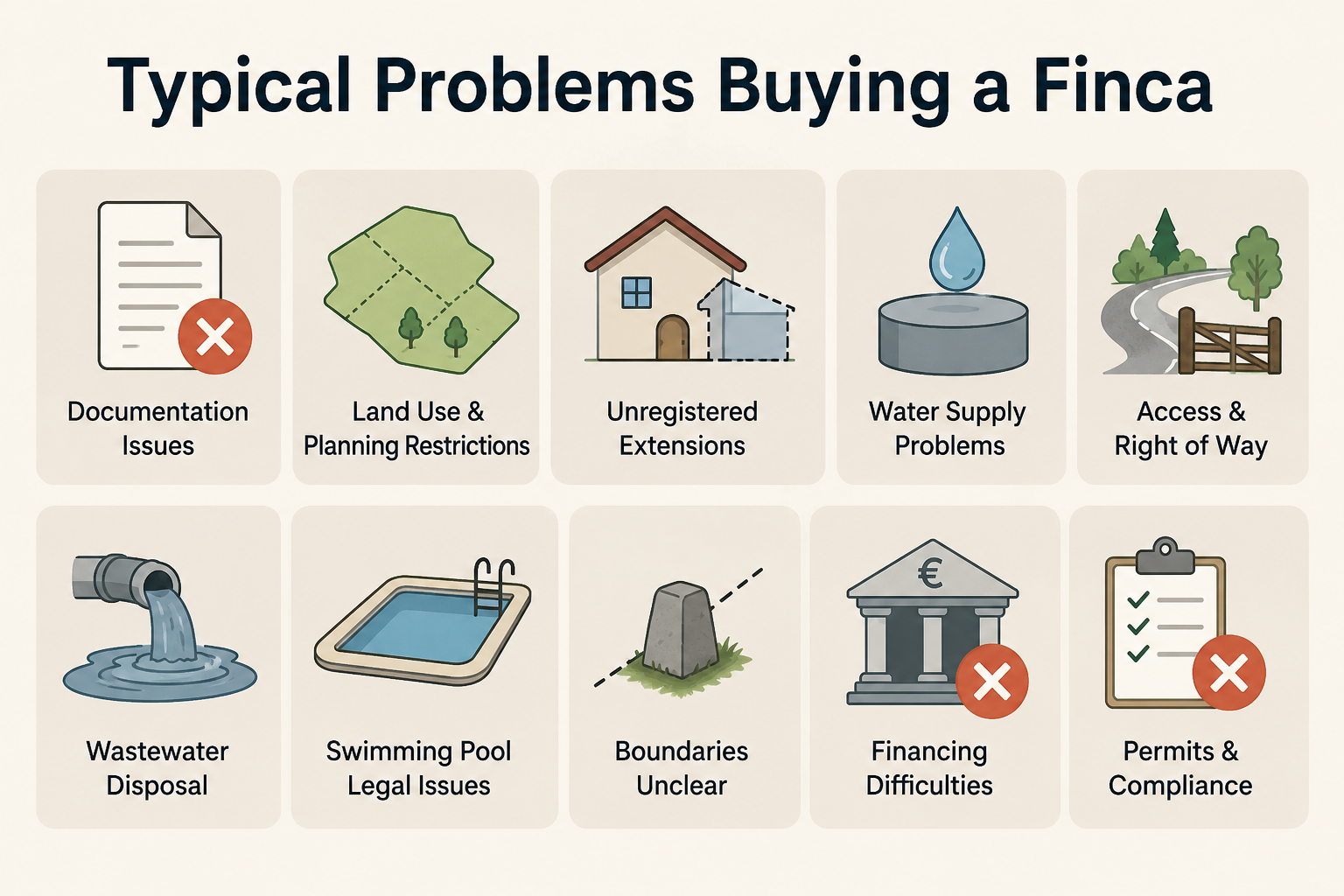
Typical Problems Buying a Finca in Spain: What Buyers Need to Check
Buying a finca in Spain can offer something that a conventional apartment or urban villa cannot: land, privacy, traditional architecture, mature gardens and the feeling of owning a genuine piece of the countryside. But the problems buying a finca in Spain can also be more complicated because the buyer is purchasing not only a house, but a combination of land, buildings, infrastructure, planning rights and historic documentation.
For buyers looking around Benissa, Benissa Costa and the wider Costa Blanca North, the most important rule is simple:
Do not judge a finca only by what you can see. Establish what legally exists, what the planning rules allow, how the property is serviced and what you will actually be able to do with it in the future.
A rural property may physically contain a 200 m² house while the documentation describes something smaller. A swimming pool may have been installed years ago but still require investigation. A finca may have its own water supply without the buyer knowing exactly where that water comes from or what documentation applies. An access road may be perfectly usable while the legal right of access needs separate verification.
None of these issues automatically means that the property is a bad purchase.
The objective of due diligence is not to find a "perfect" finca. It is to identify potential problems before you become committed, understand their consequences and decide whether the property still makes sense.
This guide covers the main finca rústica problems in Spain, with particular attention to the issues buyers should consider when purchasing rural property in Benissa and the Marina Alta.
Important: Spanish property, planning, water, environmental and tourist-use regulations can change. Rules may also differ according to the autonomous community, municipality, planning classification and individual property. This guide is for general information and should not replace independent advice from a Spanish property lawyer, architect or other appropriately qualified professional.
The 7 Biggest Finca Risks at a Glance
Before going into the detail, these are the areas I would investigate most carefully when buying a finca:
| Risk | Why it matters | Who should investigate it? |
|---|---|---|
| Building legality | The physical house may not match the legally recognised construction | Lawyer + architect/technical professional |
| Land classification | Determines what uses and works may be possible | Lawyer + architect/Town Hall |
| Catastro/Registro discrepancies | Differences can reveal documentation or boundary issues | Lawyer + technical professional |
| Water supply | Private supplies can involve separate rights and documentation | Lawyer + relevant specialist |
| Wastewater | Septic and private treatment systems need their own checks | Lawyer + technical professional |
| Access | Physical access is not necessarily legal access | Lawyer |
| Mortgageability | The property itself can affect lending | Bank + lawyer |
If a property raises concerns in several of these categories at the same time, pause before signing and obtain professional advice.
Table of Contents
Why Buying a Finca in Spain Can Be More Complicated
What is a finca rústica?
A finca rústica is, in practical terms, property associated with rural or rustic land rather than conventional urban development.
It can describe very different properties, including:
-
a traditional country house on agricultural land;
-
an old stone finca;
-
a rural villa surrounded by fields;
-
agricultural land with an existing dwelling;
-
land containing agricultural buildings;
-
or a substantial rural estate with several structures.
The word "finca" itself does not tell you what you can legally do with the property.
The important questions are:
-
What is the planning classification?
-
What buildings are legally recognised?
-
What uses are permitted?
-
How large is the legally recognised plot?
-
What services does the property have?
-
Is access legally established?
-
Can the existing building be renovated or extended?
-
Can you use it as a permanent home?
-
Could you finance it?
-
What happens when you eventually sell it?
That distinction is particularly important for international buyers, because the word finca can sound like a straightforward property category when, legally, the underlying circumstances can be very different from one property to another.
Why rural land classification matters
A property described as suelo rústico or suelo no urbanizable is not treated in the same way as a typical urban plot.
The applicable planning framework can influence:
-
permitted uses;
-
residential use;
-
agricultural uses;
-
extensions;
-
new construction;
-
ancillary buildings;
-
pools;
-
changes of use;
-
environmental constraints;
-
landscape considerations;
-
and other development rights.
In the Valencian Community, the principal regional planning framework is the Decreto Legislativo 1/2021, which consolidates the legislation on territorial planning, urbanism and landscape. The official BOE record shows that the consolidated text was updated on 2 July 2026.
That does not mean that one rule applies identically to every finca in Valencia.
The exact parcel, municipality, planning classification and proposed use matter.
Expert Tip: Never interpret "rustic land" as meaning either "you cannot do anything" or "you can build because the plot is large". Both assumptions can be wrong.
Plot size does not automatically tell you what you can build
One of the most common questions from finca buyers is:
"How many square metres do I need to build?"
The answer should never be reduced to a single Spain-wide number.
Development potential can depend on the exact planning classification, the existence and status of a dwelling, the municipality, applicable planning instruments, the nature of the proposed work and other restrictions.
This is particularly important in Benissa.
A buyer might hear that a particular plot-size threshold applies to rustic land and assume that owning a sufficiently large plot automatically creates a right to construct a new house or extension.
It does not.
Plot size is one planning factor, not the entire planning analysis.
Before buying land because of its development potential, obtain property-specific confirmation.
Why the house you see is not necessarily the house that is legally documented
One of the most important concepts for a finca buyer is the difference between:
what physically exists
and
what is legally and administratively documented.
Imagine a finca where you can see:
-
a 180 m² main house;
-
a 25 m² enclosed terrace;
-
a 30 m² garage;
-
a swimming pool;
-
and a separate storage building.
The paperwork may describe those elements differently.
The correct response is neither:
"Everything must be illegal."
nor:
"Everything must be fine because it has been there for years."
The correct response is:
"Why are the documents different, and what does that difference mean?"
The 12 Most Common Problems When Buying a Finca in Spain
1. The House Is Not Fully Registered
A common finca problem is that the physical construction is larger or different from the construction recorded in the documentation.
You may encounter:
-
extensions;
-
enclosed terraces;
-
converted garages;
-
additional bedrooms;
-
covered porches;
-
storage buildings;
-
agricultural structures;
-
or other additions.
The important questions are:
-
Was the work authorised?
-
Is it recognised by the relevant authorities?
-
Is it properly documented?
-
Can any discrepancy be corrected or regularised?
-
Could it affect financing?
-
Could it affect resale?
A missing construction record does not automatically make a property worthless. But it should never be ignored.
Why this can affect resale
A future buyer's lawyer may identify exactly the same issue.
If that buyer needs a mortgage, the lender and valuation process may introduce another layer of scrutiny.
An issue that seems manageable when you buy can therefore become a negotiation problem when you sell.
Common Mistake: "Nobody has complained about the extension, so it must be legal."
The absence of a dispute is not the same thing as confirmation of planning legality.
2. The Catastro, Registro and Actual Property Do Not Match
This is one of the most common areas of confusion for international buyers.
The Catastro is an administrative register dependent on the Spanish Ministry of Finance. It describes rural, urban and special-category properties and can include information such as location, cadastral reference, surface area, use, construction characteristics and graphical representation. Registration in the Catastro is compulsory and free.
The Registro de la Propiedad has a different function. It records property rights and registered circumstances affecting real estate. A Nota Simple can identify the finca, registered owners, rights, charges, extent, nature and limitations.
The third reference point is the actual property.
A discrepancy might involve:
-
land area;
-
building area;
-
boundaries;
-
the description of the dwelling;
-
the number of buildings;
-
or the relationship between buildings and the land.
Not every discrepancy has the same significance.
A small historical difference may have a straightforward explanation. A substantial discrepancy involving a house extension, plot boundary or additional building may require much more investigation.
The Catastro and Registro are separate systems, although Spanish law provides for coordination between them through georeferenced property descriptions.
3. Extensions or Alterations Were Built Without the Correct Permission
Older rural properties often evolve over decades.
Owners may have:
-
enclosed terraces;
-
added bedrooms;
-
built garages;
-
converted agricultural structures;
-
added porches;
-
created storage rooms;
-
altered roofs;
-
or changed internal layouts.
The age of the work does not automatically establish that it was authorised.
Likewise, the fact that a construction appears in the Catastro does not, by itself, establish every aspect of its planning legality.
Common Mistake: "It is shown on the Catastro, so it must be legal."
The Catastro is an administrative property register with a different function from the Registro de la Propiedad and from municipal planning records.
If you are buying a property with an extension, our guide to illegal extensions and property sales can be useful alongside professional legal advice.
What should you do?
If the physical property is larger than the documented construction:
-
identify exactly what differs;
-
establish when the work was carried out;
-
ask what licences or permits exist;
-
have the planning position assessed;
-
determine whether the construction can be documented or regularised;
-
and understand the consequences before signing.
4. The Swimming Pool Is Not Properly Documented
A swimming pool deserves its own check.
A pool can have existed for many years while its documentation is incomplete, inconsistent or unclear.
Ask:
-
When was it constructed?
-
Was the appropriate permission obtained?
-
Does the documentation correspond with the pool that exists?
-
Is it represented consistently in the available property information?
-
Are there planning restrictions affecting it?
-
Could future works be carried out legally?
-
Does the pool create any issue for a future sale?
This matters particularly if you intend to:
-
renovate it;
-
enlarge it;
-
add surrounding structures;
-
finance the property;
-
or resell it.
See the Telio Homes guide to pool legalisation in Spain.
5. You Cannot Assume You Can Renovate or Extend the Finca
Buying an existing house does not automatically give you unrestricted rights to change it.
There is a major difference between:
-
repainting;
-
replacing finishes;
-
updating furniture;
and:
-
altering structural elements;
-
increasing the building footprint;
-
adding another floor;
-
constructing an additional building;
-
converting an agricultural structure;
-
or substantially changing the use of an existing building.
The Valencian planning framework regulates land use and development, but the practical answer for an individual finca depends on the property's circumstances and applicable planning instruments.
Before buying, write down exactly what you want to achieve.
For example:
Buy → renovate → extend → add a pool → create guest accommodation.
Then investigate whether that entire plan is realistically achievable before purchasing.
6. Water Supply Is More Complicated Than It Appears
"Has water" is not enough information for a rural property.
A finca may have:
-
mains water;
-
a well or borehole;
-
a private supply;
-
a water deposit or cistern;
-
delivered water;
-
irrigation water;
-
or several systems operating together.
These arrangements should not be treated as interchangeable.
Mains water
Establish:
-
whether there is a mains connection;
-
whether there is a functioning meter;
-
who supplies the property;
-
whether there are outstanding issues;
-
and whether the existing connection corresponds with the property.
Wells and private water supplies
A private water source needs separate investigation.
Questions can include:
-
What is the source?
-
What is it used for?
-
Is there documentation?
-
What rights or authorisations apply?
-
Is it sufficient for the intended use?
-
Is it connected to a storage system?
-
Are there any restrictions?
The existence of a functioning well does not, by itself, answer the legal questions surrounding its use.
Water deposits and cisterns
A deposit can be perfectly practical for a rural property, but understand:
-
its capacity;
-
how it is filled;
-
whether water is delivered;
-
whether another water source exists;
-
how the system is maintained;
-
and what happens during periods of high consumption.
See the related guide: Water Deposits for Fincas.
Agricultural and irrigation water
If the finca contains productive agricultural land, investigate irrigation separately.
Do not assume that:
"The land has water"
means the same thing as:
"The house has a legally established domestic water supply."
The source, purpose, infrastructure and applicable rights can be different.
7. The Septic Tank or Wastewater System Creates Problems
Rural properties may not have the same wastewater infrastructure as homes connected to a municipal sewer network.
A finca may use:
-
a septic tank;
-
a private treatment system;
-
another wastewater arrangement;
-
or a combination of systems.
Establish:
-
what system is installed;
-
where it is located;
-
its approximate age;
-
its capacity and condition;
-
what documentation exists;
-
whether maintenance has been carried out;
-
whether any authorisations apply;
-
and whether it is appropriate for the property's intended use.
This is particularly important where the buyer plans renovation, needs documentation associated with residential use or expects to resell the property later.
See also: septic tanks and rural properties in Spain.
Warning: Never assume that a septic tank is acceptable simply because the property has been using it for years.
8. Access to the Finca Is Not Properly Documented
A finca can have an obvious physical route to the property while the legal position is more complicated.
Access may involve:
-
a public road;
-
a private road;
-
a shared road;
-
a registered easement;
-
a right of way;
-
or access across another person's land.
The critical distinction is:
Physical access is not the same thing as legally documented access.
A buyer should establish:
-
who owns the access;
-
who has the right to use it;
-
whether the right is documented;
-
who maintains the road;
-
whether several properties share it;
-
and whether any restrictions apply.
This is particularly important for isolated rural properties.
During a viewing, also assess the practical access:
-
road surface;
-
width;
-
gradient;
-
gates;
-
turning space;
-
drainage;
-
and access for construction or emergency vehicles.
9. Plot Boundaries or Land Size Do Not Match
Rural plots can have discrepancies between:
-
Catastro;
-
Registro;
-
historic deeds;
-
physical boundary markers;
-
fences;
-
walls;
-
and what the seller believes they own.
Do not assume that a fence or stone wall is automatically the legal boundary.
The official Catastro provides cadastral mapping and property information, while the Registro deals with registered property rights. Spanish law also provides a framework for coordinating cadastral and Registry graphical information.
For a significant discrepancy, your lawyer may recommend technical surveying or other specialist investigation.
See: property boundaries in Spain.
10. Getting a Mortgage Can Be More Difficult
A finca can be an excellent property while still creating additional questions for a mortgage lender.
The lender may consider:
-
registered construction;
-
physical construction;
-
land classification;
-
valuation;
-
property condition;
-
access;
-
documentation;
-
and the relationship between the land and buildings.
The exact criteria are lender-specific and can change.
This creates an important distinction:
Buyer affordability is not the same as property mortgageability.
You may have sufficient income, savings and borrowing capacity while the particular property presents issues for the lender.
When should you check?
If you need finance, investigate the property before becoming contractually committed wherever possible.
11. Planning or Environmental Restrictions Affect the Property
Rural land can be affected by planning, environmental, landscape, infrastructure, water or other sector-specific restrictions.
Depending on the exact location, considerations may include:
-
protected land;
-
non-urbanisable land;
-
landscape restrictions;
-
environmental constraints;
-
water-related restrictions;
-
agricultural requirements;
-
infrastructure corridors;
-
and municipal planning rules.
The Valencian planning framework expressly incorporates landscape and other territorial considerations into planning policy.
The exact location matters.
A finca in Pedramala should be assessed according to its actual parcel and planning status, not assumptions about "Benissa countryside" generally.
Flood and fire considerations
For a rural property, buyers should also consider whether the parcel is affected by relevant:
-
flood-risk mapping;
-
watercourses;
-
drainage constraints;
-
wildfire exposure;
-
vegetation-management requirements;
-
or access requirements associated with rural emergency response.
These issues do not affect every property in the same way. They are reasons to investigate the exact location, not automatic reasons to reject a finca.
12. Problems Can Affect Future Resale
A problem does not necessarily disappear when you become the owner.
Future buyers may ask:
-
Is the house legally documented?
-
Are extensions recognised?
-
Is the pool documented?
-
Does the Catastro correspond?
-
Does the Registry correspond?
-
Is access legally established?
-
Is the water supply properly understood?
-
Can the property be financed?
-
Can the property be renovated?
-
Can it be used as intended?
This is why due diligence is not simply a legal formality.
It protects your future options.
Additional Rural-Property Issues Buyers Should Not Overlook
The following issues deserve attention because they can become particularly relevant to a finca purchase.
Can You Actually Live in the Finca?
Do not assume that a building's physical appearance answers the question of whether it can lawfully be used as a permanent home.
Investigate:
-
the legal status of the dwelling;
-
planning classification;
-
permitted use;
-
habitation/occupancy documentation where relevant;
-
utility arrangements;
-
and any restrictions affecting residential use.
A property can be physically habitable without every legal question surrounding residential use having been resolved.
What About a Second Occupancy or Habitation Licence?
Where the applicable rules require or recognise documentation relating to occupancy or habitation, establish the current position before buying.
This should be considered separately from:
-
Registry registration;
-
Catastro registration;
-
building legality;
-
and utility connections.
If a property has an expired or missing occupancy document, ask your lawyer and technical professional what that means for the particular transaction and intended use.
Agricultural Buildings and Traditional Structures
Traditional rural buildings can be particularly attractive around the Marina Alta.
A buyer may see an old agricultural structure and immediately think:
"I could turn that into a guest bedroom."
That is not a safe assumption.
The existing building, its historical use, planning status and the proposed new use all need to be considered.
Riuraus and Traditional Rural Buildings
The Marina Alta has a distinctive rural architectural heritage, including traditional riuraus associated historically with agricultural activity.
A traditional building can add enormous character to a finca, but character does not automatically create a right to convert it into residential accommodation.
Before purchasing a property partly because of a riurau or another agricultural structure, establish:
-
its legal status;
-
its recognised use;
-
whether it is protected or subject to heritage considerations;
-
and what changes, if any, are possible.
Inheritance and Multiple Ownership
Some rural properties have complicated ownership histories.
Potential issues include:
-
several registered owners;
-
inherited property;
-
usufruct;
-
unresolved estates;
-
powers of attorney;
-
or historical ownership arrangements.
The Nota Simple is an essential starting point for identifying registered ownership and rights. The official Colegio de Registradores confirms that the Nota Simple identifies the registered finca, owners, rights, extent, nature and limitations.
Where ownership is complicated, have your lawyer establish that all necessary parties can validly sell the property.
Agricultural Use and Livestock
If you want to use the land for:
-
olive trees;
-
vineyards;
-
orchards;
-
horses;
-
livestock;
-
agricultural buildings;
-
commercial farming;
-
or another rural activity,
raise that objective before purchasing.
The question is no longer simply:
"Can I live in this house?"
It becomes:
"Can I legally use the land for the purpose I have in mind?"
The Most Important Legal Checks Before Buying a Finca
Check the Nota Simple
The Nota Simple should be one of the first documents reviewed.
It can identify:
-
the registered finca;
-
owners;
-
mortgages;
-
usufructs;
-
other registered rights;
-
charges;
-
limitations;
-
and restrictions.
The Colegio de Registradores states that a Nota Simple is informative and does not have the same evidential status as a formal Registry certification.
For a purchase, your lawyer should interpret it in the context of the full transaction.
Check the Escritura
The Escritura Pública can provide important information about:
-
property description;
-
land;
-
buildings;
-
ownership;
-
historical transactions;
-
and the way the property has been described.
Compare it with the current Registry information and the physical property.
Check the Catastro
The Catastro can help establish:
-
cadastral reference;
-
plot area;
-
building information;
-
mapping;
-
use;
-
and other cadastral characteristics.
It is an administrative register and is distinct from the Registro de la Propiedad.
Check the Planning Classification
Establish:
-
the land classification;
-
applicable planning instrument;
-
permitted uses;
-
building restrictions;
-
environmental or landscape considerations;
-
and whether your proposed works are realistic.
Do not rely on:
"The owner says you can build."
Obtain appropriate professional confirmation.
Check Building Licences and Other Permits
Depending on the property's history, investigate documentation relating to:
-
original construction;
-
extensions;
-
pools;
-
garages;
-
agricultural buildings;
-
structural works;
-
alterations;
-
and other relevant construction.
Check for Charges, Easements and Restrictions
Look beyond the purchase price.
Investigate:
-
mortgages;
-
usufructs;
-
rights of way;
-
easements;
-
restrictions;
-
third-party rights;
-
and other registered burdens.
Catastro vs Registro de la Propiedad: Why Both Matter
What Is the Catastro?
The Catastro is an administrative register dependent on the Ministry of Finance.
It describes property characteristics including location, cadastral reference, surface area, use or destination, construction characteristics and graphical representation.
What Is the Registro de la Propiedad?
The Registro records property rights and registered legal circumstances affecting real estate.
A Nota Simple can provide information about:
-
registered ownership;
-
mortgages;
-
usufruct;
-
rights;
-
limitations;
-
and other registered circumstances.
Why Can They Contain Different Information?
The systems have different purposes and histories.
A property may have changed physically over decades without all records being updated at the same time.
Examples include:
-
extensions;
-
changes in building descriptions;
-
historic boundary changes;
-
cadastral updates;
-
inherited properties;
-
old rural buildings;
-
or changes that were recorded in one system but not another.
Which Differences Are Minor and Which Are Serious?
There is no universal square-metre difference that automatically makes a discrepancy safe or dangerous.
The reason for the difference matters.
| Difference | Potential significance |
|---|---|
| Small historical measurement difference | May be explainable |
| Different building surface | Needs investigation |
| Missing extension | Potential planning/documentation issue |
| Different plot boundaries | Potential boundary issue |
| Missing outbuilding | Needs documentation check |
| Major land-area discrepancy | Professional investigation recommended |
| Physical building absent from legal documentation | Potentially significant |
Why You Should Compare the Documents With the Actual Property
The correct approach is:
Catastro + Registro + Escritura + planning + physical property.
Not:
Catastro OR Registro.
The official Catastro explains that a legal framework exists for coordination between the Catastro and Registro using georeferenced graphical information, precisely to improve certainty around location, boundaries and surface area.
A simple example
Imagine a property where:
| Source | Built area |
|---|---|
| Estate-agent particulars | 200 m² |
| Physical inspection | Approximately 200 m² |
| Catastro | 190 m² |
| Registro | 150 m² |
This is not a reason to panic.
It is a reason to ask:
Why are the numbers different?
That question should be answered before the buyer commits.
Building Legality: One of the Biggest Finca Risks
Is the Main House Legally Documented?
Start with the main dwelling.
Establish:
-
what the documents say exists;
-
what physically exists;
-
how the building is described;
-
and what planning status applies.
A building appearing in one database does not automatically resolve every planning or construction question.
Are Extensions Registered?
Walk around the property and identify anything that appears to have been added.
Ask:
-
Is this part of the original house?
-
Was this terrace enclosed?
-
Was the garage converted?
-
Is this bedroom part of the original construction?
-
Is this outbuilding documented?
What About Pools, Garages and Outbuildings?
Check every permanent structure:
-
swimming pools;
-
garages;
-
agricultural buildings;
-
workshops;
-
storage rooms;
-
covered terraces;
-
guest accommodation;
-
and other additions.
Does an Older Building Have Different Considerations?
Older construction can raise questions about:
-
historical planning status;
-
evidence of age;
-
enforcement;
-
regularisation;
-
existing use;
-
and rules applicable to the property.
But:
"It is old" does not automatically mean "it is legal".
What Happens If Construction Is Not Properly Documented?
The consequences depend on the specific circumstances.
An irregularity may sometimes be capable of:
-
documentary correction;
-
registration;
-
regularisation;
-
technical remediation;
-
or another legally available solution.
In other circumstances, the issue may be substantially more difficult.
Do not assume the answer before a qualified professional reviews the property.
Can an Irregularity Be Resolved?
Sometimes.
But the answer can depend on:
-
when the construction occurred;
-
planning classification;
-
applicable planning rules;
-
the nature of the work;
-
municipality;
-
environmental or sectoral restrictions;
-
and whether enforcement or other legal issues exist.
There is no single Spain-wide answer.
The current Valencian planning framework should be checked against the particular property, rather than relying on old articles or advice relating to another autonomous community.
Can You Renovate or Extend a Finca in Spain?
Cosmetic Renovations
Routine cosmetic improvements are very different from planning-sensitive construction.
Examples may include:
-
painting;
-
replacing finishes;
-
changing furniture;
-
replacing certain kitchen elements;
-
and ordinary maintenance.
The precise municipal requirements still depend on the work.
Structural Renovations
Structural changes require much greater care.
Examples include:
-
altering structural walls;
-
changing roofs;
-
major openings;
-
changing floor structures;
-
or substantial reconstruction.
Obtain professional advice before starting.
Extending the House
An extension requires more than enough physical land.
You need to establish:
-
the land classification;
-
the status of the existing dwelling;
-
applicable planning parameters;
-
whether the proposed work is permitted;
-
what authorisations are required;
-
and whether other restrictions apply.
Adding a Swimming Pool
Do not assume:
"There is plenty of land, so I can add a pool."
A new pool should be assessed against the property's planning position and the applicable municipal requirements.
Converting Agricultural Buildings
This is a common rural-property misconception.
An old agricultural building may look ideal for:
-
a guest bedroom;
-
studio;
-
office;
-
annexe;
-
or accommodation.
But physical suitability does not establish a right to change its use.
Building New Structures
The same caution applies to:
-
garages;
-
guest houses;
-
storage buildings;
-
workshops;
-
carports;
-
agricultural structures.
Why You Should Check Your Future Plans Before Buying
If your plan is:
Buy → renovate → extend → add pool → create accommodation
test the whole plan before buying.
That is one of the most effective ways to avoid purchasing a finca that is beautiful today but unsuitable for the life you intend to create.
Water, Electricity and Wastewater: What Buyers Need to Check
Mains Water
If the property has mains water, check:
-
connection;
-
supplier;
-
meter;
-
bills;
-
supply arrangement;
-
and any outstanding issue.
Wells and Private Water Supplies
Private water requires separate investigation.
Establish:
-
source;
-
purpose;
-
documentation;
-
applicable rights;
-
authorisations where relevant;
-
and practical reliability.
Do not treat:
"There is a well"
as equivalent to:
"The property has a straightforward mains water connection."
Water Deposits and Cisterns
A deposit may be an entirely practical solution.
Understand:
-
capacity;
-
filling method;
-
water source;
-
frequency of delivery;
-
maintenance;
-
and backup supply.
See: Water Deposits for Fincas.
Electricity Connection
Establish whether the property has:
-
mains electricity;
-
solar generation;
-
batteries;
-
generator backup;
-
or a combination.
Solar Power
Ask:
-
What equipment is installed?
-
Is there battery storage?
-
Is there a mains connection?
-
How old is the installation?
-
Is documentation available?
-
Who owns the equipment?
See: Solar Panels for Rural Properties.
Septic Tanks and Wastewater
Establish:
-
system type;
-
location;
-
age;
-
capacity;
-
maintenance;
-
documentation;
-
and whether future works could affect the system.
Internet
Internet should also be treated as part of the rural-property due diligence.
A finca can have electricity and water while having a completely different broadband situation from a nearby urbanisation.
If reliable internet is essential for working from home, ask:
-
what technology is available;
-
whether fibre reaches the property;
-
what mobile coverage exists;
-
whether fixed wireless is available;
-
and what speeds are realistically achievable.
See the Telio Homes guide to Internet for a Finca.
What If the Finca Has No Mains Services?
That does not automatically make it a bad property.
But the buyer should understand the complete system.
| Service | What to establish |
|---|---|
| Water | Source, supply, storage and relevant rights |
| Electricity | Grid connection or independent system |
| Wastewater | System, documentation and condition |
| Internet | Technology, coverage and realistic performance |
| Access | Road condition and legal basis |
Expert Tip: Treat "off-grid" as a technical specification, not simply a lifestyle feature.
Access, Boundaries and Rural Land Issues
Legal Road Access
Ask your lawyer to establish the legal basis of access.
Do not rely solely on:
"We have always used this road."
That explains the physical situation but does not necessarily establish the legal position.
Private and Shared Roads
Find out:
-
who owns the road;
-
who maintains it;
-
who pays for maintenance;
-
who can use it;
-
and what rights are documented.
Rights of Way and Easements
Review registered easements and other rights affecting the property.
See: easements and rights of way in Spain.
Boundary Discrepancies
Check:
-
fences;
-
walls;
-
gates;
-
cadastral mapping;
-
deeds;
-
Registry information;
-
and, where appropriate, a professional survey.
A fence is evidence of the physical situation.
It is not automatically conclusive proof of legal ownership.
Plot Size Differences
The question should not simply be:
"Which number is correct?"
Ask:
"Why are the numbers different, and does the difference affect ownership, planning, value or future use?"
Why Rural Land Should Be Checked Professionally
Rural properties can involve more variables than a conventional apartment.
Where a discrepancy is material, professional investigation can be far cheaper than discovering the problem after completion.
Can You Get a Mortgage to Buy a Finca in Spain?
Why Banks May Treat Fincas Differently
Mortgage lenders assess risk.
A rural property may create additional questions around:
-
land;
-
construction;
-
legal documentation;
-
valuation;
-
access;
-
services;
-
condition;
-
and resale.
Different lenders use different criteria.
What the Bank and Valuer May Consider
The exact process varies, but property characteristics can include:
-
registered construction;
-
physical construction;
-
land classification;
-
property valuation;
-
access;
-
condition;
-
and documentary consistency.
Why Property Documentation Matters
A buyer can be financially suitable for a mortgage while the particular property creates difficulties.
This distinction is essential:
The bank may approve you as a borrower but still have reservations about the property.
Why an Attractive Finca Can Still Be Difficult to Finance
A beautiful rural house with views, a pool and substantial land can be highly desirable while still requiring more scrutiny than a standard urban property.
When to Check Mortgage Feasibility
If finance is essential:
Check the actual property as early as possible.
Do not assume that because another finca received a mortgage, yours will receive one on identical terms.
See: mortgages for rustic properties in Spain.
Who Should Check What Before You Buy?
A strong purchase process uses different professionals for different questions.
| Issue | Estate Agent | Lawyer | Architect / Technical Professional | Town Hall / Authority |
|---|---|---|---|---|
| Property history known to agent | ✓ | |||
| Nota Simple | Support | ✓ | ||
| Ownership and charges | ✓ | |||
| Catastro comparison | Support | ✓ | ✓ | |
| Building condition | ✓ | |||
| Building legality | ✓ | ✓ | ✓ | |
| Planning classification | Support | ✓ | ✓ | ✓ |
| Extension feasibility | ✓ | ✓ | ✓ | |
| Pool documentation | Support | ✓ | ✓ | ✓ |
| Water arrangements | Support | ✓ | ✓ | Where applicable |
| Access/easements | ✓ | |||
| Mortgage feasibility | Support | |||
| Future renovation plans | ✓ | ✓ | ✓ |
What the Estate Agent Can Help With
A specialist local agent can help the buyer understand:
-
the property's known history;
-
practical characteristics;
-
available information;
-
local infrastructure;
-
access;
-
common questions;
-
and which issues need professional investigation.
An estate agent should not replace the buyer's independent lawyer or technical adviser.
What the Property Lawyer Should Check
The lawyer should assess the legal side of the transaction, including:
-
ownership;
-
charges;
-
Registry information;
-
contracts;
-
easements;
-
legal risks;
-
and contractual protection.
What an Architect or Technical Professional Should Check
A technical professional can help assess:
-
building condition;
-
construction discrepancies;
-
physical measurements;
-
structural matters;
-
extensions;
-
proposed works;
-
and technical feasibility.
What the Town Hall Can Confirm
The municipality may be relevant to:
-
planning;
-
licences;
-
planning classification;
-
municipal records;
-
and local requirements.
The appropriate procedure should be confirmed for the individual property.
What the Buyer Should Personally Verify
The buyer needs to be clear about:
-
intended use;
-
renovation plans;
-
financing;
-
service requirements;
-
acceptable maintenance;
-
rental expectations;
-
and future resale plans.
Finca Due-Diligence Checklist Before Signing
Before Making an Offer
-
Confirm exactly what land and buildings are included.
-
Identify the cadastral reference.
-
Establish the property's planning classification.
-
Ask whether extensions, pools and outbuildings are documented.
-
Ask how water is supplied.
-
Ask how wastewater is managed.
-
Establish how access works.
-
Explain your intended renovation plans.
-
Consider whether permanent habitation or holiday rental is important to you.
-
If financing is required, discuss the property with your mortgage provider.
Before Paying a Reservation Deposit
-
Obtain the available Registry information.
-
Review the Escritura.
-
Review the Catastro.
-
Compare the documents with the physical property.
-
Identify any obvious discrepancy.
-
Investigate building legality where necessary.
-
Investigate the pool where relevant.
-
Investigate water and wastewater.
-
Investigate access.
-
Consider flood, fire or environmental issues where relevant.
-
Establish whether the property has the habitation/occupancy documentation relevant to its intended use.
-
Make sure important conditions are addressed before paying a deposit.
Before Signing an Arras Contract
-
Have your independent lawyer review the contract.
-
Confirm seller ownership.
-
Confirm registered charges and rights.
-
Confirm the property description.
-
Address material discrepancies.
-
Investigate building legality where necessary.
-
Investigate the pool where relevant.
-
Investigate water and wastewater.
-
Investigate access.
-
Confirm mortgage feasibility if applicable.
-
Ensure contractual protection reflects any unresolved issue.
-
Confirm that your intended use is legally and practically realistic.
Before Completion
-
Confirm there has been no material change in the property's legal position.
-
Check outstanding charges and contractual obligations.
-
Confirm agreed documentation has been delivered.
-
Confirm agreed works or legalisations have actually occurred.
-
Review utility arrangements.
-
Confirm completion arrangements with your lawyer and notary.
-
Keep copies of all relevant documentation.
Important: Never assume that a seller's promise to "sort something out after completion" is sufficient protection. If an issue matters to the purchase, have your lawyer assess it and ensure the contract adequately protects you.
Buying a Finca in Benissa: Local Issues to Consider
Benissa is an interesting rural-property market because the municipality combines countryside, traditional agricultural areas and established coastal residential zones.
A finca around Pedramala, Benimarco, Buenavista, Fanadix or other countryside areas of Benissa should not automatically be assessed in exactly the same way as an apartment or villa in a conventional urbanisation.
Why Local Planning Knowledge Matters in Benissa
The most important question is the exact planning position of the individual parcel.
Do not assume that two rural properties a short distance apart have identical development possibilities.
The Valencian regional planning framework provides the wider legal framework, while the property's municipal planning position determines how those rules apply in practice. The official consolidated regional text was updated as recently as July 2026.
Rural Land and Planning Classification
For a Benissa finca, establish:
-
exact parcel;
-
planning classification;
-
permitted use;
-
existing building status;
-
restrictions;
-
proposed works;
-
and whether the property is affected by environmental, landscape, water or infrastructure considerations.
A large plot is not automatically a development opportunity
This is worth repeating because it is a common rural-property misconception.
A buyer may see several thousand square metres and think:
"There is plenty of land."
But planning questions are not determined solely by the visual size of the property.
If development potential is part of the reason you are buying, obtain property-specific advice before making the purchase.
Water and Rural Infrastructure
Countryside properties around Benissa can have very different service arrangements.
You may encounter:
-
mains water;
-
private water systems;
-
deposits;
-
wells;
-
private wastewater systems;
-
solar installations;
-
or combinations of these.
The right question is:
How does this property obtain, store, use and dispose of each service, and is the arrangement properly documented?
Access and Rural Roads
Rural access around areas such as Pedramala and Benimarco can differ considerably from conventional residential streets.
During a viewing, look at:
-
road condition;
-
width;
-
gradient;
-
turning space;
-
drainage;
-
gates;
-
shared access;
-
and practical vehicle access.
Then separately investigate the legal basis of the access.
Older Fincas and Building Extensions
Traditional rural properties can have a long physical history.
A building may have evolved through several stages.
Compare:
what you see → Catastro → Escritura → Registro → planning information.
That comparison is often more informative than any single document.
Pools, Outbuildings and Other Structures
Inspect:
-
pools;
-
garages;
-
agricultural buildings;
-
storage areas;
-
terraces;
-
covered structures;
-
walls;
-
and other permanent works.
Every significant structure can create a separate documentation question.
Traditional Rural Buildings and Riuraus
The Marina Alta has a distinctive agricultural heritage.
A traditional structure such as a riurau can be a wonderful feature of a finca, but buyers should not assume that it can automatically be converted into a home, guest accommodation or another use.
If the building is important to the purchase, investigate its legal and planning status before relying on a proposed conversion.
Occupancy and Residential Use
If your intention is to live permanently in the property, specifically investigate the documentation and planning position relevant to residential use.
Do not treat:
-
Catastro registration;
-
Registry registration;
-
a functioning electricity connection;
-
a functioning water supply;
-
and habitation/occupancy documentation
as interchangeable concepts.
Holiday Rental Use
If your purchase depends partly on holiday-rental income, investigate the current rules before calculating projected returns.
The relevant requirements can involve planning, the property's legal status, tourist-use rules and other regional or municipal requirements.
Do not buy a finca on the assumption that:
"Because it is a house, I can automatically rent it to tourists."
Why Every Finca Needs Property-Specific Due Diligence
There is no universal checklist that can determine whether every Benissa finca is legally straightforward.
A local property specialist can help identify the questions.
An independent lawyer and, where appropriate, an architect or technical professional should assess the answers.
Three Realistic Examples of Finca Problems
The following are illustrative examples, not representations of specific Telio Homes client transactions unless expressly stated otherwise.
Example 1 — A Benissa Finca With 6,000 m² of Land and an Existing House
What the buyer sees
A rural property with:
-
6,000 m² of land;
-
an existing house;
-
a pool;
-
an agricultural structure;
-
and attractive countryside surroundings.
The assumption
"The plot is large, so extending or adding another building should be straightforward."
The correct approach
The buyer investigates:
-
exact planning classification;
-
existing dwelling status;
-
documented construction;
-
proposed extension;
-
pool;
-
agricultural structure;
-
and applicable planning restrictions.
Lesson
Plot size alone does not determine development potential.
Example 2 — The Finca With a 200 m² House, Private Water and Septic Tank
What the buyer sees
The property appears to have everything required:
-
approximately 200 m² of accommodation;
-
a water deposit;
-
private water;
-
septic tank;
-
electricity;
-
and a pool.
The paperwork
The available documents show different building areas and do not clearly answer every question concerning the private systems.
Investigation
The buyer's lawyer and technical adviser establish:
-
what construction is documented;
-
what water system exists;
-
what documentation applies;
-
how wastewater is handled;
-
and whether any discrepancy needs resolving.
Lesson
One finca can contain four separate due-diligence issues:
building + water + wastewater + pool.
Do not treat the property as one single legal question.
Example 3 — The Finca That Creates Mortgage Problems
The buyer
The buyer has:
-
sufficient deposit;
-
strong income;
-
and an initial indication that financing should be possible.
The property
The finca appears ideal but has discrepancies between its physical construction and available documentation.
What happens
The lender's assessment and valuation raise questions about the property.
Result
The buyer discovers that:
Being financially suitable for a mortgage does not necessarily mean the property itself is straightforward for the lender.
Lesson
Check mortgage feasibility early.
Finca Red Flags: When Should You Walk Away?
Not every red flag means:
"Walk away."
Some mean:
Stop → investigate → understand → negotiate.
Red Flags That Need Further Investigation
Examples include:
-
building size does not match the documents;
-
unclear pool documentation;
-
private water without clear documentation;
-
unclear access;
-
substantial Catastro/Registro discrepancy;
-
septic system requiring investigation;
-
unclear planning status;
-
expired or unclear habitation documentation;
-
seller unwilling to provide reasonable documentation;
-
mortgage lender raises concerns.
Problems That May Be Fixable
Depending on the circumstances, an issue may potentially be addressed through:
-
documentary correction;
-
registration;
-
regularisation;
-
technical remediation;
-
clarification;
-
or contractual arrangements.
But "potentially fixable" does not mean:
cheap + quick + guaranteed.
Problems That Could Make a Property Unsuitable
Consider withdrawing or renegotiating where:
-
your intended use is not realistically achievable;
-
serious planning restrictions affect the property;
-
the cost of resolving defects destroys the financial case;
-
essential financing cannot be obtained;
-
legal access cannot be established;
-
or the uncertainty is unacceptable.
Never Assume the Seller Will Resolve a Problem After Completion
If the seller says:
"We will sort that out later."
Ask:
Who will do it?
By when?
At whose cost?
What happens if it cannot be resolved?
What protection does the contract provide?
A material problem is generally safest to resolve before the buyer becomes fully committed.
Finca Risk Matrix
| Risk | Typical response |
|---|---|
| Minor documentary discrepancy | Investigate and document |
| Unclear pool documentation | Professional review |
| Significant building discrepancy | Lawyer + technical review |
| Unclear water arrangement | Specialist investigation |
| Unclear legal access | Do not proceed without resolution |
| Major planning restriction affecting intended use | Reassess purchase |
| Mortgage difficulty caused by property | Reassess financing |
| Serious unresolved legal defect | Consider walking away |
How to Buy a Finca in Spain Safely
Step 1 — Decide How You Intend to Use the Property
Before viewing properties, decide whether you want:
-
a permanent home;
-
holiday home;
-
investment;
-
agricultural property;
-
renovation project;
-
rental property;
-
or a combination.
Your intended use determines the questions you need to ask.
Step 2 — Review the Property Documentation
Obtain the key documents early.
Do not leave the legal review until the final days before completion.
Step 3 — Check the Land and Planning Status
Establish:
-
classification;
-
permitted uses;
-
restrictions;
-
existing building status;
-
proposed works;
-
environmental considerations;
-
and whether your intended use is realistic.
Step 4 — Compare the Registry, Catastro and Physical Property
Create a simple comparison.
| Item | Registry | Catastro | Physical property |
|---|---|---|---|
| Land area | |||
| Main house | |||
| Extensions | |||
| Pool | |||
| Garage | |||
| Outbuildings |
Any unexplained material difference should be investigated.
Step 5 — Check Buildings, Pools and Extensions
Inspect every permanent structure.
Do not focus exclusively on the main house.
Step 6 — Check Water, Electricity, Wastewater and Access
Treat each service separately.
A rural property can have an attractive setting while having a complicated infrastructure arrangement.
Step 7 — Obtain Appropriate Professional Advice
Use the right professional for the right question:
-
lawyer for legal matters;
-
architect/technical professional for construction;
-
municipality/authority for planning questions;
-
relevant water authority where applicable;
-
mortgage provider for finance.
Step 8 — Confirm Mortgage Feasibility
If finance is required, check the actual property.
Do not rely on a generic statement that "Spanish mortgages are available".
Step 9 — Only Then Commit to the Purchase
The objective is not to eliminate every possible risk.
It is to understand the property sufficiently to make an informed decision.
Final Finca Buyer Checklist
Land
-
Planning classification checked
-
Plot size checked
-
Boundaries investigated
-
Access established
-
Easements investigated
-
Relevant environmental, flood or fire considerations checked
Building
-
Main construction documented
-
Extensions checked
-
Pool checked
-
Garage checked
-
Outbuildings checked
-
Agricultural structures checked
-
Physical property compared with documents
-
Proposed renovation checked for feasibility
Documentation
-
Nota Simple
-
Escritura
-
Catastro
-
Planning information
-
Relevant licences
-
Building legality checked where necessary
-
Occupancy/habitation documentation checked where relevant
-
Ownership and inheritance position confirmed
Services
-
Water
-
Private water rights/documentation where relevant
-
Electricity
-
Wastewater
-
Internet
-
Rural systems inspected
Future Use
-
Permanent habitation
-
Renovation
-
Extension
-
Pool
-
Agricultural use
-
Holiday rental
-
Resale
-
Mortgage
Frequently Asked Questions
What are the most common problems when buying a finca in Spain?
The most common problems include discrepancies between the physical property and its documentation, unregistered extensions, unclear planning status, pool documentation, private water supplies, septic systems, access rights, boundary discrepancies and mortgage difficulties. The seriousness of each issue depends on the specific property.
What is a finca rústica in Spain?
A finca rústica is generally property associated with rural or rustic land. It can include agricultural land, countryside houses and rural buildings. The important issue is the property's actual planning classification and permitted use rather than the estate-agent description alone.
Is buying a finca rústica risky?
It can require more due diligence than buying a conventional urban property, but a finca rústica is not automatically risky. The key is understanding the land, buildings, documentation, services, access, planning position and intended use before committing.
Can I legally live in a finca rústica?
Possibly, but the answer depends on the specific property. You need to investigate its planning status, legal building status, permitted use and any relevant habitation or occupancy documentation. A house physically existing on rustic land does not, by itself, answer every residential-use question.
Can I renovate a finca in Spain?
Often, some forms of renovation are possible, but the type of work matters. Cosmetic maintenance can be very different from structural alterations, extensions or changes of use. Obtain advice on the specific property and proposed works before starting.
Can I extend a finca rústica?
Not necessarily. The possibility of extending a finca depends on the specific property, planning classification, existing building status, applicable rules and proposed works. A large plot does not automatically mean that an extension is permitted.
Can I build a house on rustic land in Benissa?
Do not assume that rustic land automatically provides a right to build a new home. The exact planning classification, parcel, existing buildings, applicable planning rules and intended use need to be assessed for the specific property.
Is there a minimum plot size to build a house on rustic land in Benissa?
Plot size can be an important planning factor, but there is no safe Spain-wide rule that can be applied to every finca. The current Benissa planning position and the exact classification of the parcel should be checked before relying on a particular minimum or building entitlement.
Can I build a swimming pool on rustic land?
Possibly, but this needs to be checked against the property's planning position and applicable municipal requirements. The existence of a pool on a neighbouring finca does not establish that a new pool will automatically be permitted on yours.
Does appearing in the Catastro mean a finca is legal?
No. The Catastro is an administrative property register with a different function from the Registro de la Propiedad and municipal planning records. Cadastral information is valuable, but it should be assessed alongside the Registry, planning information, licences and physical property.
What happens if the house is in the Catastro but not the Registro?
The difference should be investigated rather than automatically treated as either harmless or fatal. Establish what construction is recorded in each system, why the difference exists and whether any planning or registration issue needs to be resolved.
What is an Obra Nueva and why does it matter?
An Obra Nueva is the formal declaration of new construction or building work in the property documentation. Where a finca has been constructed or substantially altered, your lawyer should establish how the building is documented and whether the Registry description corresponds with the physical property.
What happens if a finca has an illegal extension?
The consequences depend on the circumstances, including the nature and age of the construction, planning classification and applicable rules. An extension may sometimes be capable of being documented or regularised, while other cases can be significantly more complicated. Obtain professional advice before buying.
Can an old finca extension be legalised?
Sometimes, but age alone does not provide a universal answer. The relevant planning history, construction, classification, municipality and current legal framework need to be assessed for the particular property.
Can I convert a riurau or agricultural building into a home?
Do not assume so. Traditional agricultural buildings can have restrictions or planning considerations that differ from the main dwelling. If conversion is part of your purchase plan, obtain property-specific planning and technical advice before committing.
Can I build a guest house on rustic land in Benissa?
Not automatically. A separate guest house is a new construction or use question that needs to be assessed against the property's planning status and applicable rules. The fact that the main house is legally occupied does not automatically create a right to build another dwelling.
Can I use a finca as a holiday rental?
Do not assume that a rural house can automatically be operated as holiday accommodation. Current tourist-use requirements, planning, the property's legal status and other applicable regional or municipal rules need to be checked for the specific property.
Can I get a mortgage if the finca has an unregistered extension?
It may be more difficult, depending on the lender and the circumstances. The property documentation can affect the lender's risk assessment and valuation. Discuss the actual property with the lender before becoming contractually committed.
Can I buy a finca without mains water?
A finca can have a private water arrangement, but the buyer should establish exactly where the water comes from, how it is stored and used, and what documentation or rights apply. A functioning private supply is not automatically equivalent to a standard mains connection.
Can I buy a finca with a private well?
Potentially, but the source and legal position should be investigated. Establish what the well is used for, what documentation exists and whether any authorisations or restrictions apply.
Is a septic tank legal on rustic land?
The answer depends on the particular property, system and applicable requirements. Do not assume that a septic tank is compliant simply because it has been in use for years. Have the system and its documentation checked.
What documents should I request before paying a reservation deposit?
At minimum, ask for the available information needed to assess ownership, the property description, Catastro, Registry information and obvious building discrepancies. If significant issues are identified, obtain legal and technical advice before committing funds.
What happens if a finca has no legal access?
This can be a serious issue. Physical access does not automatically establish a legal right of access. Your lawyer should investigate ownership of the route, rights of way and easements before you commit to the purchase.
Can I buy a finca if the Catastro and Registro show different plot sizes?
Possibly, but the difference should be understood. Some discrepancies may have straightforward explanations; others can indicate boundary or documentation issues. The important question is why the records differ and whether the difference affects ownership or future use.
How do I check whether a finca is legally registered?
Start with the Nota Simple and Escritura, then compare them with the Catastro, physical property and relevant planning and building documentation. For significant discrepancies, use an independent property lawyer and, where appropriate, an architect or technical professional.
Who checks whether a finca is legal in Spain?
No single professional answers every aspect of "legality". A lawyer should assess legal and Registry matters, while an architect or other technical professional can assess construction and technical issues. Planning questions may also require confirmation from the relevant municipality or authority.
Should I have an architect inspect a finca before buying?
It can be particularly valuable where the property is old, has extensions, pools, outbuildings, unusual construction or where you intend to renovate. A technical inspection can identify issues that may not be apparent from the legal documentation alone.
Can I buy a finca with a boundary discrepancy?
Potentially, but a material discrepancy should be investigated before purchase. Your lawyer may recommend technical surveying or further documentary analysis. Do not assume that fences or walls conclusively establish ownership.
Can I buy a finca with no mains electricity?
Possibly. Rural properties can use solar systems, batteries, generators or other arrangements. Establish how the property is powered, whether the installation is suitable for your intended use and what maintenance or replacement requirements may exist.
Can I buy a finca in an area with flood or fire risk?
Potentially, but the risk should be investigated as part of property-specific due diligence. Check relevant mapping, access, environmental considerations and any restrictions affecting the parcel. The existence of a risk designation does not automatically mean that the property cannot be purchased.
Can I keep horses or livestock on my finca?
Do not assume that owning rural land automatically permits every agricultural or livestock activity. The intended use, land classification, buildings and applicable municipal or sector-specific rules should be investigated before buying specifically for this purpose.
Can I sell a finca later if it has documentation problems?
You may be able to sell it, but unresolved documentation issues can affect the buyer pool, negotiations, mortgageability and transaction process. A problem that seems manageable today can become a resale issue later.
When should I walk away from buying a finca?
Consider walking away when a material problem cannot be satisfactorily explained or resolved, your intended use is not realistically achievable, essential financing is unavailable, legal access cannot be established, or the cost and uncertainty of resolving the defects make the purchase unattractive.
Conclusion
The biggest problems buying a finca in Spain are rarely visible in the estate-agent photographs.
The views, stone walls, mature olive trees, swimming pool and large plot may be exactly what attracted you to the property. But before buying, you need to understand what lies behind those features.
The essential questions are:
-
What is the exact planning classification?
-
Is the house properly documented?
-
Do the Catastro, Registro, Escritura and physical property broadly correspond?
-
Are extensions, pools and outbuildings properly dealt with?
-
Can you legally use the property as intended?
-
How is water supplied?
-
How is wastewater managed?
-
Is access legally established?
-
Are the boundaries clear?
-
Can you obtain the mortgage you need?
-
Can you carry out the renovation or extension you have planned?
-
Could unresolved issues affect your future resale?
For buyers considering a finca in Benissa, Benissa Costa, Pedramala, Benimarco, Buenavista, Fanadix or La Fustera, local knowledge can make it much easier to identify the right questions early.
But local estate-agent knowledge should complement — not replace — independent legal and technical due diligence.
The safest finca purchase is not necessarily the property with no imperfections.
It is the property where you understand the imperfections, know what they mean, know what can be resolved and have made the decision with appropriate professional advice.
If you are considering buying a finca in Benissa, Telio Homes can help you understand the practical characteristics of the property and identify the questions that should be investigated with your lawyer, architect, mortgage provider and relevant authorities.
And if you already own a rural property in Benissa and are considering selling, our finca valuation and rustic-property guides can help you understand how documentation, construction and property condition may affect the sales process.
Before you make an offer on a finca, remember the five-part test:
Land → Building → Documentation → Services → Future Use.
If all five make sense, you are in a much stronger position to decide whether the finca is the right purchase for you.